快消零售

Search documents
发力原创IP 名创优品叶国富:从零售企业转型全球IP运营平台
Xin Lang Cai Jing· 2026-01-31 11:59
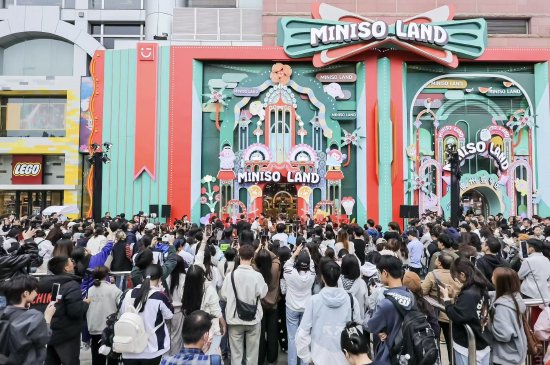
Core Insights - MINISO aims to become a global leading IP operation platform, focusing on building an IP ecosystem and incubating proprietary IPs to create world-class Chinese IPs [2][5] - The company plans to transform from a retail business to a leading global IP operation platform, emphasizing the importance of culture and IP in future competition [2][5] - MINISO expects to exceed 10,000 global stores within three years, serving as a main channel for the globalization of Chinese IPs and aiming to take 100 Chinese IPs overseas [2][5] Strategic Initiatives - The "MINISO LAND" concept is central to the new vision, with a focus on large and well-managed stores to drive this strategy [2][5] - Currently, there are over 25 MINISO LAND stores globally, with plans for these city IP parks to spread worldwide and lead global interest consumption trends [2][5] - The newly opened MINISO LAND store in Guangzhou spans over 1,100 square meters and features over 90% of its products as IP-related, showcasing popular global IPs and MINISO's proprietary IPs [2][5]

汇通达网络获H股全流通“备案通知书“
Zhi Tong Cai Jing· 2026-01-19 12:56
Group 1 - The core announcement is that Huitongda Network (09878) has received a filing notice from the China Securities Regulatory Commission regarding the full circulation of H-shares, with over 349 million domestic shares converted to H-shares [1] - Following the conversion, the circulation ratio of Huitongda's H-shares will increase significantly from 32% to 94%, which is expected to greatly expand its market capitalization in the Hong Kong stock market and potentially meet the inclusion criteria for the Stock Connect program [1] - Since 2025, the company has been deepening its "smart supply chain" and "AI+SaaS" strategic layout, while also entering new models and new tracks in the fast-moving consumer goods and community hard discount retail sectors [1] Group 2 - Market expectations suggest that the ongoing strategic upgrades and innovative scenarios will lead to sustained and stable growth for the company [1]
中国市场成核心增长引擎 无印良品2026财年第一季度营收、利润双增
Bei Jing Shang Bao· 2026-01-15 12:07
Core Insights - Muji's parent company, Ryohin Keikaku, reported significant revenue and profit growth for Q1 of FY2026, with revenue reaching 10.73 billion yuan, a year-on-year increase of 15.4% [1] - Operating profit rose to 1.334 billion yuan, reflecting a 29.3% increase compared to the previous year [1] - Net profit attributable to shareholders surged to 1.037 billion yuan, marking a substantial year-on-year growth of 47.4% [1] Market Performance - The Chinese mainland market showed exceptional performance, with existing store and e-commerce sales increasing by 118.3%, becoming the key driver of global performance [1] - Marketing activities, including the "Double 11" e-commerce promotion and the "Good Friends Festival" launched at the end of September, created a synergistic effect [1] Product Strategy - Muji strengthened its core product categories, particularly skincare, during the reporting period [1] - The launch of the "Rice Bran Fermentation Essence Series" in August 2025 became a best-seller for the autumn and winter season, complementing existing product lines to meet diverse skincare needs [1] Channel Development - The company continued to optimize its offline presence, adding 15 new stores in the Chinese mainland during the quarter [1] - Enhanced efficiency through the integration of online and offline operations led to a significant improvement in sales and management expense ratios compared to the previous year [1]
名创优品发力海外“兴趣消费”市场 业务已覆盖全球112个国家和地区
Zheng Quan Shi Bao Wang· 2025-11-28 09:39
Core Insights - MINISO is experiencing a global trend of "interest consumption," transitioning from a focus on the mass market to high-potential consumer segments, appealing to families and a broader audience [1][2] - The company's transformation is driven by a "multi-IP matrix + multi-category quality products + immersive experience" ecosystem, establishing itself as a leading global IP operation platform [1] - MINISO has partnered with over 150 well-known IPs and successfully incubated its own IPs, creating a diverse IP matrix that caters to all age groups [1] Business Expansion - MINISO's operations now span 112 countries and regions, with over 8,000 stores, including flagship locations in major global shopping districts [2] - The introduction of MINISO LAND stores, designed as "immersive IP parks," has been successful, with the Shanghai MINISO LAND achieving over 100 million in sales within nine months [2] - The company aims to cultivate Chinese original IPs into globally influential brands, leveraging its global brand presence and store network [2]
新消费派|IP“破圈”进行时 “花式”文创激活消费
Xin Hua Cai Jing· 2025-11-18 02:49
Core Insights - The cultural and creative fast-moving consumer goods (FMCG) market is expected to experience explosive growth by 2025, driven by consumption upgrades and trend iterations, with various sub-sectors like cultural heritage, film, and trendy retail showing impressive performance [1] Group 1: Market Performance - Retail brands like MINISO are leveraging precise IP strategies and innovative collaboration models, transforming cultural co-branding from a marketing highlight into a performance engine, leading to a consumption boom globally [2] - For instance, a CHIIKAWA themed pop-up store in Shanghai achieved sales of 2.68 million yuan in ten hours, with total sales exceeding 8 million yuan in three days [2] - MINISO LAND's global flagship store in Shanghai recorded over 100 million yuan in sales within nine months, with IP series products contributing 79.6% of the sales [2] Group 2: Consumer Demand and Product Strategy - Cultural co-branding has evolved beyond single-hit products to a "full-domain hot sales" model, with various international and local IPs demonstrating strong market appeal [3] - The Sanxingdui cultural products, as a benchmark in cultural heritage, achieved total sales of 38 million yuan during the summer of 2025, marking a 12% year-on-year growth [3] - The success of cultural co-branding is attributed to a balance between cost-effectiveness and quality, with products priced between 10 to 49.9 yuan, appealing to consumers seeking affordable yet trendy items [4] Group 3: Future Directions - The industry is shifting from quantity growth to quality cultivation, addressing issues of product homogeneity and weak brand building [5] - Future strategies include deep integration of IP core values with product functionality, expanding exclusive collaborations, and enhancing product scarcity and collectible value [6] - Upgrading channels and expanding experiential scenarios are also crucial, with retail companies focusing on IP-themed stores and enhancing the shopping experience through digital innovations [6]
MUJI無印良品携在地共创商品亮相进博会 传递”自然的力量”
Zheng Quan Ri Bao Wang· 2025-11-09 11:46
Core Insights - MUJI showcased its commitment to sustainability and local integration at the China International Import Expo, emphasizing its 20-year journey in the Chinese market with the theme "The Beauty of Cultivation" [1][3] - The company introduced a new collection of hemp products sourced from Heilongjiang province, highlighting its collaboration with local designers and the promotion of sustainable fashion [2][3] - MUJI's exhibition featured various products that embody the concept of "natural power," including wool and cashmere items sourced from Inner Mongolia, and initiatives that support local economies and biodiversity [2][3] Group 1 - MUJI's participation in the expo reflects its deep-rooted strategy in China, focusing on local culture and natural resources [1] - The brand's philosophy of using minimal resources for a fulfilling life resonates with Chinese consumers, leading to increased recognition and appreciation [1] - The exhibition design was inspired by natural elements, creating an immersive experience for visitors [2] Group 2 - The 2026 Spring/Summer hemp collection was globally launched at the expo, showcasing designs that will be mass-produced based on a recent design competition [2] - MUJI's OBP series combines recycled materials with traditional craftsmanship, contributing to local employment opportunities [3] - Interactive experiences at the expo included hands-on activities that engaged consumers with the theme of "The Beauty of Cultivation" [3]
【好礼】遇“建”数币惊喜购 至高省215元
中国建设银行· 2025-11-06 09:54
Core Points - The article promotes various promotional activities related to digital currency, specifically targeting new and existing users of the platform, emphasizing discounts and benefits available during specific time frames [2][14][18]. Group 1: Promotional Offers - New users can receive a 20 yuan no-threshold red envelope, while both new and existing users can enjoy payment discounts ranging from 15 to 50 yuan [2]. - The promotional period for these offers is from November 1, 2025, to November 30, 2025 [2]. Group 2: Activity Participation - Users can participate in multiple promotional activities, with a limit of one red envelope per person during the promotional period [3]. - Users can enjoy up to two discounts during the promotional period [5]. Group 3: Specific Promotions - Various brands and services are included in the promotions, such as Luckin Coffee and Meituan, with specific promotional periods outlined [18][21]. - The digital currency wallet from the Bank of China is a prerequisite for participating in these promotions [7].


宽类窄品,低效零售自残的利器
3 6 Ke· 2025-10-29 04:27
Core Viewpoint - The retail industry is witnessing a significant shift towards the "wide category, narrow product" strategy, exemplified by the success of retailers like Aldi, which has achieved remarkable sales figures and efficiency through this approach [1][10]. Group 1: Concept of Wide Category, Narrow Product - The concept of "wide category, narrow product" signifies a strategic shift in retail management, focusing on a limited number of high-performing products within broad categories to enhance operational efficiency [3][4]. - This strategy is not merely a voluntary action by retailers but a necessary response to competitive pressures and the need for improved retail efficiency [3][4]. - Effective implementation requires a thorough understanding of customer needs and a well-structured product organization, rather than arbitrary reductions in product offerings [4][5]. Group 2: Importance of Category Management - Category management, introduced by leading fast-moving consumer goods brands, has evolved into a critical component of retail strategy, emphasizing the need for effective product organization and consumer preference analysis [4][5]. - Retailers must adapt their product structures to align with customer demographics and preferences, ensuring that the right products are available in the right categories [4][6]. - The success of the "wide category, narrow product" approach hinges on the ability to identify and eliminate underperforming products while enhancing the visibility of high-demand items [7][8]. Group 3: Self-Branding Strategy - Many retailers are leveraging self-branded products as a means to establish price positioning, achieve higher margins, and differentiate themselves in a crowded market [8][9]. - The "wide category, narrow product" strategy can facilitate the development of self-branded products by consolidating consumer demand into fewer, more impactful offerings [8][9]. - Retailers are encouraged to focus on high-selling categories and create self-brands that resonate with customer expectations, thereby reducing risks associated with inventory and enhancing profitability [9]. Group 4: Operational Efficiency and Market Trends - The retail sector is experiencing intense competition, necessitating a focus on operational efficiency as a fundamental survival strategy [10]. - The "wide category, narrow product" approach is not just about product assortment but is also a reflection of deeper insights into customer behavior and operational effectiveness [10]. - Early adoption of this strategy can provide a competitive edge, allowing retailers to differentiate themselves in a rapidly evolving market landscape [10].
名创优品(09896)叶国富:最新的愿景是成为全球领先的IP运营平台型公司
智通财经网· 2025-10-22 11:13
Core Viewpoint - The founder and CEO of Miniso, Ye Guofu, aims to transform the company from a retail-focused entity into a cultural and creative company, with a vision to become a leading global IP operation platform [1] Company Strategy - Miniso plans to boldly acquire and sign contracts with numerous Chinese intellectual properties (IPs) to enhance its cultural offerings [1] - The company has already signed exclusive agreements with 17 artist IPs and aims to promote new cultural creators in China [1] Global Expansion - With nearly 8,000 stores worldwide, Miniso intends to leverage its global presence to sell these cultural products, contributing to cultural output [1] - Ye Guofu expresses confidence that Chinese culture and IPs will be on par with those from Japan and the United States in the future [1]
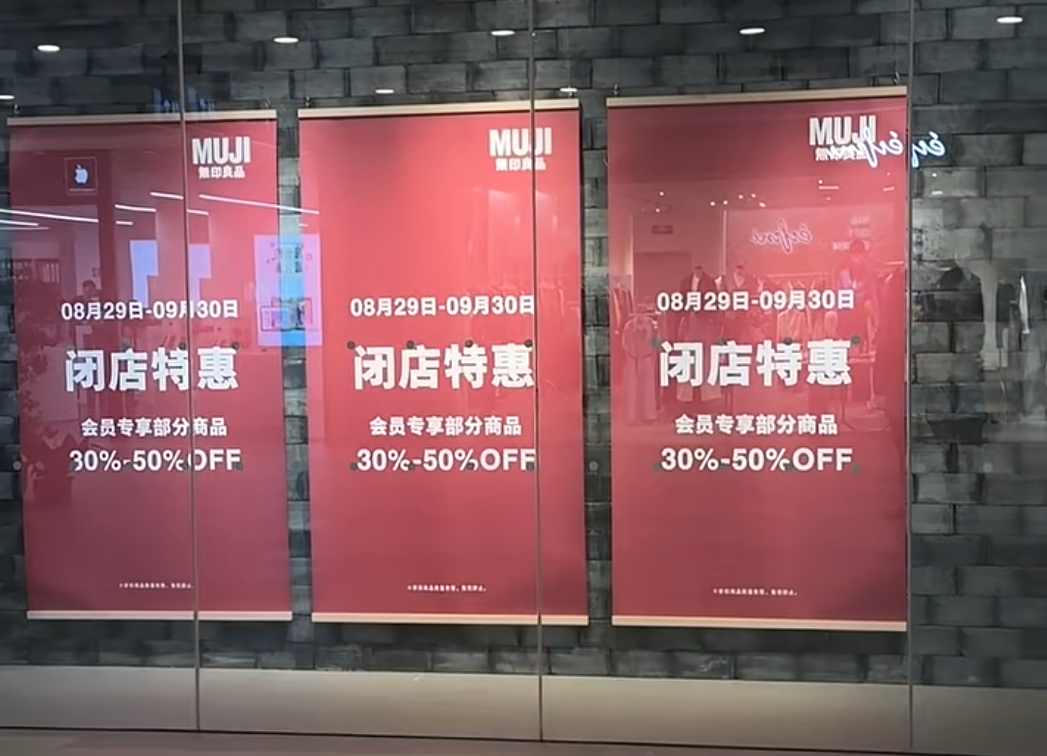
知名品牌上海一门店闭店清仓!顾客却大呼“上当”,门店回应……
Huan Qiu Wang· 2025-09-11 09:25
Core Viewpoint - MUJI is closing several stores in China, including locations in Beijing and Changsha, citing operational efficiency and declining foot traffic as reasons for the closures [14][16]. Store Closure Details - The MUJI store at Shimao Gong 3 in Beijing will close on August 31, 2025, with a notice indicating that customers can return items at another location [14]. - Other stores, including those in Jinan and Wuhan, are also set to close, raising concerns among consumers about the brand's sales performance [16]. Discount Promotions - The Shimao Gong 3 store is currently offering discounts of 20% to 80% on seasonal items, with additional discounts for purchasing multiple items [16]. - Despite the promotional efforts, customers have reported that the actual discounts are not as substantial as advertised, with some items only seeing minor reductions [5][7]. Customer Sentiment - Some customers express disappointment over the perceived lack of genuine discounts, with comments suggesting that the promotions feel misleading [3][7]. - However, loyal customers continue to visit the stores for brand loyalty rather than discounts, indicating a mixed sentiment towards the brand's future [11]. Business Strategy - MUJI's official statement clarifies that the store closures are part of a normal operational adjustment rather than a sign of overall business decline, with plans to open approximately 40 new stores annually [16][17]. - The company is focusing on expanding its presence in first and new first-tier cities, with larger flagship stores planned [17].