
智能网联汽车等

Search documents
凝心聚力 推动重点产业链高质量发展
Xin Lang Cai Jing· 2026-02-24 20:22
Core Viewpoint - Chengdu is focusing on promoting high-quality development of key industrial chains as a strategic response to external uncertainties and to enhance its core competitiveness in the modern industrial system [1][2]. Group 1: Key Industrial Chains Development - A meeting was held on February 24 to discuss the high-quality development of key industrial chains, involving representatives from government departments and 64 key enterprises [1]. - The city aims to deepen the "full park" initiative and accelerate the construction of a modern industrial system, emphasizing the importance of chain collaboration and innovation [1][2]. - Chengdu has established two trillion-level industrial clusters and 13 billion-level industrial chains, leading among vice-provincial cities in terms of advanced manufacturing and specialized industrial clusters [2]. Group 2: Strategic Initiatives and Goals - The city is committed to enhancing its industrial chains through a "chain leader + special class" approach, focusing on strengthening, extending, and supplementing these chains [2]. - Continuous efforts will be made to improve the business environment, facilitate economic circulation, and support innovation through initiatives like "Science and Technology Innovation Tianfu" [3]. - Chengdu aims to build a world-class advanced manufacturing cluster and become a national advanced manufacturing base during the 14th Five-Year Plan period [3].
2025杭州工信经济十件大事
Mei Ri Shang Bao· 2026-02-13 01:35
Core Viewpoint - Hangzhou is committed to accelerating the construction of a global advanced manufacturing base by integrating technological and industrial innovation, aiming for high-quality economic development by 2025 [1] Group 1: Advanced Manufacturing Cluster - Hangzhou is advancing the "296X" advanced manufacturing cluster initiative, which includes two trillion-level industry clusters in artificial intelligence and visual intelligence, and nine hundred billion-level clusters in various sectors [2] - The city's industrial added value is projected to reach 462.4 billion yuan in 2025, marking a 6% increase from the previous year, the fastest growth in four years [2] Group 2: High-Quality Development Foundation - Hangzhou has maintained the highest manufacturing quality development index in Zhejiang province for six consecutive years and is set to receive the "Golden Ding" award in 2025 [3] Group 3: Innovative Ecosystem - The city is fostering a robust innovation ecosystem, with new enterprises like the "Six Little Dragons of Hangzhou" gaining prominence and significant technological advancements in humanoid robots and AI models [4] - By the end of 2025, Hangzhou will have established several key platforms for AI medical applications and innovative drug approvals, achieving a historical high [4] Group 4: Digital Economy - The core digital economy industries in Hangzhou are expected to generate an added value of 678 billion yuan in 2025, with a growth rate of 9.3%, accounting for 29.5% of the GDP [6] - The revenue from the software and information technology services sector is projected to reach 1,301.147 billion yuan, with a growth rate of 14% [6] Group 5: International Cooperation - Hangzhou is enhancing its role in international cooperation within the industrial economy, with the establishment of the China-Africa Digital Technology Cooperation Center and the International Silk Organization [7] Group 6: National Pilot Projects - The city is leading national pilot projects, including the largest smart connected vehicle testing area in the country, covering 6,910 square kilometers [9] Group 7: Policy Initiatives - In 2025, Hangzhou will introduce a series of policies to promote high-quality manufacturing development, including a three-year action plan and specific measures for various industries [10] Group 8: Quality Enterprise Cultivation - The city aims to accelerate the cultivation of quality enterprises, with six new national manufacturing champions and 129 new specialized "little giant" enterprises added in 2025 [11] Group 9: Support for Enterprises - Hangzhou is facilitating industrial circulation through targeted services, with 232 matchmaking events held, resulting in order amounts of 3.87 billion yuan and financing connections of 11.99 billion yuan [12]
广东:加快提升金融业规模能级
Zhong Guo Zheng Quan Bao· 2026-01-26 20:54
Group 1 - The Guangdong provincial government aims for a GDP growth target of 4.5%-5% for the year, emphasizing the importance of a strong start to the 14th Five-Year Plan [1] - The report highlights the need to enhance the scale and capability of the financial sector, support insurance product innovation, and facilitate corporate financing and mergers [1] - By 2025, Guangdong's GDP is projected to grow by 3.9%, maintaining its position as the top province in China for 37 consecutive years, with public budget revenue increasing by 3% and goods import-export growth at 4.4% [1] Group 2 - The report emphasizes the acceleration of emerging industries such as new energy, new materials, and smart vehicles, aiming to cultivate more pillar industries [2] - It calls for strengthening original innovation and tackling key core technologies, particularly in quantum technology, artificial intelligence, and integrated circuits [2] - In the real estate sector, the focus is on stabilizing the market through targeted policies, promoting the utilization of idle commercial properties, and enhancing the quality of housing and property services [2]
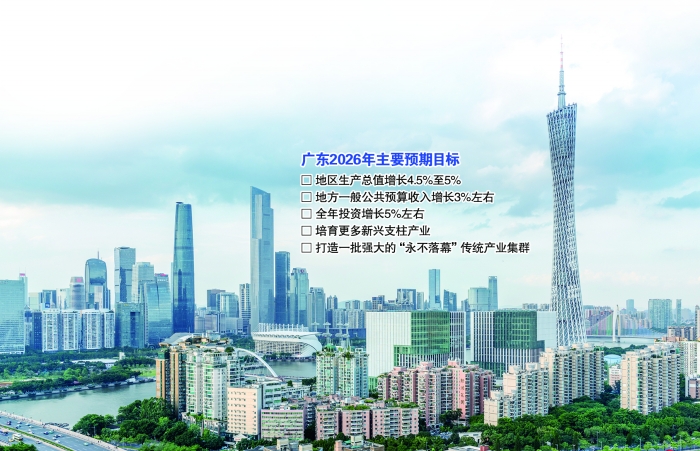
育产业 重创新 扩内需 广东:今年GDP预期增长4.5%至5%
Shang Hai Zheng Quan Bao· 2026-01-26 19:16
Core Viewpoint - Guangdong aims for a GDP growth of 4.5% to 5% in 2026, with a focus on enhancing the economy and improving residents' income in line with economic growth [2] Group 1: Economic Goals and Strategies - The government plans to promote the construction of the Guangdong-Hong Kong-Macao Greater Bay Area, aiming to create a vibrant and internationally competitive urban cluster [2] - Emphasis will be placed on the real economy and manufacturing, with efforts to build a modern industrial system [2] - The province will focus on high-level dynamic matching of supply and demand to expand potential consumption, production, and effective investment [2] Group 2: Emerging Industries Development - Guangdong will strengthen emerging industries such as new energy, new materials, smart connected vehicles, and biomanufacturing, aiming to cultivate new pillar industries [3][4] - The province will implement ongoing assessments for nascent industries and provide targeted support for those in growth and expansion phases [3][4] Group 3: Innovation and Investment Funds - Guangdong is establishing targeted funds to foster new quality productivity, with a focus on key industrial chains and innovation resources [5] - The Guangdong-Hong Kong-Macao Fund, with a total scale exceeding 50 billion yuan, will support early-stage projects in fields like integrated circuits and artificial intelligence [5][6] - The Guangdong Provincial Guiding Fund, with an initial capital of 100 billion yuan, will focus on upgrading traditional industries and nurturing emerging sectors [5][6] Group 4: Consumption and Investment Interaction - The province will promote a demand-driven approach, enhancing consumer spending and investment in both goods and human resources [7] - Initiatives will include supporting the opening of new stores and hosting various launch events to stimulate consumption [7] - Guangdong aims for an investment growth of around 5% by coordinating demand-side potential and supply-side reforms [7]

广西“人工智能+制造”成型起势
Guang Xi Ri Bao· 2026-01-24 02:55
Core Insights - In 2025, Guangxi aims to implement the "Artificial Intelligence + Manufacturing" initiative, targeting an industrial output value of 89 billion yuan in AI core industries and the introduction of 258 new intelligent products, including 1,000 humanoid robots [1][2] - The initiative is expected to enhance production efficiency by over 30% and reduce costs by more than 20% for key enterprises [1] - Guangxi plans to establish 80 new intelligent factories and digital workshops by 2026, further promoting the digital transformation of the manufacturing sector [1] Group 1 - Guangxi will implement a three-year action plan to promote the deep integration of AI and manufacturing, focusing on intelligent factory cultivation and the establishment of high-standard digital parks [2] - The region will launch three special actions: scenario empowerment, intelligent product breakthroughs, and high-quality data set construction, targeting key industries and products [2] - The scenario empowerment action will create industry-specific AI transformation guidelines and facilitate the implementation of high-value scenarios [2] Group 2 - The intelligent product breakthrough action will focus on developing smart robots, smart mobile terminals, and intelligent connected vehicles [2] - High-quality data sets will be constructed in pilot industries such as sugar, non-ferrous metals, steel, and denim, categorized to create industry-specific knowledge bases [2]
艾媒咨询:2026年中国新消费趋势白皮书
Sou Hu Cai Jing· 2026-01-23 12:47
Core Insights - The report highlights the structural upgrade of China's new consumption market driven by demographic changes, income levels, policy guidance, and technological innovation, transitioning from scale expansion to structural adaptation [1][3]. Group 1: Market Characteristics - The new consumption market is characterized by three core tracks: emotional economy, quality of life, and smart technology, reflecting profound changes in consumption logic and market structure [2][3]. - The emotional economy focuses on fulfilling emotional needs, with market size expected to reach 23,077.7 billion yuan by 2024 and double by 2029 [2]. - The quality of life track emphasizes health, comfort, and spiritual satisfaction, with the silver economy shifting from "elderly care" to "enjoying old age" [2][3]. - The smart technology track leverages AI and big data, with applications in AI terminals, service robots, and smart connected vehicles, becoming a key engine for consumption upgrade [2][3]. Group 2: Consumption Trends - Five major trends are anticipated for 2026: the shift from population dividends to value dividends in lower-tier markets, the integration of "AI+" services for personalized living, the acceleration of virtual and physical integration, sustainable consumption throughout the supply chain, and the globalization of brand ecosystems [3][9]. - Consumer motivations are evolving from functional satisfaction to emotional resonance and value recognition, with a dual decision-making logic of "extreme practicality" and "emotional premium" [2][9]. - The market structure is becoming more layered, with vertical communities emerging as the core soil for brand growth [2][9]. Group 3: Policy and Economic Context - The transition from "scale expansion" to "structural adaptation" is marked by a new policy framework aimed at enhancing the adaptability of consumer goods supply and demand, promoting consumption's contribution to economic growth [17][19]. - The government has set quantitative targets for optimizing supply structures, including three trillion-level fields and ten hundred-billion-level hotspots, to foster a healthy interaction between supply and demand [18][19].

城市24小时 | 又一座“准万亿”之城“出分”了
Mei Ri Jing Ji Xin Wen· 2026-01-14 17:25
Economic Growth Projections - Dalian's GDP is expected to grow by over 5.5% in 2025, with industrial added value increasing by over 11.7% and retail sales of consumer goods growing around 3% [1] - The "14th Five-Year Plan" outlines 20 key indicators for economic and social development, including an average annual GDP growth of 5% and urbanization rate reaching 83.75% by 2030 [1][2] - Dalian aims for a GDP target of over 5% growth in 2026, with industrial added value growth of 7% and fixed asset investment growth of around 5% [1] Industrial Development - Dalian's industrial growth has been a significant driver, achieving a two-digit growth rate of over 11.7% in industrial added value, surpassing the initial target of 7% [2] - The city is focusing on transforming its industrial structure, with the green petrochemical industry maintaining a stable scale of around 400 billion yuan, and new energy vehicle industry exceeding 100 billion yuan in output [2] - Other key industries include shipbuilding and marine engineering at 80 billion yuan, and high-end bearings and advanced rail transit equipment at 58 billion yuan [2] Innovation and R&D - Dalian's government report sets specific innovation-driven targets, including a research and development expenditure intensity of around 3.2% by 2030, and a digital economy core industry value added accounting for 14.5% of GDP [3] - The goal is to achieve 23.5 high-value invention patents per 10,000 people, indicating a strong emphasis on innovation and technology development [3]
八部门发文:2027年我国人工智能产业规模稳居世界前列
Yang Zi Wan Bao Wang· 2026-01-12 11:11
Core Viewpoint - The integration of artificial intelligence (AI) with the real economy is accelerating, significantly transforming manufacturing production models and economic forms. The Chinese government has issued a joint implementation opinion aimed at enhancing AI capabilities in the manufacturing sector by 2027 [1]. Group 1: Implementation Goals - By 2027, key AI technologies in China are expected to achieve secure and reliable supply, with the industry scale and empowerment level remaining among the world's top [1]. - The plan aims to promote the deep application of 3-5 general large models in manufacturing, launch 1,000 high-level industrial intelligent entities, create 100 high-quality data sets in industrial fields, and promote 500 typical application scenarios [2]. - The initiative includes cultivating 2-3 globally influential leading enterprises and a number of specialized small and medium-sized enterprises, as well as establishing a global leading open-source ecosystem [1][2]. Group 2: Focus Areas for Development - The opinion emphasizes accelerating the empowerment of key manufacturing sectors such as raw materials, equipment manufacturing, consumer goods, electronic information, and software services [2]. - It highlights the importance of intelligent auxiliary design, software code assistance, and drug research and development to create personalized, low-cost, and efficient new research and design models [2]. - The plan encourages leading enterprises and state-owned enterprises to pioneer the application of industrial intelligent entities and explore new models of AI empowerment in manufacturing [2]. Group 3: Technological Advancements - The initiative calls for the acceleration of intelligent equipment iterations, including the application of intelligent entities in industrial mother machines and robots, and the development of new-generation AI numerical control systems [2]. - It aims to promote the integration of AI technologies into the research, manufacturing, and operation of major technical equipment such as large aircraft and ships, as well as the development of intelligent low-altitude equipment like drones [2]. - The plan also includes testing and safety evaluations for smart connected vehicles equipped with autonomous driving functions [2]. Group 4: Ethical and Transparency Measures - The opinion requires enhancing AI transparency and explainability through measures such as the identification of generated synthetic content [3]. - It emphasizes the implementation of ethical management services for AI technology and the strengthening of industry self-regulation to improve enterprises' ability to prevent ethical risks associated with AI [3].
利好来了!刚刚,八部门重磅发布!
Zheng Quan Shi Bao Wang· 2026-01-07 11:00
Core Insights - The Chinese government aims to enhance the integration of artificial intelligence (AI) and manufacturing, with a target for key AI technologies to achieve reliable supply by 2027, maintaining a leading position globally in terms of industry scale and empowerment levels [5][6] - The initiative includes the development of 3-5 general large models for deep application in manufacturing, the creation of 100 high-quality industrial data sets, and the promotion of 500 typical application scenarios [5][6] Group 1: AI and Manufacturing Integration - The Ministry of Industry and Information Technology (MIIT) and seven other departments released the "AI + Manufacturing" implementation plan, focusing on the collaborative development of smart chips and key technologies [2][3] - The plan emphasizes the establishment of a robust AI model training and inference framework tailored for the manufacturing sector, promoting lightweight model deployment and application in industrial scenarios [2][3] Group 2: Industrial Internet and AI Fusion - The "Industrial Internet and AI Fusion Empowerment Action Plan" aims to significantly enhance the integration level of industrial internet and AI by 2028, targeting the upgrade of at least 50,000 enterprises with new industrial networks [7][8] - The action plan includes the development of a nationwide integrated computing network and encourages the deployment of edge computing devices to improve real-time data processing capabilities [8][9] Group 3: Support for Enterprises - The initiative supports the cultivation of small and medium-sized enterprises (SMEs) specializing in AI, encouraging local governments to provide resources such as "computing power vouchers" to reduce development costs [4][6] - The plan aims to establish a national manufacturing innovation center in the AI field to enhance the supply capacity of key common technologies and promote the development of specialized service providers in industrial data and models [4][9]
培育200家智能制造先进工厂
Xin Lang Cai Jing· 2026-01-05 20:49
Group 1 - The Sichuan provincial government aims to cultivate 200 advanced smart manufacturing factories within 3 to 5 years as part of its digital economy innovation development plan [1] - The plan includes the establishment of 1 to 2 national-level emerging industry clusters and around 10 leading enterprises in the digital economy sector [1] - The initiative seeks to create approximately 20 digital application scenario laboratories and around 200 provincial digital transformation promotion centers [1] Group 2 - The strategy emphasizes a collaborative development model to enhance the overall layout of the digital industry across the province, aiming to build a significant national digital industry cluster [2] - Key cities like Chengdu and Mianyang will enhance their capabilities in smart equipment, new software, industrial internet, data security, and data infrastructure [2] - The plan includes exploring new business models in digital logistics, digital low-altitude, digital new energy, and intelligent connected vehicles [2]