梦龙冰淇淋

Search documents
净利几近腰斩 梦龙单飞遭阵痛
Bei Jing Shang Bao· 2026-02-25 02:28
Core Viewpoint - The first financial report of the newly independent Magnum ice cream company post-Unilever spin-off shows a significant decline in net profit, highlighting challenges in achieving growth targets amid high restructuring costs and market competition [1][2][3]. Financial Performance - Magnum's revenue for 2025 was €7.9 billion, remaining flat year-on-year, while net profit plummeted by 48.4% to €307 million from €595 million in 2024 [1][2]. - The decline in net profit is attributed to increased costs related to the spin-off (€118 million), higher financial costs (€104 million), and adverse currency fluctuations [2]. - The total cash expenditure for the spin-off reached €564 million (approximately ¥4.653 billion), which included costs for business acquisition and disposal (€196 million), organizational separation (€120.5 million), and mid-term operational implementation (€148.5 million) [2]. Market Position and Strategy - Despite the challenges, Magnum achieved organic sales growth in China, maintaining a strong market share [1][3]. - The company plans to focus on low-sugar and plant-based product innovations, enhance localization efforts in China, and consider acquisitions of local or unique brands in China and Europe/America to expand its business [1][3][4]. - In the first half of 2025, revenue from the Chinese market reached €270 million, reflecting double-digit growth, with plans to launch nearly 30 new products [4]. Challenges and Competitive Landscape - Magnum faces intense competition from local brands like Yili and Mengniu, which dominate the lower-tier market with established distribution channels [4][6]. - The company’s profitability in Europe and Australia/New Zealand has been impacted by rising raw material costs, particularly cocoa [3]. - The anticipated adjusted EBITDA margin for 2025 is expected to decrease from 16.8% to approximately 16% due to lower sales and profit margins [3]. Future Outlook - The company aims to strengthen product innovation and expand consumption scenarios while promoting premium brands globally [5]. - In the AMEA region, Magnum plans to enhance freezer placements and improve distribution in countries like Indonesia and the Philippines [6]. - The management previously indicated a target of 5% growth post-spin-off, but this goal may be postponed beyond 2026, necessitating proof of the spin-off's strategic validity through performance [6].
梦龙独立上市后战略聚焦冰淇淋赛道,2026年拟在华推近30款新品
Xin Lang Cai Jing· 2026-02-21 15:04
Core Viewpoint - Magnum has recently completed its spin-off from Unilever and is now independently listed, with future strategic execution, product planning, and potential acquisition activities warranting attention [1] Group 1: Performance Strategy - Magnum completed its spin-off from Unilever in December 2025 and is now listed in Amsterdam, London, and New York. The company aims to focus more on the ice cream sector, emphasizing accelerated product innovation (such as low-sugar and plant-based products), strengthening global supply chains, and optimizing channel reach. The market will monitor its ability to achieve management's targets of increasing annual revenue growth by 1 to 2 percentage points and improving profitability by 400 to 500 basis points [2] Group 2: Business Progress - According to company disclosures, Magnum plans to launch nearly 30 new products in the Chinese market by 2026 to enhance local investment. The company will continue to pursue a premium strategy in China and respond to competition from local brands like Yili and Mengniu through digital marketing and channel penetration. Its revenue in China for the first half of 2025 was €270 million, with a market share of approximately 11%, and future growth potential is highly anticipated [3] Group 3: Future Development - Magnum's listing documents indicate that the company will consider acquiring specialty brands in Europe, the U.S., or China, or small local brands with established market positions in certain regions to accelerate expansion. This could significantly impact the company's business landscape [4]
梦龙冰淇淋计划2026年推出近30款新品加码中国市场
Jing Ji Guan Cha Wang· 2026-02-13 17:33
Group 1 - The core viewpoint of the article highlights that the parent company of the Magnum brand, which belongs to Unilever, is planning to launch nearly 30 new products by 2026, with a focus on the Chinese market [1] - The strategy aims to enhance the product line to address market competition and increase market share [1]

梦龙冰淇淋公司:2025财年销售额79亿欧元,与上一年度基本持平
Cai Jing Wang· 2026-02-13 14:36
Core Viewpoint - The company reported its full-year performance for the fiscal year 2025, indicating stable sales but a significant decline in net profit compared to the previous year [1] Financial Performance - The company achieved sales of €7.9 billion for the fiscal year 2025, remaining roughly unchanged from the previous year [1] - Operating profit was €599 million, down from €764 million in the prior year [1] - Net profit decreased by 48.4% to €307 million compared to the previous year [1] Future Outlook - The company anticipates organic sales growth of 3% to 5% for the fiscal year 2026 [1] - There is an expectation for improvement in the base profit margin [1]
梦龙冰淇淋公司2025年度净利润3.07欧元
Bei Jing Shang Bao· 2026-02-13 12:26
Core Viewpoint - TMICC reported a stable sales figure for 2025, but a significant decline in net profit due to substantial cash expenditures related to its spin-off [1] Financial Performance - The company achieved a total sales revenue of €7.9 billion for the year 2025, which remained essentially unchanged compared to the previous year [1] - The net profit for TMICC was €307 million, reflecting a year-on-year decrease of 48.4% [1] - The primary reason for the decline in net profit was the cash outflow of €564 million incurred for the spin-off process in 2025 [1]
2.13犀牛财经早报:新基金发行火热 公募备战节后行情
Xi Niu Cai Jing· 2026-02-13 01:45
Group 1: Fund Issuance and Market Trends - In January 2026, the number of new fund issuances reached 169, the highest level since March 2023, with several funds selling out in one day and some triggering proportionate allotment due to oversubscription [1] - The number of newly established public FOFs (funds of funds) in 2026 has reached 31, a year-on-year increase of 244.44%, driven by strong demand for stable value-added products and continuous innovation in product offerings [1] Group 2: Bond Market and Investment Products - The issuance of pure bond funds has significantly declined in 2026, with only a few new pure bond funds launched, while "fixed income +" funds continue to dominate the new bond fund market [2] - The demand from residents and institutions for "fixed income +" funds is expected to support their development, although the industry faces challenges such as pressure on bond market yields and increased competition [2] Group 3: Corporate Developments - Mercedes-Benz is recalling 11,895 vehicles in the U.S. due to a potential fire risk from high-voltage batteries [3] - Dream Dragon Ice Cream reported a revenue of 65.175 billion yuan for the fiscal year 2025, but net profit plummeted by 48.4% to 2.533 billion yuan [3] - Lantu Motors announced plans to list on the Hong Kong Stock Exchange on March 19, 2026, with approximately 885.38 million H-shares [4] - Zhengzhou Bank's president resigned after one year due to personal reasons [4] Group 4: Financial Challenges and Risks - Baili Technology is facing overdue debts and is in communication with creditors to resolve the situation, which may impact its financing capabilities [5] - ST Haihua announced a projected revenue of 336 million yuan for 2025, with a net profit loss of approximately 70 million yuan, putting its stock at risk of delisting [5] - ST Zhongdi's stock experienced abnormal fluctuations, with a projected revenue of 180 to 220 million yuan for 2025, alongside significant expected losses [7] Group 5: Fundraising and Market Positioning - Fulongma plans to raise up to 1.005 billion yuan through a stock issuance to enhance its competitiveness in the environmental services market [8] - Xinlitai has submitted an application for H-share issuance and listing on the Hong Kong Stock Exchange [9]
梦龙冰淇淋股价一度大跌16%,业绩指引不及预期
Ge Long Hui A P P· 2026-02-12 09:02
Group 1 - The core viewpoint of the article is that the stock price of the Magnum ice cream company experienced a significant decline due to disappointing earnings guidance [1] - The company expects organic sales growth for the new fiscal year to be between 3% and 5% [1] - Last year, the company recorded an organic sales growth of 4.2% [1]
梦龙独立上市后战略进展受关注,机构给予买入评级
Jing Ji Guan Cha Wang· 2026-02-11 16:47
Core Viewpoint - The company Dream Dragon will be spun off from Unilever and listed in Amsterdam, London, and New York on December 8, 2025, aiming for more agile operations and growth as an independent entity [1] Group 1: Company Overview - The CEO Peter ter Kulve emphasized the goal of achieving more agile operations and growth as an independent company, with plans for reinvestment based on mid-term objectives [1] - Investors should pay attention to the first financial report released after the independent operation to assess the effectiveness of the strategic implementation [1] Group 2: Institutional Perspectives - Morgan Stanley and UBS have both given Dream Dragon a "Buy" rating, with target prices set at $19.18 and $16.62 respectively [2] - Future updates on ratings or target prices from other institutions should be monitored [2] Group 3: Future Development - The company will advance its business according to established mid-term goals, necessitating tracking of specific progress in growth strategies [3] - As a consumer goods company, it is important to monitor changes in global ice cream market demand, fluctuations in raw material costs, and seasonal sales performance [3]
独立上市、渠道重构与情绪价值:梦龙冰淇淋的中国“破壁”战
Zhong Guo Jing Ying Bao· 2025-12-20 06:20
Core Viewpoint - The independent listing of TMICC marks a significant transformation in the ice cream industry, transitioning from a seasonal product to a global frozen snack category, driven by the need for capital, brand, and consumption scenario restructuring [1][2]. Group 1: Business Evolution Post-Spin-off - TMICC's total share capital is 612 million shares, with a par value of €3.50 per share, reflecting a strategic move to unbind from Unilever's constraints [2]. - The CEO of Unilever acknowledged that the spin-off and listing were the most logical outcomes due to the ice cream business's historical limitations within a large conglomerate [2]. - TMICC aims to become a more agile and focused capital operator, enhancing its ability to respond to market demands and pursue a "frozen snack revolution" [2][3]. Group 2: Market Positioning and Brand Strategy - TMICC is positioned as a key player in the Chinese market, which is highly competitive, with brands like Cornetto and Magnum ranking fourth and fifth in retail sales [4]. - The company's competitive advantage lies in its brand premium and emotional value, which are difficult for local brands to replicate in the short term [4][5]. - TMICC's strategy includes "micro-innovation" to cater to local tastes, such as introducing matcha flavors and smaller portion sizes, enhancing its appeal to diverse consumer preferences [5]. Group 3: Channel Strategy and Market Dynamics - The shift in retail channels is crucial for TMICC, as traditional supermarkets see declining traffic, necessitating a new approach to distribution [6]. - The company is adopting a "hugging the big leg" strategy by partnering with quality retail systems like Sam's Club and Hema, which align with its mid-to-high-end positioning [6]. - Instant retail is identified as a significant growth channel, with platforms like Meituan and Douyin reshaping ice cream consumption scenarios, allowing TMICC to enhance distribution efficiency [6][7]. Group 4: Future Growth and Market Engagement - TMICC's future growth will rely on deepening local market engagement through regional distributors and leveraging digital tools for better product-market fit [7]. - The company is focusing on experiential marketing strategies targeting social occasions, which is transforming ice cream consumption from mere purchases to integrated experiences [7]. - The success of TMICC's independent operations will hinge on balancing profitability and scale in the competitive landscape of the ice cream market [7].
精品咖啡甩卖潮:可口可乐、雀巢为何甘愿“割肉”?
3 6 Ke· 2025-12-15 08:44
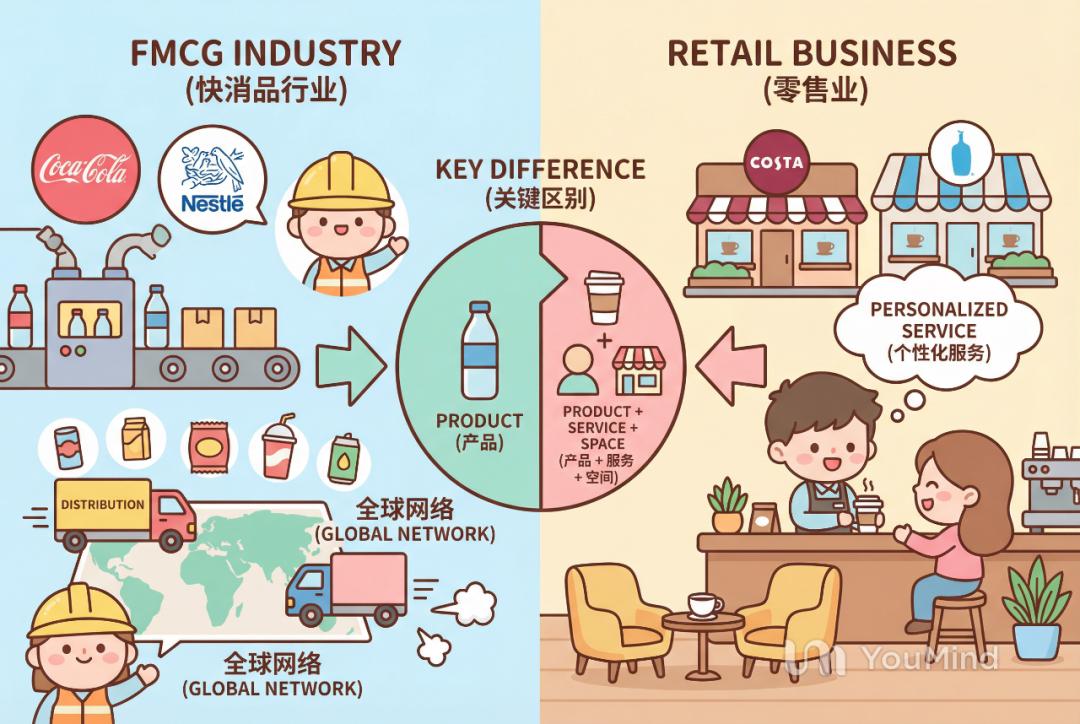
Core Viewpoint - The food and beverage industry is experiencing a surge in mergers and acquisitions, with notable companies like Starbucks, Coca-Cola, and Nestlé divesting from their coffee brands, often at prices significantly lower than their acquisition costs [1][7]. Group 1: Reasons for Divestiture of Physical Store Businesses - The divestiture often involves physical store operations, which differ from the fast-moving consumer goods (FMCG) sector that focuses on product and distribution rather than service and space [1][4]. - Physical retail businesses are more complex and face higher management challenges compared to FMCG, making them less strategic for companies like Coca-Cola and Nestlé [4]. - The capital-intensive nature of coffee shops, with high initial investments and long payback periods, makes them less attractive during economic pressures, prompting companies to divest [5][10]. Group 2: Reasons for Selling at a Discount - Companies prioritize focusing on core businesses to streamline their balance sheets, leading to the decision to sell off less strategic assets [7][10]. - For Coca-Cola, the acquisition of Costa was initially aimed at expanding its coffee platform, but changing market dynamics, particularly in China, rendered the physical store operations less viable [9][10]. - The value of physical stores is reassessed when more efficient distribution channels can achieve growth without the overhead of managing retail locations [10]. Group 3: Value of Divested Brands - Brands like Costa and Blue Bottle Coffee possess strong product offerings and loyal customer bases, indicating that they are not inherently poor investments [11][15]. - The divestiture allows these brands to potentially thrive under new ownership that can provide the necessary resources for expansion and operational efficiency [15][18]. - The example of the newly independent Magnum ice cream company illustrates how divestiture can lead to enhanced strategic flexibility and growth potential [18]. Conclusion - The current trend of divestiture in the food and beverage sector reflects a strategic realignment of resources, with the potential for good brands to find new life under different ownership structures [19].