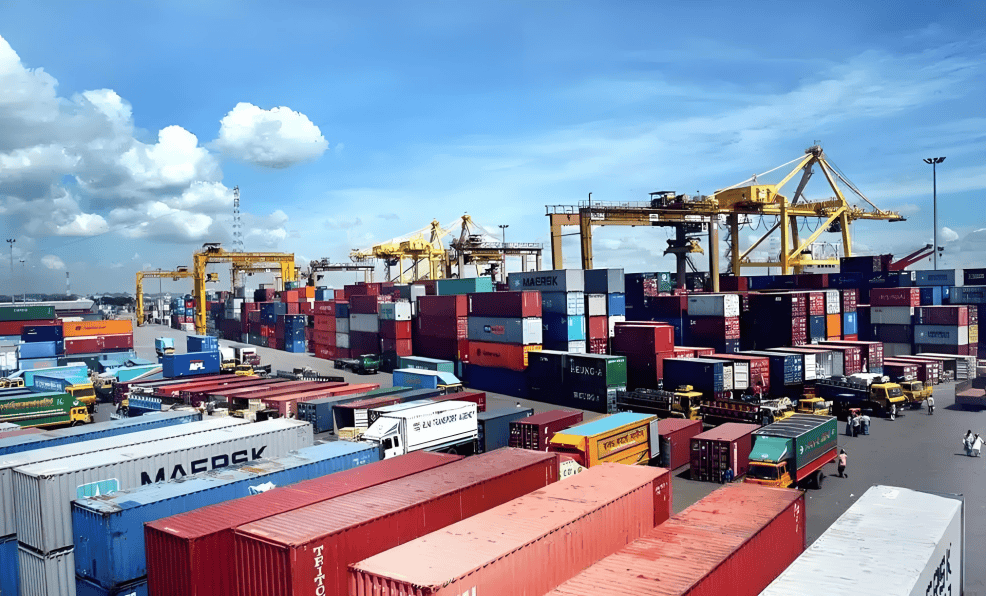
交通运输设备

Search documents
20+图看2025年出口结构
一瑜中的· 2026-01-18 14:59
Core Viewpoint - The article analyzes the export structure of China in 2025, highlighting the significant contributions from emerging markets and the contrasting performance of developed markets, particularly the U.S. and non-U.S. regions [2][16]. Group 1: Regional Structure Characteristics - Emerging markets are showing significant contributions, while the internal dynamics of developed markets, particularly between the U.S. and non-U.S. regions, are largely offsetting each other [5][17]. - In 2025, the share of exports to emerging markets is projected to be 49.1%, an increase of approximately 2.5 percentage points from 2024. Exports to the U.S. are expected to decline to 11.1%, down about 3.5 percentage points, while exports to non-U.S. developed markets will rise to 39.8%, up about 1 percentage point [17][18]. Group 2: Commodity Structure Characteristics By Usage - Intermediate goods are expected to contribute significantly, while consumer goods are projected to have a negative contribution, and capital goods are expected to remain stable. From 2017 to the first 11 months of 2025, the share of intermediate goods in exports is expected to rise from 41.9% to 47.4%, while consumer goods will decline from 36.6% to 28.7% [6][22]. - The contribution rate of intermediate goods to export growth is expected to increase from 55.8% in 2018 to 85% in 2025, while consumer goods' contribution will drop from 24.7% to -34% [6][22]. By Category - Four types of goods are identified based on economic conditions: 1. **Sustained Growth Goods**: High export growth over the past two years, including transportation equipment, pharmaceuticals, and machinery [7][25]. 2. **Reversal Goods**: Poor performance in 2024 but better in 2025, such as non-metallic products and chemicals [7][26]. 3. **Weak Sustained Goods**: Consistently low growth, including umbrellas and toys [7][26]. 4. **Diminishing Momentum Goods**: Good performance in 2024 but poor in 2025, including furniture and textiles [7][26]. Group 3: Key Regional Export Commodity Structure - The analysis focuses on the export commodity structure to developed markets (U.S. and Europe) and emerging markets. In 2024, exports to these regions accounted for about 67% of China's total exports [28]. - In the U.S., there is an overall decline, with intermediate goods showing some resilience [29]. - In the EU, intermediate and capital goods are expected to balance each other, while consumer goods will negatively impact growth [35]. - In ASEAN, intermediate goods are expected to see significant growth, while consumer goods will contribute negatively [39]. - In Africa, there is expected to be overall growth, with capital and intermediate goods each contributing about 40% [43]. - In the Middle East, growth is expected to be balanced across all types of goods [49]. - In Latin America, intermediate goods are projected to grow by over 60%, with consumer and capital goods showing slight growth [54]. - In Central Asia (excluding Russia), the contribution of intermediate and capital goods is expected to be 7:4, with consumer goods negatively impacting growth [59].


梳理2025年中国出口结构:20+图看2025年出口结构-20260116
Huachuang Securities· 2026-01-16 12:41
Export Structure Overview - In 2025, China's export structure shows a significant contribution from emerging markets, with a 49.1% share, up 2.5 percentage points from 2024[21] - Exports to the US decreased to 11.1%, down 3.5 percentage points from 2024, while non-US developed markets increased to 39.8%, up 1 percentage point[21] Commodity Contribution - Intermediate goods' export share rose from 41.9% in 2017 to 47.4% in 2025, with an annual increase of 0.7 percentage points[28] - Consumer goods' share fell from 36.6% to 28.7%, with an average annual decline of about 1 percentage point[28] - Capital goods' share slightly decreased from 21.5% to 20.1%, maintaining relative stability[28] Growth Contribution - From 2018 to 2025, the contribution of intermediate goods to export growth increased from 55.8% to 85%, while consumer goods' contribution dropped from 24.7% to -34%[28] - Capital goods' contribution rose from 19.4% to 22.4% during the same period[28] Regional Analysis - In the US, intermediate goods' share increased by 2.7 percentage points to 33.2%, while consumer goods decreased by 1 percentage point to 43.3%[41] - In the EU, intermediate goods remained stable at 39.3%, with consumer goods dropping by 3.1 percentage points to 31.7%[46] - In ASEAN, intermediate goods rose by 3.1 percentage points to 61.6%, while consumer goods fell by 5 percentage points to 19.1%[52] Market Dynamics - Emerging markets are driving growth, with significant contributions from regions like Africa, ASEAN, and Latin America, which collectively boosted exports by 5.6%[22] - The overall export growth for China in 2025 is projected at 5.5%, a slight decline of 0.3 percentage points from the previous year[21]
实体经济物流业务需求持续活跃
Zheng Quan Ri Bao· 2026-01-08 01:04
Core Viewpoint - The logistics industry in China is experiencing sustained demand from the real economy, with a notable recovery in the logistics business activity index, indicating a positive outlook for the sector in 2025 [1] Group 1: Industry Performance - The logistics industry prosperity index for December 2025 is reported at 52.4%, reflecting a month-on-month increase of 1.5 percentage points, marking the highest index for the year [1] - The average prosperity index for the logistics industry in 2025 is 50.8%, with quarterly averages showing a steady increase: 50.2%, 50.8%, 50.9%, and 51.3% [1] - The business volume index for December 2025 is also at 52.4%, showing a continuous rise and a 1.7 percentage point increase from October [2] Group 2: Regional Performance - The business volume indices for December 2025 across three major regions are as follows: Eastern region at 51.7%, Central region at 52%, and Western region at 52.9%, with respective month-on-month increases of 1.2, 1.0, and 1.7 percentage points [2] Group 3: Market Expectations - The business activity expectation index for December 2025 stands at 54.8%, with the fourth quarter average remaining at 55, indicating stable high market expectations [2] - The new orders index for December 2025 is at 51.8%, reflecting a month-on-month increase of 0.2 percentage points, indicating ongoing expansion in new orders [2] Group 4: Consumer Sector Insights - The online retail sales of physical goods reached 11.8 trillion yuan in the first 11 months of 2025, growing by 5.7% and accounting for 25.9% of total retail sales [3] - The logistics indices for railway transport, multimodal transport, and postal express services remain above 55, indicating high activity levels in these sectors [3] Group 5: Operational Dynamics - Equipment utilization and capital turnover indices showed month-on-month increases of 1.3 and 0.1 percentage points, respectively, with the average equipment utilization index for the fourth quarter at 49.1% [4] - The average profit index for main business operations in the fourth quarter is reported at 47%, reflecting a 0.6 percentage point increase from the previous quarter [4] Group 6: Future Outlook - The logistics industry is expected to maintain a high level of fixed asset investment completion index above 55%, with business activity expectation index at 54.8%, indicating a stable and positive outlook for the future [4]
2025年12月份中国物流业景气指数为52.4% 实体经济物流业务需求持续活跃
Zheng Quan Ri Bao· 2026-01-07 17:25
Core Viewpoint - The logistics industry in China is showing signs of recovery and growth, with the logistics prosperity index reaching 52.4% in December 2025, indicating sustained demand in the real economy [1] Group 1: Industry Performance - The logistics prosperity index for 2025 averaged 50.8%, with quarterly averages of 50.2%, 50.8%, 50.9%, and 51.3%, reflecting a steady recovery and optimization of industry dynamics [1] - The business volume index for December 2025 was 52.4%, marking a 1.7 percentage point increase from October, with all three major regions (East, Central, and West) showing balanced growth [1] - The fourth quarter business volume index averaged 51.3%, which is 0.4 percentage points higher than the third quarter [1] Group 2: Market Expectations - The business activity expectation index for December 2025 was 54.8%, with the fourth quarter average remaining at 55, indicating stable high expectations in the market [2] - The new orders index for December was 51.8%, reflecting a 0.2 percentage point increase, suggesting ongoing expansion in demand [2] - E-commerce retail sales reached 11.8 trillion yuan in the first 11 months of 2025, growing by 5.7% and accounting for 25.9% of total retail sales [2] Group 3: Sector-Specific Insights - Demand from bulk energy, manufacturing, and consumer sectors is driving overall logistics improvement, with significant logistics needs emerging in sectors like new energy vehicles and high-end pharmaceuticals [3] - The equipment utilization index and capital turnover index showed month-on-month increases of 1.3 percentage points and 0.1 percentage points, respectively, indicating improved operational efficiency [3] - The average profit index for main business operations in the fourth quarter was 47%, reflecting a 0.6 percentage point increase from the third quarter [4] Group 4: Future Outlook - The logistics industry is expected to maintain a high level of fixed asset investment completion index above 55%, with business activity expectations remaining strong at 54.8% [4] - The development of logistics and supply chains is poised for significant opportunities, particularly with the operational launch of the Hainan Free Trade Port [4]
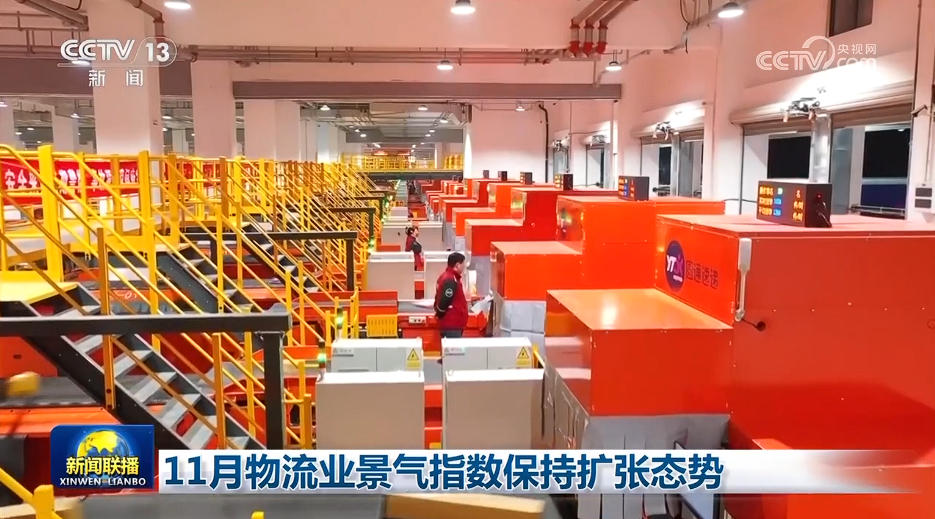
11月物流业景气指数保持扩张态势
Yang Shi Wang· 2025-12-03 12:08
Core Viewpoint - The logistics industry in China shows signs of recovery with a logistics prosperity index of 50.9% in November, reflecting a month-on-month increase of 0.2 percentage points [1] Group 1: Regional Performance - The business volume index across eastern, central, and western regions of China is relatively balanced [3] - In terms of demand, manufacturing is recovering, energy is slowing down, and consumption is stabilizing [3] Group 2: Sector-Specific Insights - The demand in transportation equipment, home appliances, smart devices, and automotive parts manufacturing remains strong [3] - The postal and express delivery industry has a business volume index of 70.2%, indicating robust performance across offline entities, social e-commerce platforms, and comprehensive e-commerce platforms [3] Group 3: Investment and Activity Expectations - The fixed asset investment completion index for the logistics industry is at 55.4%, and the business activity expectation index is at 54.9%, both indicating sustained high prosperity levels [5] - The multi-modal transport sector, aviation transport, and postal express industries maintain high business activity expectation indices, supporting stable industry outlooks [5]
11月物流业景气指数50.9% 需求保持扩张
Yang Shi Xin Wen· 2025-12-02 22:53
Core Viewpoint - The logistics industry in China shows continued expansion in demand and positive expectations, with key indices remaining in a prosperous range [1]. Group 1: Logistics Industry Performance - The logistics industry prosperity index for November is 50.9%, reflecting a month-on-month increase of 0.2 percentage points [2]. - The business volume index for the central and western regions is 51% and 51.2%, respectively, surpassing the national average, while the eastern region's index is 50.5%, with a month-on-month increase of 0.1 percentage points [2]. - The logistics demand for industrial products has rebounded compared to the previous month, while energy logistics demand continues to decline [6]. Group 2: Investment and Future Expectations - The fixed asset investment index for the logistics industry in November is 55.4%, indicating a high level of prosperity [9]. - Research indicates that trade logistics companies have high investment demand in areas such as equipment sharing and adaptation of upstream and downstream facilities [9]. - The business activity expectation index for November is 54.9%, remaining in a high prosperity range, with multi-modal transport, air transport, and postal express industries maintaining high levels of business activity expectations [9].

中国制造网金秋采洽会迎“开门红” 多元布局成效显著
Jing Ji Wang· 2025-08-13 09:58
Core Insights - The MIC International Station's Autumn Procurement Fair has shown strong initial results, indicating a new trend in trade diversification [3] - Chinese exports to the EU and ASEAN have seen significant growth, with exports to Belt and Road countries exceeding 50% of total exports [3] - The fair has highlighted the potential for emerging markets, with companies successfully securing orders in Southeast Asia and Latin America [3][4] Group 1: Event Performance - The first week of the Autumn Procurement Fair saw a 23.9% year-on-year increase in overall traffic and a 23.4% rise in business opportunities [3] - Notable successes include Foshan Senbo Home Technology Co., which secured a trial order in Turkey, and Ningbo Quanwei Rubber Products Co., which experienced a 67% increase in store traffic and nearly 50% rise in inquiries [1][3] Group 2: Market Trends - The fair's "explosive order trend" in Southeast Asia and Latin America reflects a shift towards diversified trade, with significant orders from countries like Vietnam and Paraguay [3][4] - The heavy industry and light industry sectors are seeing strong demand, particularly in manufacturing machinery, transportation equipment, and consumer electronics [4] Group 3: Platform Support - The MIC International Station has launched the "New Maritime Plan" to support Chinese companies in exploring diverse markets, focusing on resource investment and industry support [5] - The platform has implemented targeted operations in key markets, enhancing local experiences and utilizing multiple channels for buyer engagement [5] Group 4: Future Outlook - The ongoing fair is expected to strengthen China's manufacturing export capabilities through a dual approach of stabilizing traditional markets and exploring new ones [6]
上海电气: 上海电气公司章程
Zheng Quan Zhi Xing· 2025-07-22 16:16
Core Points - The articles of association of Shanghai Electric Group Co., Ltd. were approved by the board of directors on July 22, 2025, and are subject to shareholder meeting approval before becoming effective [1] - The company is established in accordance with the Company Law of the People's Republic of China and other relevant laws and regulations [1][2] - The company is a permanent limited liability company and its articles of association serve as a legally binding document governing the organization and behavior of the company and the rights and obligations between the company and its shareholders [4][5] Company Structure - The company was approved by the Shanghai Municipal Government and obtained its business license in September 2004 [2] - The registered name of the company is Shanghai Electric Group Co., Ltd. with its address located at 16, Lane 1100, Huashan Road, Shanghai [2][3] - The legal representative of the company is the chairman of the board, and the company must appoint a new legal representative within 30 days if the current one resigns [3][4] Share Capital and Stock - The company has issued a total of 12,507,686,405 ordinary shares, with 9,534,774,405 A shares and 2,972,912,000 H shares [12][14] - The initial issuance of H shares was 2,972,912,000 shares, representing 25% of the total share capital [12] - The company’s registered capital was adjusted to RMB 15,579,809,092 as of March 17, 2022, following various capital increases and stock issuance events [17] Business Objectives and Scope - The company's business objectives include honest operation, creating wealth and benefits for society, and providing high-quality equipment products and services through technological innovation [7] - The business scope includes power generation and distribution, electromechanical integration, environmental protection equipment, lithium-ion batteries, and various engineering services [7][8] Shareholder Rights and Obligations - Shareholders have the right to receive dividends, request meetings, supervise company operations, and transfer their shares in accordance with the law [36][40] - Shareholders are obligated to comply with laws and regulations, pay their subscribed capital, and not abuse their rights to harm the company or other shareholders [47]

10.3万亿!美国跌至第三,不再是中国第一大出口国,谁上位了?
Sou Hu Cai Jing· 2025-07-02 16:02
Core Insights - China's foreign trade has shown remarkable resilience, with a total import and export value of 10.3 trillion yuan in Q1 2025, including exports of 6.13 trillion yuan, despite a 6% decline in imports [1][4][21] - The trade surplus reached 237.6 billion USD, highlighting the irreplaceable role of Chinese manufacturing in the global market [1][4] - The easing of U.S. tax policies has led to an influx of foreign trade orders, benefiting Chinese exporters [3][4] Trade Performance - In Q1 2025, China's total trade volume increased year-on-year, marking the second consecutive year of surpassing 10 trillion yuan in a single quarter [4][21] - Exports to ASEAN and the EU have been growing, with figures exceeding 146 billion USD and 122.08 billion USD respectively [6][21] - The share of trade with countries involved in the Belt and Road Initiative has also increased, particularly with ASEAN, which saw a 7.1% growth in trade share compared to the previous year [7][21] Export Categories - The top three export categories in Q1 2025 were electromechanical products, integrated circuits, and automobiles, with electromechanical products accounting for over 60% of exports [10][11] - The rise of technical products such as industrial machinery, semiconductor components, and transportation equipment showcases China's strong manufacturing capabilities [11][14] Import Trends - The slowdown in import growth is attributed to fluctuations in international commodity prices, particularly for energy and agricultural products [12][14] - China is undergoing a significant energy structure transformation, optimizing the import of coal and iron resources while promoting green economic development [14][25] Emerging Products - New categories of exports, referred to as the "new three samples," include wind power generators, integrated circuits, and lithium batteries, which have seen significant growth [15][20] - Wind power generator exports increased by 71.9% last year, with a further 43% growth in Q1 2025 [17] - Integrated circuits are projected to reach a trade total of nearly 160 billion USD in 2024, with a year-on-year increase of 18% [18] - Lithium battery exports to the U.S. reached over 15.3 billion USD in 2023, with a 7.7% increase in Q1 2025 despite tariff sanctions [20] Market Diversification - China's GDP is increasingly reliant on the domestic market, with over 60% of GDP coming from domestic consumption [24][25] - Chinese companies are actively reducing dependence on the U.S. market by exploring diverse export channels and developing non-U.S. market strategies [25][26] - The cross-border e-commerce sector has played a crucial role in expanding foreign markets, supported by the establishment of over 165 cross-border e-commerce pilot zones [26][28]