人工智能ETF易方达

Search documents
科技基金密集上新,AI是投资主线
第一财经· 2026-03-18 13:54
Core Viewpoint - The article highlights the accelerating investment in the technology sector, particularly in AI and hard technology, with significant capital inflows and a growing number of funds focused on these areas [3][5][7]. Investment Trends - 15 hard technology-themed funds have recently been approved, expanding investment channels for technology-focused investors [3][5]. - As of March 18, 2023, the total fundraising for technology-related equity funds has reached nearly 240 billion yuan, with 37 new funds established this year [5][6]. - The demand for technology-related products is increasing, with 12 additional products currently in the fundraising stage [5]. AI as a Long-term Investment Focus - AI is viewed as a core investment theme in the capital market, with long-term value and growth potential [3][7]. - The focus is shifting from "what AI can do" to "what AI will replace," prompting a movement of funds from potentially disrupted assets to "AI immune assets" [3][7]. Fund Performance and Market Dynamics - Technology sectors are experiencing significant capital inflows, with over 120 billion yuan attracted to AI-related ETFs this year [6]. - Notable funds, such as the Huaxia Semiconductor ETF, have seen their assets double within a year due to strong net inflows [6][9]. Market Sentiment and Future Outlook - Despite short-term market fluctuations, technology remains a key investment theme for the year, driven by ongoing advancements in AI and related technologies [7][9]. - The overall market risk appetite is expected to stabilize, with a potential return of funds to equity markets as external risks diminish [9][10].


“落袋为安”?14亿,跑了
Zhong Guo Ji Jin Bao· 2026-02-26 04:17
Group 1 - On February 25, the A-share market saw all three major indices rise, but the stock ETF market experienced a net outflow of approximately 1.4 billion yuan [1] - As of February 25, the total scale of 1,344 stock ETFs in the market reached 4.18 trillion yuan, with a reduction of 503 million fund shares, resulting in a net outflow of about 1.48 billion yuan [2] - The Hong Kong stock market ETFs led in net inflows, totaling 1.881 billion yuan, with the CSI 500 Index ETF seeing the highest inflow of 1.678 billion yuan [2] Group 2 - On February 25, 32 ETFs had net inflows exceeding 100 million yuan, with the CSI 500 ETF leading at 1.424 billion yuan, followed by the Electric Grid Equipment ETF and A500 ETF with inflows of 1.059 billion yuan and 618 million yuan respectively [2] - E Fund's ETFs continued to attract net inflows, with the Hang Seng Technology ETF receiving 270 million yuan, the SSE 50 ETF 229 million yuan, and the Artificial Intelligence ETF 203 million yuan [2] - The Electric Grid Equipment ETF and Hang Seng Internet ETF from Huaxia Fund saw significant net inflows of 1.059 billion yuan and 603 million yuan respectively, with their latest scales at 20.465 billion yuan and 37.213 billion yuan [3] Group 3 - The ChiNext Index ETF experienced the largest net outflow on February 25, amounting to 1.946 billion yuan [4] - ICBC Credit Suisse Fund remains optimistic about the A-share market in the medium term, citing that total demand adjustments are nearing equilibrium and supply-side adjustments will enhance confidence in capital return rates [4]
56亿,加仓!
Zhong Guo Ji Jin Bao· 2026-02-25 05:48
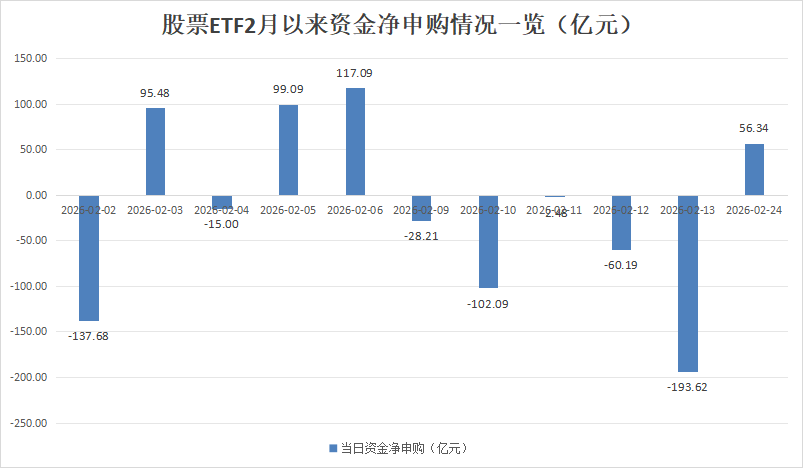
Group 1 - The stock ETF market experienced a significant inflow of 56.34 billion yuan on the first trading day of the Year of the Horse, reversing the trend of outflows seen in the previous five trading days [1][2] - The A-share market opened higher and closed with the Shanghai Composite Index up 0.87%, stabilizing above 4100 points, while the market turnover slightly increased to 2.18 trillion yuan [2] - The inflow was primarily driven by strong performance in the Hong Kong stock sector, with several ETFs tracking the Hong Kong market seeing substantial inflows [1][4] Group 2 - The largest inflows were observed in Hong Kong market ETFs, totaling 84.72 billion yuan, and thematic industry ETFs, which saw inflows of 25.79 billion yuan, while broad-based ETFs experienced outflows of 50.11 billion yuan [4] - ETFs tracking the Hang Seng Technology Index led the inflows with 46.59 billion yuan, while those tracking the CSI A500 Index saw outflows of 17.18 billion yuan [4] - Major fund companies like E Fund and Huaxia Fund reported significant inflows in their ETFs, with E Fund's total ETF scale reaching 659.7 billion yuan, increasing by 4.88 billion yuan on February 24 [4][5] Group 3 - Specific ETFs such as the Huaxia Hang Seng Technology Index ETF and the E Fund's China Internet ETF saw inflows of 16.53 billion yuan and 13.75 billion yuan, respectively [5][6] - The performance of the robotics sector was highlighted, with the Huaxia Robotics ETF also receiving over 4 billion yuan in inflows, reflecting a growing interest in the domestic robotics industry [7] - The market sentiment around the Hang Seng Technology Index is optimistic, with analysts noting the potential for growth driven by advancements in AI and technology [6][7]
热门赛道,获加仓
Zhong Guo Ji Jin Bao· 2026-02-12 05:49
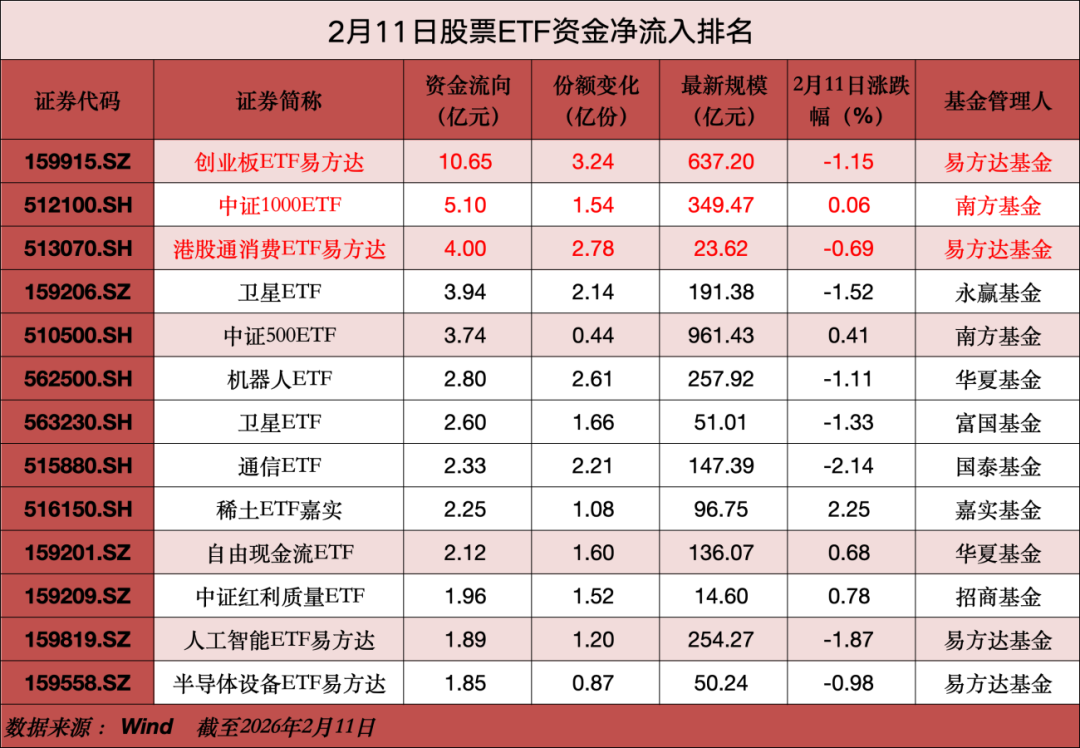
Core Viewpoint - The A-share market is experiencing mixed performance with significant inflows into the ChiNext and satellite industry ETFs, indicating a shift in investor sentiment towards these sectors as the market prepares for the upcoming holiday season [1][2]. ETF Fund Flows - As of February 11, the total scale of 1,339 stock ETFs in the market reached 4.19 trillion yuan, with an overall net outflow of 236 million yuan on that day [2]. - The ChiNext index ETF saw the most significant net inflow of 1.14 billion yuan, while the CSI A500 index ETF experienced a notable net outflow [3]. - The satellite industry also attracted substantial investment, with a net inflow of 890 million yuan on February 11 [3]. Notable ETF Performances - The top-performing ETFs included: - E Fund ChiNext ETF with a net inflow of 1.065 billion yuan [4]. - Southern CSI 1000 ETF with a net inflow of 510 million yuan [5]. - Yongying Satellite ETF with a net inflow of 394 million yuan [4]. - In the past five days, the Hang Seng Technology Index ETF saw inflows exceeding 6 billion yuan, and the SGE Gold 9999 Index ETF attracted over 4.2 billion yuan [3]. Outflows in Broader Market - The broad-based ETFs experienced a net outflow of 755 million yuan, with the CSI A500 ETF leading the outflows at 1.605 billion yuan [6][7]. - The new energy sector also faced significant outflows, totaling 820 million yuan [8]. Market Outlook - The market is expected to focus on macroeconomic data and industry trends post-holiday, with a potential shift towards structural changes in trading logic [9]. - Analysts suggest that the core growth assets are currently at historical median valuations, providing a potential for valuation recovery, while the technology sector remains strong amid ongoing innovations [10].
概念研究所-CPO和可拔插光模块的区别
Xin Lang Cai Jing· 2026-02-06 06:54
Core Viewpoint - CPO technology is emerging as a key solution for the next generation of AI infrastructure, driven by the need for high-speed data interconnectivity in AI model training, while traditional pluggable optical modules face significant limitations in power consumption, density, and cost [1][2][3][4]. Group 1: Differences Between CPO and Pluggable Optical Modules - CPO (Co-Packaged Optics) integrates optical engines with switching chips on the same substrate, enhancing performance and efficiency at the cost of modularity [1]. - Pluggable optical modules are standardized, hot-swappable components that prioritize flexibility but incur connection losses [1]. - The fundamental difference lies in "integration" versus "separation," with CPO aiming for maximum performance and efficiency [1]. Group 2: Impact of AI on CPO Demand - The explosion of AI model training has led to a surge in demand for optical interconnects, with sales of AI-related optical devices expected to grow significantly from 2023 to 2025 [2]. - Traditional pluggable solutions face three major bottlenecks: power consumption, density limitations, and escalating costs due to high-speed requirements [2][3]. Group 3: Changes in the Industry Chain Due to CPO - CPO represents not just a product upgrade but a reconfiguration of the optical communication industry chain, shifting value towards silicon photonics and advanced packaging [5]. - The traditional modular approach is being replaced by a collaborative design that integrates optics, electronics, and packaging, breaking down barriers between switch manufacturers, chip makers, and optical module producers [5]. - There are opportunities for domestic companies to catch up in key areas like silicon photonics and high-speed lasers, despite current low domestic production rates [5]. Group 4: Market Demand and Technical Outlook - The global CPO technology market is projected to grow rapidly, from approximately $46 million in 2024 to about $947 million by 2031, reflecting a compound annual growth rate of 41.9% [7]. - CPO is expected to penetrate 2.9%, 9.5%, and 50.6% of the 800G, 1.6T, and 3.2T optical module markets by 2029, respectively [7]. - In the short term, pluggable modules will remain dominant, but CPO is anticipated to become the preferred solution for AI networks as demand scales up post-2026 [7]. Group 5: Investment Strategies in AI Computing Power - The rise of CPO technology signifies a shift in hardware logic, suggesting that investors may consider diversified exposure to the AI hardware supply chain through index tools [8]. - Specific investment vehicles include ETFs that track AI-related indices, covering a range of companies involved in AI chips, software, and applications [8].
权益ETF,谁是主题轮动下一棒?
HUAXI Securities· 2026-01-20 07:41
Group 1: Report's Investment Rating - No information about the industry investment rating is provided in the report. Group 2: Core Viewpoints - In early 2026, the market sentiment has significantly warmed up, and the market has risen strongly. However, the risk - return ratio of chasing the rising market may not be high. Thematic investment remains popular, and funds from previously over - heated themes are expected to shift to other thematic sectors [1][7]. - The technology main line is still the market consensus. Funds are likely to flow into sectors such as semiconductor computing power and robotics within the technology sector, while lithium battery, non - ferrous metals, power grid, chemical, and innovative drugs are important supplementary sectors for the market [2][22]. Group 3: Summary by Directory 1. Which theme ETFs are expected to be the direction of capital return? - **Market situation**: In early 2026, the market has risen strongly, with commercial aerospace, AI applications, and non - ferrous metals becoming the focus. But there are signs of the market correcting irrational behaviors under regulatory guidance, and the risk - return ratio of chasing the rising market may be low. Thematic investment is still very popular. As of January 19, 2026, the cumulative net capital inflow of thematic index ETFs in the past five days exceeded 42.254 billion yuan, while industry index ETFs only had a net inflow of 9.763 billion yuan, and broad - based index ETFs showed a large net outflow [1][7]. - **Analysis from the perspective of rise and valuation**: Technological industries generally have high rises, while traditional cyclical industries such as liquor, coal, and breeding have relatively low rises. New energy sectors like lithium battery, photovoltaic, and new - energy vehicles, as well as the chemical industry, have risen but still have room to reach previous highs. From the valuation dimension, the current valuations of the game, intelligent driving, lithium battery, and breeding sectors are low [8]. - **Analysis using the quadrant chart**: - **First quadrant (high rise and high congestion)**: Mainly includes commercial aerospace, communication, AI, and non - ferrous metals. Non - ferrous metals (such as copper) and AI have relatively moderate congestion, and relevant sectors are still worthy of attention [2][17]. - **Second quadrant (high rise and low congestion)**: There are relatively few relevant industries, mainly semiconductor equipment (including related industrial chains such as storage) and lithium battery. The sector sentiment is not over - heated, and the industrial supply - demand pattern is optimized, so they are still worthy of attention [2][17]. - **Third quadrant (low rise and low congestion)**: Sectors such as innovative drugs, chemicals, and games have both industrial logic and market capacity, with large potential for a supplementary rise. For example, since 2026, the chemical ETF has re - entered the state of net inflow [2][17]. - **Fourth quadrant (low rise and high congestion)**: Includes robotics, power grid equipment, consumer electronics, and software. Power grid equipment has received renewed attention due to the unexpected increase in the 14th Five - Year Plan expenditure, and robotics has also been favored by the market because Tesla's third - generation robot has entered the scheme confirmation stage [2][21]. - **Specific ETF selection**: For ETFs tracking the same index, products with larger scale, relatively lower fees, and smaller tracking errors are selected. Specific ETF lists are provided in the report [22].
净流出,超400亿元!
Zhong Guo Ji Jin Bao· 2026-01-20 06:22
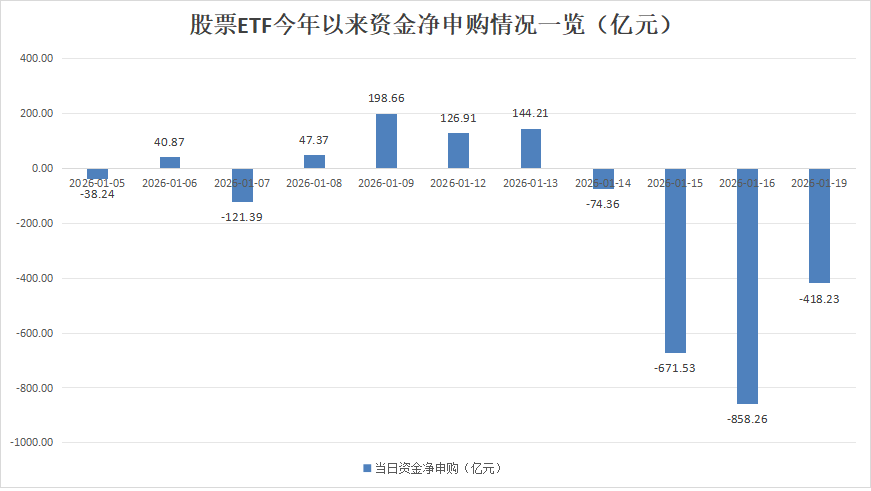
Core Viewpoint - The stock ETF market experienced significant net outflows, exceeding 400 billion yuan on January 19, marking the third consecutive day of substantial outflows, totaling over 1.9 trillion yuan in the past three trading days [1][2]. Group 1: Market Performance - The A-share market continued its volatile trend, with the Shanghai Composite Index rising by 0.29% to 4114.00 points, while the CSI 300 Index increased by 0.05% [2]. - Trading volume in the Shanghai and Shenzhen markets decreased to 2.73 trillion yuan, with weaker performance from large-cap stocks and stronger performance from growth-style sectors [2]. Group 2: ETF Fund Flows - The total scale of all stock ETFs (including cross-border ETFs) reached 4.61 trillion yuan, with a net outflow of 418.23 billion yuan on January 19 [2]. - Industry and commodity ETFs saw net inflows of 155.04 billion yuan and 22.44 billion yuan, respectively, while broad-based ETFs experienced net outflows of 586.07 billion yuan, leading to a decrease in their scale by 694.95 billion yuan [4]. Group 3: Specific ETF Performance - The top net inflows were observed in industry ETFs, with the Huaxia Electric Grid Equipment ETF leading at over 25 billion yuan, followed by the Penghua Chemical ETF with over 11 billion yuan [6]. - Four major CSI 300 ETFs collectively saw net outflows exceeding 300 billion yuan, with the Southern CSI 1000 ETF experiencing over 50 billion yuan in outflows [5][6]. Group 4: Market Sentiment and Outlook - Analysts noted that the recent net outflows from broad-based ETFs have contributed to a cooling effect on the previously hot market, aiding in the stable operation of the A-share market [7]. - The market is expected to maintain a volatile pattern in the short term, with potential support from funds adjusting their positions, while long-term sentiment remains optimistic [7].
天量资金,动向延续
Zhong Guo Ji Jin Bao· 2026-01-19 04:17
Core Viewpoint - On January 16, the A-share market experienced a decline, with a net outflow of over 85.5 billion yuan from the stock ETF market, indicating a continued trend of capital withdrawal [2][3]. Group 1: Market Performance - The three major indices in the A-share market closed lower, with the Shanghai Composite Index down 0.26%, the Shenzhen Component Index down 0.18%, and the ChiNext Index down 0.2% [3]. - The semiconductor industry chain saw significant gains, particularly in advanced packaging and memory sectors, while the cultural media and short drama gaming sectors experienced adjustments [3]. Group 2: ETF Fund Flows - As of January 16, the total scale of 1,308 stock ETFs in the market was approximately 4.9 trillion yuan, with a reduction of 15.365 billion units in fund shares, leading to a net outflow of 85.505 billion yuan [3][4]. - Industry-themed ETFs and strategy-style ETFs saw substantial inflows, amounting to 19.118 billion yuan and 1.768 billion yuan, respectively [4]. - The ETF tracking the semiconductor materials and equipment index had the highest single-day net inflow of 2.995 billion yuan [4]. Group 3: Notable Inflows - A total of 57 ETFs had net inflows exceeding 1 billion yuan on January 16, with the top three being the non-ferrous metals ETF, semiconductor equipment ETF, and electric grid equipment ETF, which saw net inflows of 1.811 billion yuan, 1.785 billion yuan, and 1.562 billion yuan, respectively [4]. - Leading fund companies continued to attract net inflows, with E Fund's semiconductor equipment ETF and artificial intelligence ETF each receiving over 600 million yuan [4]. Group 4: Market Outlook - The broad-based ETFs experienced the largest net outflow, totaling 106.907 billion yuan, with the CSI 300 index products seeing a net outflow of 58.007 billion yuan [6]. - Market analysts expect a "spring offensive" driven by ample liquidity and improved risk appetite, particularly as 2026 marks the beginning of the "14th Five-Year Plan" [6].
超140亿元!加仓
Zhong Guo Ji Jin Bao· 2026-01-14 06:29
Core Insights - On January 13, the A-share market experienced adjustments, but stock ETFs saw a significant net inflow of 146.46 billion yuan, indicating a reverse trend in funding during market fluctuations [1] Group 1: ETF Performance - The total scale of 1,301 stock ETFs in the market reached 5.06 trillion yuan, with a net inflow of 146.46 billion yuan on January 13 [2] - Industry-themed ETFs and Hong Kong market ETFs attracted the most funds, with net inflows of 175.86 billion yuan and 33.68 billion yuan, respectively [2] - The media sector saw the most significant net inflow, with 45.35 billion yuan on January 13, and over 79 billion yuan in the past five days [2] - The satellite industry also experienced notable inflows of 37.8 billion yuan, with a single product, the Yongying Fund's satellite ETF, seeing a net inflow of 18.86 billion yuan [2] - Other sectors like artificial intelligence, computing, and non-ferrous metals also had substantial inflows, with net inflows of 37.6 billion yuan, 32.6 billion yuan, and 22.4 billion yuan, respectively [2] Group 2: Institutional Insights - The manager of the Rongtong Internet Media Fund anticipates that by 2026, the AI narrative will shift towards commercialization, with the AI application market expected to grow from hundreds of billions to trillions of yuan [3] - EasyOne Fund's AI ETF saw a net inflow of over 7 billion yuan, while other ETFs like software and cloud computing also experienced significant inflows [3] - Huaxia Fund's ETFs, including the electric grid equipment ETF and the Sci-Tech 50 ETF, had notable net inflows of 7.95 billion yuan and 6.26 billion yuan, respectively [3] Group 3: Market Trends - The broad-based ETFs faced significant outflows, totaling 57.65 billion yuan, with the CSI 300 index leading the outflows at 24.7 billion yuan [4] - The market is expected to maintain a stable upward trend in 2026, supported by policy and industrial drivers, with a favorable macro environment anticipated in the first quarter [4] - EasyOne Fund's index investment department believes that the market's rhythm is likely to remain stable and positive in January, with a focus on core growth assets [5]
超140亿元!加仓
中国基金报· 2026-01-14 06:24
Core Viewpoint - On January 13, the A-share market experienced adjustments, but stock ETFs saw a significant net inflow of 14.646 billion yuan, indicating a reverse trend in capital flow amidst market fluctuations [2]. Group 1: ETF Inflows - The total scale of all stock ETFs in the market reached 5.06 trillion yuan, with a net inflow of 14.646 billion yuan on January 13 [4]. - Industry-themed ETFs and Hong Kong market ETFs attracted the most capital, with net inflows of 17.586 billion yuan and 3.368 billion yuan, respectively [4]. - The media sector saw the most significant capital inflow, with a net inflow of 4.535 billion yuan on January 13, and over 7.9 billion yuan in the past five days [4]. - The satellite industry also experienced notable inflows of 3.78 billion yuan, with a single product, the Yongying Fund's satellite ETF, seeing a net inflow of 1.886 billion yuan [4]. - Other sectors such as artificial intelligence, computing, and non-ferrous metals also had substantial inflows, with net inflows of 3.76 billion yuan, 3.26 billion yuan, and 2.24 billion yuan, respectively [4]. Group 2: ETF Outflows - The broad-based ETFs faced significant outflows, totaling 5.765 billion yuan on the same day, with a decrease in scale of 34.343 billion yuan [9]. - The CSI 300 index saw the largest outflow at 2.47 billion yuan, followed by the CSI A500 index with 1.92 billion yuan, and the ChiNext index with 1.64 billion yuan [10]. Group 3: Market Outlook - Analysts expect a stable and positive market rhythm in January, with macro policies providing a solid foundation for economic recovery [12]. - The market is anticipated to maintain an upward trend in 2026, supported by a favorable macro environment and structural opportunities [11].