代餐奶昔

Search documents
代餐行业,正告别野蛮生长进入硬实力比拼
Sou Hu Cai Jing· 2026-02-04 11:52AI Processing
文|食安时代 一瓶奶昔代替晚餐、一根蛋白棒作为加餐,不知从何时起这种饮食理念成为大部分人心中"健康减重"的方式,带动了整个代餐市场蓬勃发展,越来越多主 打"科学营养"的代餐产品出现,精准拿捏众人体重焦虑心理,尤其是在国家相关政策发布后大部分人对减重的迫切程度进一步上升,代餐食品更是迎来了新 一轮发展机遇。 狂欢背后也是暗流涌动,热量虚标、营养不均衡等产品问题日益突出,夸大宣传、虚假宣传事件层出不穷。今时不同往日,代餐食品"肆意生长"时期已过, 在政策约束和市场信任的双重压力下,代餐品牌将科学营养作为核心价值才有望在竞争激烈的市场中立于不败之地。 赛道增长快速,品牌混战 代餐概念起源于欧美国家且渗透度较高,在全球肥胖人群和慢性病人群不断增多的趋势下,代替高脂肪、高热量正餐的代餐食品逐渐传入中国。2000年前后 康宝莱等国外知名品牌进入我国带动了行业起步,2010年在苏州、长沙等地建设工厂,市场规模进一步扩大代餐行业进入快速发展期。 Smeal、王饱饱、超级零、野兽生活、WonderLab、ffit8、鲨鱼菲特等越来越多本土化品牌成立,将代餐行业推向了新的高度,2020年以后我国代餐行业彻底 进入"互联网+"发展 ...


长沙老板卖蛋白粉,9个月入账16亿
2 1 Shi Ji Jing Ji Bao Dao· 2026-01-10 11:21
Core Viewpoint - Hunan Xizi Health, led by entrepreneur Liu Jianwei, is preparing for an IPO on the Hong Kong Stock Exchange, aiming to capitalize on the growing market for sports nutrition products [1][2]. Company Overview - Hunan Xizi Health has submitted its listing application to the Hong Kong Stock Exchange, with CITIC Securities as the sole sponsor [2]. - The company operates in the sports nutrition sector, owning four proprietary brands: FoYes, fiboo, Guben Diary, and Hot Rule, offering products such as protein powders, functional gummies, and coffee [2]. Leadership and Background - Liu Jianwei, the chairman and founder, is a self-made entrepreneur who graduated from Hunan Engineering Vocational and Technical College with a degree in logistics management [3][4]. - He has spent over a decade building a successful nutrition brand, with annual revenue exceeding 10 billion yuan [4]. Brand Development - Initially focused on third-party brand operations, Liu identified opportunities in the nutrition market and pivoted to develop proprietary brands [5]. - The four brands cover various segments, including professional training, health maintenance, weight management, and daily nutrition needs [6]. Product Performance - The fiboo brand, launched in 2021, targets women's health and has seen significant sales, with its top-selling iron-rich gummies priced around 90 yuan and over 200,000 units sold [6]. - As of November 2025, fiboo ranked first in GMV for various vitamins and minerals on Douyin [7]. - FoYes, launched in 2024, focuses on high-quality protein products, while Hot Rule, introduced in April 2025, aims at Gen Z consumers with trendy flavors [8][9]. Financial Performance - The revenue share from proprietary brands increased from 42.4% in 2023 to 97.3% by September last year [10]. - For the first nine months of 2025, the company reported revenue of 1.609 billion yuan, surpassing the total revenue for 2024, with a net profit of 127 million yuan and a record high gross margin of 59.5% [10]. - The company's shareholders include institutions like Dacheng Caizhi and Zhongguang Tianze, with Liu holding a direct stake of 12.4% and an indirect stake of approximately 57% through Xizi Technology [10]. Sales Strategy - The company's sales strategy is heavily focused on online channels, with 99% of revenue generated from online sales, primarily through Douyin [10]. - If the IPO is successful, the funds raised will be used to expand sales channels and distribution networks, solidifying its position in the sports nutrition and functional food markets [10].
健身教练是运动营养师吗?
3 6 Ke· 2025-12-01 00:25
Core Viewpoint - The increasing demand for integrated fitness services that combine exercise and nutrition guidance is reshaping the role of personal trainers, highlighting the need for enhanced nutritional knowledge among fitness professionals [1][5][26]. Group 1: Demand for Nutritional Guidance - There is a growing trend among fitness members seeking nutritional advice, driven by an increase in health awareness and various dietary concepts such as high-protein diets and intermittent fasting [1][5]. - Personal trainers are often viewed as the primary source of nutritional information by their clients, despite their limited qualifications to provide comprehensive dietary guidance [3][6][19]. - A survey indicated that 43.5% of personal trainers recognize the increasing demand for nutrition-related knowledge [15]. Group 2: Limitations of Personal Trainers - Personal trainers can supervise basic dietary habits but are not qualified to diagnose or treat eating disorders or create detailed meal plans [5][19]. - The role of personal trainers is evolving, but they still face restrictions in providing specific nutritional advice, especially for clients with chronic health issues [19][26]. - The complexity of modern dietary questions, such as the effects of low-carb or ketogenic diets, often exceeds the expertise of typical personal trainers [6][19]. Group 3: Professional Development and Market Trends - The fitness industry is witnessing a shift towards more specialized training services, with personal trainers increasingly focusing on health coaching that encompasses nutrition, sleep quality, and mental health [17][26]. - The market is pushing for personal trainers to enhance their nutritional skills, with many considering certification as nutrition coaches to meet client needs [24][26]. - Companies like Keep and薄荷健康 are expanding into the nutrition sector, offering meal replacements and health foods, indicating a trend where fitness and nutrition are becoming more intertwined [28][30].
不运动不挨饿也能瘦?万益蓝“餐前控控片”遭多人投诉“虚假宣传”
Guo Ji Jin Rong Bao· 2025-09-26 15:20
Core Viewpoint - The product "Pre-meal Control Tablets" by Wonderlab has gained attention for its claims of weight loss without diet or exercise, but it faces skepticism and complaints regarding its effectiveness and marketing practices [1][5][8] Group 1: Product Claims and Marketing - The product is marketed as a means to block carbohydrate absorption, appealing to consumers who struggle with dieting and exercise [1][5] - Despite high sales, with 200 million tablets sold, many consumers report no weight loss and even adverse effects like stomach pain [1][8] - The marketing includes ambiguous statements that suggest weight loss benefits while disclaiming these claims in fine print [5][7] Group 2: Consumer Feedback and Efficacy - Numerous consumer complaints highlight the ineffectiveness of the product, with reports of no weight loss and gastrointestinal issues [8][10] - Some consumers have conducted personal experiments, finding that the product did not lead to weight loss and, in some cases, resulted in weight gain [10][13] - Industry experts suggest that the key ingredient, white kidney bean extract, may have limited effects on carbohydrate absorption but is not a comprehensive solution for weight loss [8][13] Group 3: Regulatory and Legal Issues - The product is classified as a "compressed candy" under Chinese law, which prohibits claims of health benefits or medical efficacy [7] - The parent company, Shenzhen Beautiful Nutrition Technology Co., has faced multiple fines for false advertising and misleading claims in recent years [14]

一个行业的双面叙事;从千亿益生菌市场到万益蓝
3 6 Ke· 2025-08-27 12:58

Core Viewpoint - The article discusses the rising popularity of probiotics among young consumers in China, driven by health concerns and lifestyle choices, while also highlighting the controversies surrounding the brand Wan Yi Lan and the broader probiotic market dynamics [2][19]. Industry Overview - The Chinese probiotic market is experiencing significant growth, with a projected annual increase of 11% to 12%, potentially reaching a market size of approximately 130 billion yuan by 2025 and 137.7 billion yuan by 2026 [2]. - A report from the National Health Commission indicates that 62.3% of adults in China suffer from various gastrointestinal issues, creating a demand for products that promote gut health [2]. Company Profile: Wan Yi Lan - Wan Yi Lan, founded in 2019, has quickly established itself in the probiotic market by leveraging strong marketing strategies and a deep understanding of consumer needs [10][11]. - The company initially gained traction with meal replacement shakes but later pivoted to probiotics, achieving significant sales milestones, including 4 billion yuan in 2020 and 5 billion yuan in 2021 [14]. Market Challenges - Despite its rapid growth, Wan Yi Lan faces increasing competition, with over 4,500 companies now operating in the probiotic space, up from 3,000 in 2022 [19]. - The brand has encountered numerous complaints regarding product effectiveness and false advertising, with over 1,000 complaints logged on consumer platforms [15][17]. Consumer Sentiment - There is ongoing debate among consumers regarding the efficacy of probiotics, with mixed reviews on their benefits, leading to a perception of some products as overpriced or ineffective [20]. - The article emphasizes that the success of probiotics depends on the specific strains used, individual health conditions, and the context of use, rather than a blanket effectiveness [20].
衡美健康北交所IPO前夜:自身产能闲置、核心客户流失 估值超20亿留不住创始成员高管?
Xin Lang Zheng Quan· 2025-08-22 06:28
Core Viewpoint - The nutritional supplement companies, including汤臣倍健 and 巨星传奇, are facing significant declines in revenue and profit, while the contract manufacturer 衡美健康 is preparing for an IPO despite recent operational challenges [1][2]. Group 1: Company Performance -汤臣倍健's revenue and net profit both decreased in the first half of 2025, with its stock price dropping from a peak of 33.28 yuan to below 10 yuan, resulting in a market value loss of 42 billion yuan [1]. -巨星传奇 expects a comprehensive profit of no more than 8.5 million yuan for the first half of 2025, a 67% drop compared to 25.5 million yuan in the same period of 2024 [1]. -衡美健康's revenue grew from 587 million yuan in 2022 to 1.072 billion yuan in 2024, with a net profit increase from 39.84 million yuan to 103 million yuan, reflecting compound annual growth rates of 22.2% and 37.3% respectively [1]. Group 2: Sales and Production Challenges - In Q1 2025,衡美健康's total revenue was 217 million yuan, a 10.1% year-on-year decline, and net profit fell by 23.1% to 20.06 million yuan [1]. - The company experienced a significant drop in sales across various product categories, with烘焙类, 糖果类, and 棒类 products seeing year-on-year decreases of 8.6%, 17.4%, and 22.7% respectively [5]. - Despite the decline in sales,衡美健康 plans to invest 249 million yuan in expanding its production capacity, which raises questions about the necessity and urgency of such expansion given the current underutilization of capacity [7]. Group 3: Client Dependency and Risks -衡美健康's top five clients accounted for 55.3%, 45.6%, and 49.7% of total revenue from 2022 to 2024, indicating a high concentration of revenue sources [7]. - The loss of key clients, such as Wonderlab, which has shifted to self-manufacturing, poses a risk to衡美健康's revenue stability [8]. - The company may face increased competition and potential price wars as it attempts to retain existing clients and attract new ones amid declining sales [9]. Group 4: IPO and Valuation -衡美健康 plans to issue up to 16.67 million shares to raise 501 million yuan, which would value the company at approximately 2 billion yuan, a 55-fold increase from its valuation in 2021 [10]. - Concerns have been raised regarding the company's governance, as several key executives, including the founder, have resigned prior to the IPO, leading to scrutiny from the 北交所 [11][12].
衡美健康北交所IPO:代餐龙头蓄力转型赌局
Hua Er Jie Jian Wen· 2025-07-23 05:50
Core Viewpoint - The demand for health and weight loss has driven the penetration of nutritional functional foods, leading to the rise of contract manufacturing companies in the industry, exemplified by Hengmei Health's successful IPO application and market position [1][3]. Group 1: Company Overview - Hengmei Health holds a leading position in the nutritional functional food contract manufacturing market with a 4.2% market share, serving notable clients such as WonderLab and Liangpinpuzi [3]. - The company has experienced significant revenue growth, with sales increasing from 578 million yuan in 2022 to 1.072 billion yuan in 2024, and net profit rising 1.5 times to 100 million yuan [17]. - Hengmei Health has established a strong patent portfolio with 56 invention patents and over 5,000 personalized product formulas [17]. Group 2: Market Dynamics - The nutritional functional food sector has seen a surge in new brands, with the number of meal replacement brands increasing from 2,837 in 2019 to 3,540 in 2020, driven by rising health awareness and investment in the consumer sector [13]. - The company has shifted its contract manufacturing model from OEM to ODM, providing comprehensive services from product planning to marketing support [14]. Group 3: Financial Performance - In 2024, the company's revenue is projected to grow by 9.5% to 1.072 billion yuan, although this represents a significant decline from the 67% growth seen in 2023 [4]. - The first quarter of 2025 shows continued pressure with revenue of 217 million yuan, reflecting nearly a 10% decline year-on-year and quarter-on-quarter [5]. Group 4: Strategic Challenges - Hengmei Health's performance is highly dependent on the stability of its downstream brand partners, with some clients seeking to reduce reliance on contract manufacturing [21]. - The company faces potential risks from key clients transitioning to self-manufacturing, as seen with WonderLab's shift towards probiotics and self-production capabilities [22]. - The company is investing in new product lines, such as "nutritional beans," to capture market opportunities, but faces challenges related to rising raw material costs and market uncertainties [27].
千亿代餐风口,谁在收割身材焦虑?
投中网· 2025-07-08 06:54
Core Viewpoint - The meal replacement market in China is experiencing rapid growth, with a projected market size of 1.75 trillion yuan by 2023, expanding 30 times from 5.82 billion yuan in 2017, driven by health trends and consumer demand for convenient nutrition solutions [2][6]. Market Overview - The meal replacement sector has seen the emergence of new brands such as Wang Baobao, Shark Fit, ffit8, and WonderLab, which are rapidly gaining market share [3][12]. - The primary consumer demographic consists of young adults aged 20-40, predominantly women, who are willing to spend over 3,000 yuan annually on meal replacement products [5][23]. Industry Challenges - Despite the growth, the industry faces challenges such as low repurchase rates, high closure rates of light meal restaurants, and issues with product quality and safety, including energy mislabeling and contamination risks [6][40]. - The lack of industry standards and reliance on marketing rather than product quality has led to significant market fragmentation and low barriers to entry [40]. Competitive Landscape - The market is characterized by intense competition, with no clear market leader emerging due to the proliferation of brands and product categories [38][39]. - Major players include Shark Fit with a 35% online market share for ready-to-eat chicken, Kangaroo Mr. with 22.1% for ready-to-eat beef, and WonderLab with 18% for meal replacement shakes [39]. Growth Drivers - The growth of the meal replacement market is attributed to factors such as the "Healthy China 2030" policy, capital investment, and increasing consumer body image concerns [7][19]. - The rise of social media and e-commerce platforms has enabled brands to effectively reach and engage their target demographics, significantly boosting sales [28][31]. Future Outlook - The industry is expected to see increased consolidation as larger companies with more resources enter the market, leading to higher industry concentration [41]. - Brands are encouraged to innovate in product offerings and explore new consumption scenarios beyond weight management to sustain growth and enhance consumer loyalty [44][45].

千亿代餐风口,谁在收割身材焦虑?
3 6 Ke· 2025-07-07 08:50
Core Insights - The meal replacement market in China is experiencing rapid growth, with an annual increase of 30%, expanding from 5.82 billion yuan in 2017 to 175 billion yuan in 2023, marking a 30-fold increase in six years [1][6][10] - Key players in this market include emerging brands such as WonderLab, ffit8, and Shark Fit, which have quickly gained traction among consumers aged 20-40, predominantly women [1][11] - Despite the growth, challenges such as low repurchase rates, high closure rates of light meal restaurants, and issues with product quality and safety standards are prevalent [1][21] Market Dynamics - The meal replacement sector is characterized by a mix of brands targeting various consumer needs, including weight loss, fitness, and health [3][7] - The market saw significant investment activity in 2020, with 19 financing events involving 13 companies, raising nearly 1 billion yuan [6][10] - The market is fragmented, with no clear leader, as brands compete in a landscape lacking product standards and facing pressure from established international brands [21][22] Consumer Behavior - The primary consumer demographic consists of young professionals, with 36.7% being office workers, and over 90% falling within the 20-40 age range [11][20] - These consumers are characterized by their willingness to spend on health and beauty, often influenced by social media and live-streaming platforms [11][13] - The trend towards meal replacements is driven by a combination of health policies, capital investment, and societal pressures regarding body image [2][10] Competitive Landscape - The market is witnessing a battle among brands, with Shark Fit holding a 35% online market share for ready-to-eat chicken, while WonderLab and ffit8 hold 18% and 15% respectively [21][22] - The lack of product differentiation and reliance on marketing rather than production capabilities contribute to the low entry barriers for new brands [21][22] - As more established companies enter the market, the concentration of resources is expected to increase, potentially leading to a more competitive environment [22][24] Future Trends - Opportunities exist in expanding offline sales channels and targeting lower-tier cities, where sales are projected to grow by 40% in 2024 [22][23] - Brands are encouraged to innovate around consumption scenarios beyond weight management, such as health-focused diets and convenience for busy lifestyles [23][24] - The industry is transitioning from a focus on "traffic dividends" to a phase where companies must enhance their core competencies and build consumer trust through scientific nutrition [24]

轻食代餐受追捧,真能实现减肥梦?专家提醒需谨慎
Yang Shi Wang· 2025-06-20 09:05
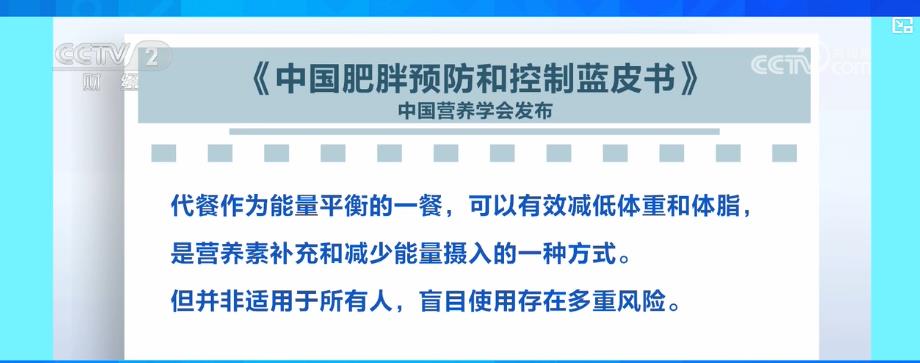
Core Viewpoint - The article discusses the effectiveness and safety of meal replacement products and light foods in weight loss, emphasizing that while they can aid in weight management, they are not suitable for everyone and may pose health risks if misused [1][3]. Group 1: Meal Replacement Products - Meal replacements can effectively reduce weight and body fat when used correctly, as they provide a means of energy balance and nutrient supplementation [3]. - Not all individuals can safely use meal replacements; those with pre-existing health conditions may experience adverse effects [3][5]. - Common forms of meal replacements include powders, bars, shakes, and porridge, but some products may achieve weight loss through unhealthy methods that can harm the body [5]. Group 2: Health Risks and Nutritional Balance - Relying solely on meal replacements for weight loss is not scientifically sound; a balanced approach to energy intake and expenditure is crucial [5]. - Long-term use of meal replacements or light foods can lead to deficiencies in essential nutrients, potentially causing health issues such as hair loss and menstrual irregularities [5][7]. - Consumers should be cautious about the quality of light food products, as poor-quality ingredients and unclear nutritional labeling can pose food safety risks [7]. Group 3: Professional Guidance - Professional guidance from nutritionists or dietitians is recommended when incorporating meal replacements into a diet to ensure a balanced nutritional plan [5].