入境游服务

Search documents
每1元带动4.3元关联消费!入境游“乘数效应”激活县乡经济
Qi Lu Wan Bao· 2026-02-27 08:56
Core Insights - The report from the International Service Trade Research Institute of the Ministry of Commerce indicates that by 2025, China's inbound tourism market is expected to reach a record high, with 82.035 million foreign tourists entering and exiting, representing a year-on-year growth of 26.4% [1] - Travel service exports are projected to reach $55.16 billion, a significant increase of 49.1% year-on-year, and 1.6 times that of 2019 [2] Group 1: Inbound Tourism Growth - By 2025, inbound tourism revenue will account for less than 0.5% of China's GDP, compared to over 10% in Thailand and 1% to 3% in many Western countries, indicating a potential market increase of 1 to 3 trillion RMB if aligned with international standards [1] - The number of foreign tourists entering through visa-free channels is expected to reach 30.08 million, making up 73.1% of total inbound tourists, with a year-on-year growth of 49.5% [4] Group 2: Trade Balance and Economic Impact - The travel service export value is expected to reach $55.16 billion, significantly contributing to narrowing the service trade deficit, which is projected to decrease from $1,646.6 billion in 2024 to $1,160.2 billion in 2025 [2] - The tourism industry has a multiplier effect, where every 1 RMB of inbound revenue generates 4.3 RMB in related industry income, leading to over 14.3 million jobs created directly and indirectly by inbound tourism [5] Group 3: Emerging Destinations and Consumer Preferences - Inbound tourism is shifting from major cities to lower-tier cities, with a remarkable annual growth rate of 134% in four and five-tier cities [6] - International tourists show a preference for culturally unique and ecologically distinctive regions, with significant increases in visitor numbers to places like Xi'an and Chaozhou [6] Group 4: Digital Platforms and Future Projections - Digital platforms are becoming crucial for the growth of inbound tourism, with Ctrip facilitating $24 billion in consumer spending through its overseas platform [7][8] - By 2035, international tourist spending in China is projected to reach approximately 1.5 trillion RMB, supported by the expansion of visa-free policies and increased international flight availability [9]


外国人在中国买买买,背后是场消费基建革命
Sou Hu Cai Jing· 2026-02-27 06:07
Core Insights - The article discusses a significant transformation in the consumer experience for foreign visitors in China, driven by a reduction in friction points such as visa issues and payment limitations [3] - The increase in inbound foreign tourists is projected to grow by 26.4% by 2025, with over 70% of these visitors benefiting from visa-free entry [3] - The sales volume of tax refund goods has surged by 95.9%, with the number of tax refund applicants increasing by 305%, indicating a structural change in the system [3] Group 1 - The easing of visa restrictions to 48 countries and the expansion of visa-free transit ports to 65 has opened the flow of tourists, but the real value lies in the seamless payment systems and tax refund processes [3] - The integration of payment methods, including large card transactions, small QR code payments, and cash options, has created a comprehensive payment ecosystem that enhances the consumer experience [3] - The improvement in the overall experience for inbound tourists is likened to a well-coordinated dining set rather than a single chopstick, emphasizing the importance of interconnected services [3] Group 2 - The article highlights a 300% increase in bookings for intangible cultural heritage projects, showcasing a shift in consumer preferences towards authentic experiences [3] - Despite existing challenges in cross-border after-sales services, the trend indicates a decrease in transaction costs and an increase in consumer trust [3] - The author posits that enhancing consumer experience is a vital component of national competitiveness, suggesting that this consumer infrastructure revolution is just beginning [3]

春节假期国内游订单量创新高,山东酒店间夜量同比增长109%
Feng Huang Wang Cai Jing· 2026-02-24 06:32
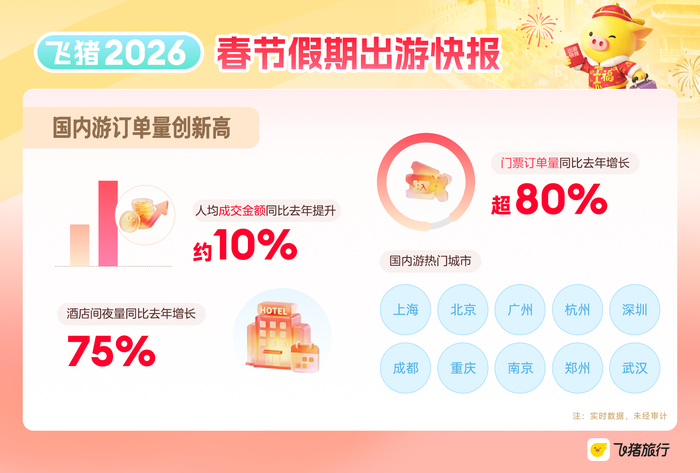
Group 1 - The Spring Festival holiday saw a record high in domestic travel orders, with ticket orders increasing by over 80% and hotel night bookings rising by 75% year-on-year [1] - There was a significant increase in travel demand during the holiday, with orders from the second to the fifth day of the new year growing by approximately 30% compared to last year [1] - The average booking amount for domestic travel during the Spring Festival increased by about 10% compared to last year, with high-star hotels averaging nearly 3 nights per booking [3] Group 2 - AI-assisted booking services experienced a surge, with AI orders on the Fliggy platform increasing by over 800% during the holiday, and ticket orders via AI rising more than 24 times [5] - The popularity of ice and snow tourism also surged, with orders for such activities increasing by over 200% during the holiday, highlighting destinations like Changbai Mountain and Yabuli [5] - Cross-border travel continued to grow strongly, with outbound travel orders for flights, hotels, and local activities maintaining a year-on-year growth rate of over 30% [7] Group 3 - The influx of foreign tourists to China during the Spring Festival was notable, with inbound flight orders increasing nearly tenfold, particularly in cities like Shanghai and Guangzhou [7] - The end of the holiday period marks a peak for off-peak travel, with significant discounts on flights available on platforms like Fliggy, with prices for certain routes dropping below 400 yuan [7]
这个春节,上海何以成为热门目的地?
Xin Lang Cai Jing· 2026-02-22 00:26
Core Insights - The 2026 Spring Festival in Shanghai has seen a significant "reverse passenger flow," with an increase in inbound tourism as the visa-free "circle of friends" expands, leading to a peak in visitors seeking to experience the Chinese New Year [1][4] Group 1: Tourism Trends - Major cities like Shanghai and Beijing have experienced a notable increase in train ticket orders from travelers aged 50 and above, with a year-on-year growth of 25% during the Spring Festival [4] - The first day of the holiday saw a rise in self-driving and free travel, with popular destinations including Sanya, Beijing, and Shanghai [4] - Shanghai's hotel occupancy rate averaged 44% during the holiday, reflecting a 3 percentage point increase year-on-year [5] Group 2: Visitor Statistics - Shanghai welcomed 12.5686 million visitors in the first five days of the Spring Festival, marking a 5.32% increase compared to the previous year [5] - On the first day of the New Year, the Yuyuan Garden in Shanghai experienced a peak visitor count of 31,000, a 39.6% increase from last year, with total visitors reaching 261,000, up 26.7% [8] Group 3: Inbound Tourism - The introduction of visa-free policies for travelers from Canada and the UK has led to a surge in inbound tourism, with the first day of the policy seeing foreign travelers arriving at Shanghai Pudong International Airport [9] - The Shanghai Border Inspection Station reported a total of 679,000 inbound and outbound travelers during the Spring Festival, with 656,000 passing through the two major international airports [9] Group 4: Cultural and Entertainment Activities - Shanghai has organized 2,570 activities across seven categories, including festivals, performances, and cultural events, to enhance the festive atmosphere for both residents and visitors [12] - The city has also issued 150 million yuan in consumer vouchers to stimulate spending during the holiday [13] - Major concerts and events are scheduled for the end of the holiday, expected to drive additional tourism and local engagement [13]
入境游火爆 外国游客扎堆来蓉寻年味
Xin Lang Cai Jing· 2026-02-13 19:34
Group 1 - The inbound tourism market in China is experiencing a significant surge as foreign tourists flock to the country to celebrate the Spring Festival, making "spending the Spring Festival in China" a global travel trend [1][2] - Chengdu has emerged as a popular destination for international visitors, thanks to its rich cultural experiences, diverse tourism offerings, and favorable international policies [1] - According to Ctrip's 2026 Spring Festival tourism market forecast, major cities favored by foreign tourists include Shanghai, Beijing, Guangzhou, Shenzhen, Chengdu, and others, creating a "Chinese New Year flavor map" [1] Group 2 - Hotel occupancy rates in Chengdu's commercial areas have surpassed 50% for the Spring Festival, indicating strong demand from inbound tourists [2] - The increase in inbound tourism is attributed to multiple factors, including visa-free policies, increased international flight routes, and the continuous expansion of cultural tourism brands [2] - Chengdu is showcasing its unique charm during the Spring Festival, with a variety of activities ranging from urban shopping districts to traditional festivals, appealing to a global audience [2]
新闻1+1丨从春节到全年 服务消费如何发力?
Yang Shi Wang· 2026-02-09 21:33
Core Insights - The article emphasizes the significant shift in consumer spending towards service consumption, which is projected to account for 46.1% of per capita consumption expenditure by 2025, highlighting the need for quality upgrades in service sectors such as transportation, housekeeping, tourism, and inbound travel [1] Group 1: Changes in Supply Side - The demand for services is characterized by diversification, personalization, and quality, which drives supply innovation [1] - The supply side is evolving under policy guidance and technological empowerment, leading to innovations in business models and enriched content in sectors like cruise economy, inbound tourism, and winter sports consumption [1] Group 2: Service Consumption Demand - Service consumption has rapidly increased, transitioning from a product-centric model to a balanced focus on both goods and services [2] - Key areas of service consumption include essential services like elderly care, childcare, and housekeeping, which are experiencing strong demand, alongside rapidly growing sectors such as tourism, wellness, and entertainment [2] Group 3: Key Growth Areas - The nine service sectors identified in the "Accelerating the Cultivation of New Growth Points in Service Consumption" plan are crucial for the current service economy and are expected to become new consumption growth points [3] Group 4: Understanding Consumer Needs - Service consumption primarily aims to fulfill emotional and experiential needs, such as leisure and relaxation, while also providing practical benefits like freeing individuals from household chores [5] Group 5: Service Consumption and Livelihood - Essential services like elderly care, childcare, and housekeeping are closely tied to daily life and are foundational to service consumption [6] - Policies should support and guide these sectors to expand supply while ensuring quality, which can stimulate enterprise engagement and enable better understanding of consumer needs through data analytics [6]
双向奔赴,开放型经济活力足
Xin Lang Cai Jing· 2026-02-07 22:52
Core Insights - The total number of inbound and outbound travelers in China reached 697 million in 2025, marking a 14.2% year-on-year increase, the highest in history [1] - The growth in inbound tourism is driven by policies such as visa exemptions and temporary entry permits, which have significantly boosted foreign visitor numbers [2][3] Group 1: Inbound Tourism Growth - In 2025, Beijing's ports recorded over 21.4 million inbound and outbound travelers, a 17.4% increase year-on-year, the highest since 2020 [2] - The number of foreign visitors benefiting from visa exemptions exceeded 2 million, 1.9 times that of the previous year, contributing to the surge in inbound traffic [2] - The implementation of new visa policies, including the addition of Indonesia to the 240-hour transit visa exemption list, has facilitated increased foreign tourism [2][3] Group 2: Cross-Border Movement - The total number of foreign travelers entering and exiting China reached 82.04 million in 2025, a 26.4% increase year-on-year, with visa-exempt entries rising by 49.5% to 30.08 million [3] - Measures to streamline border inspection processes, such as expanding the number of ports with 24-hour transit visa exemptions, have improved efficiency [3] - The "dual-channel inspection" model at Beijing Capital International Airport has enhanced the efficiency of foreign traveler processing by approximately 30% during peak times [3] Group 3: Regional Connectivity - The movement between mainland China and Hong Kong, Macau, and Taiwan has intensified, with 279 million entries and exits recorded, a 10.1% increase year-on-year [4] - The introduction of new high-speed rail routes connecting Hong Kong to various mainland cities reflects the growing demand for cross-border travel [4] - Policies to facilitate talent movement and streamline visa processes for residents traveling between regions have been well received, enhancing cross-border collaboration [4][5] Group 4: Efficient Cargo Flow - In 2025, the number of inbound and outbound aircraft, trains, ships, and vehicles increased significantly, with aircraft movements rising by 14.5% and cargo ships by 4.9% [6] - Jiangsu province reported a notable increase in cargo inspections, with a 73.6% rise in cargo aircraft movements, indicating robust export activity [6] - The implementation of expedited customs processes at various ports has improved cargo transit times, supporting national and regional economic strategies [6][7]
入境游,如何做好文旅行业的下一个增长极
3 6 Ke· 2026-02-06 05:27
Core Insights - The "China Travel" trend is expected to continue growing, with inbound tourist numbers projected to exceed 35 million in 2025, potentially setting a historical record [1] - The inbound tourism market in China is anticipated to reach $180 billion by 2030, indicating significant growth potential [1] Group 1: Inbound Tourism Growth - China has implemented unilateral visa exemptions or comprehensive mutual visa waivers for 76 countries, facilitating increased tourist inflow [1] - Ctrip's report indicates a 100% year-on-year growth in inbound travel bookings for the first three quarters of 2025, with orders from visa-exempt countries increasing by an average of 153% [3][11] - Asian countries, particularly South Korea, Singapore, and Malaysia, remain the primary sources of inbound tourists, while Russia shows the fastest growth rate at 205% [3] Group 2: Challenges for Travel Agencies - Many travel agencies rely on traditional B2B models, which limit their profit margins and bargaining power, as they depend on overseas agents for customer acquisition [6][7] - The travel industry faces challenges in recruiting multilingual talent due to low profit margins, which hampers effective communication and service delivery to international tourists [8] - Understanding the diverse preferences of overseas tourists is crucial, as different regions have distinct cultural sensitivities and expectations [10] Group 3: Industry Adaptation and Innovation - Domestic OTA platforms are enhancing their international marketing capabilities, allowing travel agencies to transition from B2B to a dual B2B and B2C model [12][14] - AI technology is being utilized to improve efficiency in translation, customer service, and product design, significantly reducing operational costs for travel agencies [14] - Platforms are providing credit backing to smaller travel agencies, enhancing their ability to attract international customers [15] Group 4: Collaborative Ecosystem Development - The inbound tourism sector has evolved through various stages, and it is now recognized as a key driver for service trade growth and national image enhancement [16] - There is a need for a collaborative effort among platforms, travel agencies, and tourism authorities to address challenges faced by international tourists, such as ticketing and transportation [18][19] - Innovations in service offerings, such as multilingual menus and immersive dining experiences, are being developed to enhance the tourist experience [20][22] Group 5: Future Outlook - The inbound tourism market in China is projected to have a growth potential of hundreds of billions of dollars, contingent on policy facilitation and technological advancements [24]

【招银研究|区域点评】2025年入境游数据点评:沪深领跑全国,特色业态成为“流量密码”
招商银行研究· 2026-02-04 09:05
Core Viewpoint - The inbound tourism market in China is expected to be a highlight of the consumer market by 2025, driven by the expansion of visa-free policies and the efforts of major cities to become leading destinations for inbound tourism [1] Group 1: Policy Benefits - The expansion of visa-free policies is creating a new regional landscape for inbound tourism, with the number of visa-free countries increasing to 48 and mutual visa exemptions to 29 by December 2025 [2] - In 2025, the total number of inbound and outbound foreign visitors is projected to rise to 82.04 million, with 73.1% of these being visa-free entrants [2] - The number of ports eligible for transit visa exemptions has increased to 65, and the areas for stay have expanded to 24 provinces, promoting a new pattern of "multi-point entry, cross-regional travel, and overall warming" in inbound tourism [5] Group 2: Key Cities - Major cities like Shanghai and Shenzhen are leading the way in inbound tourism, with Shanghai expected to receive 9.36 million inbound tourists in 2025, a nearly 40% increase from the previous year [6] - Shenzhen has seen a significant rise in inbound foreign visitors, surpassing traditional destinations like Beijing and Guangzhou, and is now ranked second [6] - Cities such as Chengdu and Zhangjiajie are also emerging as popular destinations, with Chengdu's inbound tourist numbers expected to grow by 54% in 2025 [6] Group 3: Inbound Tourism Trends - The inbound tourism experience is shifting from traditional sightseeing to more experiential and participatory activities, with cities adapting to these changes [6] - International flight capacity is a key factor in determining a city's inbound tourism potential, with Shanghai, Beijing, and Guangzhou leading in international passenger traffic [9] - The optimization of tax refund policies and the construction of international consumption environments are enhancing the conversion of inbound tourist flow into consumption growth [11] Group 4: New Tourism Formats - New tourism formats such as cultural experiences, tech tourism, and medical tourism are emerging, enhancing the attractiveness of major cities for inbound tourists [15] - Cities are leveraging unique cultural and technological attributes to create new highlights in inbound tourism, such as Beijing's cultural workshops and Shenzhen's tech shopping experiences [15] - Marketing strategies and content creation are helping cities like Chengdu and Zhangjiajie gain international recognition and attract more visitors [16] Group 5: Outlook - The inbound tourism sector is expected to continue its upward trajectory in 2026, supported by ongoing policy benefits and accelerated consumer conversion [17] - Major cities are likely to remain the primary destinations for inbound tourism, with new first-tier and popular cities also showing significant growth potential [17] - The trend towards diversified inbound tourism routes and experiences is anticipated to create opportunities for lesser-known destinations to gain popularity [17]

全域贯通!中国入境游跑出“加速度”
Sou Hu Cai Jing· 2026-01-29 08:43
Group 1 - The core viewpoint is that China's inbound tourism is thriving, characterized by a new pattern of "central cities leading, border areas active, and comprehensive routes connecting" [1] - The border city of Heihe in Heilongjiang has become a new tourism hotspot, receiving 91,000 visa-free Russian tourists from September 15 to December 31, 2025 [3] - Over half of cross-regional inbound tourists are expected to choose routes that combine "core cities and border towns" by 2025 [5] Group 2 - First-tier cities are becoming the primary destinations for inbound tourism, with Shanghai leveraging Hongqiao Airport to create a "Airport-Disneyland-Bund" golden route, where over 60% of inbound visitors are cross-regional tourists [6] - A new trend for foreign visitors in 2025 is combining sightseeing with deep shopping experiences, supported by the new tax refund policy that allows "buy now, refund later" services [8] - Language services are being enhanced to facilitate communication, with Beijing and Shanghai adding signage in eight languages and Zhangjiajie training 1,338 small language tour guides [10]