
公开市场操作

Search documents
央行最新报告定调 适度宽松货币“不换挡”!
Bei Jing Shang Bao· 2026-02-10 14:58
Core Viewpoint - The People's Bank of China (PBOC) is committed to implementing a moderately loose monetary policy to support stable economic growth and financial market stability in 2025, with a GDP growth target of 5% for the year [1]. Monetary Policy Implementation - In 2025, the PBOC employed various monetary policy tools, including reserve requirement ratios and open market operations, to maintain ample liquidity and support effective credit demand from the real economy [3]. - The PBOC aims to lower the overall financing costs in society by reducing policy interest rates and specific loan rates, thereby enhancing support for key sectors and strategic areas [3]. Financial Indicators - By the end of 2025, the total social financing scale and broad money supply (M2) grew by 8.3% and 8.5% year-on-year, respectively, significantly outpacing the nominal GDP growth rate [4]. - The new corporate loan and personal housing loan rates were approximately 3.1% in December 2025, indicating a decline in financing costs [4]. - Key loan categories such as technology loans, green loans, and loans for the elderly industry saw significant year-on-year growth rates, with technology loans increasing by 11.5% and loans for the elderly industry by 50.5% [4]. Future Policy Directions - The PBOC plans to continue its moderately loose monetary policy, focusing on promoting stable economic growth and reasonable price recovery while adjusting the implementation of policies based on domestic and international economic conditions [5]. - There will be an emphasis on improving the interest rate adjustment framework and enhancing the transmission mechanism of market interest rates to lower financing costs further [6]. - The PBOC aims to maintain the stability of the RMB exchange rate while expanding financial support for key areas such as domestic demand, technological innovation, and small and micro enterprises [6].

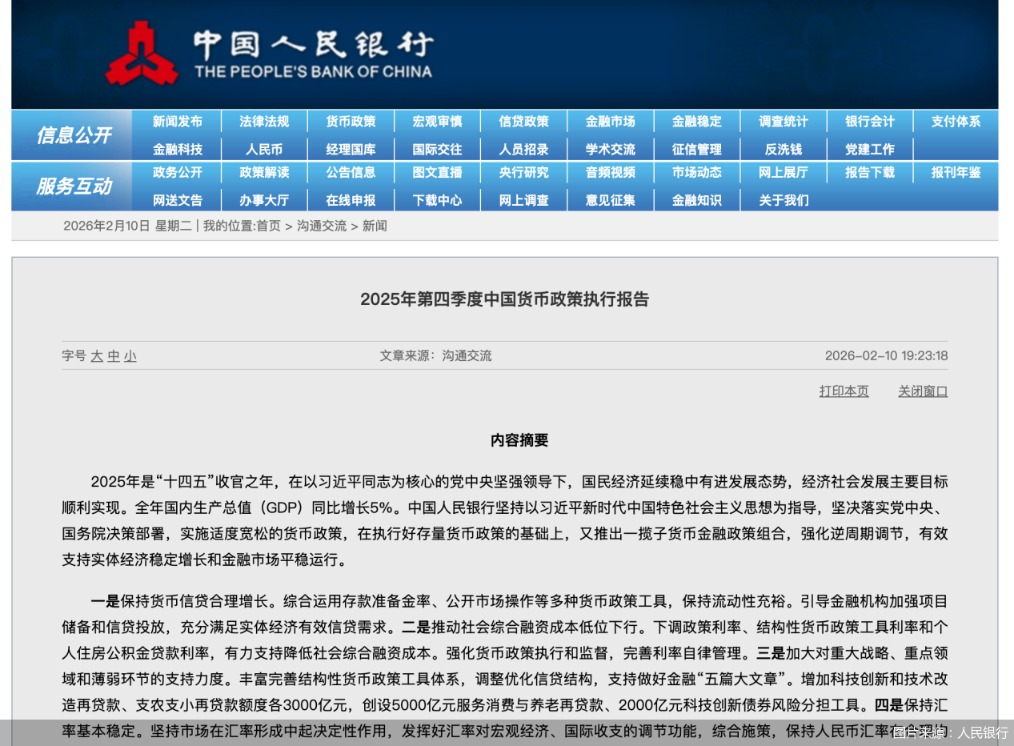
央行:灵活高效运用降准降息等多种政策工具,引导金融总量合理增长、信贷均衡投放
Xin Lang Cai Jing· 2026-02-10 11:51
Core Viewpoint - The Chinese economy is expected to maintain a steady growth trajectory, with a GDP growth rate of 5% in 2025, supported by a moderately loose monetary policy and effective financial measures to stabilize the economy and financial markets [1]. Monetary Policy Measures - The People's Bank of China (PBOC) aims to maintain reasonable growth in money and credit by utilizing various monetary policy tools, ensuring ample liquidity to meet the effective credit demands of the real economy [2]. - The PBOC plans to lower social financing costs by reducing policy interest rates and other related rates, thereby supporting the overall financing environment [2]. - There will be increased support for major strategic areas and weak links, with specific allocations such as 300 billion yuan for technology innovation and agricultural loans, and 500 billion yuan for consumer and elderly care loans [2]. - The PBOC will ensure the stability of the exchange rate, allowing the market to play a decisive role in its formation while maintaining the yuan's stability at a reasonable level [2]. Economic Indicators - By the end of 2025, the total social financing scale and broad money supply (M2) are projected to grow by 8.3% and 8.5% respectively, significantly outpacing nominal GDP growth [3]. - The growth rate of loans, after adjusting for local government debt impacts, is expected to be around 7%, indicating strong credit support [3]. - The average interest rates for new corporate loans and personal housing loans are projected to be around 3.1% [3]. - Various loan categories, including technology, green, inclusive, elderly care, and digital economy loans, are expected to see double-digit growth rates, with technology loans growing by 11.5% and green loans by 20.2% [3]. External Economic Environment - The global economic landscape is facing challenges such as insufficient growth momentum, increased trade barriers, and divergent economic performances among major economies, leading to uncertainties in inflation and monetary policy adjustments [4]. - Despite these challenges, China's economic foundation remains strong, with advantages and resilience that support long-term positive trends [4]. Future Policy Directions - The PBOC will continue to implement a moderately loose monetary policy, focusing on stabilizing economic growth and ensuring reasonable price recovery [5]. - There will be a flexible approach to using various policy tools to maintain liquidity and support balanced credit distribution, aligning social financing and money supply growth with economic growth and price expectations [5]. - The PBOC aims to enhance its macro-prudential management and financial stability frameworks to prevent systemic financial risks [6].
货币政策工具更加精准有力
Jing Ji Ri Bao· 2026-01-18 22:18
Core Viewpoint - The People's Bank of China (PBOC) has implemented a series of monetary policy measures to support stable economic growth and financial market stability, with a commitment to continue a moderately accommodative monetary policy in 2026 [1][2]. Monetary Policy Measures - In 2026, the PBOC plans to lower the interest rates of various structural monetary policy tools by 0.25 percentage points to enhance support for key sectors [8][9]. - The PBOC will also increase the quotas for specific loans, including an additional 500 billion yuan for agricultural and small business loans and a 1 trillion yuan quota for private enterprises [9][10]. Financial Data Highlights - By the end of December 2025, the balance of RMB loans reached 271.91 trillion yuan, a year-on-year increase of 6.4% [2]. - The total social financing scale for 2025 was 35.6 trillion yuan, an increase of 3.34 trillion yuan compared to 2024, with a year-on-year growth of 8.3% [2]. - The broad money supply (M2) was 340.29 trillion yuan, growing by 8.5% year-on-year [2]. Loan Structure and Support - In 2025, loans to key areas such as technology, green initiatives, and digital sectors saw significant growth, with increases of 11.5%, 23%, and 14.6% respectively [3]. - Direct financing accounted for 46.9% of the total social financing increment, with net financing from government bonds reaching 13.84 trillion yuan [3][4]. Cost of Financing - The average interest rates for new corporate loans and personal housing loans were around 3.1% in December 2025, reflecting a decline of 2.5 and 2.6 percentage points since the second half of 2018 [4]. - The PBOC has made ten interest rate cuts since mid-2018 to lower overall financing costs [4]. Liquidity Management - In 2025, the PBOC conducted net liquidity injections totaling 6 trillion yuan through various open market operations, including a net purchase of 1.2 trillion yuan in government bonds [5][6]. - The PBOC's operations aim to ensure sufficient liquidity and stable short-term interest rates in the market [5][7]. Support for Private Enterprises - The PBOC announced a 1 trillion yuan re-loan specifically for private enterprises to enhance financial support for small and medium-sized private businesses [10][11]. - The focus on private enterprises reflects their critical role in innovation and employment, with ongoing efforts to improve financing conditions for these businesses [9][10].
央行的货币政策工具主要有哪些
Jin Tou Wang· 2026-01-06 03:46
Core Viewpoint - The central bank's monetary policy tools are categorized into general, selective, and unconventional tools, primarily aimed at regulating market liquidity, influencing interest rates, and subsequently controlling economic growth and inflation [1]. Group 1: General Monetary Policy Tools - These tools, known as the "three major weapons," affect the entire financial market, influencing overall credit scale and money supply [2]. - The reserve requirement ratio refers to the proportion of deposits that financial institutions must hold as reserves with the central bank. An increase in this ratio tightens market liquidity, while a decrease releases liquidity and lowers financing costs for businesses and households [3]. - The rediscount rate is the interest rate at which commercial banks can discount their bills with the central bank. An increase in this rate raises the financing costs for banks, leading them to tighten credit, while a decrease lowers costs and encourages lending [4]. - Open market operations involve the central bank buying and selling securities (such as government bonds) in the financial market to adjust money supply and market interest rates. Buying securities injects funds into the market, while selling them withdraws funds, thus tightening liquidity. This is the most commonly used and flexible monetary policy tool [5]. Group 2: Selective Monetary Policy Tools - These tools are more targeted, primarily regulating credit and funding flows in specific areas [6]. - Consumer credit control involves restrictions on down payment ratios and repayment terms for consumer installment purchases, thereby regulating the scale of consumer credit and influencing consumption demand [7]. - Securities market credit control adjusts the margin requirements for margin trading, controlling the scale of credit funds flowing into the securities market to prevent excessive speculation [8]. - Real estate credit control manages the down payment ratios and interest rates for real estate loans issued by financial institutions, regulating the flow of funds into the real estate market and stabilizing prices [9]. Group 3: Unconventional Monetary Policy Tools - These tools are employed when conventional tools become ineffective (e.g., when benchmark interest rates approach zero) to address special economic conditions [10]. - Quantitative easing (QE) involves the central bank purchasing large amounts of government bonds and mortgage-backed securities to inject liquidity into the market, lowering long-term interest rates and stimulating economic recovery. Conversely, quantitative tightening (QT) involves reducing or halting reinvestment in maturing bonds or directly selling assets to withdraw liquidity from the market and tighten money supply [11]. - Forward guidance is a strategy where the central bank publicly communicates the future direction of monetary policy (e.g., maintaining interest rates for a certain period) to guide market expectations and stabilize investment and consumption behaviors of economic entities [12].
三季度中国货币政策执行报告发布——适度宽松的货币政策持续发力
Ren Min Ri Bao Hai Wai Ban· 2025-11-14 07:16
Core Viewpoint - The People's Bank of China (PBOC) has released the monetary policy execution report for Q3 2025, highlighting the effectiveness of its counter-cyclical monetary policy measures in supporting economic recovery and stabilizing financial markets [1] Monetary Policy Implementation - The PBOC has maintained a moderately loose monetary policy, leading to a rapid growth in financial totals and an optimized credit structure, effectively supporting key areas and strategic economic transformations [2] - Various monetary policy tools, including open market operations and medium-term lending facilities, have been employed to ensure ample liquidity and meet the effective credit demands of the real economy [2][3] - The social financing cost has decreased, with a market-oriented interest rate adjustment framework in place, resulting in lower deposit and loan rates [2] - The PBOC has focused on optimizing the credit structure by utilizing specific re-lending quotas for consumption and elderly care, as well as supporting technological innovation and transformation [2][4] Financing Structure Optimization - The financing structure has been continuously optimized, with significant year-on-year growth in various loan categories, including technology loans (11.8%), green loans (22.9%), and loans for the elderly industry (58.2%) [4] - The PBOC has implemented structural monetary policies to enhance financial services for economic adjustments and high-quality development, supporting rural revitalization and regional coordinated development [4] Policy Execution and Transmission - The report emphasizes the continuation of a moderately loose monetary policy and the importance of enhancing the execution and transmission of monetary policy [5][7] - There is a renewed focus on consumer finance support and the transmission mechanisms of policies, with detailed discussions on the monetary policy framework [6] Future Outlook - The PBOC plans to maintain a relatively loose social financing condition while continuing to refine the monetary policy framework and enhance the execution and transmission of policies [7] - The aim is to align the growth of social financing and money supply with economic growth and price level expectations, ensuring a suitable monetary financial environment [7]
央行:前三季度GDP同比增长5.2%,下阶段将保持金融总量合理增长
Qi Huo Ri Bao· 2025-11-11 10:20
Core Insights - The People's Bank of China (PBOC) has implemented a moderately accommodative monetary policy to support economic recovery and stabilize financial markets, with GDP growth of 5.2% year-on-year in the first three quarters of the year [1] Group 1: Monetary Policy Implementation - The PBOC is maintaining reasonable growth in money and credit by utilizing various monetary policy tools such as open market operations and medium-term lending facilities to ensure ample liquidity [1] - The central bank aims to reduce the overall financing costs in society by enhancing the market-oriented interest rate adjustment framework, leading to a decline in deposit and loan interest rates [1] - The PBOC is optimizing the credit structure by utilizing 500 billion yuan for consumer services and elderly care re-lending, as well as increasing funding for technological innovation and transformation [1] Group 2: Exchange Rate Stability - The PBOC emphasizes maintaining basic stability of the exchange rate, allowing the market to play a decisive role in exchange rate formation while ensuring the exchange rate's regulatory function on the macroeconomy and international balance of payments [2] Group 3: Risk Management - The PBOC is focused on steadily resolving financial risks in key areas and improving the financial risk monitoring, assessment, and early warning systems [3] - The central bank plans to maintain reasonable growth in financial aggregates and implement a moderately accommodative monetary policy, ensuring that social financing conditions remain relatively loose [3] - The PBOC will closely monitor changes in the monetary policies of major overseas central banks and strengthen analysis and monitoring of liquidity supply and demand in the banking system [3]
央行发布最新货币政策执行报告
2 1 Shi Ji Jing Ji Bao Dao· 2025-11-11 10:02
Core Viewpoint - The People's Bank of China (PBOC) has implemented a moderately accommodative monetary policy in 2023, ensuring ample liquidity and creating a favorable monetary environment for economic recovery and financial market stability [1][2] Summary by Relevant Sections Monetary Policy Implementation - The PBOC has utilized various monetary policy tools, including open market operations, medium-term lending facilities, and re-lending, to maintain sufficient liquidity and support the effective credit demand of the real economy [1] - The report emphasizes the importance of improving the efficiency of fund utilization and enhancing the quality of services provided to the real economy [1] Financing Costs and Interest Rates - A market-oriented interest rate adjustment framework has been established to lower the overall financing costs in society, with new corporate and personal housing loan rates decreasing by approximately 40 and 25 basis points year-on-year, respectively [2] - The broad money supply (M2) increased by 8.4% year-on-year as of the end of September, indicating a reasonable growth in financial volume [2] Credit Structure Optimization - The PBOC has allocated 500 billion yuan for re-lending to support consumption and elderly care, along with additional funds for technological innovation and transformation [1] - The report highlights the ongoing optimization of the credit structure, with a focus on boosting consumption and technological innovation [1][2] Exchange Rate Stability - The PBOC aims to maintain basic stability of the exchange rate, allowing the market to play a decisive role in its formation while ensuring that the exchange rate serves as a regulator for the macroeconomy and international balance of payments [1] - As of the end of September, the RMB appreciated by 1.2% against the US dollar compared to the end of the previous year [2] Risk Prevention and Financial Stability - The PBOC is focused on systematically addressing financial risks in key areas and enhancing the monitoring, assessment, and early warning systems for financial risks [2] - The effectiveness of counter-cyclical monetary policy adjustments is gradually becoming evident, contributing to the overall stability of the financial system [2]
央行发布2025年第三季度中国货币政策执行报告
清华金融评论· 2025-11-11 09:59
Core Viewpoint - The People's Bank of China (PBOC) emphasizes the implementation of a moderately loose monetary policy to support economic recovery and stability in the financial market, guided by Xi Jinping's leadership and the principles of socialism with Chinese characteristics [5][8]. Summary by Sections Economic Performance - In the first three quarters of the year, China's GDP grew by 5.2% year-on-year, demonstrating resilience and vitality amid pressures [5][6]. Monetary Policy Implementation - The PBOC has maintained reasonable growth in money and credit by utilizing various tools such as open market operations and medium-term lending facilities to ensure ample liquidity [6][7]. - The bank aims to reduce the overall financing costs in society by enhancing the market-oriented interest rate adjustment framework, leading to a decline in both corporate and personal loan rates [6][7]. Credit Structure Optimization - The PBOC is focusing on optimizing the credit structure by utilizing specific loan quotas for consumption, elderly care, and technological innovation, thereby supporting key areas of domestic demand [6][7]. Exchange Rate Stability - The PBOC is committed to maintaining a stable exchange rate, allowing the market to play a decisive role in its formation while ensuring the RMB remains stable against the USD [6][7]. Risk Management - The PBOC is actively working to mitigate financial risks in key areas and is enhancing its risk monitoring and assessment systems [6][8]. Future Outlook - Despite external uncertainties and challenges, the PBOC remains confident in the long-term positive trends of the Chinese economy and plans to deepen financial reforms and promote high-level opening-up [8][9].
下一阶段货币政策主要思路,央行最新披露
Di Yi Cai Jing· 2025-11-11 09:43
Core Viewpoint - The People's Bank of China (PBOC) has implemented a moderately accommodative monetary policy in 2023, aiming to create a favorable monetary environment for economic recovery and financial market stability [1][2]. Monetary Policy Implementation - The PBOC has maintained reasonable growth in money and credit by utilizing various monetary policy tools such as open market operations and medium-term lending facilities to ensure ample liquidity [1][2]. - The central bank aims to reduce the overall financing costs in society by enhancing the market-oriented interest rate adjustment framework, leading to a decline in both deposit and loan rates [1][2]. - The PBOC is focusing on optimizing the credit structure by utilizing 500 billion yuan for consumption and pension-related loans, as well as increasing support for technology innovation and transformation [1][3]. Exchange Rate Stability - The PBOC emphasizes maintaining basic stability in the exchange rate, allowing the market to play a decisive role in its formation while ensuring it serves as a stabilizer for the macro economy and international balance of payments [1][4]. Financial Risk Management - The central bank is committed to systematically addressing financial risks by enhancing monitoring, assessment, and early warning systems for key financial sectors [2][6]. - The PBOC plans to maintain reasonable growth in financial aggregates and ensure that social financing conditions remain relatively loose, adapting to changes in the economic and financial landscape [2][6]. Financial Market Development - The PBOC is focused on accelerating the development of the bond market, particularly for technology enterprises, and enhancing the legal framework for corporate bonds [5]. - The central bank aims to promote the internationalization of the renminbi and expand its use in cross-border trade and investment [5].
央行:将降低银行负债成本,推动社会综合融资成本下降
Sou Hu Cai Jing· 2025-11-11 09:23
Core Viewpoint - The People's Bank of China (PBOC) has implemented a moderately accommodative monetary policy in 2023, aiming to create a favorable monetary environment for economic recovery and financial market stability [1][2][3] Summary by Sections Monetary Policy Implementation - The PBOC has maintained ample liquidity through various monetary policy tools, including open market operations and medium-term lending facilities, to support the effective credit demand of the real economy [1][2] - The report indicates a year-on-year growth of 8.7% in social financing scale and 8.4% in broad money supply (M2) as of September, with the RMB loan balance reaching 270.4 trillion yuan [2] Financing Costs and Credit Structure - The PBOC has worked to lower the overall financing costs in society, with new corporate and personal housing loan rates decreasing by approximately 40 and 25 basis points year-on-year, respectively [2] - The PBOC is focusing on optimizing the credit structure by utilizing 500 billion yuan for consumption and pension-related loans, as well as increasing the quota for technological innovation and transformation loans [1][3] Exchange Rate Stability - The PBOC aims to maintain the RMB exchange rate stability by allowing the market to play a decisive role in its formation and implementing measures to stabilize expectations [1][3] - As of September, the RMB appreciated by 1.2% against the US dollar compared to the end of the previous year [2] Future Monetary Policy Directions - The PBOC plans to continue its moderately accommodative monetary policy, ensuring that social financing conditions remain relatively loose while enhancing the monetary policy framework [3] - The focus will be on promoting reasonable price recovery and maintaining the RMB exchange rate at a reasonable equilibrium level [3]