冰洗产品

Search documents
海信家电:公司信息更新报告:2025年内销市场承压,外销稳中向好态势持续-20260401
KAIYUAN SECURITIES· 2026-04-01 08:24
Investment Rating - The investment rating for Hisense Home Appliances is maintained at "Buy" [1] Core Views - The domestic sales market is under pressure in 2025, while the overseas sales show a steady improvement. The company is expected to achieve revenue of 879.3 billion yuan in 2025, a year-on-year decrease of 5.2%, with a net profit attributable to the parent company of 31.9 billion yuan, down 4.8% [1] - The company has adjusted its profit forecasts for 2026-2027 and added a new forecast for 2028, expecting net profits of 32.1 billion yuan, 35.3 billion yuan, and 38.2 billion yuan for 2026, 2027, and 2028 respectively [1] - The company maintains a good profitability despite rising raw material prices, and the overseas business continues to perform well [1] Financial Performance Summary - In 2025, the HVAC business generated revenue of 388.3 billion yuan, down 3.6%, with a gross margin of 27.4%, a decrease of 2.1 percentage points. The company holds over 23% market share in the central air conditioning sector [2] - The ice washing business achieved revenue of 312.0 billion yuan, an increase of 1.2%, with a gross margin of 17.6%, up 1.1 percentage points. The retail market share for Hisense refrigerators reached 17.0% [2] - Domestic revenue was 454.1 billion yuan, down 5.4%, primarily due to the low prosperity of the domestic real estate industry and price wars. In contrast, overseas revenue was 379.2 billion yuan, up 6.4%, with significant growth in various regions [2] Profitability and Cost Structure - The overall gross margin for 2025 was 21.3%, an increase of 0.5 percentage points, while the expense ratio rose to 16.7%, up 0.7 percentage points. The net profit margin for 2025 was 5.4%, a slight decrease of 0.1 percentage points [3] - In Q4 2025, the gross margin improved to 22.3%, while the expense ratio increased to 19.5%, leading to a net profit margin of 4.0% [3] - The company implemented a dividend of 1.75 billion yuan in 2025, accounting for 54.9% of the annual net profit attributable to the parent company [3] Financial Projections - Revenue projections for 2026-2028 are as follows: 94.4 billion yuan in 2026, 99.9 billion yuan in 2027, and 105.9 billion yuan in 2028, with corresponding net profits of 32.1 billion yuan, 35.3 billion yuan, and 38.2 billion yuan [4] - The expected EPS for 2026, 2027, and 2028 are 2.31 yuan, 2.55 yuan, and 2.76 yuan respectively, with the current P/E ratios at 11.9, 10.8, and 10.0 times [4]
海信家电(000921):营收阶段回落,毛销差同比提升
Changjiang Securities· 2026-04-01 06:52
Investment Rating - The investment rating for the company is "Buy" and is maintained [12]. Core Insights - In 2025, the company achieved operating revenue of 87.928 billion yuan, a year-on-year decline of 5.19%. The net profit attributable to shareholders was 3.187 billion yuan, down 4.82% year-on-year, and the net profit after deducting non-recurring gains and losses was 2.445 billion yuan, a decrease of 6.18% year-on-year. In Q4 2025, the company reported operating revenue of 16.396 billion yuan, a year-on-year decline of 26.03%, with a net profit of 375 million yuan, down 32.46% year-on-year, and a net profit after deducting non-recurring gains and losses of 118 million yuan, a decrease of 62.79% year-on-year. The company plans to distribute a cash dividend of 12.65 yuan per 10 shares (including tax), corresponding to a dividend payout ratio of 54.95% [2][6]. Summary by Sections Revenue Performance - The company's revenue declined by 5.19% in 2025, with specific segments showing varied performance: HVAC revenue decreased by 3.61%, while washing machines and refrigerators saw growth of 1.16% and 6.48%, respectively. Domestic sales fell by 5.38%, but international sales increased by 6.44%. Notably, the European market for white goods grew by 22%, with refrigerators up 15% and washing machines up 38% [12]. Profitability Metrics - The gross margin improved by 0.53 percentage points year-on-year. However, the HVAC segment's gross margin decreased by 1.12 percentage points due to intensified domestic competition and rising copper prices. The overall operating profit declined by 4.06% year-on-year, with a slight increase in operating profit margin of 0.05 percentage points [12]. Future Outlook - The company is expected to enhance its brand synergy and supply chain optimization to achieve efficiency improvements. It aims to expand into automotive compressors and comprehensive thermal management systems while strengthening its overseas market presence. Projected net profits for 2026, 2027, and 2028 are 3.224 billion yuan, 3.395 billion yuan, and 3.641 billion yuan, respectively, with corresponding price-to-earnings ratios of 9.18, 8.72, and 8.13 [12].
海信家电(000921):公司信息更新报告:2025年内销市场承压,外销稳中向好态势持续
KAIYUAN SECURITIES· 2026-04-01 05:48
Investment Rating - The investment rating for Hisense Home Appliances is maintained at "Buy" [1] Core Views - The domestic sales market is under pressure in 2025, while the overseas sales show a steady improvement. The company is expected to achieve revenue of 87.93 billion yuan in 2025, a year-on-year decrease of 5.2%, with a net profit attributable to the parent company of 3.19 billion yuan, down 4.8% [1] - The company has adjusted its profit forecasts for 2026-2027 and added a new forecast for 2028, expecting net profits of 3.21 billion yuan, 3.53 billion yuan, and 3.82 billion yuan for 2026-2028, respectively [1] - The company maintains a good profitability despite rising raw material prices, and the overseas business continues to perform well [1] Financial Performance - In 2025, the HVAC business generated revenue of 38.83 billion yuan, down 3.6%, with a gross margin of 27.4%, a decrease of 2.1 percentage points [2] - The ice washing business achieved revenue of 31.20 billion yuan, an increase of 1.2%, with a gross margin of 17.6%, up 1.1 percentage points [2] - The company’s total revenue from domestic sales was 45.41 billion yuan, down 5.4%, while overseas revenue reached 37.92 billion yuan, up 6.4% [2] Profitability Metrics - The overall gross margin for 2025 was 21.3%, an increase of 0.5 percentage points, while the expense ratio rose to 16.7%, up 0.7 percentage points [3] - The net profit margin for 2025 was 5.4%, a slight decrease of 0.1 percentage points [3] - The company implemented a dividend of 1.75 billion yuan in 2025, accounting for 54.9% of the net profit attributable to the parent company [3] Valuation Metrics - The projected earnings per share (EPS) for 2026-2028 are 2.31 yuan, 2.55 yuan, and 2.76 yuan, respectively, with corresponding price-to-earnings (P/E) ratios of 11.9, 10.8, and 10.0 [4] - The company’s return on equity (ROE) is expected to decline from 26.5% in 2025 to 17.7% in 2028 [4] - The price-to-book (P/B) ratio is projected to decrease from 2.5 in 2025 to 1.5 in 2028 [4]
海尔智家20260129
2026-01-30 03:11
Summary of Conference Call for Haier Smart Home Company Overview - **Company**: Haier Smart Home - **Industry**: Home Appliances Key Points 1. Recent Performance - Haier reported a small single-digit growth globally in December and Q4, with domestic performance being weaker and overseas performance slightly better [2][3] - The company is focusing on efficiency and user experience improvements for 2025 [2] 2. Product and Market Strategy - Emphasis on enhancing product strength, digital inventory, and marketing transformation [3] - The operational efficiency is described as stable, with a focus on brand upgrading and market strength [3] 3. Air Conditioning Segment - For 2026, the internal target for air conditioning revenue is set for double-digit growth, with a strong performance in installation services showing over 30% growth in 2025 [4][7] - The company plans to manage raw material cost increases through hedging and operational efficiencies [5][6] 4. Casarte Brand Performance - Casarte is expected to achieve double-digit growth in 2025, with high internal targets for 2026 [7][9] - The brand is focusing on product upgrades and expanding its urban experience centers to enhance channel effectiveness [8] 5. Domestic Market Dynamics - The company will not engage in price wars but will focus on enhancing its competitive strength [10][11] - The domestic market is facing pressure, with a noted decline in the industry [11] 6. North American Market Outlook - The North American market is expected to perform better than the industry average in 2026, with ongoing adjustments to supply chains to mitigate tariff impacts [11][12] - Profitability in North America is projected to improve compared to 2025 [13] 7. European Market Expectations - Positive feedback from internal assessments suggests improved efficiency and product pricing in Europe for 2026 [14][15] 8. Emerging Markets Growth - Emerging markets, particularly in Southeast Asia, are expected to maintain over 20% growth in 2025, with a target of triple-digit growth for 2026 [16][17] - The company is enhancing local management capabilities and product support in these regions [17][18] 9. Cost Reduction Initiatives - Digital transformation and supply chain cost reductions are ongoing, with expectations for continued improvements in profit margins [19][20] 10. Capital Expenditure Plans - Capital expenditure for 2026 is expected to be slightly higher than in 2025, with a focus on overseas supply chain development [22] 11. Dividend Policy - The company aims for a stable increase in dividends, targeting over 50% for the upcoming year [23] 12. 2026 Financial Guidance - Revenue growth is projected to be in the mid-single digits, with profit growth expected to be in the high single digits to low double digits [25] 13. Overall Company Outlook - Haier Smart Home is characterized as a stable and responsible leader in the home appliance sector, with a favorable valuation compared to historical levels [27] Additional Notes - The conference highlighted the company's commitment to maintaining growth and efficiency while navigating market challenges and opportunities [26][28]

格力电器:公司稳步推进多元化战略
Zheng Quan Ri Bao Wang· 2026-01-08 14:13
Group 1 - The company owns three major consumer brands: Gree, TOSOT, and Jinghong, along with industrial brands such as Lingda, Kaibang, and Xinyuan, covering both consumer goods and industrial equipment sectors [1] - The consumer appliance segment is primarily supported by the air conditioning business, which includes a range of products such as refrigeration, washing machines, kitchen appliances, and environmental appliances [1] - The industrial products and equipment segment focuses on smart equipment, industrial robots, compressors, motors, and molds, indicating a diverse industrial strategy [1] Group 2 - The company is committed to a diversified strategy based on core technology and market demand, continuously optimizing its industrial layout [1]

美的、海尔、海信、TCL,一场决定未来十年命运的战争
虎嗅APP· 2026-01-02 09:36
Core Viewpoint - The Chinese home appliance industry is at a critical juncture, with the focus shifting towards international expansion as domestic markets reach saturation. The theme for 2026 is "going abroad," which represents a significant opportunity for companies like Haier, Midea, Hisense, and TCL to explore new markets and alleviate overcapacity issues [7]. Group 1: Overseas Market Potential - The global home appliance market is valued at nearly 4.5 trillion yuan, indicating substantial overseas market potential. In 2024, Midea and Haier are projected to generate approximately 270 billion yuan each in appliance revenue, translating to a global market share of only about 6% [9]. - Domestic brands have low market shares in most overseas regions, with Midea and Haier struggling to exceed 10% in many markets. In contrast, their competitors like Samsung and LG dominate the market [11]. - The growth strategy for domestic brands hinges on increasing their market share abroad, transitioning from competing with regional brands to facing established global giants [13]. Group 2: Challenges of Past Success - Historically, Chinese home appliance companies have relied on capacity expansion and brand acquisitions for international growth. However, this simplistic growth model is becoming unsustainable, as evidenced by the significant gap between global manufacturing share (over 45%) and retail share (less than 20%) [17]. - The stagnation in overseas revenue for leading companies like Haier and Midea, which has remained around 50% and 42% respectively for the past five years, highlights the need for a shift in strategy [18]. Group 3: Brand and Channel Development - The success of domestic brands in China was due to a strong competitive edge in product, brand, and channel management. However, these strengths have not yet translated effectively to international markets, where brand recognition and channel control remain challenges [23]. - Building brand recognition in mature markets is particularly difficult, as Chinese brands face trust issues despite offering lower prices compared to Japanese and Korean brands [25]. - The reliance on traditional retail channels in overseas markets poses significant barriers, as these channels are often fragmented and dominated by established players [30]. Group 4: Opportunities for Breakthrough - Technological innovation is seen as a key pathway to overcoming brand premium challenges and building core competitiveness. Chinese companies have increased R&D investments, achieving breakthroughs in areas like robotic vacuum navigation technology [33]. - Emerging markets such as Southeast Asia and Latin America present significant growth opportunities due to low penetration rates and a favorable demographic profile. These markets are less saturated, allowing for greater brand establishment potential [43]. - The rise of e-commerce in overseas markets offers a new avenue for brand penetration, enabling companies to reach consumers without the need for extensive physical retail investments [45].



80后“女帅”掌舵海信家电一周年,业绩增速垫底 | BUG
Xin Lang Cai Jing· 2025-11-27 00:47
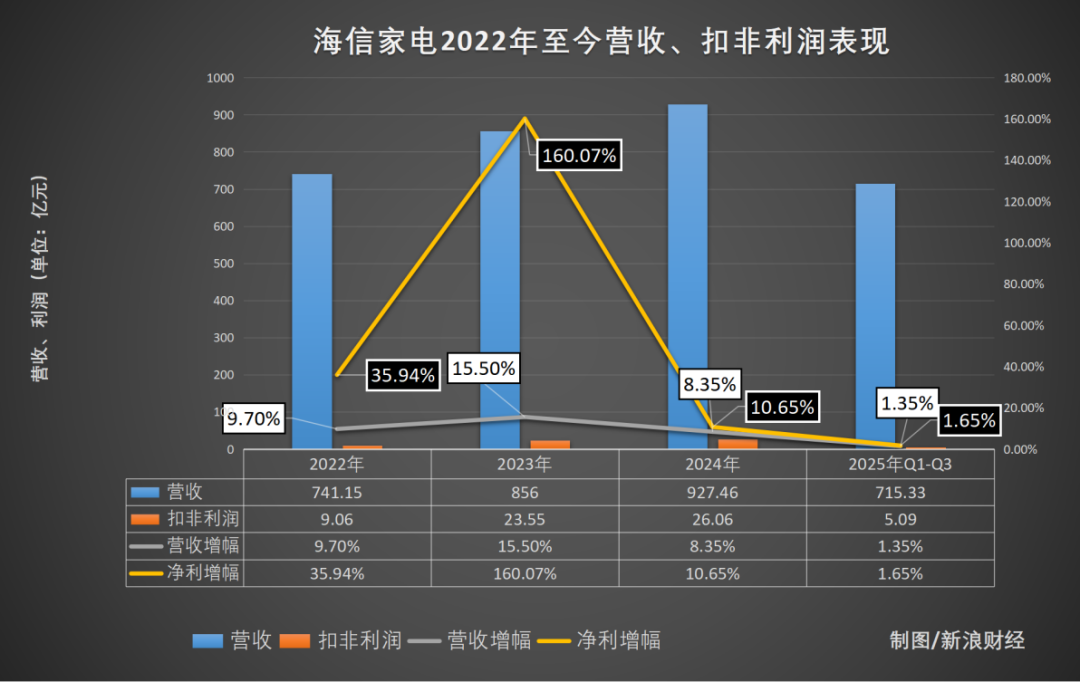
Core Insights - The leadership of Gao Yuling at Hisense Home Appliances has seen a decline in revenue growth and net profit margins, marking the lowest performance in recent years [5][6] - Key executives, including Yin Zhixin, have been promoted or given expanded roles, indicating a strategic shift within the company [3][4] Financial Performance - Revenue growth rates from 2022 to 2025 for the first three quarters are 13.90%, 13.81%, 8.75%, and 1.35%, while the net profit growth rates are 14.10%, 165.99%, 10.99%, and 1.65% [5] - The current performance under Gao Yuling is the worst in nearly four years, attributed to increased competition and price reductions in the domestic appliance market [6] Executive Changes - Gao Yuling was elected as the new chairman on November 21, 2022, following the retirement of the previous chairman [2] - Yin Zhixin has been promoted to President of Hisense Group China while still managing the ice-wash business, which has been a significant revenue source [3][4] Market Challenges - The air conditioning segment, a major revenue contributor, has seen a decline in gross margins, with a year-on-year drop of 1.56% [6][7] - The company faces challenges in online sales channels, lagging behind competitors like Gree and Midea, which could impact future market share [7] Strategic Initiatives - Hisense has initiated a restructuring plan to enhance its air conditioning business, including the establishment of a new air conditioning division [7] - Despite these efforts, the effectiveness of the restructuring has yet to be realized, with market share and pricing under pressure [7][8]
80后「女帅」掌舵海信家电一周年,业绩增速垫底 | BUG
Xin Lang Ke Ji· 2025-11-27 00:38
Core Viewpoint - The leadership of Gao Yuling at Hisense Home Appliances has seen a decline in revenue and net profit growth, marking the lowest performance in recent years, amid increasing competition in the domestic home appliance industry [1][7][9]. Leadership Changes - Gao Yuling was elected as the new chairman of Hisense Home Appliances on November 21, 2022, marking the beginning of the "Gao Yuling era" [2]. - Following her appointment, several key personnel changes occurred, including the resignation of former president Hu Jianrong and the departure of board member Zhu Dang [2][3]. - Key figures supporting Gao Yuling, including Yin Zhixin, have been promoted to significant roles within the company, indicating a consolidation of leadership [3][4]. Financial Performance - The financial data from 2022 to the first three quarters of 2025 shows a significant decline in revenue growth and net profit growth, with figures of 13.90%, 13.81%, 8.75%, and 1.35% for revenue growth, and 14.10%, 165.99%, 10.99%, and 1.65% for net profit growth, respectively [6][7]. - This performance represents the lowest growth rates in nearly four years for the company [7]. Business Segment Analysis - The ice washing business, previously led by Yin Zhixin, has shown strong performance with revenues of 26.07 billion, 30.84 billion, and 15.39 billion for 2023, 2024, and the first half of 2025, respectively, reflecting year-on-year growth rates of 22.93%, 18.29%, and 4.76% [5]. - In contrast, the air conditioning segment, which is the largest revenue source, has seen much lower growth rates of 12.02%, 4.22%, and 4.07% during the same periods [5]. Market Challenges - The home appliance industry is experiencing intensified competition, leading to price reductions in high-margin products like air conditioners, which has negatively impacted Hisense's revenue and profit [9][10]. - The company's air conditioning products have faced a decline in gross margin, with a year-on-year decrease of 1.56% reported for the first half of the year [10]. - Despite efforts to restructure and enhance market competitiveness, the effectiveness of these initiatives has yet to be realized, as indicated by the declining market share in both online and offline channels [11].
海尔智家20251120
2025-11-24 01:46
Summary of Haier Smart Home Conference Call Company Overview - **Company**: Haier Smart Home - **Date**: October 2025 Key Points Industry Performance - In October, Haier Smart Home achieved growth in both domestic and international markets, with performance skewed towards the left of the median, indicating resilience compared to the overall industry [2][4] - The company reported a double-digit growth in Q3 2025, while the industry faced a double-digit decline [3] Domestic Market Insights - The domestic market showed strong resilience, outperforming the overall industry, with significant revenue and profit growth driven by improved product, channel, and marketing efficiencies [3][4] - Key product categories such as air conditioners and water products performed better than washing machines [4] Strategic Initiatives - To counter the high base effect from the 2024 national subsidy policy, Haier Smart Home enhanced product competitiveness and implemented digital inventory reforms to improve overall efficiency [2][4] - The company is focusing on product structure optimization and iterative upgrades to maintain competitiveness amid subsidy reductions [7][8] Pricing Strategy - The company is managing pricing strategies by considering market competition and avoiding vicious price competition, ensuring profit margins are protected [2][9] - Despite an increase in average prices due to national subsidy impacts, the company has implemented self-supplement measures within strict profit assessment limits [6][8] Future Expectations - For 2026, the company anticipates the continuation of national subsidy policies, albeit with potential changes in amount and scope. The company aims to maintain a double-digit growth target regardless of subsidy status [10][11] - The company is optimistic about achieving higher-end revenue growth and maintaining double-digit profit growth in 2026 [11] Export Performance - In October, exports to emerging markets outperformed those to developed countries, indicating a positive outlook for future growth [12] Macro-Economic Considerations - Despite uncertainties in the macroeconomic environment, including domestic policies and geopolitical factors, the company plans to seize growth opportunities by enhancing efficiency and market share [13] Overall Confidence - The company expresses confidence in its performance planning for 2026, focusing on both domestic and international market strategies to improve profitability and market presence [13]
美的集团11月20日全情报分析报告:「美的在泰国布局全球化」对股价有积极影响
36氪· 2025-11-20 13:30
Core Viewpoint - Midea Group is actively expanding its global presence, particularly in Thailand, by establishing a new Asia-Pacific headquarters and the first overseas air conditioning lighthouse factory, which is expected to enhance its global competitiveness and attract investor confidence [6][11]. Group 1: Market Performance - On November 20, Midea Group's stock rose by 0.70%, closing at 77.94, with a trading volume of 261,900 shares [4]. - The stock's turnover rate was 0.38%, with a trading value of 2.05 billion, and the total market capitalization reached 598.974 billion [5]. Group 2: Strategic Developments - Midea has signed a strategic cooperation agreement with Prologis and COSCO Shipping to build a green smart supply chain delivery center in Thailand, which will optimize supply chain management and reduce costs [6][11]. - The company operates seven manufacturing bases in Thailand and aims to achieve over 10% market share in washing machines and the second position in refrigerators by 2024 [6][11]. Group 3: Sentiment Analysis - As of November 20, there were 878 pieces of online sentiment information related to Midea's expansion, with 70% being positive, indicating a strong favorable public perception [7]. - The primary dissemination channel for this information was WeChat, accounting for 19.36% of the total [9]. Group 4: Impact Analysis - Midea's global expansion and supply chain optimization are expected to positively influence its stock price and investor confidence in the company's growth potential [11][12]. - The planned construction of the smart manufacturing technology park in Thailand in 2024 signifies Midea's commitment to enhancing its technological capabilities and market competitiveness [12]. Group 5: Professional Opinions - Analysts from Shenwan Hongyuan view Midea as a leading white goods manufacturer with attributes of low valuation, high dividends, and stable growth, suggesting a positive long-term outlook [18]. - Zhongtai Securities expresses a neutral stance, noting short-term performance pressures but potential for growth as industry conditions improve [19].