
华泰柏瑞中证韩交所中韩半导体ETF

Search documents
油价走高催化,多只油气ETF涨超7.5%丨ETF晚报
2 1 Shi Ji Jing Ji Bao Dao· 2026-02-24 09:03
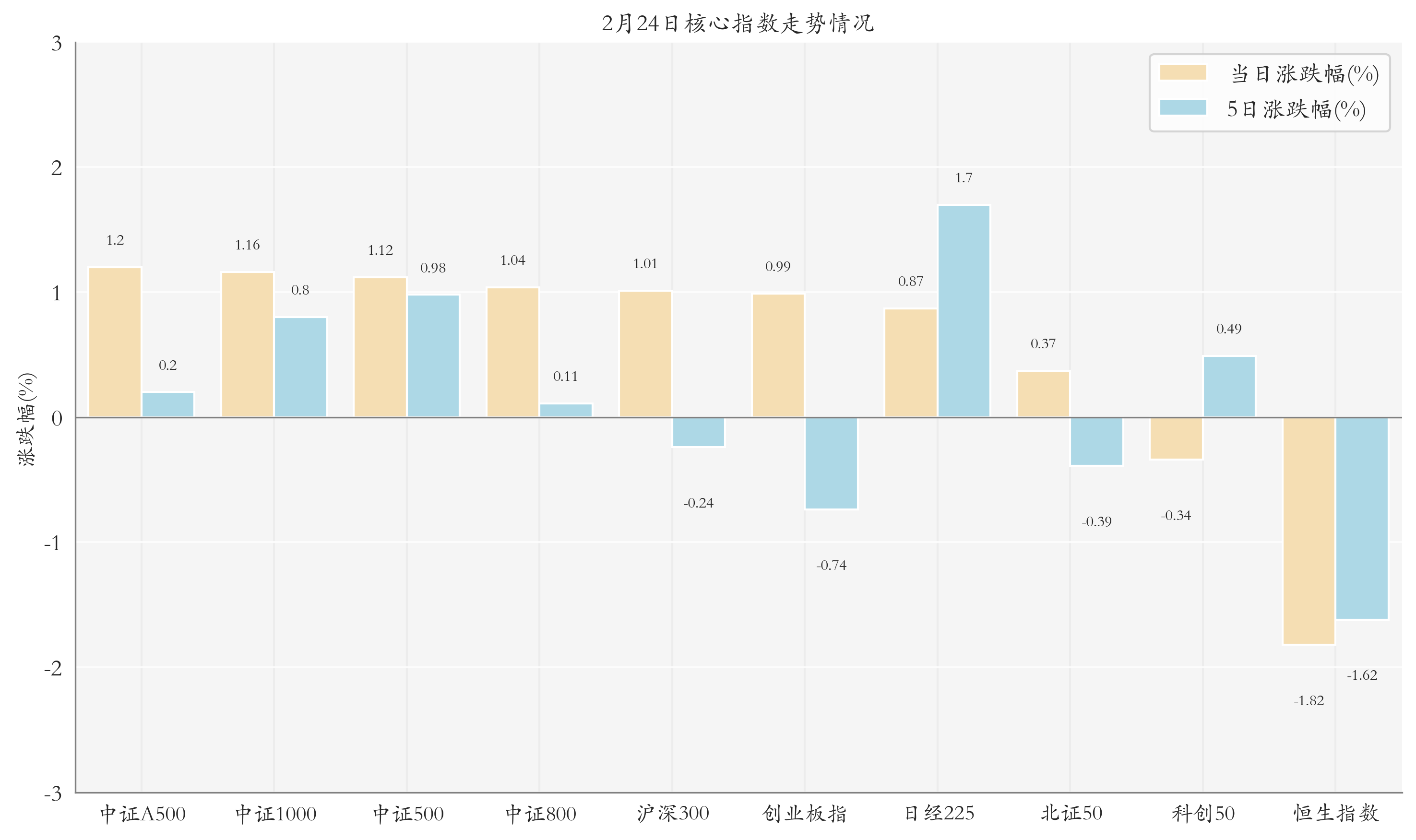
ETF Industry News - The three major indices collectively rose, with oil and gas ETFs leading the gains. The Shanghai Composite Index increased by 0.87%, the Shenzhen Component Index by 1.36%, and the ChiNext Index by 0.99%. Notably, oil and gas ETFs such as Yinhua (563150.SH) rose by 9.53%, Bosera (561760.SH) by 8.42%, and Huatai-PB (159309.SZ) by 7.72% [1][4][13] - Concerns over reduced oil and gas supply due to geopolitical conflicts have led to a rise in oil prices. However, the recovery in oil service sector sentiment is expected to take at least six months to materialize [1][4] Fund Performance - A total of 481 funds that reported negative returns last year have turned positive in net value growth this year, with 19 funds showing a difference of over 20 percentage points. The majority of these funds are medium to long-term pure bond funds and mixed equity funds, accounting for 57.1% and 10.6% respectively [2] Storage Industry Insights - SK Hynix has indicated that the global memory chip industry has shifted to a seller's market, with price increases expected to continue throughout 2026. The HuaTai-PB China-Korea Semiconductor ETF has seen a year-to-date increase of 25.65% [3] - Investment opportunities in the semiconductor supply chain, particularly in high-end equipment and key components, are anticipated to be significant in 2026, providing market resilience and certainty [3] Market Overview - The overall performance of ETFs shows that commodity ETFs had the best average daily increase of 3.36%, while cross-border ETFs had the worst performance with an average decline of 0.49% [10] - The top-performing ETFs today included oil and gas ETFs, with significant gains noted for Yinhua, Bosera, and Huatai-PB [13] Trading Activity - The top three ETFs by trading volume were the A500 ETF Fund (512050.SH) with a trading volume of 8.372 billion, A500 ETF Huatai-PB (563360.SH) with 7.928 billion, and the China A500 ETF (159338.SZ) with 6.344 billion [16]

存储价格涨势将贯穿全年!相关ETF年内涨超25%,基金经理看好半导体机会
Sou Hu Cai Jing· 2026-02-23 03:20
Core Viewpoint - The global memory chip industry has shifted to a seller's market, with price increases expected to continue throughout 2026 [2] Group 1: Market Dynamics - SK Hynix reports that DRAM and NAND inventory levels are critically low, with only about 4 weeks of supply remaining, leading to increased bargaining power for suppliers [2] - The demand for memory chips is driven by the surge in AI models and high-performance computing, which exceeds industry expectations [2] - The production capacity for high bandwidth memory (HBM) has been sold out in advance, indicating a significant supply-demand gap [2] Group 2: Financial Performance - SK Hynix's financial report for the fiscal year ending December 31, 2025, shows record-high revenues of 97.1467 trillion KRW and operating profits of 47.2063 trillion KRW, with a profit margin of 49% [3] - The fourth quarter of 2025 saw a revenue of 32.8 trillion KRW and an operating profit of 19.2 trillion KRW, marking a quarter-on-quarter increase of 34% and 68% respectively [3] - The fiscal year 2025 revenue is projected to increase by approximately 30 trillion KRW compared to 2024, with operating profits expected to double [3] Group 3: Investment Opportunities - The Huatai-PB CSI Korea Semiconductor ETF has seen a year-to-date increase of 25.65%, providing investors with a channel to benefit from the rising memory prices [4] - Fund managers express optimism about the semiconductor investment landscape, particularly in high-end equipment and key components related to memory expansion [4][6] - The semiconductor industry is viewed as being in the middle of an innovation cycle, with AI-related capital expenditures expected to remain high through 2026 [5] Group 4: Sector Focus - Investment managers highlight three key areas: domestic computing power, wafer fab expansion, and military semiconductors, with domestic computing power being a core growth driver [6] - The expansion of wafer fabs is expected to benefit from AI demand and supply shortages, creating upward potential for related equipment and materials [6] - The military semiconductor sector is anticipated to see growth driven by increased demand from commercial aerospace and government planning initiatives [6]

ETF 日报 2026.01.28-20260128
天府证券· 2026-01-28 09:09
Report Summary 1. Report Industry Investment Rating No relevant information provided. 2. Core View of the Report The report presents the market performance of A - shares and various ETFs on January 28, 2026, including the performance of the Shanghai Composite Index, Shenzhen Component Index, and ChiNext Index, as well as the price changes and trading volumes of different types of ETFs [2][3][4]. 3. Summary by Related Catalogs Market Overview - The Shanghai Composite Index rose 0.27% to close at 4151.24 points, the Shenzhen Component Index rose 0.09% to close at 14342.89 points, and the ChiNext Index fell 0.57% to close at 3323.56 points. The trading volume of A - shares in the two markets was 29919 billion yuan. The top - performing industries were non - ferrous metals (5.92%), petroleum and petrochemical (3.54%), and coal (3.42%), while the bottom - performing industries were comprehensive (-2.53%), media (-1.77%), and national defense and military industry (-1.68%) [2][6]. Stock ETF - The top - trading - volume stock ETFs included: Huatai - Peregrine CSI 300 ETF, up 0.32% with a discount rate of 0.24%; E Fund CSI 300 ETF, up 0.29% with a discount rate of 0.19%; and China AMC CSI 300 ETF, up 0.27% with a discount rate of 0.18% [3][7]. - The report also provided a table of the top ten stock ETFs by trading volume, showing details such as code, fund name, price, change rate, tracking index, and discount rate [8]. Bond ETF - The top - trading - volume bond ETFs were: Haifutong CSI Short - term Financing Bond ETF, down 0.00% with a discount rate of 0.00%; China AMC Shanghai Stock Exchange Benchmark Market - making Treasury Bond ETF, up 0.04% with a discount rate of 0.03%; and Bosera CSI Convertible and Exchangeable Bond ETF, up 0.99% with a discount rate of 1.22% [4][9]. - A table of the top five bond ETFs by trading volume was presented, including code, fund name, price, change rate, discount rate, and trading volume [10]. Gold ETF - Gold AU9999 rose 3.57% and Shanghai Gold rose 3.27%. The top - trading - volume gold ETFs were: Huaan Gold ETF, up 3.16% with a discount rate of 3.23%; E Fund Gold ETF, up 3.19% with a discount rate of 3.22%; and Bosera Gold ETF, up 3.20% with a discount rate of 3.20% [10]. - A table of the gold ETFs showed details such as code, fund name, price, change rate, trading volume, IOPV, and discount rate [11]. Commodity Futures ETF - Dacheng Non - ferrous Metals Futures ETF rose 0.74% with a discount rate of 0.98%; Jianxin Yisheng Zhengzhou Commodity Exchange Energy and Chemical Futures ETF rose 1.53% with a discount rate of 1.27%; and China AMC Feed Soybean Meal Futures ETF rose 0.76% with a discount rate of 3.92% [11]. - A table provided information on the commodity futures ETFs, including code, fund name, price, change rate, trading volume, IOPV, discount rate, tracking index, and tracking index change rate [12]. Cross - border ETF - The previous trading day, the Dow Jones Industrial Average fell 0.83%, the Nasdaq rose 0.91%, the S&P 500 rose 0.41%, and the German DAX fell 0.15%. On this day, the Hang Seng Index rose 2.58% and the Hang Seng China Enterprises Index rose 2.89%. The top - trading - volume cross - border ETFs were: E Fund CSI Hong Kong Securities Investment Theme ETF, up 0.62% with a discount rate of - 0.43%; Huatai - Peregrine Hang Seng Technology ETF, up 1.88% with a discount rate of 1.56%; and Huatai - Peregrine CSI KRX China - South Korea Semiconductor ETF, up 7.43% with a discount rate of 17.96% [14]. - A table of the top five cross - border ETFs by trading volume was shown [15]. Money ETF - The top - trading - volume money ETFs were: Yin Hua Ri Li ETF, Hua Bao Tian Yi ETF, and Money ETF Jianxin [16]. - A table presented the top three money ETFs by trading volume [17].
全球化资产配置需求提升 QDII基金总规模逼近1万亿元
Zheng Quan Ri Bao· 2026-01-20 16:16
Group 1 - The total scale of QDII funds has reached 970 billion yuan, marking a 59% increase from 610 billion yuan a year ago, and accounts for 2.6% of the total market fund scale [1] - The rapid growth of QDII funds reflects an increasing demand for global asset allocation among investors, despite still being lower than mainstream fund products like equity, bond, and index funds [1] - QDII fund scale has entered a fast growth phase since last year, with significant milestones reached: 610 billion yuan at the beginning of last year, 700 billion yuan in July, 900 billion yuan in September, and currently at 970 billion yuan [1] Group 2 - The performance of QDII funds has shown strong resilience, with 68 products having a net value increase of over 10% this year, particularly in technology-themed products [2] - The main holdings of QDII funds are concentrated in sectors like semiconductors and innovative pharmaceuticals, reflecting high market demand and providing stable support for fund performance [2] - The semiconductor industry's sales have significantly increased since last year, with expectations for continued growth driven by strong demand from AI applications and data center infrastructure [2] Group 3 - The "AI+" sector in healthcare has made significant breakthroughs, with expectations for scaling applications by 2026, enhancing the attractiveness of related sectors [3] - AI technology is gradually being integrated into the entire chain of research, diagnosis, treatment, and management in healthcare, which is expected to further increase interest in this sector [3]
2025年度QDII业绩出炉:最高汇添富香港优势精选涨超112%VS易方达原油跌逾13%(附涨跌榜)
Xin Lang Cai Jing· 2026-01-09 08:36
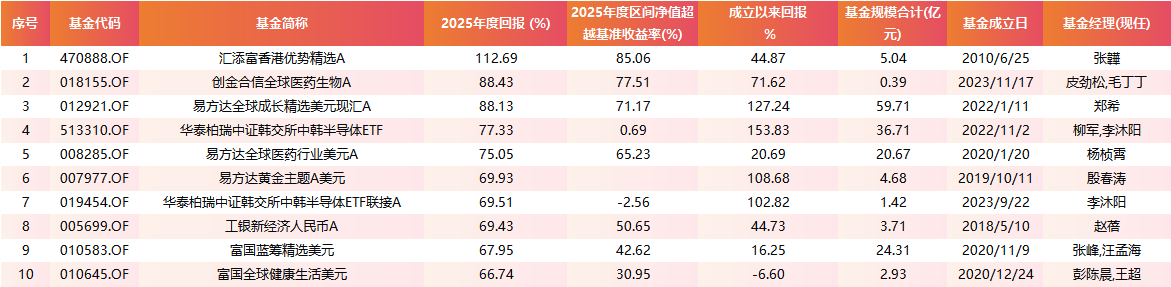
Core Insights - The QDII (Qualified Domestic Institutional Investor) funds have shown significant performance differentiation in 2025, with some funds achieving remarkable returns while others faced substantial losses due to market volatility and sector-specific challenges [1][4][6]. Performance Highlights - The top-performing QDII fund, Huatai-PB Hong Kong Advantage Selection, achieved a return of over 112%, benefiting from the global rise in innovative pharmaceuticals and biotechnology [2][9]. - Other notable funds include China Universal Global Pharmaceutical Biology and E Fund Global Growth Selection, both with returns exceeding 88%, driven by the global pharmaceutical sector's growth [2][9]. - The E Fund Gold Theme QDII also performed well, nearing a 70% return amid global risk aversion and monetary policy adjustments [2][9]. Underperformers - In contrast, several QDII funds focused on oil and real estate faced significant declines, with returns ranging from -10.78% to -13.76% for oil-themed funds like E Fund Oil and Southern Oil [4][11]. - Funds tracking the Saudi Arabian market also struggled, with returns exceeding -12% since their inception in 2024 [4][11]. - Real estate-focused funds, such as Penghua US Real Estate and Nuveen Global Real Estate, reported negative annual returns, reflecting broader market challenges [4][11]. Market Trends - The performance of QDII funds in 2025 highlights the importance of sector-specific trends, with technology and healthcare being key drivers of growth, while traditional cyclical assets like oil and real estate remain sensitive to macroeconomic conditions [6][13]. - The ability to diversify across different asset classes and geographic regions is emphasized as a critical strategy for investors to mitigate risks associated with concentrated investments [6][13].
455只公募基金开年以来净值增长超5% 科技类基金表现最优异
Zheng Quan Ri Bao Wang· 2026-01-06 12:26
Group 1 - In the first two trading days of the year, 455 public funds have seen net value growth exceeding 5%, with several products surpassing 10% [1] - The best-performing products are primarily mixed and equity funds, with a significant focus on technology assets such as semiconductors, digital industries, and healthcare innovation [1] - Specific funds like Huatai Bairui's ETF for Korean semiconductor stocks and Yongying's semiconductor fund have shown impressive returns of 8.21% and 9.27% respectively, ranking them among the top in their categories [1] Group 2 - The current capital market is experiencing a stable upward trend due to liquidity, industrial cycles, and confidence, with A-share core asset valuations significantly lower than overseas markets [2] - Analysts predict that the technology sector will remain a key investment theme through 2026, with high-growth industries like artificial intelligence and semiconductors driving market momentum [2] - There are warnings about potential risks, including the transmission of overseas market risks to domestic markets and the possibility of overvaluation if significant market increases occur without corresponding improvements in macroeconomic conditions [2] Group 3 - Investment potential is seen in aerospace precision guidance and commercial aerospace, along with opportunities in robotics and advanced manufacturing [3] - Analysts recommend focusing on technology and healthcare theme funds, particularly in semiconductors and innovative pharmaceuticals, which have shown strong short-term and long-term returns [3] - The market environment is favorable for innovative industries, suggesting that investors should optimize their allocations to seize growth opportunities [3]
246只ETF获融资净买入 华泰柏瑞沪深300ETF居首
Zheng Quan Shi Bao Wang· 2026-01-06 02:02
Core Viewpoint - As of January 5, the total margin balance for ETFs in the Shanghai and Shenzhen markets reached 117.108 billion yuan, reflecting an increase of 0.258 billion yuan from the previous trading day [1] Group 1: ETF Financing and Margin Balances - The ETF financing balance stood at 109.584 billion yuan, with a slight increase of 0.01 billion yuan compared to the previous trading day [1] - The ETF margin short balance was recorded at 7.524 billion yuan, which increased by 0.248 billion yuan from the previous trading day [1] Group 2: Net Inflows in ETFs - On January 5, a total of 246 ETFs experienced net inflows, with the Huatai-PB CSI 300 ETF leading the pack, attracting a net inflow of 0.319 billion yuan [1] - Other ETFs with significant net inflows included the E Fund CSI Hong Kong Securities Investment Theme ETF, Southern CSI 500 ETF, Guotai CSI Semiconductor Materials and Equipment Theme ETF, Huatai-PB CSI Korea Exchange Korea-China Semiconductor ETF, and others [1]
241只ETF获融资净买入 华泰柏瑞中证韩交所中韩半导体ETF居首
Zheng Quan Shi Bao Wang· 2026-01-05 02:30
Core Viewpoint - As of December 31, 2025, the total margin balance for ETFs in the Shanghai and Shenzhen markets is 116.85 billion yuan, reflecting a decrease of 2.302 billion yuan from the previous trading day [1] Group 1: ETF Margin Balance - The ETF financing balance stands at 109.574 billion yuan, down by 2.276 billion yuan from the previous trading day [1] - The ETF margin short balance is 7.276 billion yuan, which is a decrease of 0.026 billion yuan from the previous trading day [1] Group 2: Net Buy Insights - A total of 241 ETFs experienced net buying on margin, with the Huatai-PB CSI Korea Exchange Korea-China Semiconductor ETF leading with a net buy of 68.9261 million yuan [1] - Other ETFs with significant net buying include the E Fund CSI Hong Kong Securities Investment Theme ETF, E Fund Gold ETF, and the Fuguo CSI Hong Kong Stock Connect Internet ETF [1]
大连商品交易所ETF日报-20251210
天府证券· 2025-12-10 09:27
Report Summary 1. Market Overview - On December 9, 2025, the Shanghai Composite Index fell 0.37% to close at 3909.52 points, the Shenzhen Component Index fell 0.39% to close at 13277.36 points, and the ChiNext Index rose 0.61% to close at 3209.60 points. The trading volume of A-shares in the two markets was 1917.9 billion yuan. The top-performing sectors were comprehensive (3.45%), communication (2.23%), and electronics (0.78%), while the worst-performing sectors were non-ferrous metals (-3.03%), steel (-2.47%), and real estate (-2.10%) [2][6] 2. Stock ETFs - The top-trading-volume stock ETFs on this day were Huatai-PineBridge CSI A500 ETF, which fell 0.56% with a premium rate of -0.56%; China AMC CSI A500 ETF, which fell 0.26% with a premium rate of -0.34%; and Southern CSI A500 ETF, which fell 0.57% with a premium rate of -0.43% [3][7] 3. Bond ETFs - The top-trading-volume bond ETFs were Haifutong CSI Short-term Financing Bond ETF, which rose 0.01% with a premium rate of -0.00%; Southern Shanghai Stock Exchange Benchmark Market-making Corporate Bond ETF, which rose 0.06% with a premium rate of -0.28%; and GF Shanghai Stock Exchange AAA Science and Technology Innovation Corporate Bond ETF, which rose 0.01% with a premium rate of -0.27% [4][9] 4. Gold ETFs - Gold AU9999 fell 0.73% and Shanghai Gold fell 0.67%. The top-trading-volume gold ETFs were Huaan Gold ETF, which fell 0.70% with a premium rate of -0.82%; E Fund Gold ETF, which fell 0.72% with a premium rate of -0.79%; and Bosera Gold ETF, which fell 0.73% with a premium rate of -0.81% [12] 5. Commodity Futures ETFs - Dacheng Non-ferrous Metals Futures ETF fell 2.19% with a premium rate of -1.41%; China AMC Feed Soybean Meal Futures ETF fell 0.46% with a premium rate of 0.77%; and CCB E Fund Zhengzhou Commodity Exchange Energy and Chemical Futures ETF fell 1.40% with a premium rate of -1.33% [13] 6. Cross-border ETFs - The previous trading day, the Dow Jones Industrial Average fell 0.45%, the Nasdaq Index fell 0.14%, the S&P 500 fell 0.35%, and the German DAX rose 0.07%. On this day, the Hang Seng Index fell 1.29% and the Hang Seng China Enterprises Index fell 1.62%. The top-trading-volume cross-border ETFs were E Fund CSI Hong Kong Securities Investment Theme ETF, which fell 2.14% with a premium rate of -2.13%; Huatai-PineBridge CSI KRX China-South Korea Semiconductor ETF, which fell 0.86% with a premium rate of 4.19%; and GF CSI Hong Kong Innovative Drugs ETF, which fell 1.44% with a premium rate of -1.37% [15] 7. Money Market ETFs - The top-trading-volume money market ETFs were Yin Hua Day Profit ETF, Hua Bao Tian Yi ETF, and CCB Tian Yi Money Market ETF [17]
跨境ETF规模逼近9000亿元 两只巴西ETF发行配售比创近5年新低
Zheng Quan Shi Bao· 2025-11-05 21:51
Group 1 - The core point of the article highlights the low subscription ratios of the first two Brazilian ETFs, which are below 12%, marking the lowest since 2021 and reflecting the current trend in cross-border ETF development [1][2][3] - The two Brazilian ETFs, managed by E Fund and Huaxia Fund, have subscription ratios of approximately 11.82% and 11.54% respectively, with total subscription funds exceeding 5 billion yuan [2][3] - The low subscription ratios are attributed to a combination of a relatively low fundraising cap of 300 million yuan and high investor enthusiasm, indicating a strong market interest in these new products [3] Group 2 - The global trend of cross-border ETFs is becoming increasingly evident, with the total number of cross-border ETFs reaching 185 and a combined scale of approximately 897.97 billion yuan as of November 5 [4] - The market has seen a significant increase in cross-border ETFs focusing on emerging markets, particularly in regions like the Middle East and South America, with new products being launched to cater to diverse investor needs [5][6] - The dual-directional flow of funds through cross-border ETFs is emphasized, showcasing the mutual benefits for both domestic and international investors, as seen in the recent ETF interconnectivity initiatives between China and Brazil [7][8]