
国债期权

Search documents
美国债市:国债与股票双双下跌 收益率曲线大幅趋陡
Xin Lang Cai Jing· 2026-01-20 20:57
Core Viewpoint - US Treasury bonds are under pressure, maintaining a downward trend during trading hours, influenced by geopolitical tensions and market risk aversion [1][4]. Group 1: Market Trends - The long end of the US Treasury yield curve steepened, with yields rising by up to 8 basis points compared to the previous trading day [1][4]. - The 2-year/10-year yield spread widened by 6 basis points, while the 5-year/30-year spread increased by 4.5 basis points [1][4]. Group 2: Yield Data - As of 3:05 PM Eastern Time, the yields were reported as follows: 2-year at 3.5947%, 5-year at 3.854%, 10-year at 4.2906%, and 30-year at 4.9179% [3][6]. - The yield spread between 5-year and 30-year bonds was 106.21 basis points, and the spread between 2-year and 10-year bonds was 69.37 basis points [3][6]. Group 3: Trading Activity - Strong demand for 5-year and 10-year Treasury bonds helped prevent a more significant sell-off, with notable purchases totaling approximately $12.5 million/DV01 [5]. - The S&P 500 index fell by about 2%, while gold prices rose nearly 2%, reflecting market reactions to heightened tensions between the US and Europe [5].
量质双升、固本强基 国债期货2025年“压舱石”功能持续凸显
Xin Hua Cai Jing· 2026-01-20 08:14
Core Viewpoint - The development of the government bond futures market in China has shown significant growth in both volume and quality, reinforcing its role as a stabilizer and price discovery anchor in the bond market, amidst a complex global macroeconomic environment in 2025 [1][2]. Market Performance and Structure - Despite experiencing multiple fluctuations in 2025, the trading activity and depth of the government bond futures market have increased, with average daily positions reaching 636,400 contracts, a 29.46% increase from 2024, and average daily trading volume rising by 41.88% to 324,700 contracts [2]. - The trading volume for 30-year government bond futures reached 125,500 contracts, indicating a strong demand for long-term interest rate risk management tools among institutions [2]. - The correlation between government bond futures and corresponding cash bonds remained above 99%, providing a smooth risk exit for market participants during liquidity adjustments [3]. - Institutional participation in the government bond futures market has solidified, with institutions accounting for approximately 80% of trading and 90% of positions by November 2025, indicating a shift towards mainstream asset-liability management tools [3]. Product Ecosystem and Strategic Alignment - The government bond futures market has expanded its product offerings, covering key maturities from 2 to 30 years, and is expected to further develop options products to meet diverse risk management needs [4]. - The introduction of government bond options is anticipated to fill the gap in domestic interest rate options products, enhancing the ability of institutions to manage tail risks [4]. - The government bond futures market has evolved from merely managing risks to supporting macroeconomic policies and financing for the real economy, with increased government bond issuance in 2025 [4][5]. - The use of government bond futures by underwriters has improved their ability to hedge interest rate risks during the bond issuance process, facilitating smoother issuance of government and local bonds [5]. Impact on Financing Costs and Asset Allocation - The growth of the government bond futures market has indirectly reduced financing costs for the real economy, as institutional investors manage interest rate risks, enhancing liquidity and pricing efficiency in the credit bond market [6]. - Various types of long-term funds are increasingly utilizing government bond futures for asset allocation, transitioning from a risk stabilizer to a core component of asset allocation strategies [6][7]. - Insurance funds are leveraging 30-year government bond futures to extend the overall duration of their asset portfolios, addressing the challenge of duration mismatch between assets and liabilities [7]. - Pension funds are using government bond futures for tactical asset allocation, locking in future bond costs and hedging against equity market volatility [7]. - Public funds are employing diverse strategies with government bond futures, enhancing risk-adjusted returns and managing liquidity effectively [7]. Future Outlook - The government bond futures market is expected to continue evolving, with plans to ensure stable and regulated operations, enhance existing products, and broaden the participant base, thereby playing a crucial role in the development of China's capital market [8].
美联储降息预期生变! SOFR交易风向转鹰 资金押注美联储全年按兵不动
Zhi Tong Cai Jing· 2026-01-14 00:24
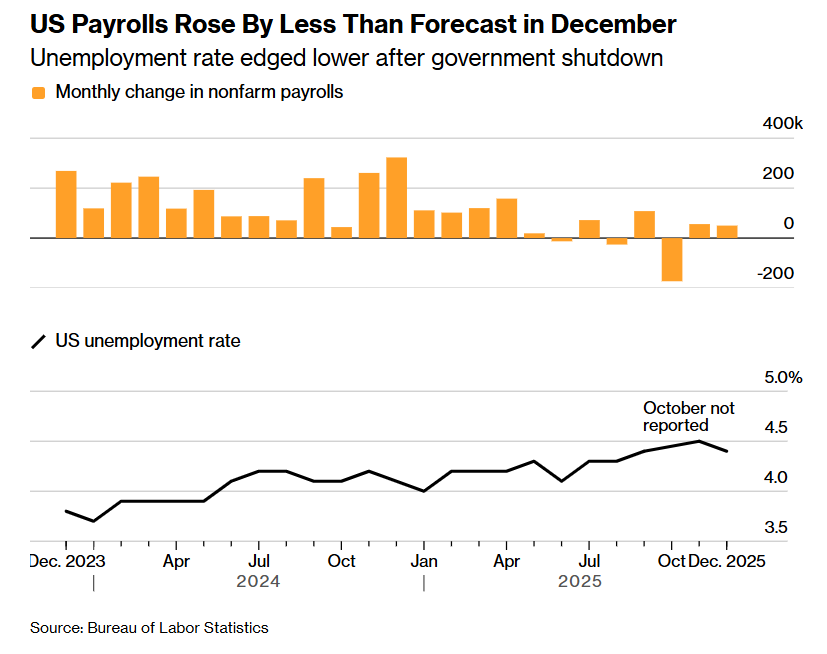
Core Viewpoint - Increasingly, traders focused on options are shifting away from expectations of interest rate cuts by the Federal Reserve in 2026, betting instead that rates will remain unchanged throughout the year, which could yield positive returns if realized [1][2][3]. Group 1: Labor Market and Economic Indicators - The December non-farm payroll data showed a modest increase of 50,000 jobs, slightly below economists' expectations of 60,000, while the unemployment rate unexpectedly dropped from a revised 4.6% in November to 4.4%, indicating a recovery in the labor market [3][5]. - The Challenger, Gray & Christmas report indicated that U.S. companies announced 35,553 job cuts in December, the lowest level since July 2024, alongside plans to add approximately 10,500 new positions, exceeding market expectations [5]. - The ADP Research data also suggested a mild expansion in the job market, with an increase of 41,000 jobs in December, following a significant decline in the previous month [5]. Group 2: Inflation and Federal Reserve Policy - The core Consumer Price Index (CPI) showed a steady decline but remains above the Fed's long-term target of 2%, reducing the urgency for further rate cuts [3][6]. - The CME FedWatch Tool indicated that traders have reduced their expectations for rate cuts in 2026 from three to two, with the first anticipated cut now pushed to June instead of March [2][3]. - The overall sentiment in the market is shifting towards the possibility of the Fed maintaining rates unchanged throughout 2026, as the labor market stabilizes and inflation remains persistent [2][3]. Group 3: Market Sentiment and Trading Strategies - Recent trading activity in SOFR options reflects a more hawkish sentiment, with significant demand for options hedging against the possibility of delayed rate cuts [10][17]. - The concentration of put options at the 96.375 strike price indicates that traders are positioning themselves for a scenario where rates remain high or do not decline further, suggesting a shift in market expectations towards maintaining current rates [17][20]. - The overall structure of SOFR options indicates that traders are increasingly abandoning expectations of significant rate cuts this year, favoring a more prolonged period of stable rates [20][21].

美债多头拥挤,市场屏息以待 “非农大考”
Hua Er Jie Jian Wen· 2025-07-02 06:42
Group 1 - Bond traders have rapidly built long positions in U.S. Treasuries, betting that the upcoming employment report will provide further momentum for the market [1] - The June non-farm payroll report is seen as a significant risk event for long investors, especially after the JOLTS job openings report showed a surprising increase in May, leading to a sell-off in the bond market [1] - Citigroup strategist David Bieber noted that the continued accumulation of long positions has reached a "highly extended" state, indicating potential for a significant pullback if employment data is strong [1] Group 2 - JPMorgan's recent survey indicated that absolute long positions in U.S. Treasuries have risen to the highest level in two weeks, with net long positions increasing by two percentage points [2] - There has been a shift towards bullish options in the Treasury market, with traders willing to pay premiums to hedge against significant price increases rather than declines [2] - Columbia Threadneedle Investment's global rates strategist mentioned that if employment data exceeds expectations, the probability of a rate cut in July could drop to zero [2]
谱写上海衍生品市场高质量发展新篇章
Qi Huo Ri Bao Wang· 2025-05-23 00:59
Core Insights - The Shanghai derivatives market is positioned as a bridge for resource connectivity along the "Belt and Road" initiative, with a focus on high-quality development and international financial center construction [1][2] - The Chinese government and regulatory bodies are actively promoting the development of the Shanghai derivatives market through various policies and collaborative mechanisms [1][2] Group 1: Market Development - The Shanghai derivatives market has made significant progress in expanding product offerings, including the successful listing of options for lead, zinc, tin, and alumina, achieving full coverage of non-ferrous metal options [2] - The market is set to launch futures and options for casting aluminum alloys, indicating ongoing innovation and responsiveness to market needs [2] - The influence of "Shanghai prices" has grown globally, becoming a reference for cross-border trade pricing and attracting more foreign investors [2] Group 2: Regulatory and Strategic Framework - The Chinese government has outlined a clear path for the high-quality development of the Shanghai derivatives market through various regulatory documents and strategic initiatives [1] - The establishment of a collaborative mechanism between the China Securities Regulatory Commission and the Shanghai municipal government aims to enhance the integration of the futures market with national strategies and the real economy [1]
【申万固收|利率专题】一文读懂国债期货及期权研究框架
申万宏源研究· 2025-04-10 01:52
Group 1 - The article discusses the definition and main functions of government bond futures, which are standardized contracts linked to virtual bonds and involve the delivery of actual government bonds [2][8][15] - Since 2013, China has gradually listed various government bond futures contracts, including 2-year, 5-year, 10-year, and 30-year bonds, with participation from securities firms, funds, insurance companies, and banks [4][23][26] - Government bond futures are widely used for hedging, directional trading, and various arbitrage strategies, including inter-period arbitrage, basis trading, and cross-commodity arbitrage [4][8][26] Group 2 - The article outlines common indicators and calculations used in government bond futures, such as conversion factors, implied repo rates (IRR), cheapest-to-deliver (CTD) bonds, and basis values [41][43][52] - The conversion factor is a crucial parameter that reflects the price relationship between deliverable bonds and the nominal standard bond [42][46] - The implied repo rate (IRR) is defined as the theoretical annualized yield obtained from buying government bonds and selling the corresponding futures, then using the bonds for delivery [52][53] Group 3 - The article highlights the participation of institutions in government bond futures, indicating that the 10-year and 30-year bonds are the most actively traded, while the 10-year and 5-year bonds show significant demand in terms of open interest [22][26] - The trading volume of government bond futures has steadily increased, reflecting growing market activity [23][24] - The article also mentions the potential listing of government bond options as a powerful risk management tool, detailing various common options strategies [4][8][26] Group 4 - The article provides a comparison of the contract terms for different types of government bond futures, including contract size, minimum price fluctuation, and trading hours [25][40] - The delivery mechanism for government bond futures is based on physical delivery, differing from cash settlement used in stock index futures [30][31] - The average delivery rates for 2-year, 5-year, 10-year, and 30-year government bond futures in 2023 were reported as 4.65%, 1.65%, 2.11%, and 4.33% respectively [30]
【申万固收|利率专题】一文读懂国债期货及期权研究框架
申万宏源研究· 2025-04-10 01:52
以下文章来源于申万宏源固收研究 ,作者黄伟平 栾强 申万宏源固收研究 . 申万宏源证券研究所债券研究部 【申万宏源固收】黄伟平 栾强 主要内容 国债期货是指在有组织的交易场所内,交易挂钩虚拟债券的标准化合约,但是采取国债现券交割机制。 国债期货作为特殊交割机制的期货产品,转换因子、隐含回购利率IRR、最廉价交割券CTD、远期的到期收益率、基差与净基差、久期与基点价值等指标 均应用较为频繁,本文将作详细阐释。 自2013年以来,我国逐步上市了5年期、10年期、2年期、30年期国债期货合约,参与机构覆盖证券公司、基金、保险、银行等群体。 从公募基金持仓来看,可能主要使用国债期货做空头套保。 国债期货用途广泛,可用于套期保值、方向交易、套利策略。其中,套利策略也较为丰富,可采用跨期套利、基差交易、IRR套利(正套/反套)、曲线 交易(平陡/凹凸/骑乘)、跨品种套利(信用债/地方债/大宗商品/股指期货)等多种策略。 技术分析指标也是期货交易的重要辅助工具,本文简要介绍了MACD指标、KDJ指标、RSI指标、BOLL指标、WR指标等技术指标。 国债期权有望上市成为有力的风险管理工具,本文也着重介绍了中金所国债期权(仿真 ...