
国内原油期货

Search documents
下周,国内成品油价或全面涨至“9元时代”
财联社· 2026-03-20 06:49
Core Viewpoint - The article discusses the recent volatility in the global energy market due to attacks on energy facilities in the Middle East and the ongoing closure of the Strait of Hormuz, leading to a significant rise in international oil prices, with Brent crude oil reaching $112 per barrel [1]. Price Adjustments - As international oil prices rise, domestic refined oil prices in China are expected to undergo their sixth adjustment of the year by March 23, with estimates indicating an increase of approximately 1900 yuan per ton based on a 28.39% change rate [1]. - According to Zhaochuang Information, the reference crude oil change rate was calculated at 45.21%, suggesting a potential retail price increase of about 2000 yuan per ton for domestic refined oil [1]. Impact on Consumers - If the price adjustments are implemented, the price of 92 gasoline in China will exceed 9 yuan per liter, resulting in a cost of over 85 yuan for filling a 50-liter tank for private car owners [1]. - For typical driving scenarios, a private car traveling 2000 kilometers per month with an average fuel consumption of 8 liters per 100 kilometers will see an increase in fuel costs of approximately 138 yuan before the next price adjustment window on April 7, 2026 [1]. - In the logistics sector, heavy trucks traveling 10,000 kilometers per month with a fuel consumption of 38 liters per 100 kilometers will experience an increase in fuel costs of around 3553 yuan during the same period [1].


宝城期货原油早报-2026-03-09-20260309
Bao Cheng Qi Huo· 2026-03-09 01:50
Group 1: Report Industry Investment Rating - Not provided in the given content Group 2: Core Viewpoints of the Report - The crude oil futures are expected to operate strongly in the short - term, with a mid - term view of oscillating on the stronger side, and are likely to maintain a strong pattern on Monday [1][5] - The core logic is that the geopolitical risk in the Middle East has escalated due to the US - Iran military conflict, which may lead to a sharp increase in the crude oil premium. With the production facilities of oil - producing countries starting to reduce production, both US WTI and Brent crude oil futures have exceeded $100. The domestic crude oil futures showed a strong upward trend in the night session last Friday [5] Group 3: Summary by Related Catalogs 1. Variety Morning Meeting Minutes - For crude oil 2604, the short - term view is strong, the mid - term view is oscillating on the stronger side, and the intraday view is strong, with a reference view of strong operation. The core logic is the escalation of geopolitical risks [1] 2. Price Quotation and Driving Logic of Main Varieties - The intraday view of crude oil (SC) is strong, the mid - term view is oscillating on the stronger side, with a reference view of strong operation. The core logic is the rapid increase in geopolitical risks in the Middle East due to the US - Iran military conflict, possible sharp increase in crude oil premium, and the reduction of production in oil - producing countries leading to the rise of US WTI and Brent crude oil futures. The domestic crude oil futures are expected to maintain a strong pattern on Monday [5]
【招银研究|资本市场快评】地缘冲击与油价飙升下的A股港股应对策略
招商银行研究· 2026-03-04 11:52
Core Viewpoint - The geopolitical tensions in Iran have led to a significant increase in oil prices, which is negatively impacting global equity markets and increasing inflation expectations, thereby limiting central banks' ability to ease monetary policy [1][2]. Group 1: Market Impact - The escalation of the Iran situation has caused a rapid decline in global market risk appetite, with a notable drop in stock markets in East Asian countries heavily reliant on oil imports [1]. - Brent crude oil futures have risen nearly 40% year-to-date, while domestic crude oil futures have increased by 44%, contributing to rising costs for upstream resources and squeezing profits for downstream companies [1]. - The potential for prolonged geopolitical conflict could lead to sustained high oil prices, further pressuring global equity markets and increasing the risk of economic stagnation [1]. Group 2: Inflation and Monetary Policy - Rising oil prices are expected to elevate inflation expectations globally, which could hinder the ability of central banks, particularly the Federal Reserve, to implement monetary easing [2]. - The shift towards stagflation pricing is accelerating, with implications for high-valuation growth stocks, which may face increased pressure as a result [2]. Group 3: Investment Strategy - The recommendation is to elevate cyclical sectors as the main offensive investment strategy, particularly in light of supply and security concerns arising from geopolitical tensions [3]. - Key areas of focus include traditional energy resources like oil, natural gas, and coal, as well as precious metals like gold, and critical metals used in military and high-tech applications [3]. - Defensive assets, such as dividend-paying stocks, are suggested as a stable long-term allocation, especially in the current high-risk environment [3]. Group 4: Regional Market Comparison - The Hong Kong market is expected to follow a similar direction and structure as the A-share market, but may underperform due to a lower weight of defensive sectors like energy and materials in the Hang Seng Index [4]. - The technology and consumer sectors in Hong Kong are more sensitive to changes in interest rate expectations and are likely to be more adversely affected by rising costs [4].

12月12日国内原油期货跌0.82%
Zhong Guo Jing Ji Wang· 2025-12-12 07:15
Group 1 - The main contract for crude oil futures at the Shanghai International Energy Exchange experienced a slight decline, closing at 437.6 yuan, down 0.82% or 3.6 yuan, with a trading volume of 60,520 lots and open interest decreasing by 1,755 lots [1] - Overnight, WTI crude oil futures prices fell by 1.47%, settling at 57.60 USD per barrel [2]
航空股普遍回暖 国际油价将继续保持高波动特征 机构看好行业四季度有望大幅减亏
Zhi Tong Cai Jing· 2025-11-19 04:08
Group 1 - The aviation stocks are experiencing a general recovery, with China National Airlines rising by 2.8% to HKD 6.6, Southern Airlines increasing by 2.05% to HKD 5.48, Eastern Airlines up by 1.69% to HKD 4.81, and Meilan Airport gaining 1.06% to HKD 2.85 [1] - As of November 18, domestic crude oil futures have rebounded over 7% from a one-month low, with the main contract reaching a high of CNY 466.2 per barrel, indicating a volatile oil market influenced by geopolitical factors and supply-demand dynamics [1] - Haitong Futures notes that while there is a natural downward pressure on oil prices due to oversupply, geopolitical uncertainties continue to inject volatility into the market, suggesting that oil prices will maintain a fluctuating trend for some time [1] Group 2 - Cathay Haitong's report indicates that the seasonal impact at the end of October was weaker than in previous years, with airlines maintaining high passenger load factors and ticket prices rising year-on-year [2] - The estimated passenger load factor for international routes in September-October exceeded 80%, a year-on-year increase of over 3 percentage points, driving ticket prices significantly higher than market expectations [2] - Zhongtai Securities highlights that the current favorable conditions in oil prices and exchange rates suggest a "not-so-slow" trend for the fourth quarter, with expectations of significant loss reduction in the aviation industry by Q4 2025 and potential profit elasticity in 2026 [2]


10月31日国内原油期货跌0.82%
Zhong Guo Jing Ji Wang· 2025-10-31 07:36
Group 1 - The main contract for crude oil futures at the Shanghai International Energy Exchange experienced fluctuations and closed lower, with a decrease in trading volume and open interest [1] - The primary contract 2512 settled at 458.7 yuan, down 0.82% or 3.8 yuan, with a trading volume of 80,193 lots and open interest of 29,622 lots, reflecting a reduction of 1,886 lots in daily open interest [1] - In contrast, the WTI crude oil futures settlement price increased by 0.15%, closing at 60.57 USD per barrel [1]
WTI与布伦特双双回落逾10%,国内原油跌破500元关口,全球供应过剩预期升至164万桶
Sou Hu Cai Jing· 2025-08-14 23:46
Core Viewpoint - The international crude oil market has experienced significant volatility since August, with both WTI and Brent crude oil futures prices dropping over 10% from their late July highs, indicating a shift in the market fundamentals [1] Supply Side Pressure - OPEC+ has announced production increases for four consecutive months since April, totaling over 1.2 million barrels per day, with a further increase of 547,000 barrels per day planned for September [3] - This shift in strategy from price stabilization to market share expansion has led to an upward revision in global crude oil supply expectations, with the U.S. Energy Information Administration projecting a supply increase of 2.28 million barrels per day for the year, up from a previous estimate of 1.81 million barrels per day [3] - The anticipated surplus in global crude oil supply has been adjusted to 1.64 million barrels per day, reflecting a broader trend of increasing supply expectations from major energy agencies [3] - The approval for Chevron to extract oil in Venezuela is expected to further boost global oil supply, despite a decline in U.S. oil production [3] - A potential easing of the Russia-Ukraine situation could reduce geopolitical risks, further weakening potential support for oil prices [3] Demand Growth Dynamics - U.S. gasoline demand during the driving season has fallen short of expectations, remaining below 9 million barrels per day for four consecutive weeks, which is below the five-year average [4] - China's gasoline consumption has also shown a declining trend, with a reported apparent consumption of 72.86 million tons in the first half of 2025, a year-on-year decrease of 6.24% [4] - Global economic slowdown is significantly constraining oil demand, with disappointing U.S. non-farm payroll data raising recession concerns and weakening oil demand expectations [4] - Seasonal factors are also impacting demand, as the summer peak consumption period is nearing its end, leading to expectations of a decrease in oil demand [4] - Despite U.S. crude oil inventories reaching their lowest levels in nearly five years and refinery utilization rates hitting 96.9%, these positive factors are expected to diminish as the summer driving season concludes [4]

基本面利空逐渐占据上风 原油价格中长期或承压
Zhong Guo Zheng Quan Bao· 2025-08-14 22:25
Group 1 - International crude oil prices have shown a downward trend since August, with WTI and Brent crude oil futures dropping over 10% from their highs at the end of July [1][2] - Domestic crude oil futures have also fallen below the important threshold of 500 yuan per barrel, with a drop of 10.43% from the July 31 high [2][4] - The decline in prices is attributed to expectations of oversupply and a decrease in geopolitical tensions in the Middle East [2][3] Group 2 - The market has seen a significant reduction in long positions, with WTI non-commercial net long positions decreasing by 14,194 contracts and Brent net long positions down by 19,559 contracts [3][4] - Analysts indicate that the ongoing increase in oil production by OPEC+ has exceeded market expectations, contributing to the downward pressure on prices [2][4] - The U.S. Energy Information Administration (EIA) has raised its forecast for global oil supply growth to 2.28 million barrels per day, while the demand growth forecast remains relatively unchanged, leading to an expected oversupply of 1.64 million barrels per day [4][6] Group 3 - Seasonal demand for oil is expected to weaken as the summer consumption peak approaches its end, with overall demand growth projected to be less than 1 million barrels per day for the year [6][7] - The market is likely to seek a temporary balance between long-term supply pressures and short-term demand support, but the overall trend for oil prices is expected to be downward [6][7] - The geopolitical situation, particularly the Russia-Ukraine conflict, may still influence oil prices in the short term, but the long-term outlook remains bearish due to ongoing OPEC+ production increases and slow global economic growth [7][8]
“火药桶”上的油阀:以伊冲突再起,霍尔木兹海峡重回风暴眼
Mei Ri Jing Ji Xin Wen· 2025-06-16 08:55
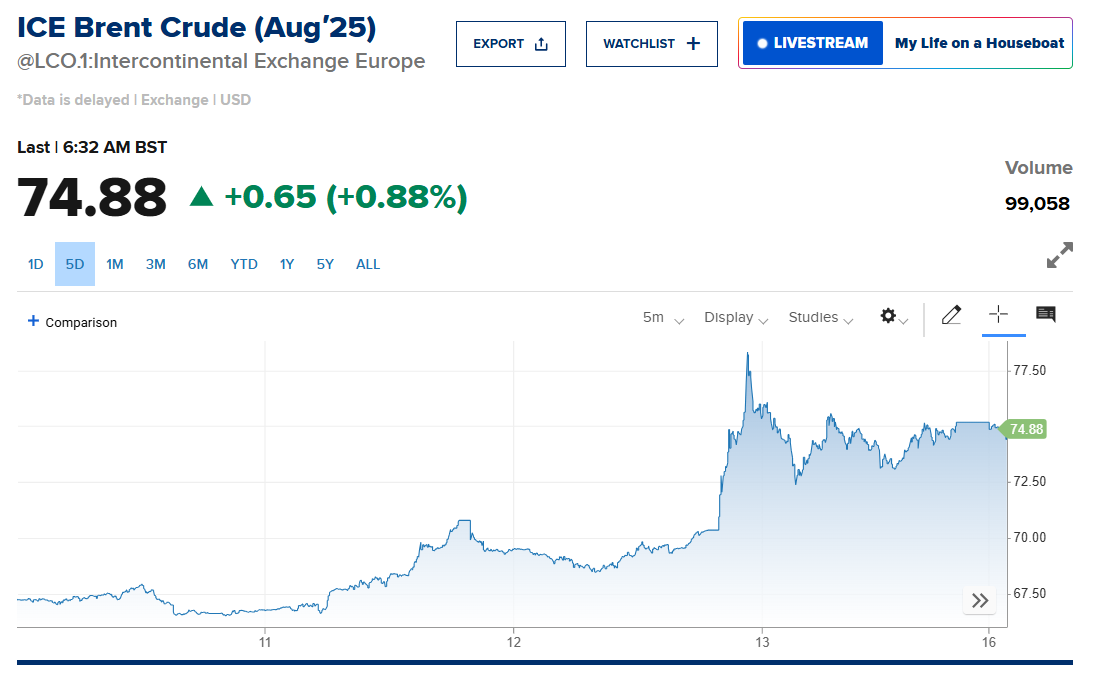
Core Viewpoint - The recent military escalation between Israel and Iran has reignited tensions in the Middle East, leading to significant increases in global oil prices, with Brent and WTI crude oil futures both recording over 10% gains last week [1][3]. Group 1: Oil Price Impact - Brent crude oil futures and WTI crude oil futures both saw over 10% increases last week due to the conflict [1]. - In early Asian trading, domestic crude oil futures surged nearly 6%, reaching a two-month high [1]. - The market's fear escalated after Iranian officials hinted at the possibility of blocking the Strait of Hormuz, a critical waterway for global oil transport [3][7]. Group 2: Strategic Importance of the Strait of Hormuz - The Strait of Hormuz is vital, facilitating the passage of approximately 20 million barrels of oil daily, accounting for nearly one-fifth of global maritime oil trade [3][10]. - The potential closure of the Strait could lead to a significant reduction in global oil supply, directly impacting global trade and energy security [10][12]. - Major oil-producing countries, including Saudi Arabia and the UAE, heavily rely on this waterway for their oil exports [10]. Group 3: Market Reactions and Predictions - JPMorgan raised the probability of a worst-case scenario involving the closure of the Strait from 7% to 17%, warning that oil prices could soar to $120-$130 per barrel [7]. - Goldman Sachs also revised its short-term oil price forecasts, indicating that prices could exceed $100 per barrel under dire circumstances [7]. - The UK Maritime Trade Operations issued warnings to seafarers operating in the region, reflecting heightened concerns in the shipping market [7]. Group 4: Expert Opinions on Conflict Escalation - Experts suggest that while the current conflict is intense, the likelihood of Iran fully blocking the Strait is low due to its own economic dependencies on oil exports [11][12]. - Analysts believe that Iran's threats are more about strategic deterrence rather than a genuine intention to close the Strait, as such actions would have severe economic repercussions for Iran itself [11][12]. - Historical precedents indicate that even the mere threat of disruption in the Strait can lead to significant oil price volatility, as seen in past crises [13][19].
地缘冲突扰动再起黄金石油标的携手大涨
Zhong Guo Zheng Quan Bao· 2025-06-13 21:23
Group 1: Oil Market Insights - On June 13, international crude oil prices surged significantly, with WTI crude futures rising over 14% to a peak of $77.62 per barrel, the highest since January 21 of this year [1][2] - Domestic crude oil futures also saw a spike, reaching a limit-up price of 535.2 yuan per barrel, marking a new high since April 7, before closing at 529.9 yuan per barrel, up 7.9% [2] - Analysts attribute the surge in oil prices to escalating geopolitical risks in the Middle East, a weaker dollar due to lower-than-expected U.S. CPI data, and strong fundamentals in the oil market [2][4] Group 2: Gold Market Developments - International gold prices also rose sharply, with London spot gold exceeding $3440 per ounce, reaching a high of $3444.49 per ounce, and COMEX gold futures hitting $3467 per ounce, both marking new highs since April 22 [1][3] - The increase in gold prices is driven by heightened geopolitical tensions and a decline in U.S. economic data, which has raised expectations for a Federal Reserve rate cut [3][5] - Domestic gold futures also experienced significant gains, with the main contract closing at 794.36 yuan per gram, up 1.72%, and peaking at 801.14 yuan per gram, the first time surpassing 800 yuan per gram since May 9 [3] Group 3: Future Price Projections - Analysts suggest that while short-term volatility in oil prices is expected due to market speculation, gold may exhibit stronger long-term performance due to its monetary and safe-haven attributes [4][5] - The potential for gold prices to reach between $3000 and $3200 per ounce for long positions, with a possibility of surpassing $3500 per ounce if geopolitical conflicts persist, is highlighted [5] - The ongoing geopolitical tensions and the shift in monetary policy are likely to support gold prices, with projections indicating a potential rise to $3800 per ounce in the future [5]