
学生用品

Search documents
《长三角区域重点工业产品质量安全现场检查指引》出台
Xin Lang Cai Jing· 2026-02-27 02:55
Core Viewpoint - The article discusses the collaborative effort among regulatory agencies in the Yangtze River Delta region to enhance the quality and safety of industrial products through the introduction of a standardized inspection guideline. Group 1: Introduction of the Guideline - The guideline titled "On-site Inspection Guidelines for Key Industrial Product Quality and Safety in the Yangtze River Delta Region" has been jointly developed by market regulatory authorities from Anhui, Shanghai, Jiangsu, and Zhejiang provinces [1][2]. - The guideline aims to establish a unified, standardized, and operable framework for on-site inspections of product quality and safety, thereby improving governance in the Yangtze River Delta region [1]. Group 2: Features of the Guideline - The guideline emphasizes regional collaboration by maintaining consistency in inspection content, judgment standards, and operational processes, effectively breaking down regulatory barriers [2]. - It incorporates practical elements by including recent typical regulatory cases, common issues, and disposal suggestions, ensuring that frontline enforcement personnel find it understandable and applicable [2]. - The guideline focuses on risk-oriented approaches, particularly addressing high-risk products and critical quality control points prevalent in the region, such as electric bicycle batteries and gas appliance valves [2]. Group 3: Implementation and Future Steps - The guideline serves as a convenient reference for frontline enforcement personnel to identify potential quality and safety hazards in products [2]. - The regulatory authorities plan to deepen collaborative efforts to ensure the comprehensive implementation of the guideline, contributing to a new development pattern of "co-construction, co-governance, and sharing" in product quality regulation in the Yangtze River Delta [2].
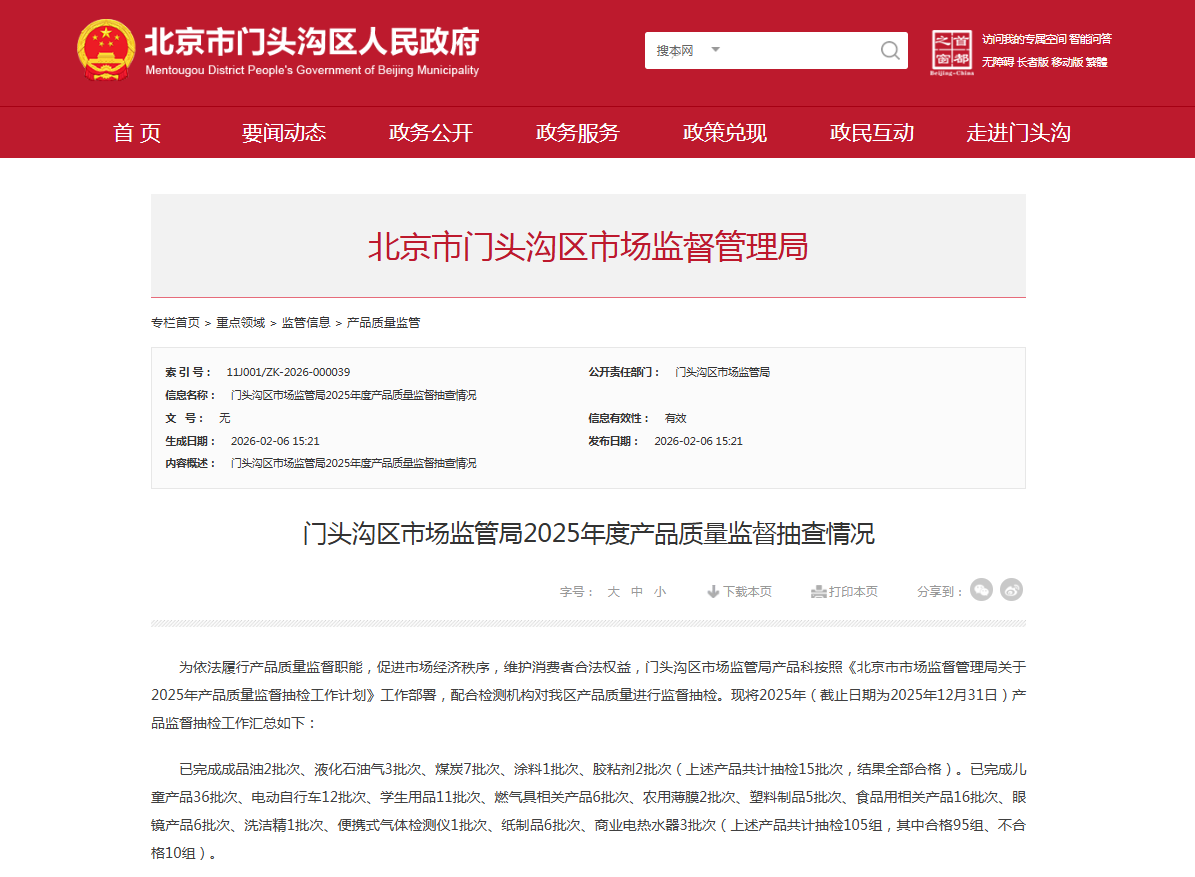
北京市门头沟区市场监管局发布2025年度产品质量监督抽查情况
Xin Lang Cai Jing· 2026-02-14 05:05
Group 1 - The Beijing Mentougou District Market Supervision Administration has released the product quality supervision and inspection results for the year 2025, aiming to uphold market order and protect consumer rights [1] - A total of 15 batches of products including finished oil, liquefied petroleum gas, coal, paint, and adhesives were inspected, with all results meeting quality standards [1] - In addition, 105 groups of various products such as children's products, electric bicycles, student supplies, gas appliances, and food-related products were tested, resulting in 95 groups passing and 10 groups failing the quality inspection [1]

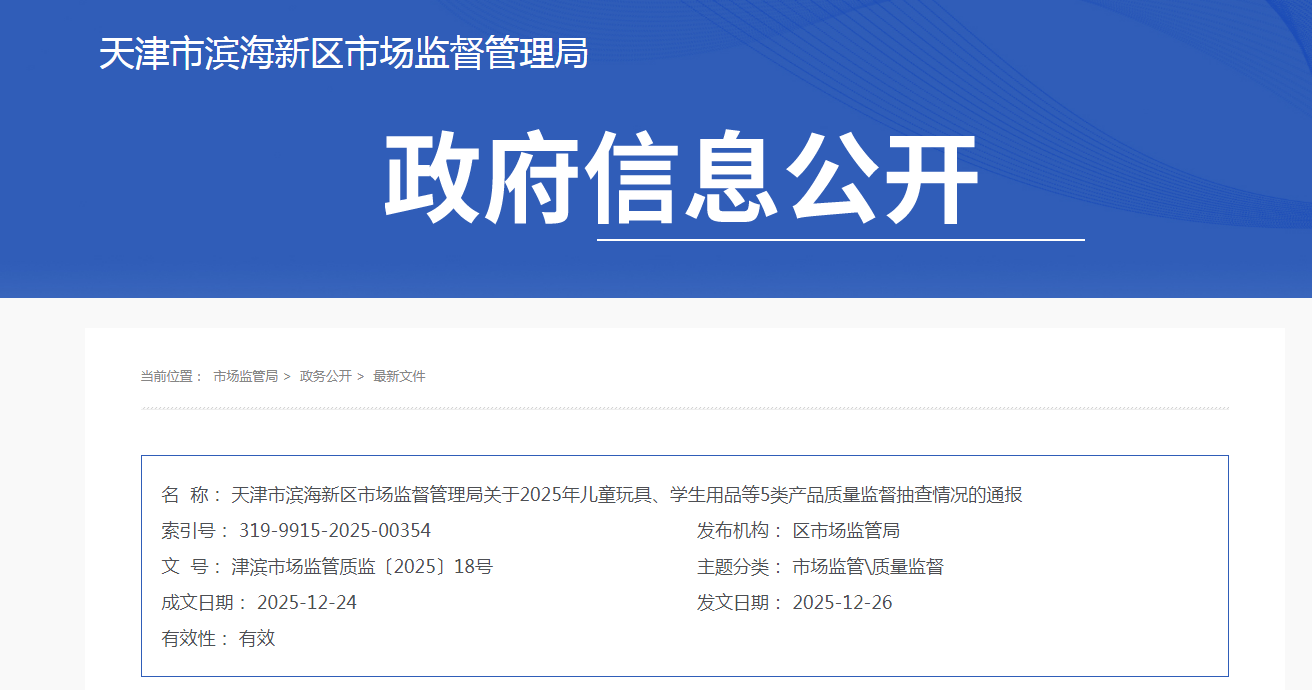
天津市滨海新区市场监督管理局通报2025年儿童玩具、学生用品等5类产品质量监督抽查情况
Zhong Guo Zhi Liang Xin Wen Wang· 2026-01-20 06:19
Summary of Key Points Core Viewpoint The quality supervision and random inspection conducted by the Tianjin Binhai New Area Market Supervision Administration in 2025 revealed that all 50 batches of products, including children's toys and student supplies, passed the quality standards without any non-conformities. Group 1: Inspection Overview - The inspection covered five categories of products: children's toys, student supplies, basketballs, table tennis balls, and bathroom products [2]. - A total of 50 batches of products were sampled, and no non-conforming products were found [2]. Group 2: Detailed Inspection Results - **Children's Toys**: 36 batches from 16 sales enterprises were inspected, focusing on materials, small parts, specific toy shapes, dimensions, strength, and flammability, with all passing [2][3]. - **Student Supplies**: 9 batches from 5 sales enterprises were inspected, emphasizing safety of pen caps, edges, and limits on certain harmful substances, with all passing [2][3]. - **Basketballs**: 1 batch from 1 sales enterprise was inspected, focusing on quality, circumference, air retention, and rebound height, with all passing [3]. - **Table Tennis Balls**: 1 batch from 1 sales enterprise was inspected, focusing on weight, bounce, roundness, and hardness, with all passing [3]. - **Bathroom Products**: 3 batches from 2 sales enterprises were inspected, focusing on various performance metrics such as flushing efficiency and safety features, with all passing [3].
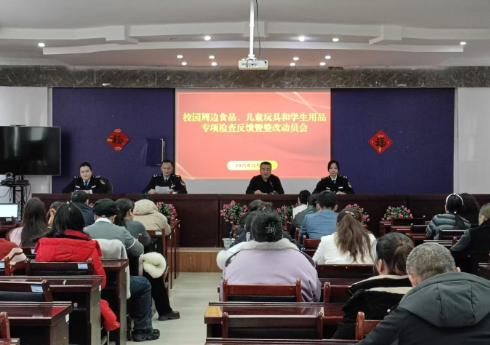
新疆沙湾市召开校园周边食品、儿童玩具和学生用品检查反馈暨整改动员会,筑牢校园周边安全防线
Zhong Guo Shi Pin Wang· 2025-12-19 14:08
Group 1 - The core focus of the meeting was to ensure the health and safety of minors by addressing issues related to food, toys, and student supplies around schools [1][5] - A total of 42 representatives from relevant business entities participated in the meeting, which aimed to purify the consumption environment around schools through a three-pronged approach: feedback on issues, training, and deployment of corrective measures [1][5] - The meeting highlighted significant problems found during previous inspections, including incomplete purchase verification records for food, lack of mandatory 3C certification for some toys, and non-compliance in labeling for certain stationery [3][5] Group 2 - The training session covered three key areas: food safety, children's toys, and student supplies, focusing on practical skills and legal knowledge [3][5] - Specific topics included the procurement traceability system, storage conditions, identification of expired and "three-no" foods, and understanding the relevant requirements of the Food Safety Law [3][5] - The training also addressed the GB6675 national standards for toy safety, emphasizing the legal risks and safety hazards of unverified toy products, as well as the harmful substance limits and labeling standards for stationery [3][5] Group 3 - Participants expressed that the training was practical and enriched their understanding of laws and regulations, enhancing their operational skills [5] - The meeting aimed to deepen the understanding of the Food Safety Law and mandatory product certification regulations among business operators, thereby improving the quality control capabilities in the circulation of food, toys, and student supplies [5][6] - Future efforts will include ongoing supervision around schools, promoting legal awareness, conducting follow-up inspections, and strengthening enforcement measures to enhance safety awareness among both operators and consumers [6]
供需协同发力 释放超大规模市场潜能
Zhong Guo Jing Ji Wang· 2025-12-11 05:31
Core Viewpoint - The article discusses the implementation of a plan by six departments, including the Ministry of Industry and Information Technology, aimed at enhancing the adaptability of supply and demand in consumer goods, promoting a two-way interaction between supply and demand, and facilitating economic circulation [1]. Group 1: Supply and Demand Interaction - The plan outlines 19 key tasks to expand new demand, tap into existing demand, segment markets, empower scenarios, and optimize the environment, emphasizing the need for a systemic reconstruction of production modes, value connotations, and market environments [1]. - The current structural contradictions on the supply side are identified as major obstacles to unleashing consumption potential, necessitating a transformation from traditional supply models to more responsive and flexible production systems [1]. Group 2: Innovation and Upgrading - The plan encourages the upgrading of existing products and precise segmentation of niche markets, focusing on green, healthy, and intelligent product iterations to align with the evolving consumer preferences from survival to development and enjoyment [2]. - It emphasizes the importance of catering to diverse age groups by enhancing the supply of products for infants, students, fashion items, and senior citizens, reflecting a comprehensive approach to consumer needs throughout the lifecycle [2]. Group 3: Consumer Experience and Environment - The article highlights the significance of innovative consumption scenarios and environments as essential for transforming demand into consumption, with examples of recent innovations that cater to diverse consumer needs and stimulate economic recovery [2]. - The plan stresses the need for financial support and improved quality assurance measures to enhance consumer confidence and safety, thereby fostering a conducive environment for consumption [2]. Group 4: Market Dynamics - The article concludes that aligning supply with consumer preferences and activating domestic demand will effectively stimulate the internal dynamics of China's large-scale market, transitioning consumption from quantity expansion to quality enhancement, thus contributing to high-quality economic development [3].
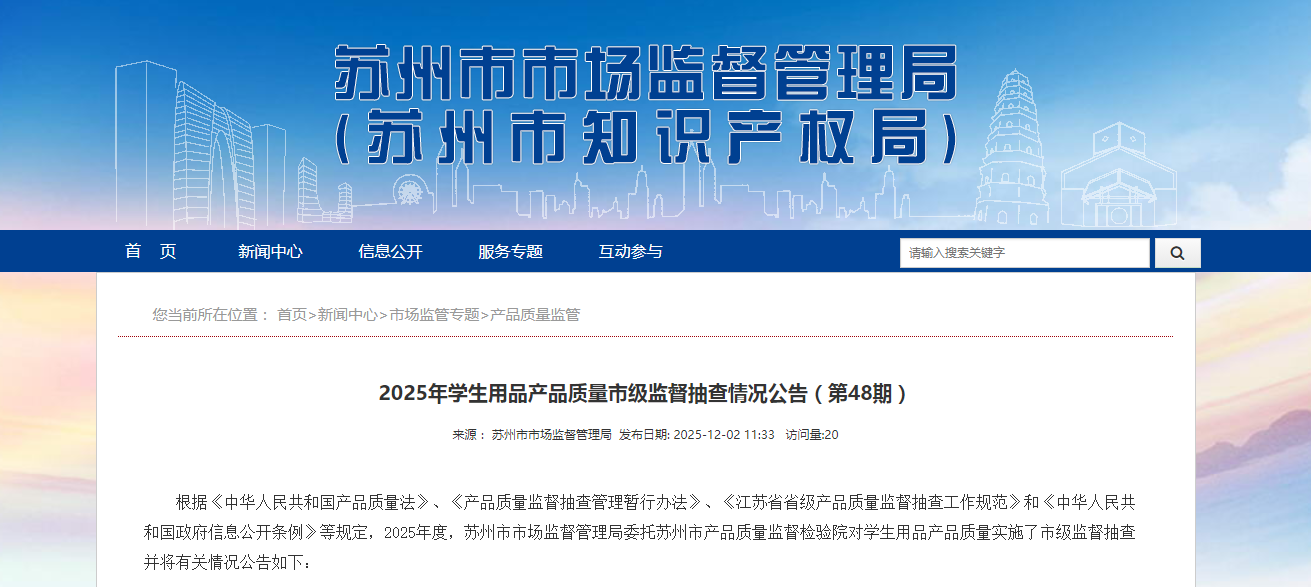
江苏省苏州市市场监管局公布2025年学生用品产品质量市级监督抽查情况(第48期)
Zhong Guo Zhi Liang Xin Wen Wang· 2025-12-04 05:57
Core Insights - The article discusses the quality inspection results of student supplies in Suzhou, Jiangsu Province, highlighting the importance of product safety and compliance with national standards [3][5][7]. Group 1: Industry Overview - The student supplies market is a significant segment of the stationery industry, encompassing various products such as art supplies, writing instruments, and notebooks [3]. - China is the largest producer of stationery globally, accounting for over 60% of the trade volume, making it a crucial sector in the light industry [4]. - The stationery industry in China has developed rapidly over the past 40 years, forming distinct industrial clusters, particularly in Guangdong and Zhejiang provinces [4]. Group 2: Quality Inspection Findings - A total of 100 batches were inspected, with 4 batches found to be non-compliant, resulting in a non-compliance rate of 4% [7]. - The non-compliance issues included problems with the inner core weight, page count, brightness, and adhesive properties of notebooks, as well as the presence of phthalate plasticizers in accessible plastic parts [7][12]. - Specific issues identified included: - Two batches failed to meet the required paper weight standards, which could lead to damage during use [8]. - One batch had fewer pages than the standard requirement, increasing consumer costs due to frequent replacements [9]. - Two batches exhibited excessive fluorescence brightness, potentially causing eye discomfort for students [10]. - One batch did not meet the adhesive quality standards, affecting writing performance [11]. - One batch exceeded the allowable limits for phthalate plasticizers, which could pose health risks [12]. Group 3: Regulatory Framework - The inspections were conducted based on several national standards, including GB21027-2020 and GB40070-2021, which outline safety and health requirements for student supplies [5][6].


增强供需适配促进形成3个万亿级消费领域|营商环境周报
2 1 Shi Ji Jing Ji Bao Dao· 2025-12-03 06:49
Group 1 - The State Administration for Market Regulation has introduced a new credit repair management method to encourage individuals to correct violations and rebuild credit, effective from December 25 [1] - The new method categorizes violations into three levels: minor, general, and serious, each with different public disclosure periods and repair conditions [1] - Minor violations with only warnings will not be publicly disclosed, while general violations will have a minimum disclosure period of three months and a maximum of one year; serious violations will be disclosed for a minimum of one year and a maximum of three years [1] Group 2 - The Ministry of Industry and Information Technology and six other departments have issued a plan to enhance the supply of consumer goods, aiming to create three trillion-yuan consumption sectors and ten billion-yuan consumption hotspots by 2027 [2] - The plan includes 19 key tasks focusing on new technology applications, expanding the supply of unique products, and creating new consumption scenarios [2] - Key industries targeted include smart connected vehicles, smart home products, consumer electronics, and green building materials, with a goal to develop iconic products and innovative enterprises [2] Group 3 - The plan emphasizes the need to improve the supply of baby products, quality student supplies, trendy fashion items, and products for the elderly [3] Group 4 - The Ministry of Industry and Information Technology has initiated commercial trials for satellite IoT services, targeting industries such as transportation, energy, and agriculture [4] - The trials aim to enhance market supply, stimulate market activity, and establish a safety regulatory framework for emerging industries [4] - Companies that fail to provide services or violate regulations may have their trial qualifications revoked [4] Group 5 - Hunan Province has launched initiatives to create friendly environments for new employment groups, addressing issues faced by delivery workers and couriers [5] - Specific measures include optimizing delivery environments, improving access to buildings, and providing essential services like drinking water and charging stations [5] - The initiative aims to enhance the overall working conditions for new employment groups [5] Group 6 - Sichuan Province has released guidelines to improve government services and administrative efficiency through the "Efficient Completion of One Thing" initiative [6] - The guidelines propose the integration of artificial intelligence into government services to provide intelligent support for both citizens and officials [6] - The focus is on creating a list of key services and exploring streamlined processes for various stages of business development [6] Group 7 - Hangzhou has introduced a new land management reform to align land use with industrial needs, promoting a market-oriented approach [7] - The reform includes categorizing commercial land into industrial and real estate types, with incentives for industrial land use [7] - The city is piloting flexible land use policies to adapt to changing industrial trends, enhancing the responsiveness of land planning [7][8]
事关促消费,重磅文件印发
Sou Hu Cai Jing· 2025-12-01 03:11
Core Viewpoint - The implementation plan aims to enhance the adaptability of supply and demand for consumer goods, leading to consumption upgrades that drive industrial upgrades, with a goal of achieving a dynamic balance between supply and demand at a higher level by 2027 [1][5]. Group 1: Objectives and Goals - By 2027, the plan targets the formation of three trillion-level consumption sectors and ten hundred-billion-level consumption hotspots, along with the creation of high-quality consumer goods that are culturally rich and globally recognized [6][1]. - By 2030, a high-quality development pattern characterized by positive interaction and mutual promotion between supply and consumption is expected to be established, with a steady increase in the contribution of consumption to economic growth [2][9]. Group 2: Key Strategies - Accelerate the innovation and application of new technologies and models, including the cultivation of flexible manufacturing factories and promoting user participation in design to meet personalized consumer demands [10]. - Expand the supply of distinctive and new products, focusing on green products, rural consumption upgrades, leisure and sports products, health product innovations, and the integration of tourism with wellness services [12]. - Precisely match the needs of different demographic groups by enriching the supply of baby and children's products, enhancing quality student supplies, expanding fashionable "trendy" products, and optimizing products for the elderly [14]. Group 3: New Consumption Scenarios and Environments - Foster new consumption scenarios and business formats, including a matrix for online and offline product launches, promoting "national trends going global," and developing new business models like live e-commerce and instant retail [15]. - Create a favorable development environment by utilizing large-scale equipment updates and trade-in policies for consumer goods, enriching consumer finance products and services, and strengthening regulatory oversight in the consumer sector [17][16].

2027年形成3个万亿级消费领域和10个千亿级消费热点
Xin Hua Wang· 2025-11-30 22:29
Core Viewpoint - The Ministry of Industry and Information Technology, along with five other departments, has issued an implementation plan aimed at enhancing the adaptability of supply and demand in consumer goods, targeting significant optimization of the supply structure by 2027 and establishing three trillion-level consumption sectors and ten hundred-billion-level consumption hotspots [1][2]. Group 1: Key Objectives - By 2027, the supply structure of consumer goods is expected to be significantly optimized, with the formation of three trillion-level consumption sectors and ten hundred-billion-level consumption hotspots [1]. - The plan emphasizes leading industrial upgrades through consumption upgrades and aims for a dynamic balance between supply and demand, with a goal of establishing a high-quality development pattern by 2030 [1][2]. Group 2: Key Tasks - The plan outlines 19 key tasks across five areas: accelerating the application of new technologies and models, expanding the supply of distinctive and new products, precisely matching the needs of different demographics, cultivating new consumption scenarios and business formats, and creating a favorable development environment [2]. - Specific focus areas include intelligent connected new energy vehicles, smart home products, consumer electronics, modern textiles, food, and green building materials, with the goal of creating hundreds of iconic products and innovative enterprises [2]. Group 3: Market Segmentation - The plan aims to enhance the supply of green products, improve rural consumer goods, and significantly develop leisure and sports products, adapting to trends in green and low-carbon consumption [2]. - It also targets niche markets by enriching the supply of baby and children's products, enhancing quality student supplies, expanding fashionable "trendy" products, and optimizing products for the elderly [2].
六部门部署2027年形成3个万亿级消费领域
Chang Jiang Shang Bao· 2025-11-27 04:25
Core Viewpoint - The implementation plan aims to enhance the adaptability of supply and demand in the consumer sector, promoting consumption potential and economic growth through structural reforms and targeted initiatives [1] Group 1: Key Tasks and Goals - The plan outlines 19 key tasks across five areas, focusing on balancing supply and demand while leading industrial upgrades through consumption upgrades [1] - By 2027, the supply structure of consumer goods is expected to be significantly optimized, creating three trillion-level consumption sectors and ten hundred-billion-level consumption hotspots [1] - By 2030, a high-quality development pattern characterized by positive interaction between supply and consumption is anticipated, with a steady increase in consumption's contribution to economic growth [1] Group 2: Innovation and New Product Supply - The plan emphasizes accelerating the application of new technologies and models, particularly in sectors like smart connected vehicles, smart home products, and green building materials [2] - It promotes flexible and customized production models, establishing a digital system that integrates user demand, intelligent design, and flexible manufacturing [2] - Specific measures include enhancing the supply of green products, upgrading rural consumer goods, and expanding the influence of historical classic products [2] Group 3: Targeted Consumer Needs - The plan aims to enrich the supply of products for different demographics, including children, students, and the elderly, focusing on quality and intelligent development [3] - It encourages the development of new consumption scenarios and business models, such as flagship stores and live e-commerce, to stimulate consumer engagement [3] - The initiative also includes promoting shared consumption models in public spaces, enhancing accessibility for various consumer groups [3] Group 4: Supportive Environment - The plan calls for strengthened financial support and the organization of special events to foster a conducive environment for consumption growth [3] - It highlights the importance of utilizing policies for equipment upgrades and trade-in programs to stimulate consumer spending [3] - The initiative aims to leverage policy funding to support the quality upgrade of the consumer goods industry [3]