
宠物清洁用品

Search documents
(新春走基层)春节宠物经济升温:“毛孩子”的别样“团圆年”
Xin Lang Cai Jing· 2026-02-12 06:09
Group 1 - The pet economy is experiencing significant growth during the Spring Festival, with an increase in pet boarding services and pet product sales, reflecting a unique consumer trend [1][3] - Pet boarding facilities are fully booked, with some pet owners making reservations two months in advance for the holiday period, indicating high demand [2][3] - The prices for pet boarding have increased, with small dogs costing 88 yuan per day and large dogs 138 yuan per day, showing a tiered pricing strategy that has not deterred demand [2][3] Group 2 - Pet stores are enhancing service quality to meet the surge in demand, providing standardized services such as daily exercise for dogs and attentive care for cats [3] - The sales of pet products have significantly increased, with a notable rise in demand for high-quality and functional items, such as health-oriented pet food and smart pet toys [3] - The booming pet market during the Spring Festival reflects an improvement in living standards and a shift in consumer attitudes towards pet ownership [3]
双十一变沉默?日均销售额腰斩,1.7万亿拆解,潜价值才是硬通货
Sou Hu Cai Jing· 2025-12-16 14:21
Core Insights - The 2025 Double Eleven shopping festival experienced a significant decline in excitement and sales reporting compared to previous years, with major platforms like Taobao, JD, and Pinduoduo being notably subdued in their announcements [1][3] - Despite the lack of specific sales figures from platforms, third-party data indicated a total online sales figure of 16,950 billion yuan, representing a 14.2% increase from the previous year [3][4] Sales Performance - Total transaction volume for 2025 reached 16,950 billion yuan, up from 14,418 billion yuan in 2024, marking a 14.2% year-on-year growth [4] - Comprehensive e-commerce transaction volume was 16,191 billion yuan, a 12.3% increase from 11,093 billion yuan in 2024 [4] - Instant retail transaction volume surged to 670 billion yuan, a remarkable 138.4% increase from 281 billion yuan in 2024 [4] - Community group buying transaction volume fell to 90 billion yuan, down 35.3% from 138 billion yuan in 2024 [4] Consumer Behavior - The average daily sales during the 36-day event were only 472 billion yuan, significantly lower than the peak daily average of 1,048 billion yuan in 2022 [5] - The volume of express deliveries increased by only 6.4%, indicating a lack of overwhelming demand [5] - Younger consumers (those born in the 1990s and 2000s) are now the main spending force, with their average spending increasing by 30% [9] Emerging Trends - Instant retail emerged as a major highlight, with live-streaming retail sales reaching 670 billion yuan, a 138.4% increase from the previous year [7] - Consumers are increasingly valuing "hidden benefits" such as immediate delivery and emotional satisfaction over traditional price discounts [19] - Health-conscious products and smart home appliances are gaining traction, with 82% of consumers purchasing kitchen appliances for health reasons [14] Customer Expectations - A significant 28.9% of consumers prioritize reliable after-sales service over influencer recommendations, which only 7.9% consider important [16] - Brands that offer trustworthy after-sales support, like 365-day return policies, are seeing increased consumer trust and sales growth [16][17] - The market is shifting towards brands that understand consumer needs rather than those competing solely on price [19]


经济日报:萌宠消费升温快
Bei Jing Ri Bao Ke Hu Duan· 2025-11-13 00:00
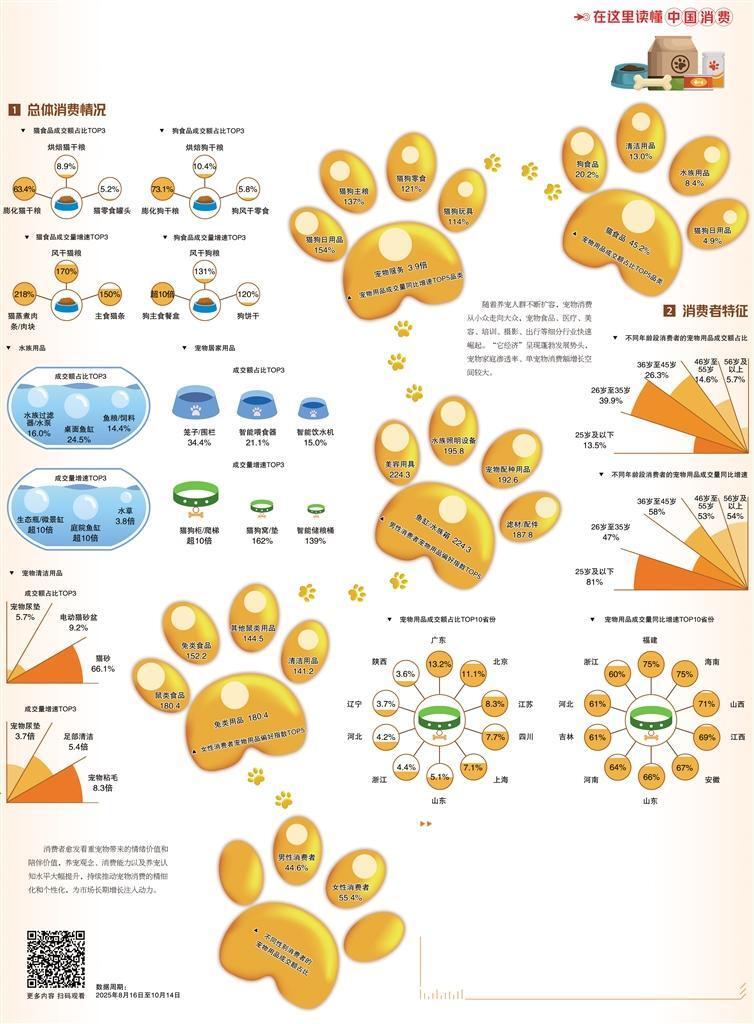
Core Insights - The pet consumption market in China is rapidly expanding, with the number of urban pets (dogs and cats) expected to exceed 120 million by 2024, driven by changing consumer attitudes and increasing demand for pet-related products and services [3][4] Market Trends - Pet owners are increasingly willing to invest time and money in their pets, leading to significant growth in the pet consumption market. The top two categories in pet product sales are cat and dog food, accounting for over 65% of total sales [3] - The transaction volume for pet services has surged by 3.9 times year-on-year, with sales of daily necessities, staple food, snacks, and toys for cats and dogs all experiencing over 100% year-on-year growth [3] Consumer Behavior - There is a noticeable shift in consumer focus from merely feeding pets to enhancing their health and quality of life. While traditional puffed pet food still holds the largest market share, there is a rapid increase in sales of premium pet food options such as dried food and meat snacks [3] - Sales of pet cleaning products and pet furniture (like cabinets and climbing frames) have also seen significant increases, indicating a broader trend towards improving pet living conditions [3] Regional Insights - The highest sales of pet products are concentrated in eastern provinces, correlating strongly with the economic and social development levels of these regions. Provinces like Hainan, Shanxi, Jiangxi, and Anhui show strong potential for pet economic growth [4] Industry Challenges - Despite the booming pet economy, challenges such as a lack of standards persist. The future of the pet industry requires continuous innovation from companies, focusing on precise nutrition and health management, alongside policy support and standardization [4]
萌宠消费升温快
Jing Ji Ri Bao· 2025-11-12 22:24
Group 1 - The core viewpoint is that the pet consumption market in China is rapidly expanding, with the number of urban pets (dogs and cats) expected to exceed 120 million by 2024, driven by changing consumer attitudes and increasing demand [1][2] - Pet owners are increasingly willing to invest time and money in their pets, leading to significant growth in the pet consumption market, particularly in pet food and services, with pet service transaction volume increasing by 3.9 times year-on-year [1][2] - There is a noticeable shift in pet food consumption from merely satisfying hunger to prioritizing quality, with sales of premium pet food products like dried pet food and meat snacks growing rapidly [1] Group 2 - The regional characteristics of pet consumption show that eastern provinces lead in pet product sales, correlating strongly with economic development levels, while provinces like Hainan, Shanxi, Jiangxi, and Anhui exhibit strong potential for pet economic growth [2] - The pet industry faces challenges such as a lack of standards, highlighting the need for continuous innovation, precise nutrition, and health management, alongside policy support and standardization for sustainable market development [2]
猫双11宠物行业市占率达64%,“它经济”迎来国货黄金时代
Sou Hu Wang· 2025-11-08 03:49
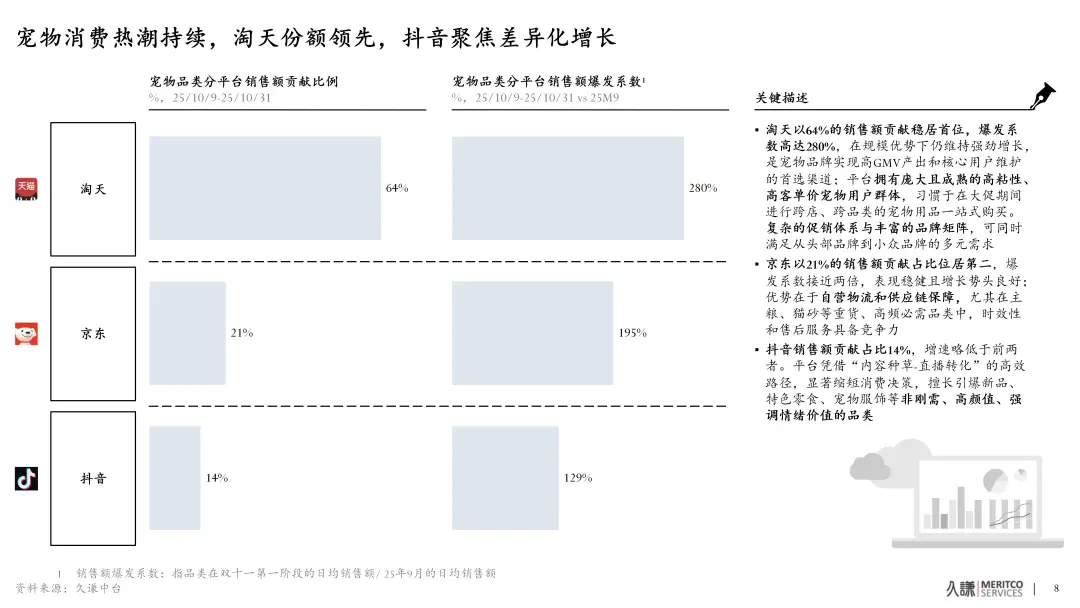
Core Insights - The pet consumption market is experiencing significant growth, with Tmall leading in sales during the Double Eleven shopping festival, contributing 64% of total sales and achieving a high explosion coefficient of 280% [1][3] - Tmall's pet industry has maintained double-digit growth despite its scale advantage, with pre-sale amounts surpassing last year's total within just half an hour [3] - Domestic brands are increasingly dominating the pet consumption landscape, accounting for 68% of the brands that achieved over 10 million in sales on Tmall during the event [3] Group 1 - Tmall's pet industry has shown remarkable growth, with 18 brands achieving over 10 million in sales within the first hour of the Double Eleven event [3] - The trend of domestic brand replacement is evident, with brands like 麦富迪 and Toptrees showing significant sales increases of over 90% and 170% respectively [3] - The pet consumption market is witnessing cross-industry integration, with brands like Adidas and Xiaomi entering the pet apparel and smart drinking fountain markets, respectively [4] Group 2 - Since its upgrade to a primary category in 2021, Tmall's pet sector has experienced continuous high growth, doubling in scale and surpassing 100 million annual purchasing users [6] - The pet industry is entering a "platform ecosystem competition" phase, with Tmall's user base supporting both short-term and long-term growth through diverse consumer insights [6] - The rise of the "it economy" is expected to further solidify Tmall's leading position in the pet industry [6]
宠物行业全景图:产业链价值重构与国产替代浪潮
2025-11-03 02:36
Summary of the Pet Industry Conference Call Industry Overview - The global pet industry is projected to exceed $200 billion in 2024, with an estimated growth to $270 billion by 2029, reflecting a compound annual growth rate (CAGR) of 5.5% [2] - The United States leads the global pet economy, expected to account for 47% of the pet food and snacks market and 52% of the pet services market by 2025 [1][2] - The European pet market is also significant, with 2023 pet food value reaching €22.93 billion, a 9% year-on-year increase [4] Key Market Insights - In the U.S., total pet industry spending is projected to reach $151.9 billion in 2024, with pet food and snacks accounting for $65.8 billion (43% of total spending) [4] - China's pet market is rapidly growing, with a projected market size exceeding ¥300 billion in 2024, a 7.5% year-on-year increase [5] - In China, the pet food market is the largest segment, making up 52.8% of total spending, followed by the medical market at 28% [5] Consumer Trends - Chinese consumers are increasingly focused on nutritional balance and ingredient transparency, with 35% of cat owners and 33% of dog owners preferring domestic brands [9] - The demand for pet health products is rising, with the pet health supplement market growing at a rate of 32% [3] Emerging Segments - The global pet wearable market is expected to grow from $3.3 billion in 2023 to $17.1 billion by 2033, with a CAGR of 18% [11] - The pet cleaning products market is seeing significant growth, particularly in functional products like deodorants and disinfectants, with sales of plant-based cat litter increasing by 307% [10] Medical and Grooming Services - The pet medical service market in China is valued at approximately ¥84 billion, with a growing demand for veterinary services due to an increasing number of aging pets [15] - The pet grooming industry in China reached ¥42 billion in 2023, with a projected growth to over ¥62 billion in 2025 [16] Challenges and Opportunities - Despite the late start, China's pet industry shows high growth potential driven by demographic changes and evolving consumer needs [18] - Investment opportunities exist in domestic brand development, niche product innovation, and the integration of insurance services within the pet care ecosystem [18]
宠物行业系列报告(一):宠物行业全景图:产业链价值重构与国产替代浪潮
Ping An Securities· 2025-10-14 12:44
Investment Rating - The industry investment rating is "Outperform the Market" [1][89]. Core Insights - The global pet industry is projected to reach approximately $207 billion in 2024, with a compound annual growth rate (CAGR) of 5.5% from 2024 to 2029 [3][12]. - The Chinese pet industry, although starting later, is rapidly expanding, with a market size expected to reach 300.2 billion yuan in 2024, reflecting a year-on-year growth of 7.5% [3][26]. - The demand for pets is shifting from functional care to emotional companionship, driven by demographic changes such as an increase in single-person households and elderly individuals [3][40]. Summary by Sections Industry Overview - The pet industry in Europe and the US dominates the global market, with the US accounting for 47% of the pet food and snacks market and 50% of the pet services market by 2025 [3][12]. - The Chinese pet market is characterized by a growing number of pets, with a total of 124 million pets expected in 2024, marking a 2.1% increase year-on-year [3][33]. Upstream - The number of pets in China is steadily increasing, with a shift in consumer demand towards emotional companionship rather than just functional care [3][31]. - The CAGR for pet cats and dogs from 2017 to 2024 is projected at 5.1%, with cats growing at a faster rate than dogs [3][33]. Midstream - The pet supplies market is diversifying, with significant growth in pet food, particularly domestically produced brands, which are increasingly replacing imported ones [3][46]. - The market for pet food is expected to reach 107.17 billion yuan in 2024, with a CAGR of 8.2% from 2018 to 2024 [3][50]. Downstream - The pet medical care market is projected to reach approximately 84 billion yuan in 2024, making it the second-largest consumer market after pet food [3][71]. - The pet grooming industry is also experiencing rapid growth, with a market size of 42 billion yuan in 2023 and a CAGR of 22.3% from 2019 to 2023 [3][76]. - The pet insurance market in China is still in its early stages, with a penetration rate of less than 1%, indicating significant growth potential [3][84]. Investment Recommendations - The pet market is characterized by sustained growth and resilience, with structural opportunities across the industry chain, particularly in domestic substitution and innovation in niche categories [3][87]. - Recommended companies include leading pet food enterprises such as Guobao Pet and attention to Zhongchong Co., Ltd. and Yuanfei Co., Ltd. [3][87].
双11小红书「宠物」直播材料
Sou Hu Cai Jing· 2025-09-27 05:25
Core Insights - The core strategy for the pet industry on Xiaohongshu for the 2025 Double Eleven event is centered around "full power of cuteness," leveraging a base of 200 million pet interest users to enhance brand awareness and conversion efficiency [1][2]. Industry Trends - The pet ownership demographic is expanding, with over 90 million pet owners on the platform, including more than 60 million cat owners and 33 million dog owners. Additionally, 40% of dog owners and 34% of cat owners plan to increase their spending [1][2]. - There is a shift towards quality and refinement in pet product demands, with brand awareness in cat food rising by 5 ranks and dog food reputation increasing by 7 ranks compared to 2023. The search for senior dog food has surged by 920% year-on-year [1][2]. - The Double Eleven shopping event is a peak search period, with significant stockpiling behavior observed for essential items like cat litter and staple food, as evidenced by a 66,470% increase in searches for cat food strategies [1][2]. Marketing Opportunities - Marketing strategies are focusing on scenario-based and ecological interactions, with events like the Asia Pet Expo serving as significant traffic drivers. The "Little Cat and Dog Book" campaign aims to create a marketing loop through online and offline engagement [2][3]. - The competitive landscape in the cat food sector is intense, necessitating a dual strategy of awareness-building during the pre-sale phase and targeted conversion during the peak sales period. The dog food sector requires phased operations focusing on different life stages [2][3]. Growth Strategies - Full-link efficiency relies on tools and rhythm management, with key performance indicators set at a click-through rate (CTR) of 10% and a conversion rate of 2.5% for marketing strategies [3]. - Budget allocation is divided into phases: 30% for awareness, 60% for conversion during peak sales, and 10% for long-term brand reputation building [3].

《2025天猫宠物经济跨界观察》:11个行业72个品牌跨界入局,宠物千亿市场格局未定
Cai Fu Zai Xian· 2025-09-25 09:20
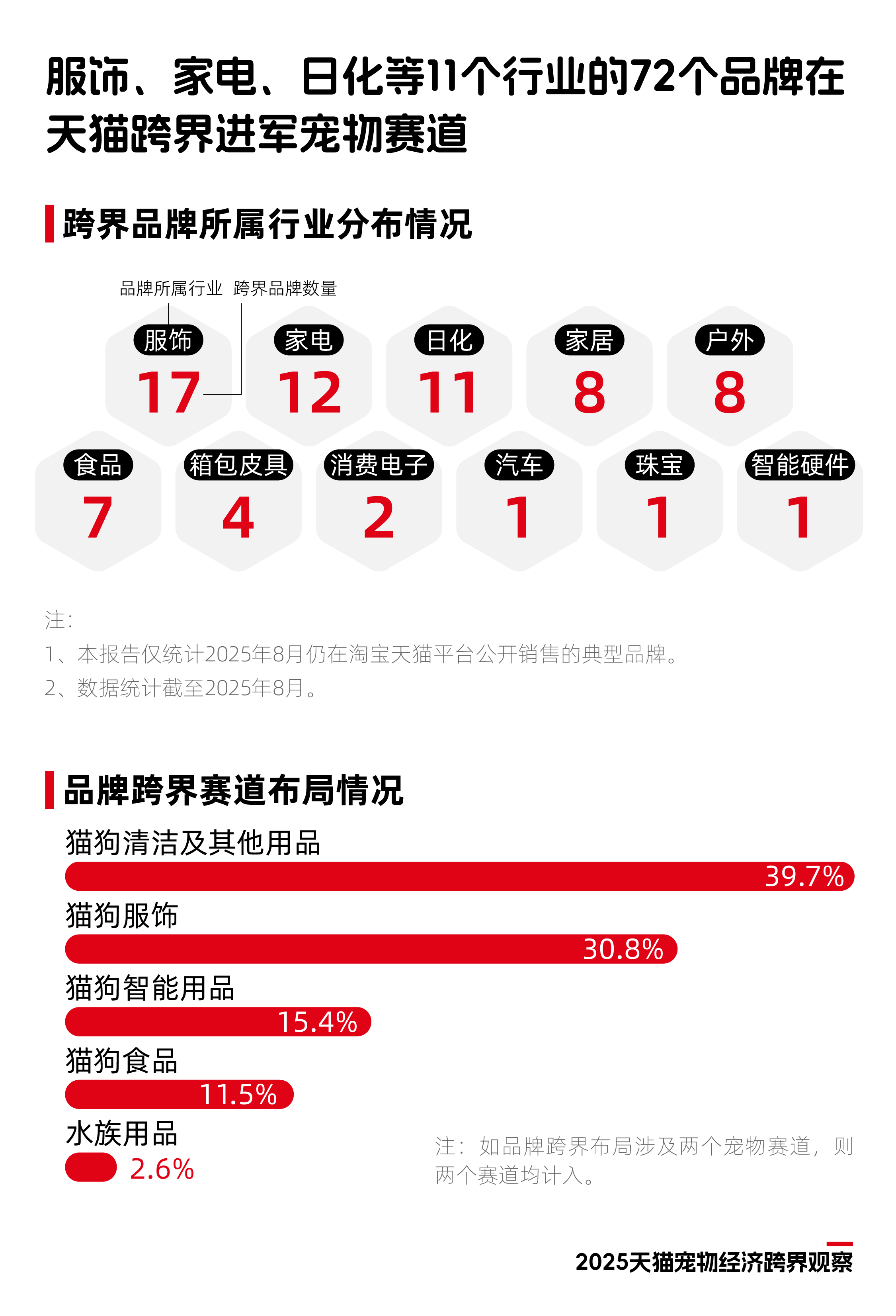
Core Insights - The report "2025 Tmall Pet Economy Cross-Industry Observation" highlights the strong appeal of the pet economy across various sectors, with 72 cross-industry brands identified in 11 categories including apparel, home appliances, and daily chemicals [1][2]. Industry Overview - Nearly 40% of cross-industry brands focus on essential pet cleaning and other supplies, while over 30% target personalized pet apparel [1]. - Chinese brands dominate the pet market, accounting for 48% of the cross-industry brands, with Guangdong, Zhejiang, and Shanghai being the top three provinces for brand concentration [2]. Brand Performance - The median establishment year for domestic brands is 2003, while international brands date back to 1949. However, both groups entered the pet market around 2022, with younger domestic brands outperforming older international ones in sales [3]. - 22% of cross-industry brands have established independent pet sub-brands or opened dedicated Tmall stores, leading to significant commercial returns. Brands that deeply invest in the pet sector see monthly sales amounts 738% higher than those with a "testing the waters" approach [5]. Market Dynamics - The top 20 cross-industry pet brands on Tmall saw a 90% turnover rate from the first half of 2024 to the first half of 2025, indicating a dynamic market with new entrants like "Golden Dad" from Three Squirrels making rapid gains [8]. - 77.8% of cross-industry brands have chosen pet segments closely related to their main business, which correlates with better performance. Brands leveraging existing strengths in related fields have seen success, exemplified by Dettol's entry into the pet cleaning market [12]. Future Opportunities - The pet market remains open for potential entrants, with significant opportunities in pet smart products and cleaning supplies, which are experiencing growth and lack dominant brands, providing a competitive edge for companies with relevant technology and R&D capabilities [12].

天猫发布《2025天猫宠物经济跨界观察》 11个行业72个品牌跨界入局
Zheng Quan Ri Bao Wang· 2025-09-25 07:48
Core Insights - The report "2025 Tmall Pet Economy Cross-Border Observation" highlights the strong appeal of the pet economy across various industries, with 72 cross-border brands identified on Tmall, spanning 11 sectors including apparel, home appliances, and daily chemicals [1][2] Group 1: Market Trends - Nearly 40% of cross-border brands focus on essential pet cleaning and other supplies, while over 30% target personalized pet apparel [1] - Domestic brands dominate the pet cross-border market, accounting for 48% of the total, with Guangdong, Zhejiang, and Shanghai being the most concentrated provinces [1] Group 2: Brand Performance - The median establishment year for domestic brands is 2003, compared to 1949 for international brands, yet both entered the pet market around 2022. Domestic brands have shown significantly better performance in 2025 compared to their international counterparts [2] - 22% of cross-border brands have established independent pet sub-brands or opened dedicated Tmall stores, indicating a strong commitment to the pet sector [2] Group 3: Sales Dynamics - In the top 10 cross-border pet brands on Tmall for the first half of 2025, 60% adopted a deep investment model, with brands that established pet sub-brands or dedicated stores achieving 738% higher average monthly sales compared to those with a "testing the waters" approach [2] - Miniso, a private label retailer, launched its pet product flagship store on Tmall in March 2024, achieving daily sales exceeding 100,000 yuan within five months, showcasing the effectiveness of independent operations in the pet market [3] Group 4: Market Opportunities - The opportunity window in the pet market remains open, with a 90% turnover rate in the top 20 cross-border pet brands from the first half of 2024 to 2025, indicating a dynamic market landscape [4] - 77.8% of cross-border brands chose pet sectors closely related to their main business, leading to better performance, as nearly 60% of top-performing brands adhered to this principle [4] - Pet smart products and pet cleaning supplies are identified as having significant blue ocean potential, with growing demand and no dominant brands, providing space for differentiated competition for brands with relevant technology and R&D advantages [4]