小布助手

Search documents
测评7个手机智能体:点一杯奶茶,意味着交付40%高敏权限
2 1 Shi Ji Jing Ji Bao Dao· 2026-02-24 00:23
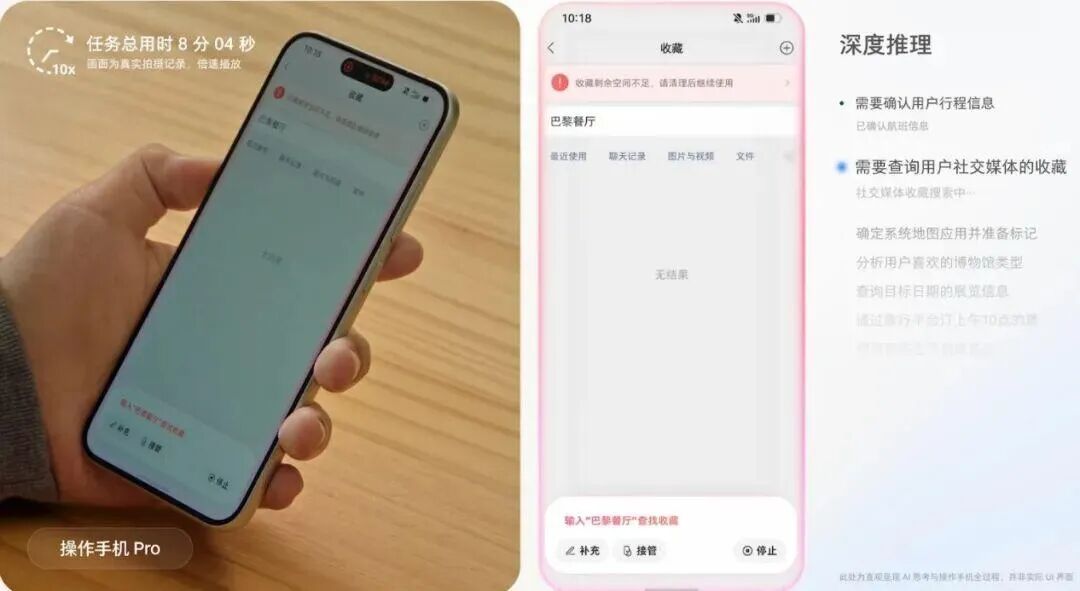
Core Insights - The rise of intelligent agents signifies a shift from machines merely chatting to machines performing tasks on behalf of users, with a notable focus on local deployment rather than cloud-based solutions [1][2] - The increasing integration of intelligent agents into personal devices raises concerns about privacy and the extent of permissions required for their operation [2][19] Group 1: Intelligent Agent Development - Intelligent agents like Doubao are being embedded in smartphones, allowing them to perform various tasks such as ordering food and playing games [3][4] - A significant number of permissions are required for these agents, with many devices exceeding 100 system permissions, which is notably higher than typical applications [5][6] Group 2: Permission and Privacy Concerns - Approximately 40% of the permissions requested by mobile intelligent agents are classified as high-sensitivity, including access to precise location and reading messages [7][10] - The use of accessibility permissions allows intelligent agents to bypass standard security measures, raising concerns about potential misuse and privacy violations [10][12] Group 3: Security Measures and User Awareness - Companies like Doubao and OPPO have begun to publish AI privacy and security white papers, focusing on user awareness and control over sensitive operations [24][25] - The need for transparent usage guidelines and the importance of logging AI operations have been emphasized to ensure accountability and traceability [25][29] Group 4: Data Handling and Cloud Risks - The process of data transmission to the cloud remains controversial, with concerns about sensitive information being exposed during this process [29][30] - Current intelligent agents struggle with effectively identifying and protecting sensitive information, highlighting a gap in privacy protection capabilities [30][32]



从联网设备到智能体终端,阿里云开启AI硬件的普惠元年
36氪· 2026-01-09 13:09
Core Viewpoint - The article emphasizes that AI hardware has evolved from being mere gimmicks to becoming independent intelligent entities, showcasing significant innovation from Chinese manufacturers at CES 2026 and the role of Alibaba Cloud in this transformation [3][6][19]. Group 1: AI Hardware Evolution - AI hardware has crossed the threshold from being toys to independent intelligent agents, indicating a major shift in the industry [3][6]. - The transition from "China manufacturing" to "China creation" is highlighted, with Alibaba Cloud playing a crucial role in providing the necessary technological support for hardware innovation [7][19]. - The year 2026 marks the beginning of a "species explosion" in AI hardware, driven by continuous technological advancements and a shift in business logic [9][10]. Group 2: Technological Advancements - AI hardware is undergoing a transformation from "functional intelligence" to "system-level intelligence," with the ability to understand complex environments [10][11]. - The collaboration between cloud computing and edge computing is becoming the industry standard, allowing for a balance between performance and power consumption [11][12]. - Alibaba Cloud's models, ranging from 0.5 billion to 480 billion parameters, provide tailored intelligence solutions for various hardware needs [11][12]. Group 3: Market Dynamics - The market for AI consumer hardware is shifting from an "enlightenment market" to a more mature one, where users demand stable performance and real-life value [13][14]. - Users are increasingly willing to pay for AI functionalities, particularly in health-related applications, indicating a significant change in consumer behavior [14][16]. - The evolution of payment models from one-time purchases to subscription services reflects a deeper integration of AI into everyday life [16]. Group 4: Role of Alibaba Cloud - Alibaba Cloud is positioned as a silent innovator, supporting over 150,000 hardware manufacturers without competing directly in the hardware market [19][34]. - The company’s approach fosters trust among manufacturers, allowing them to innovate collaboratively rather than defensively [19][34]. - By providing a robust AI infrastructure, Alibaba Cloud enables Chinese manufacturers to transition from low-margin assembly to high-value innovation [39][40]. Group 5: New Product Innovations - New AI products, such as the Mooni M1 for children, demonstrate how AI capabilities are integrated into hardware, enhancing user interaction [22][28]. - The collaboration with various companies has led to significant advancements in wearable technology and creative hardware, showcasing the versatility of AI applications [24][26]. - The smartphone industry is also experiencing a transformation, with enhanced interaction capabilities through AI, making devices more intuitive and responsive [29][30]. Group 6: Global Market Position - Chinese hardware is evolving from being a follower in the global tech landscape to becoming a leader in defining new standards [36][38]. - The collaboration between Alibaba Cloud and hardware manufacturers is reshaping the global value chain, allowing for a more competitive stance in the international market [39][40].

对话 OPPO 姜昱辰:没有明确拒绝与豆包手机合作,坚持与三方生态共建
雷峰网· 2026-01-06 00:40
Core Viewpoint - OPPO's ultimate goal is to develop an AI operating system (AIOS), which is a primary reason for moving away from the Doubao phone collaboration [1][2]. Group 1: OPPO's Strategy and AIOS Development - OPPO maintains a flexible stance regarding collaboration with Doubao, indicating that the decision is based on finding suitable opportunities rather than outright rejection [2]. - The focus is on a user-centric approach, emphasizing the importance of user experience in the development of AI technologies [3]. - OPPO's AI strategy is characterized by the integration of various AI functionalities into a cohesive system, referred to as "Agent to Agent," which aims to enhance user interaction and data privacy [4][5]. Group 2: Collaboration and Technological Framework - OPPO is collaborating with Alipay to establish a standardized framework for sharing user context securely, known as the "Agent Matrix protocol" [10]. - The choice of the Agent to Agent model over GUI Agent is driven by the need for stability and quality assurance, given OPPO's large user base of over 750 million monthly active users [5][9]. - OPPO's approach is to be agile, allowing for rapid adaptation to new technologies while ensuring quality and user satisfaction [6][19]. Group 3: User Experience and Memory Function - The "Memory Symbiosis Engine" is a key technology that enables OPPO to provide personalized services while ensuring user privacy [15]. - OPPO aims to evolve its AI capabilities gradually, focusing on user needs and pain points, with features like automatic bookkeeping and collection being introduced in future updates [16][18]. - The goal is to transform the user experience from occasional AI assistance to a more integrated and continuous support system throughout the user's journey with the device [17]. Group 4: Market Position and Future Outlook - OPPO recognizes the importance of understanding user needs and adapting to market changes, emphasizing that the success of AI phones will depend on their ability to meet evolving consumer expectations [21][22]. - The company is committed to making AI a more integral part of daily user interactions, with ongoing improvements to features that enhance usability and provide tangible benefits [22].

独家丨OPPO AI部门再次整合,成立智慧产品研发部
雷峰网· 2025-12-11 09:43
Core Viewpoint - OPPO is intensifying its focus on AI by restructuring its AI center and consolidating key AI-related services into a single project called "Super Xiaobu" [2]. Group 1: Organizational Changes - OPPO has completed a new organizational structure adjustment for its AI center, merging three core services: Xiaobu Memory, Xiaobu Assistant, and Xiaobu Suggestions into "Super Xiaobu" [2]. - The newly formed Smart Product R&D Department will oversee the development of "Super Xiaobu," led by Jiang Yuchen, who was previously in charge of Xiaobu Memory [2]. - This restructuring reflects OPPO's strategic approach to unify AI capabilities, contrasting with other brands that are still competing for dominance between AI and operating systems [2]. Group 2: AI Center Development - The AI center was established in January 2024, integrating various AI-related fields from within the company, including digital engineering and software engineering [2]. - Over the past two years, the AI center has successfully delivered products such as the integration of Xiaobu Assistant with DeepSeek and the development of one-click memory capabilities [2]. Group 3: Future Prospects - Jiang Yuchen has recently founded a startup called Wave Intelligent, focusing on long-text generation for novel writing, which OPPO plans to acquire in October 2024 [3]. - In a recent interview, Jiang mentioned that the AI technology used in the Doubao phone serves as a fallback solution for OPPO to cover long-tail scenarios, indicating a preference for an Agent to Agent approach for ecosystem interconnectivity [3].

豆包不必这么匆匆忙忙
3 6 Ke· 2025-12-05 11:44
Core Insights - The article discusses the recent adjustments made by Doubao Mobile Assistant, which will limit AI capabilities in certain scenarios, particularly in financial applications and competitive gaming, in response to public controversy [1][4] - Doubao Mobile Assistant, developed by ByteDance and ZTE, is integrated into the Nubia M153 smartphone, which has gained significant market attention and is priced at 3499 yuan, with secondary market prices exceeding 10,000 yuan [1][4] - The core innovation of Doubao Mobile Assistant lies in its ability to operate at the system level, allowing AI to perform complex tasks across different applications, which could redefine user interaction with mobile devices [4][5][6] Technical Aspects - Doubao Mobile Assistant is the first AI assistant to be integrated at the operating system level, enabling it to control the system and execute tasks across apps, which is a significant technological advancement [5][6] - The assistant relies heavily on "screen reading" technology, which monitors user interactions and simulates clicks, raising privacy concerns among users [6][8] - The AI's ability to perform tasks like price comparison and automated ordering is contingent on obtaining high-level permissions (INJECT_EVENTS) from the device manufacturer, which is a unique feature of this collaboration with ZTE [12][13] Market Dynamics - Other smartphone manufacturers, such as Huawei and Xiaomi, are also developing their AI assistants, but they do not face the same scrutiny regarding user data privacy as ByteDance does, which is perceived as having a more aggressive data monetization strategy [9][15] - The article highlights the skepticism users have towards Doubao's intentions, viewing it as a potential data harvesting mechanism rather than a genuine service [9][10] Ecosystem Challenges - The article points out that major apps like WeChat and Taobao are unlikely to open their interfaces for Doubao AI, which could hinder its functionality and user experience [11][12] - Following the launch of Doubao AI, several apps implemented security measures that restricted its access, indicating a defensive stance from established platforms against potential encroachment [11][12] Opportunities for Innovation - Doubao's attempt to address user pain points, such as intrusive ads and poor app navigation, presents a potential market opportunity if it can deliver a seamless user experience [16][17] - The introduction of the ANP (Agent Network Protocol) could serve as a breakthrough, allowing for standardized communication between different AI applications, which may facilitate interoperability and reduce privacy concerns [18][20][21] - The article suggests that Doubao should focus on refining its technology and privacy measures while seeking industry-wide collaboration to establish standards for AI integration [22]
OPPO与蚂蚁集团签署战略合作:10月底推出“支付宝碰一下发红包”功能
Feng Huang Wang· 2025-10-24 04:12
Core Viewpoint - OPPO and Ant Group have signed a strategic cooperation agreement to collaborate in various fields including AI, service ecosystems, near-field interaction, healthcare, and insurance [1] Group 1: AI and Technology Collaboration - The partnership aims to advance the multi-end intelligent agent collaboration solution, Agent Hub Access (AHA), which was showcased at the 2025 OPPO Developer Conference [1] - The AHA solution is designed to enable efficient collaboration between OPPO's system-level AI and Alipay's agents, covering smart service scenarios such as transportation, government services, healthcare, logistics, food delivery, and utility payments [1] Group 2: New Features and Services - A new feature, "Alipay Tap to Send Red Envelopes," will be launched by the end of October, marking the first implementation of this function in domestic smartphones [1] - OPPO Wallet will collaborate with Ant Insurance to cover various insurance types, including auto insurance and accident insurance [1] Group 3: Healthcare Initiatives - The two companies will enhance their collaboration in healthcare services, promoting the popularization and service upgrade of AI health applications [1] Group 4: Strategic Importance - OPPO's Senior Vice President and Chief Product Officer, Liu Zuohua, stated that the cooperation aims to explore multi-agent collaboration in vertical fields and to jointly create industry-leading AI technology solutions [1] - This partnership is viewed as a significant practice in AI ecosystem development between terminal manufacturers and internet service platforms [1]
OPPO全新AI战略曝光 ColorOS深度融入AI
Zheng Quan Shi Bao Wang· 2025-10-15 08:56
Core Insights - OPPO unveiled its new AI strategy and the ColorOS 16 operating system at the OPPO Developer Conference on October 15, focusing on new computing, perception, and ecosystem development [1] Group 1: AI Strategy and Features - OPPO's AI strategy emphasizes on-device computing, the PersonaX memory symbiosis engine, and the Agent Matrix intelligent ecosystem framework to create a personalized AI operating system called AIOS [1] - ColorOS 16 aims to enhance user experience by deeply understanding user habits and providing personalized services, with a focus on smooth performance across all scenarios and devices [1] Group 2: AI Applications and Innovations - The upgraded AI One-Click Flash Note feature in ColorOS 16 allows effective extraction and saving of text and images from long content, as well as summarizing long videos into structured AI chapter summaries [2] - The AI One-Click Flash Note can also record spontaneous ideas through voice interaction and automatically upload codes like meal orders and coupons to the cloud [2] Group 3: Memory and Assistant Features - ColorOS 16 integrates the Xiaobu memory system for intelligent services, including memory search, Q&A, and recommendations based on user habits, enhancing personalized user experiences [3] - The upgraded Xiaobu assistant supports continuous real-world dialogue, allowing users to interrupt and ask questions even in noisy environments, utilizing voice recognition technology [3] Group 4: Additional AI Enhancements - The AI recording feature now supports real-time role-based transcription and AI summarization, along with automatic title extraction for audio files [4] - ColorOS 16 will begin internal testing on October 15 and will first be available on the OPPO Find X9 series and OnePlus 15, with a formal release scheduled for November [4]
OPPO发布ColorOS 16:三大引擎重构流畅体验,AI记忆能力成核心竞争力
Feng Huang Wang· 2025-10-15 05:19
Core Insights - OPPO officially launched the new operating system ColorOS 16 and announced its AI strategic layout during the ColorOS 16 launch event in Shenzhen [1] - The new system will first be available on devices including OPPO Find X9 series, OnePlus 15, OnePlus Ace 6, and OPPO Pad 5 [1] System Performance - ColorOS 16 features three core technology engines: the Aurora Engine for seamless architecture, the Tidal Engine for a 37% improvement in system reloading smoothness and a 13% reduction in power consumption, and the Starry Compiler for flagship-level performance on mid-range devices [1] AI Features - The upgraded "One-Click Flash Memory" function can intelligently recognize complex images and long video content, enhancing daily usage efficiency [2] - The Xiao Bu assistant now includes multi-modal perception capabilities and the new "AI Real Scene Dialogue" feature utilizes voiceprint recognition for real-time information retrieval [2] Design Aspects - ColorOS 16 incorporates the "Light Field Design" concept, integrating real light and shadow effects into the interface, and supports dynamic depth effects for wallpapers [2] Ecosystem Connectivity - The system enhances cross-platform experiences by fully integrating with the Apple Watch ecosystem, allowing features like fluid cloud and memo usage on Apple devices [2] Developer Support - OPPO introduced the "Privacy Security Smart Protection System" to optimize permission management and reduce development costs, along with the "One-Click Going Global" service to help developers reach 108 countries [3]
QuestMobile 2025年8月AI应用行业月度报告:移动端应用用户规模达到6.45亿,5大类应用、23个赛道厮杀激烈
QuestMobile· 2025-09-16 02:02
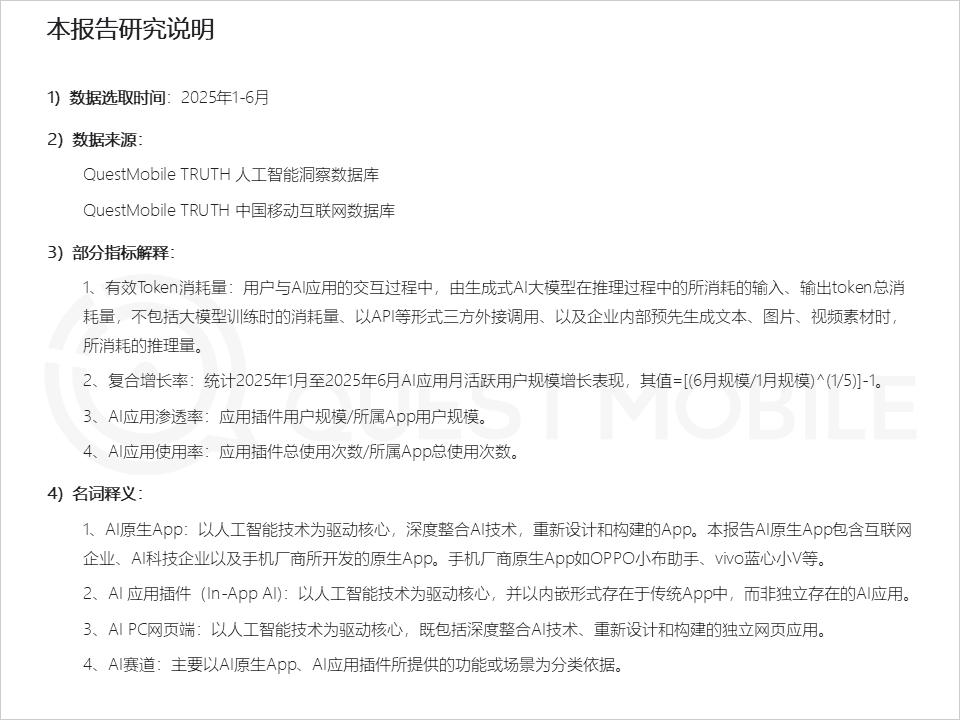
Core Insights - The article discusses the "AI Application Industry Monthly Report" for August 2025, highlighting the growth and challenges within the AI application landscape, driven by government initiatives and user engagement metrics [3][4][7]. Group 1: Industry Overview - The "Opinions on Deepening the Implementation of 'Artificial Intelligence +'" was released by the State Council, outlining milestones for 2027, 2030, and 2035, focusing on enhancing foundational model capabilities and data supply innovation [4][7]. - As of August 2025, the user base for native apps in the internet and AI technology sector reached 277 million, while In-App AI users totaled 622 million, indicating a combined AI application user base of 645 million [4][22]. Group 2: User Engagement and Growth Metrics - The top 50 AI applications by monthly active users show that In-App AI applications dominate with 29 entries, followed by PC web applications (9), mobile AI assistants (6), native apps (5), and PC client applications (1) [4][28]. - The leading AI search engine and comprehensive assistant applications have user bases of 672 million and 651 million, respectively, with AI information retrieval emerging as a significant growth area, showing a 39% month-over-month increase [4][26][38]. Group 3: Competitive Landscape - The competitive landscape reveals that while major applications continue to grow, long-tail applications (under 100,000 users) are struggling, with an average month-over-month decline of 6.7% [5][37]. - Mobile AI assistants from manufacturers like OPPO, Xiaomi, and Huawei hold significant market shares, with user engagement rates varying, where Xiaomi's assistant shows a 37.7% active user rate due to its integration with smart home devices [5][58]. Group 4: Application Categories and Challenges - The report categorizes AI applications into five main types, each facing unique challenges: native apps are stable but long-tail applications struggle; In-App AI applications show a clear divide between top and bottom performers; and PC applications are experiencing traffic declines [5][35][46]. - The AI search sector is characterized by a "function easy to popularize, habit hard to cultivate" dilemma, with only three of the top ten search applications achieving over 10% usage [67][69]. Group 5: Future Directions - The future focus for mobile AI assistants is shifting towards enhancing user experience and retention, with a growing emphasis on intelligent data management and personalized services [57][60]. - The integration of AI search with service offerings is becoming a consensus, with the need to stimulate user search behavior being critical for commercial success [73][75].

QuestMobile 2025年AI应用市场半年报:移动端达6.8亿,三类形态应用此消彼长,手机厂商亟需提升生态整合能力……
3 6 Ke· 2025-08-05 02:47
Core Insights - The AI application market is rapidly evolving, with a significant increase in user engagement across various segments, leading to the formation of four distinct tiers of applications [1][12][19]. Group 1: Market Overview - As of June 2025, the first tier includes AI search engines and comprehensive assistants, with monthly active users (MAU) reaching 685 million and 612 million respectively [1]. - The second tier consists of AI social interaction and professional advisors, with MAUs of 126 million and 111 million [1]. - The third tier includes AI efficiency tools and image processing applications, with MAUs of 69 million and 49 million [1]. - The fourth tier encompasses AI creative design, copywriting, and educational applications, each around 20 million MAUs [1]. Group 2: User Engagement Trends - The "In-App AI" model has seen a user base of 630 million, while native apps have 570 million users, and PC web applications have 180 million users, indicating a shift towards mobile and integrated solutions [1][9]. - The growth of application plugins reflects users' preference for seamless AI experiences, with notable usage rates for Baidu AI and Quark AI search at 9.6% and 56.0% respectively [2][19]. Group 3: Competitive Landscape - The market is witnessing a dual oligopoly, where the combination of "search + service" is reshaping traffic entry points, leading to service integration and the development of intelligent agents [12][24]. - The majority of PC web players are facing decline, with 80% of them having user counts below 500,000 and 68.8% experiencing negative growth [2][31]. Group 4: Application Performance - Among software service providers, the photography and beautification sector is rapidly adopting AI plugins, driven by the "aesthetic economy" [14]. - As of June 2025, the average app with AI integration has 2.1 AI applications, with photography apps averaging 5.5 AI features [15][27]. Group 5: Future Outlook - The integration of AI into mobile applications is expected to enhance user engagement, with a focus on system-level integration capabilities [9][49]. - The competition will hinge on becoming the "only option" in users' minds or embedding deeply into essential workflows, with model iteration speed and ecosystem integration being critical factors for success [56].