恒生科技ETF南方

Search documents
集体拉升!大反弹在即?
格隆汇APP· 2026-03-25 09:36
Core Viewpoint - The article discusses the recent downturn in the Hang Seng Technology Index, attributing it to three main negative factors, and questions whether the index has reached a value bottom [2][3]. Group 1: Factors Driving the Downturn - The first factor is the heightened global risk aversion due to the Iran conflict, which has led to significant disruptions in the Strait of Hormuz and increased oil prices, with Brent crude surpassing $100 per barrel [4][5][6][7]. - The second factor is the renewed expectations of monetary tightening by the Federal Reserve, as indicated by Chairman Powell's hawkish remarks, which have raised concerns about liquidity and inflation [9][10][12][13]. - The third factor involves disappointing market reactions to earnings reports from major tech companies like Tencent and Alibaba, despite their solid financial performance, due to concerns over AI capital expenditures and competitive dynamics [14][15][16]. Group 2: Current Valuation of the Hang Seng Technology Index - The Hang Seng Technology Index is currently at a historical low valuation, with a PE (TTM) ratio of 21.41, placing it in the 19.66% historical percentile, indicating that 80% of the time, valuations have been higher [20]. - Relative to similar indices, the Hang Seng Technology Index is significantly undervalued, with the Nasdaq at 37.43 and the ChiNext Index at 40.1, suggesting that the Hang Seng's valuation is slightly more than half of the Nasdaq and equal to about half of the ChiNext [23][24]. - Earnings growth expectations for the Hang Seng Technology Index are projected at 34% for 2026, with a PEG ratio of less than 1, indicating that the low valuation is not based on deteriorating earnings expectations but rather on market sentiment and external liquidity pressures [25][26]. Group 3: Market Sentiment and Fund Flows - Domestic investors are actively buying into the market, with net inflows from southbound funds reaching HKD 403.84 billion since March, indicating a positive long-term outlook despite the current downturn [36]. - The Hang Seng Technology ETF has seen a net inflow of HKD 1.342 billion this year, reflecting continued interest in core technology assets [37]. - In contrast, foreign investors remain cautious, although interest in Chinese stocks has reportedly increased, with only about 10% of surveyed clients considering Chinese stocks "uninvestable," a significant improvement from two years ago [41][42]. Group 4: Conditions for a Potential Rebound - A potential rebound in the Hang Seng Technology Index may depend on several conditions, including a de-escalation of the Iran conflict and a subsequent improvement in market sentiment regarding oil prices, inflation, and interest rates [30][31]. - The commercial viability of AI technologies is also crucial, as evidenced by Tencent and Alibaba's earnings reports showing tangible benefits from AI, which could provide fundamental support for the sector [32][33]. - Overall, while the index is currently undervalued, a sustained rebound will require careful monitoring of geopolitical risks, monetary policy expectations, and the pace of AI commercialization [45].


估值底已现?资金借道公募ETF加速南下!
券商中国· 2026-03-17 01:17
Core Viewpoint - The Hong Kong stock market, driven by new technology and new consumption, is experiencing a strong rebound, supported by public funds and increased capital inflow from the Middle East [1][4]. Group 1: Market Performance - On March 16, the Hang Seng Technology Index rebounded by 2.69%, leading a collective rise in sectors such as internet, new technology, and new consumption, indicating a valuation recovery for previously adjusted industries [2][3]. - The Hang Seng Technology ETF saw a significant increase of approximately 6 times in shares over four months, reflecting heightened trading activity and institutional interest [2][3]. Group 2: Institutional Investment Trends - Institutional investors are expected to gradually enter the market as many Hong Kong companies prepare to disclose their earnings at the end of the month, with a notable focus on QDII and mainland fund heavyweights [3][4]. - The influx of Middle Eastern capital is recognized as a key factor in supporting the Hong Kong market, with various companies establishing strategic partnerships in the region [4]. Group 3: Valuation and Investment Strategy - The Hang Seng Technology Index's PE-TTM is currently at 21.21 times, indicating it is at a historical low valuation, below 85% of its historical periods, with a cumulative decline of 28% since its peak in October 2025 [5][6]. - Compared to global tech indices, the Hang Seng Technology Index offers significant valuation advantages, being approximately 50% cheaper than the ChiNext Index and 40% cheaper than the NASDAQ Index [6]. Group 4: Future Outlook - Fund managers express confidence in the long-term recovery potential of Hong Kong technology stocks, driven by low valuations, capital inflows, and ongoing industrial upgrades [7][8]. - The focus for stock selection should be on companies with stable performance, reasonable valuations, and high gross margins, particularly in the AI sector, which is expected to be a core theme for 2026 [8].

南方基金旗下恒生科技ETF南方(520570)放量上行,低位配置价值凸显
Sou Hu Cai Jing· 2026-02-27 06:09
Group 1 - The Hang Seng Technology Index rebounded, reaching 5156.06 points, up 0.91% from the previous trading day, with a trading volume of 11.73 billion shares and a turnover of 32.5 billion HKD, indicating a moderate increase in trading activity [1] - The current PE-TTM of the Hang Seng Technology Index is 21.35 times, which is at a historical low of 26.0% over the past year, providing a significant valuation advantage compared to the STAR 50 Index (165 times) and the NASDAQ 100 Index (34 times) [1] - The market sentiment is gradually improving, as evidenced by the Hang Seng Index rising 0.96%, reflecting a recovery in overall market sentiment [1] Group 2 - The moderate rise in the Hang Seng Technology Index reflects a gradual repair of market sentiment, supported by the AI partnership emphasis from Anthropic, alleviating concerns about traditional software companies being replaced by AI [2] - The Hang Seng Technology ETF (520570) closely tracks the Hang Seng Technology Index and includes 30 large-cap, liquid tech companies listed in Hong Kong, making it a key tool for capturing trends in the Hong Kong tech sector [2] - The combination of low historical valuations, continued inflow of southbound funds, and the acceleration of AI commercialization suggests that the index may continue to experience structural upward movement in the short term, with a sustained recovery logic in the medium term [2]
南方基金:用“春夏秋冬”看恒生科技,当前是机会or风险?
Sou Hu Cai Jing· 2026-02-26 16:20
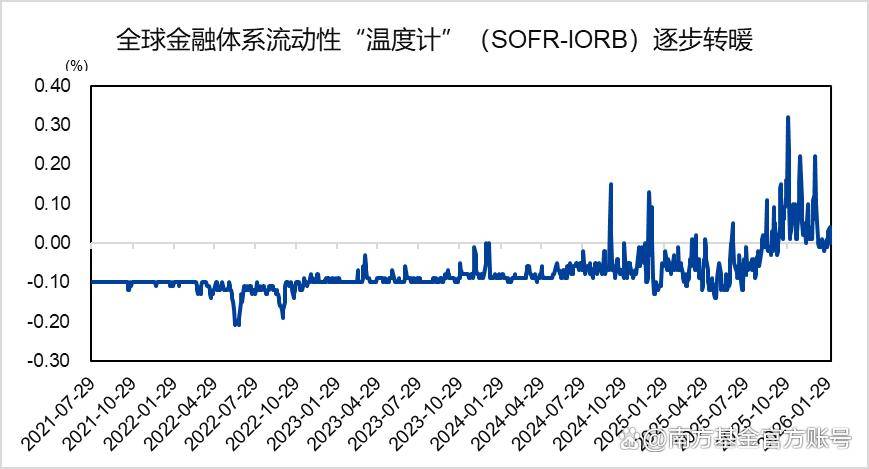
Group 1 - The Hang Seng Tech Index is viewed with mixed feelings by investors, appreciated for its elasticity during market rallies but criticized for its volatility and the need for precise timing in entry and exit [2][3] - The recent performance of the Hang Seng Tech Index shows a decline from 5725.99 points on January 26 to 5260.50 points on February 25, representing a drop of 9.27% over the month, indicating a challenging holding experience for investors [3][4] - The external liquidity environment is tightening, significantly impacting the performance of the Hang Seng Tech Index, as it is influenced by the dollar liquidity conditions despite the Fed being in a rate-cutting cycle [4][5] Group 2 - Some forward-looking indicators are showing signs of improvement, such as the narrowing spread between SOFR and IORB, which suggests that the previously tight liquidity conditions are beginning to ease [6][7] - In the context of high-risk, high-elasticity assets like the Hang Seng Tech Index, cost considerations are crucial for long-term investment success, with lower fees potentially leading to significantly better returns over time [9][10] Group 3 - The Hang Seng Tech Index is currently undervalued compared to other indices like the ChiNext and NASDAQ, which may provide significant upside potential if macro conditions improve and liquidity increases [10][12] - Recent market adjustments are not indicative of systemic risk but rather structural adjustments, with a stable market sentiment and continued capital inflow reflecting long-term investment value [14][15]
资金借道ETF布局港股
Xin Lang Cai Jing· 2026-02-13 02:42
Group 1 - The core viewpoint of the news highlights the performance and trends of the Hang Seng Technology ETF and its underlying index, indicating a mixed performance among its constituent stocks, with notable gains from companies like Hua Hong Semiconductor and Lenovo [1][4] - As of February 12, the Hang Seng Technology ETF has seen continuous net inflows over the past eight days, with a total net inflow of 544.35 billion yuan into Hong Kong-themed ETFs this year, reflecting a strong investor interest despite market adjustments [2] - The Hang Seng Technology Index, which the ETF tracks, includes the top 30 Hong Kong-listed companies highly related to technology themes, with major constituents such as Alibaba, SMIC, and Tencent, representing the overall performance of leading tech firms in the Hong Kong market [4] Group 2 - Xiaomi's founder and CEO Lei Jun announced significant advancements in the company's robotics team, showcasing the Xiaomi-Robotics-0 model, which has achieved optimal results in various mainstream test sets and has been open-sourced [3] - Xiaomi Group also announced a share buyback of 4.05 million shares at prices ranging from 36.500 to 36.780 Hong Kong dollars, totaling approximately 148 million Hong Kong dollars, indicating a strategic move to enhance shareholder value [3] - Despite global market volatility affecting the tech sector, there remains a substantial inflow of foreign and southbound capital into the Hong Kong stock market, particularly benefiting traditional sectors like agriculture and food and beverage [3]

资金借道ETF布局港股,科技赛道成配置主力,南方基金旗下恒生科技ETF南方(520570)连续8日获资金净流入
Xin Lang Cai Jing· 2026-02-13 02:39
Group 1 - The Hang Seng Technology ETF (520570) has seen a trading volume of 30.1388 million yuan as of February 13, 2026, with mixed performance among its constituent stocks, including a 2.66% increase in Hua Hong Semiconductor and a 2.11% rise in Lenovo Group [1] - As of February 12, the Hang Seng Technology ETF has experienced continuous net inflows for eight consecutive days, indicating strong investor interest [1] - The cross-border ETF market has reached a scale of 1 trillion yuan, with Hong Kong-themed ETFs totaling 822.451 billion yuan, and a net inflow of 54.435 billion yuan year-to-date as of February 11 [1] Group 2 - Xiaomi's founder and CEO Lei Jun announced the successful development of the embodied intelligence VLA model, Xiaomi-Robotics-0, which has achieved optimal results in various mainstream test sets and has been open-sourced [2] - Xiaomi Group-W has repurchased 4.05 million shares at a price range of 36.500 to 36.780 HKD per share, totaling 148 million HKD [2] - Despite global market volatility, foreign and southbound capital continues to flow significantly into the Hong Kong stock market, benefiting traditional sectors such as agriculture, food and beverage, and transportation [2] Group 3 - The Hang Seng Technology Index tracks the top 30 Hong Kong-listed companies highly related to technology themes, with major constituents including Alibaba-W, SMIC, BYD, Meituan-W, and Xiaomi Group-W [3] - The index is designed to represent the overall performance of leading technology companies in Hong Kong, selected based on criteria such as operational use of technology platforms and R&D expenditure as a percentage of revenue [3]
恒生科技ETF南方(520570)获资金逆势加仓
2 1 Shi Ji Jing Ji Bao Dao· 2026-02-06 06:16
Group 1 - The Hong Kong stock market opened lower on February 6, with the Hang Seng Tech Index dropping over 2% before narrowing its losses, closing at 5349.48 [1] - The Southern Fund's Hang Seng Tech ETF (520570) experienced active trading, with a transaction amount of approximately 96.62 million yuan and a turnover rate of about 3.70% [1] - During this adjustment phase, there was a notable trend of capital accumulation, with the ETF seeing a net subscription of around 77.85 million yuan on February 4, ranking 17th out of 212 in net inflows among cross-border ETFs, and a cumulative net inflow of approximately 78.75 million yuan over the past five days, indicating strong medium to long-term investment interest in the Hong Kong tech sector [1] Group 2 - Brokerages generally believe that the current valuation of the Hong Kong tech sector is at a near five-year low, with the Hang Seng Tech Index's yield differential compared to the ChiNext Index at a historical high, suggesting a high margin of safety [1] - The Hong Kong tech sector occupies a core position in AI application and commercialization, with strong certainty in profit growth, supported by expectations of a weak US dollar and stabilization of the RMB, which may jointly bolster the sector's valuation recovery [1] - On February 4, southbound trading saw a net purchase of approximately 6.16 billion HKD in Hong Kong stocks, with major tech leaders like Tencent and Alibaba receiving significant net inflows, and on February 5, net purchases exceeded 8 billion HKD [1]
回调后的恒生科技,性价比凸显
Sou Hu Cai Jing· 2025-11-17 03:44
Core Viewpoint - The market has gained confidence in the Hang Seng Tech Index following Tencent's earnings report, which exceeded expectations and initiated a buyback, providing market support. Additionally, the end of the U.S. government shutdown and potential interest rate cuts by the Federal Reserve in December may drive a new rally in Hong Kong stocks [1]. Group 1: Market Conditions - The Hang Seng Tech Index is currently at a pivotal point, with recent lows around 5700, primarily due to declines in the U.S. stock market and global risk aversion [2]. - The recent volatility in U.S. markets has not significantly affected major Hong Kong stocks like Tencent and Alibaba, which have shown relative stability [1][3]. - The upcoming macroeconomic clarity and potential interest rate cuts by the Federal Reserve are expected to provide upward momentum for Hong Kong stocks [1][3]. Group 2: Investment Strategies - Investors are encouraged to consider index products like the newly listed Hang Seng Tech ETF (520570) to capitalize on the index's recovery potential [1][23]. - The Southbound capital flow has been a stabilizing factor for the Hong Kong market, providing support during periods of volatility [11]. - The Hang Seng Tech ETF features a low management fee of 0.15%, making it an attractive option for investors looking to minimize costs while gaining exposure to key tech stocks [24][25]. Group 3: Valuation and Growth Potential - Tencent's third-quarter advertising revenue grew by 21% year-on-year to 36.2 billion CNY, driven by increased ad loads and AI-driven targeting improvements [19]. - Tencent's current valuation is around 16 times PE, with a target price of 700 CNY, indicating potential upside as earnings per share (EPS) grow [21]. - The overall valuation of Hong Kong tech stocks remains low compared to their U.S. counterparts, suggesting significant room for growth as market conditions improve [21][9].


ETF市场日报 | 油气相关ETF逆市领涨!AI资产回调居前
Sou Hu Cai Jing· 2025-11-14 07:54
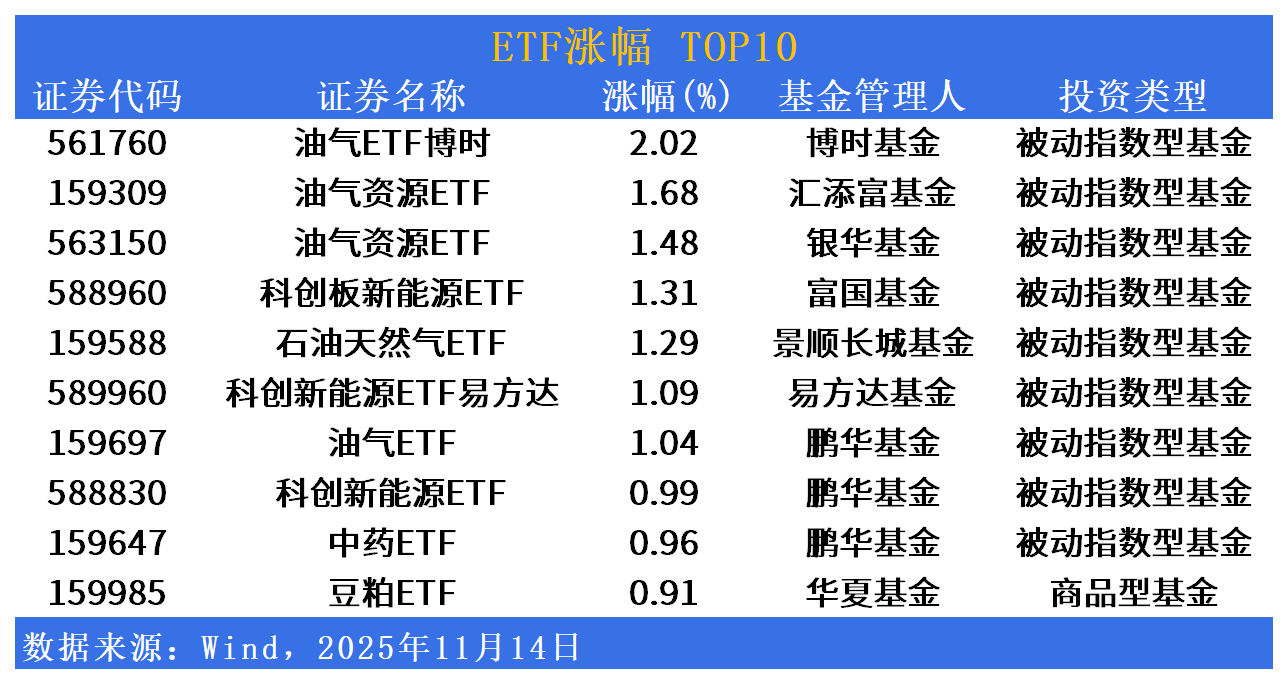
Market Overview - A-shares experienced a collective pullback with the Shanghai Composite Index down by 0.97%, Shenzhen Component down by 1.93%, and ChiNext down by 2.82% on November 14, 2025, with a total trading volume of 1,958.1 billion yuan [1] ETF Performance - Oil and gas-related ETFs led the gains, with the top performers including: - Oil and Gas ETF Bosera (561760) up by 2.02% - Oil and Gas Resource ETF (159309) up by 1.68% - Oil and Gas Resource ETF (263150) up by 1.48% [2] - Conversely, the top decliners included: - Sino-Korea Semiconductor ETF (513310) down by 4.45% - Hang Seng Internet ETF (159688) down by 3.66% - ChiNext AI ETF Guotai (159388) down by 3.64% [4] Sector Insights - Guolian Minsheng Securities noted that OPEC+ unexpected production increases and U.S. tariffs are pressuring oil prices, but a slowdown in U.S. oil and gas production growth may provide fundamental support. The focus remains on leading oil and gas central enterprises with quality upstream assets and high dividends [3] - The current investment strategy is diversified, emphasizing "anti-involution," domestic demand, and emerging industries. The traditional cyclical chemical sector is expected to see improvements as excess capacity is gradually eliminated [3] A-share Strategy Outlook - Guoxin Securities projected that the bull market initiated in 2024 is not over, entering its second phase with a shift from sentiment to fundamentals. The focus for 2026 will be on technology, particularly in AI applications, robotics, and smart driving [5] - The market is expected to revolve around themes of technological self-reliance, industrial upgrades, and resource security, with opportunities in AI, semiconductors, and high-end manufacturing [5] ETF Trading Activity - The Short-term Bond ETF (511360) had the highest trading volume at 19.797 billion yuan, followed by Silver Hua Daily ETF (211880) at 12.553 billion yuan and Huabao Tianyi ETF (211990) at 11.818 billion yuan [6][7] - The National Debt Policy Bond ETF (511580) led in turnover rate at 275%, indicating high trading activity [7] New ETF Launch - A new QDII product, the Hang Seng Technology ETF Southern (520570), will be launched next Monday, tracking the Hang Seng Technology Index. It is suitable for investors optimistic about China's long-term tech development [8]

风起青萍,财随势动——解读十五五中暗藏了哪些机会
点拾投资· 2025-11-07 06:45
Core Viewpoint - The article emphasizes the importance of the "15th Five-Year Plan" in shaping investment strategies, highlighting the shift towards a modern industrial system and the prioritization of technological self-reliance and innovation as key drivers for economic growth [1][12]. Summary by Sections Introduction - The "15th Five-Year Plan" prioritizes the construction of a modern industrial system and sets "technological self-reliance" as the second development goal, providing quantifiable targets for the capital market [1]. Historical Context - Previous five-year plans have led to the emergence of significant industries: - The 12th Five-Year Plan (2011-2015) focused on seven strategic emerging industries including energy conservation and new energy vehicles [2]. - The 13th Five-Year Plan (2016-2020) emphasized supply-side reforms [3]. - The 14th Five-Year Plan (2021-2025) introduced a focus on carbon neutrality and supply chain security [4]. Investment Opportunities - The "15th Five-Year Plan" is expected to drive investment in strategic emerging industries, with a focus on sectors such as new energy, biotechnology, and high-end equipment [7][12]. - Historical data shows that industries highlighted in the 14th Five-Year Plan have outperformed the market, with significant excess returns observed in sectors like photovoltaics and new energy vehicles [6][8]. Policy Tools - The article outlines the policy tools prepared for the "15th Five-Year Plan": 1. Fiscal measures to enhance macroeconomic policies and increase central government spending. 2. Monetary policies aimed at developing direct financing and financial markets. 3. Industrial policies to boost innovation and new productivity [4]. Strategic Focus Areas - The "15th Five-Year Plan" identifies key strategic areas for investment, including: - Advanced manufacturing, artificial intelligence, and semiconductor industries as core components of the hard technology sector [15][18]. - Emphasis on the integration of technology and industry, with a focus on scaling innovations [12][16]. ETF Recommendations - Specific ETFs are highlighted as investment vehicles to capitalize on the trends outlined in the "15th Five-Year Plan": 1. Chip ETF focusing on semiconductor industries. 2. AI ETF targeting companies in the artificial intelligence sector. 3. Robotics ETF covering the entire robotics supply chain [18][29]. Conclusion - The article concludes that the "15th Five-Year Plan" is not just a domestic economic strategy but also a framework for global capital reallocation, with significant implications for investment in technology and innovation [28].