抖音豆包

Search documents
A股马年“开门红”
Sou Hu Cai Jing· 2026-02-24 10:50
Market Performance - A-shares opened strong on the first trading day after the Lunar New Year, with the Shanghai Composite Index rising by 0.87% to 4117.41 points, and the Shenzhen Component Index increasing by over 1% [1][3] - The total market turnover exceeded 2 trillion yuan, with over 4,000 stocks rising and 111 stocks hitting the daily limit [1] Sector Performance - Defensive sectors showed strong performance, with resource stocks experiencing a rebound; indices for energy equipment, oil and gas, and precious metals led the gains [1][4] - The hard technology sector also performed well, particularly in optical modules (CPO) and optical communication concepts, while several large model concepts, including AI applications and the film and media sector, saw declines [3][4] Analyst Insights - Analysts noted that the overall market performance was impressive, with resource-heavy stocks significantly supporting the indices; the Shenzhen Component Index rose by 1.36% and the ChiNext Index by 0.99% [3] - Geopolitical risks and inflation expectations have driven a collective surge in resource sectors, while AI application and media sectors experienced notable pullbacks [4] Future Market Outlook - Analysts predict that the market will continue to show upward momentum, particularly as the "Two Sessions" approach, with a focus on structural opportunities rather than broad index movements [6] - The expectation of a stronger renminbi and the upcoming policy drivers from the "Two Sessions" are seen as supportive factors for the A-share market [6]
4100点+3万亿,同日突破!A股,今天发生了什么
Mei Ri Jing Ji Xin Wen· 2026-01-09 08:08
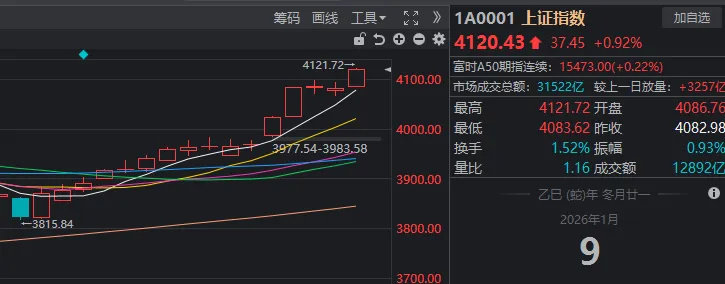
Market Performance - The Shanghai Composite Index (沪指) opened high and broke through the 4100-point mark, closing up 0.92%, while the Shenzhen Component Index (深成指) rose over 1% and the ChiNext Index (创业板指) increased by 0.77% [1] - The total market turnover reached 3.12 trillion yuan, marking a significant increase of 322.4 billion yuan from the previous trading day, and it was the fifth time in history that turnover exceeded 3 trillion yuan [1] - The Shanghai Composite Index saw a weekly increase of 3.82%, moving from 3983 points to 4121 points [1] Sector Performance - Leading sectors included AI applications, commercial aerospace, and controllable nuclear fusion, while the brain-computer interface sector experienced a decline [1] - The brain-computer interface concept saw a cumulative increase of over 20% since the beginning of the year, although it was the only sector among strong performers to close down on Friday [11] - The commercial aerospace sector also performed well, with a cumulative increase of over 22% since December 24, and an 11.41% rise this week [11] Economic Indicators - The Consumer Price Index (CPI) for December showed a month-on-month increase of 0.2% and a year-on-year increase of 0.8%, indicating a recovery in consumer demand [7] - The Producer Price Index (PPI) also showed signs of improvement, with a month-on-month increase of 0.1% and a narrowing year-on-year decline [7] - Analysts believe that the recovery in CPI and PPI supports the trend of economic stabilization, providing a fundamental basis for the capital market [7] Future Outlook - According to China International Capital Corporation (中金公司), the upward trend in A-shares is expected to continue into 2026, with an anticipated influx of 2 trillion yuan in new capital throughout the year [7] - The report from Guosen Securities (国信证券) suggests that retail investor participation is likely to increase, with active retail funds expected to enter the market [8] - The AI application sector is projected to enter a "golden year" in 2026, driven by technological advancements, supportive policies, and increasing market demand [13]

利好传来,A股大涨!4100点+3万亿同日突破!发生了什么?
天天基金网· 2026-01-09 08:04
Market Performance - On January 9, the market experienced a significant rally, with the Shanghai Composite Index breaking through 4100 points, closing up 0.92%, while the Shenzhen Component Index rose by 1.15% and the ChiNext Index increased by 0.77% [2] - The overall market saw over 3900 stocks rise, with more than a hundred stocks hitting the daily limit for two consecutive days. The trading volume reached 3.12 trillion yuan, marking the fifth time in history that it surpassed 3 trillion yuan [2] Weekly Overview - In the first week of 2026, the Shanghai Composite Index gained 3.82%, moving from 3983 points to 4121 points. The trading volume for the first four days exceeded 2.5 trillion yuan, with Friday's volume soaring to 3.15 trillion yuan, marking a return to the 3 trillion yuan level after 73 trading days [3] Economic Indicators - The rise in market confidence was likely bolstered by the release of CPI and PPI data from the National Bureau of Statistics. In December, the CPI increased by 0.2% month-on-month and 0.8% year-on-year, while the core CPI rose by 1.2% year-on-year. The PPI saw a month-on-month increase of 0.1% and a narrowing year-on-year decline [10] - Analysts believe that the recovery in CPI and PPI data supports the trend of economic stabilization, providing a fundamental backing for the capital market [11] Investment Outlook - Looking ahead to 2026, the A-share market is expected to continue its upward trend, with an anticipated influx of 2 trillion yuan in new capital driven by increased retail participation [11][12] - The report from Guosen Securities indicates that retail investors are likely to become more active, while institutional and foreign capital flows may improve [12] Sector Performance - Key sectors such as AI applications, commercial aerospace, and controllable nuclear fusion have led the market rally, while the brain-computer interface sector saw a decline [2][14] - The brain-computer interface concept recorded a year-to-date increase of 21.82%, while commercial aerospace gained 11.41% this week [15][16] AI Application Growth - The AI application sector is expected to experience significant growth in 2026, driven by technological advancements, supportive policies, and increasing market demand [18] - According to Huaxin Securities, 2026 is projected to be a "golden year" for AI applications, with major models like GPT-5 and Gemini 3 expected to enhance capabilities [18]

大模型:第一股,第一考
Bei Jing Shang Bao· 2026-01-08 15:45
Group 1 - The core point of the article is that Zhiyuan's successful IPO marks a significant milestone for the AI industry in China, showcasing the transition from technological exploration to commercial validation [1][2] - Zhiyuan's stock price rose over 13% on its first trading day, establishing it as the "first global stock of large models" and highlighting the growing market expectations for AI commercialization [1][2] - The company aims to leverage its technological capabilities and commercial ambitions to compete with major players in the B-end market, indicating a strong market positioning [1][2] Group 2 - The AI industry is at a critical juncture, shifting from parameter competition to practical application, which requires companies to demonstrate sustainable financial performance and clear profitability [2][3] - The competitive landscape in Beijing is intensifying, with the city aiming to become the "global AI capital" and achieve a core industry scale exceeding 1 trillion yuan within two years [3] - Zhiyuan is one of over 200 registered large model competitors in Beijing, indicating a crowded and competitive market environment [3]
中国AI崛起,“根”在这里
Bei Ke Cai Jing· 2026-01-08 08:52
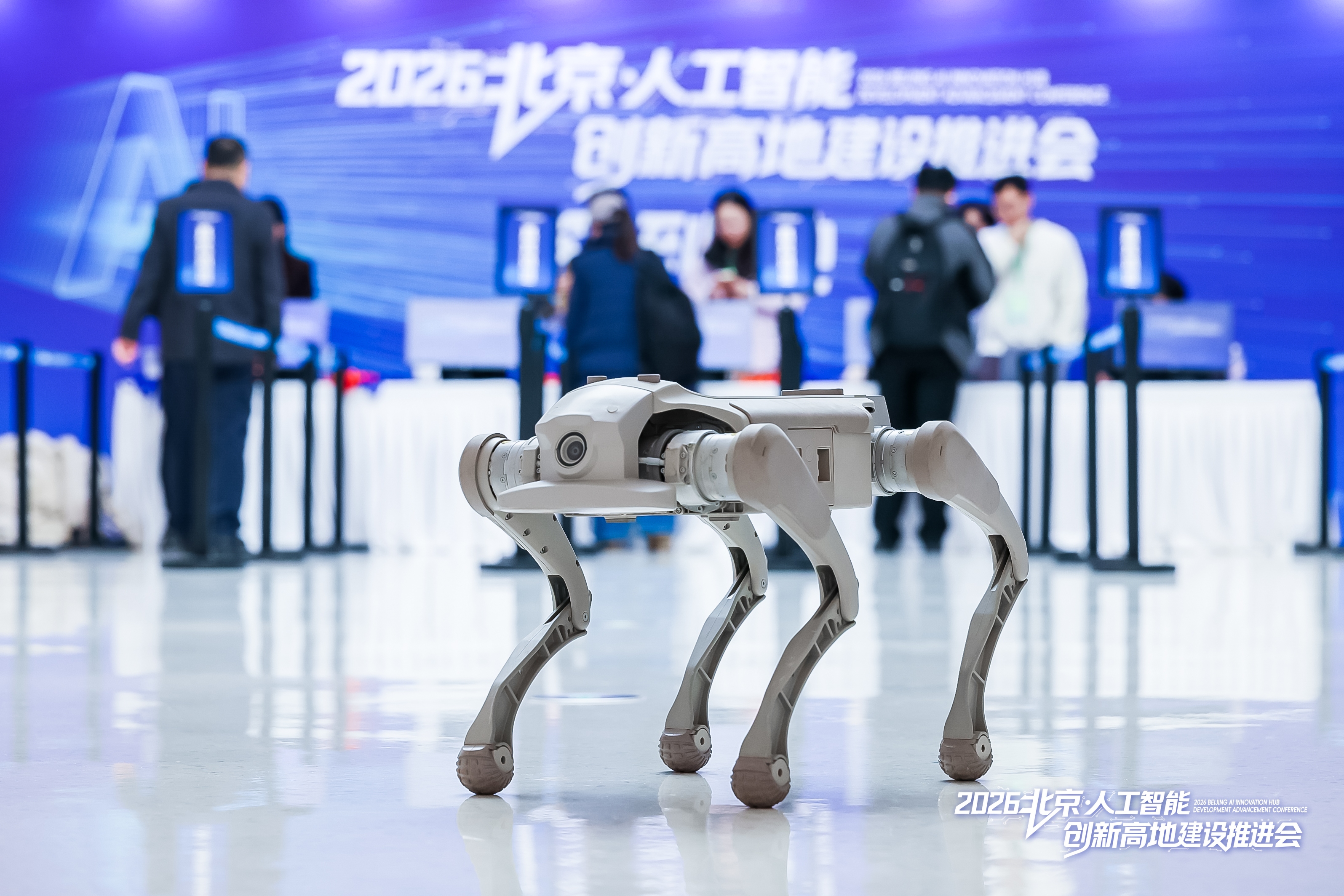
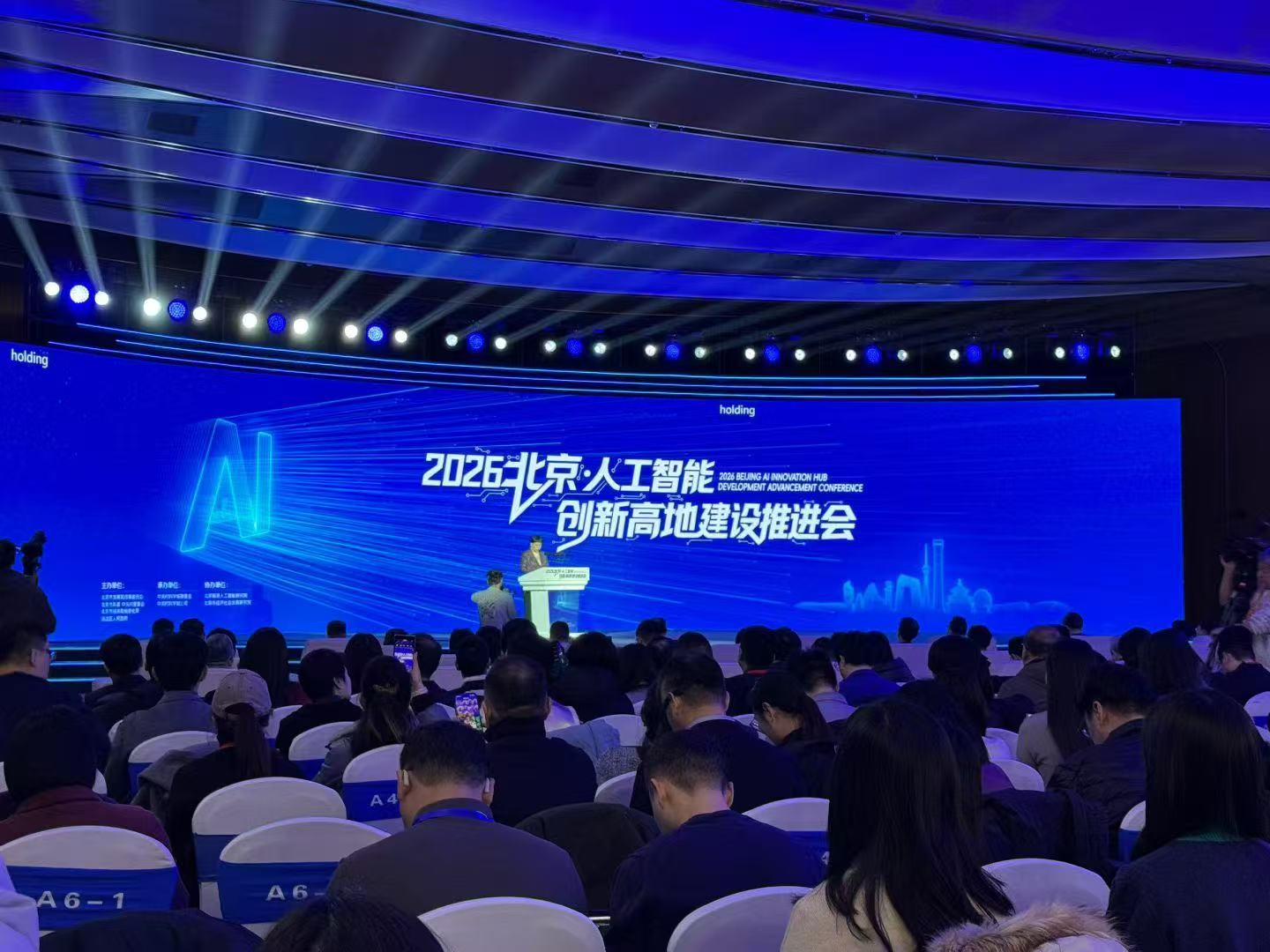
Core Insights - The "AI New Year First Meeting" was held in Beijing on January 5, focusing on the construction of the 2026 Beijing Artificial Intelligence Innovation High Ground [5][18] - Beijing has rapidly advanced its position in the global AI landscape, with numerous prominent AI models emerging from the city [4][8] - The city is recognized as a fertile ground for tech startups due to its talent pool, research resources, and supportive government policies [4][11][18] Group 1: AI Development and Innovation - The Beijing Academy of Artificial Intelligence officially released the "Zhongzhi FlagOS 1.6," a software stack aimed at solving compatibility issues for training large models across different AI chips [5] - Beijing's AI research output is significant, with 7,340.3 adjusted papers and an AI index of 402.59, placing it first globally [8] - The city has transformed from a "follower" to a core source of AI research and innovation [8] Group 2: Talent and Ecosystem - The concentration of high-end, interdisciplinary talent in Beijing is a key factor driving innovation in the AI sector [4][11] - The presence of major universities like Tsinghua University facilitates a strong academic atmosphere, fostering a culture of innovation among young researchers [6][11] - Companies in Beijing benefit from a well-established AI ecosystem that encourages collaboration and avoids isolated development [11][12] Group 3: Government Support and Policy - The Beijing government demonstrates a deep understanding of technological frontiers, providing strong support for long-term investments and early-stage startups [18][19] - The city is developing multiple innovation districts, including the Haidian Original Community, to enhance its AI industry landscape [18][20] - Beijing's development strategy emphasizes a "one committee, one industry, one area, one product" approach to foster AI integration across various sectors [19] Group 4: Industry Growth and Future Prospects - By 2025, Beijing's core AI industry is projected to reach a scale of 450 billion yuan, with over 2,500 companies established [16] - The city is expected to continue leading in AI innovation, contributing to various sectors such as healthcare, governance, and industry [22][23] - The narrative of Beijing's AI development reflects China's commitment to technological self-reliance and innovation [22][23]
北京新年AI第一会:瞄准“第一城”,两年内产业规模破万亿
2 1 Shi Ji Jing Ji Bao Dao· 2026-01-07 11:33
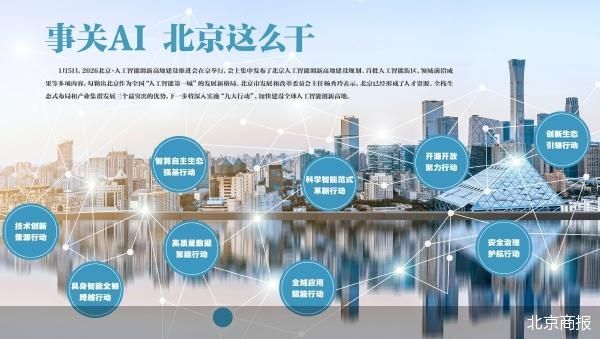
Core Insights - Beijing aims to establish itself as a global hub for artificial intelligence (AI) with a comprehensive action plan that includes significant quantitative targets for the AI industry [2][3] Group 1: Action Plan and Goals - The "Beijing AI Innovation High Ground Construction Action Plan" was launched, targeting a substantial enhancement in original capabilities for AI foundational theories and core technologies within two years [2][6] - The core AI industry is projected to exceed 1 trillion yuan, with a goal of reaching 4.5 trillion yuan by 2025 [3][6] - The plan encompasses nine major actions, including technology innovation, data aggregation, and application empowerment, aiming to create a complete ecosystem for AI development [4][6] Group 2: Market and Talent Landscape - Beijing has become a focal point for AI enterprises, housing nearly half of the nation's AI companies and achieving over 200 registered large models [3][4] - The city boasts a significant talent pool, with 148 influential AI scholars listed in the AI 2000 global ranking, representing over 40% of the national total [3][4] - The AI industry in Beijing is characterized as talent-intensive, with top talent being a critical resource for competitive advantage [3] Group 3: Industry Developments and Innovations - Haidian District remains a central hub for AI, with a complete industry chain covering chips, frameworks, large models, and integrated applications [7][9] - Notable companies such as Cambricon, Kunlun, and Moore Threads have gained prominence, with Moore Threads being recognized as the "first domestic GPU stock" [7][9] - The district aims to achieve an AI core industry scale of 2.822 trillion yuan by 2024, maintaining an annual growth rate of 30% [9][10] Group 4: Future Initiatives - Haidian plans to solidify its position as a source of original innovation and a gathering place for emerging industries, focusing on creating an "AI super application" environment [10] - The district will also develop an AI service platform to facilitate global collaboration and support companies in international markets [10]
多地召开新年第一会,信息量很大
21世纪经济报道· 2026-01-07 10:10
Core Viewpoint - The article discusses the strategic initiatives and economic plans of various provinces in China for the year 2026, emphasizing the importance of technology innovation, major project construction, and consumer spending to achieve a strong economic start for the "14th Five-Year Plan" period [1][6]. Group 1: Technology Innovation - Hubei aims to become a highland for original innovation and strategic talent during the "14th Five-Year Plan," focusing on enhancing research platforms and promoting enterprise-led collaborative innovation [3]. - Beijing's action plan for building an artificial intelligence innovation hub includes nine major actions aimed at achieving a core industry scale of 1 trillion yuan within two years, with significant investments in data and technology [4][5]. Group 2: Major Project Construction - Henan's 2026 plan emphasizes the integration of infrastructure and industrial projects, with a focus on advanced manufacturing and major infrastructure developments [8]. - Yunnan has declared 2026 as a year for project breakthroughs, aiming to enhance investment efficiency and prioritize industrial projects to ensure economic growth [9]. Group 3: Consumer Spending - Guangdong's government is actively promoting consumer spending through various initiatives, including a recycling program for consumer goods, which has already generated significant sales [11][12]. - Hainan is focusing on enhancing its free trade port by boosting consumer spending and expanding the supply of quality goods and services, with a target GDP of over 800 billion yuan for 2025 [13][14].

4500亿元!北京正在打造“人工智能第一城”
Xin Lang Cai Jing· 2026-01-07 10:07
Core Insights - The "Beijing Artificial Intelligence Innovation High Ground Construction Action Plan" was officially released, marking a new phase in Beijing's journey to become the "AI Capital" [1][8] - By 2025, the core AI industry in Beijing is projected to reach a scale of 450 billion yuan, with over 2,500 companies, accounting for approximately half of the national total [1][8] Industry Development - Beijing has made significant progress in implementing the "AI+" action plan, leading to the initial emergence of industrial cluster effects and a complete AI industry chain covering foundational, technical, and application layers [3][10] - As of mid-2025, the core AI industry in Beijing reached 215.22 billion yuan, reflecting a year-on-year growth of 25.3% [3][10] - The city is home to nearly 60 listed AI companies and about 40 unicorns, showcasing a robust industrial ecosystem [3][10] Innovation Ecosystem - Beijing ranks second globally in AI innovation cities, with notable advantages in talent and research, including 2 national laboratories and 14 universities with AI programs [5][12] - The city is fostering deep integration of AI technology into urban development, focusing on both industrial empowerment and public welfare through innovative mechanisms [5][12] Application Areas - AI technologies are significantly empowering key industries such as manufacturing, finance, automotive marketing, energy, and agriculture [7][14] - Notable projects include the launch of the "Qingrui" model by Jingneng Group for precise monitoring and risk prediction, and the "Yuanzheng Intelligent" system by BAIC Group covering all dimensions from technology to user experience [7][14] Action Plans - The action plan outlines nine key initiatives to create a comprehensive development framework, including technology innovation, infrastructure enhancement, data resource development, and application promotion [8][14] - Future goals include a substantial increase in original capabilities in AI theory and core technologies, with plans to attract over 200 billion yuan in investment funds and to see the emergence of more than 10 new listed companies and 20 unicorns in the AI sector [8][15]
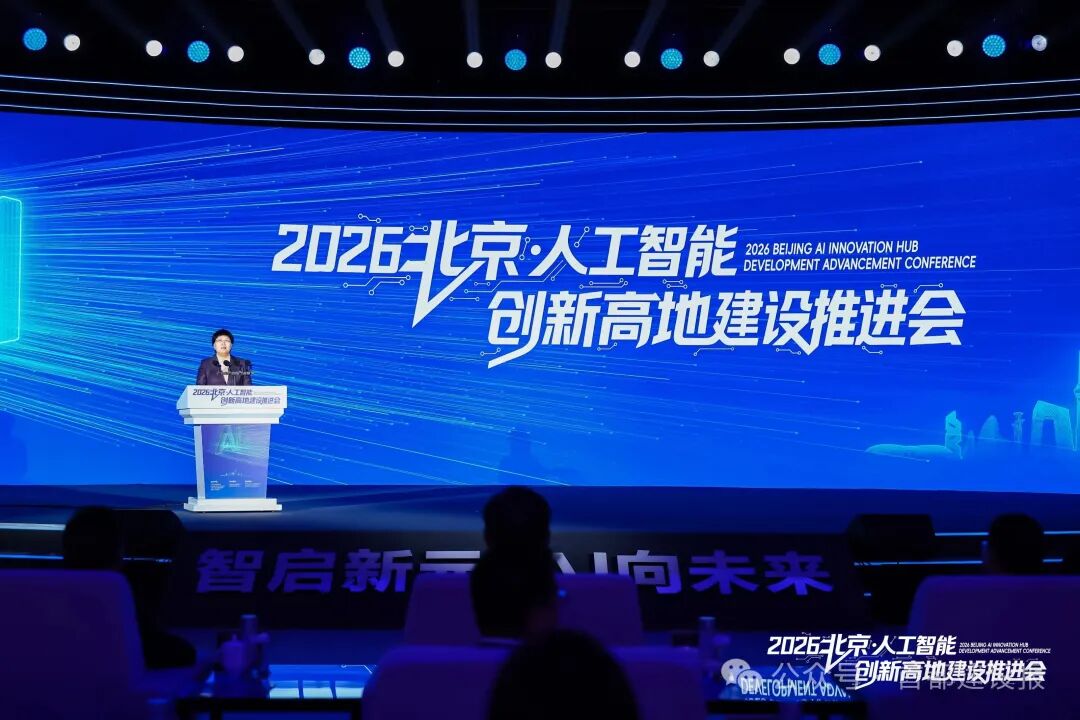
地方经济2026年开好局关键词:科技创新、重大项目、提振消费
2 1 Shi Ji Jing Ji Bao Dao· 2026-01-06 11:33
Group 1: Economic Development Plans - Various provinces are accelerating their economic plans for 2026, focusing on major project construction, technological innovation, and improving the business environment [1][5][12] - Guangdong aims to push forward with proactive work, funding, project implementation, and policy execution to ensure a strong start in 2026 [10] - Hainan emphasizes expanding the import and supply of quality goods and services, particularly in duty-free shopping, healthcare, and international education [1][12] Group 2: Technological Innovation - Hubei is implementing a stronger technology innovation strategy to establish itself as a hub for original innovation and new productivity [2] - Beijing's action plan for artificial intelligence aims to achieve a core industry scale of 1 trillion yuan within two years, with significant investments in AI infrastructure and applications [3][4] - The focus on collaborative innovation between enterprises and research institutions is highlighted as a key strategy for technological advancement [2] Group 3: Major Projects and Infrastructure - Henan plans to combine infrastructure projects with industrial improvements, focusing on transportation, energy systems, and urban renewal [7][8] - Yunnan has declared 2026 as a year for project breakthroughs, emphasizing the importance of high-quality project planning and execution [9] - The emphasis on enhancing investment efficiency and prioritizing industrial projects is evident in Yunnan's approach to economic growth [9] Group 4: Consumer Market and Investment - Guangdong's government is actively promoting consumption and service sector development through various initiatives, including a "national subsidy" program for key consumer goods [10][11] - The optimization of the old-for-new consumption policy is expected to enhance the effectiveness of subsidies for consumer goods [11] - Hainan's economic performance in 2025 shows promising growth in retail sales and industrial output, indicating a strong consumer market [12][13]
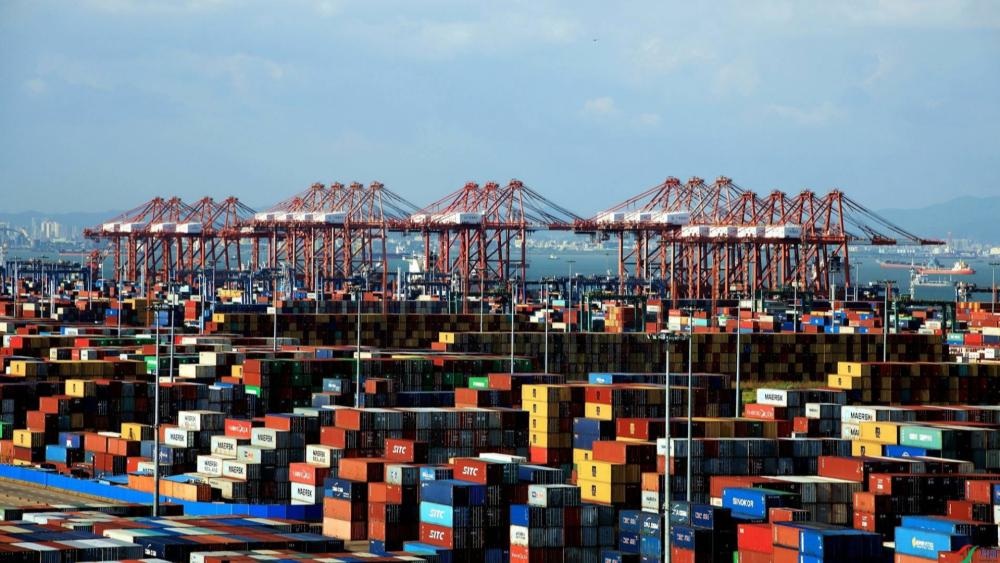
北京将打造“人工智能第一城”
Bei Jing Shang Bao· 2026-01-05 15:29
Core Insights - Beijing is positioning itself as the "first city of artificial intelligence" in China, with a comprehensive development plan that includes the establishment of AI innovation districts and a focus on core technology advancements [1][11] - The core industry scale of artificial intelligence in Beijing is projected to reach 450 billion yuan by 2025, with over 2,500 AI companies and 209 registered large models [1][5] - The city aims to enhance its original capabilities in AI theory and technology significantly within the next two years, aspiring to become a global leader in scientific intelligence and embodied intelligence [1][6] Talent Resources - Beijing has a significant talent pool, with 148 influential AI scholars listed in the AI 2000 global ranking, accounting for over 40% of the national total [3] - The city ranks second globally in terms of AI innovation and hosts numerous research institutions and educational platforms, including two national laboratories and four new R&D institutions [3][4] Ecosystem and Infrastructure - The city has developed a comprehensive ecosystem that integrates computing power, data, and algorithms, with advancements in domestic computing chips and software ecosystems [4][5] - Major AI models and platforms have emerged, with 209 registered models demonstrating capabilities that are among the best globally [4] Industry Cluster Development - By 2025, Beijing's AI core industry is expected to account for about half of the national total, with nearly 60 listed companies and around 40 unicorns in the AI sector [5] - The city is fostering a favorable business environment and rich application scenarios, which are crucial for enterprise growth [5] Nine Major Actions - Beijing plans to implement nine major actions to bolster AI development, including technology innovation, data quality enhancement, and application empowerment [6][8] - Specific initiatives will focus on foundational theories, core technology breakthroughs, and the establishment of a robust AI ecosystem [6][7] Innovation Districts - The first four AI innovation districts will be established in Haidian, Chaoyang, Shijingshan, and the Economic Development Zone, each with unique focuses and development goals [11][12][13] - These districts aim to enhance innovation resource density and entrepreneurial activity, positioning them as key engines for AI development in Beijing [11] Future Vision - The overall goal is to create a new intelligent economy and establish Beijing as a global AI innovation hub, with a core industry scale exceeding one trillion yuan [1][5]