
抵押贷款支持证券(MBS)

Search documents
鹰派预期升温 沃什提名扰动全球资产
Jin Tou Wang· 2026-02-04 07:56
Core Viewpoint - The nomination of Kevin Warsh as the next Federal Reserve Chairman by Trump signals a clear shift towards a hawkish monetary policy, leading to significant volatility in global financial markets [1] Group 1: Federal Reserve Policy - The Federal Reserve has maintained the federal funds rate in the range of 3.50%-3.75%, pausing rate cuts for several meetings and adhering to a data-driven decision-making framework [1] - Warsh's past tenure emphasizes inflation control and monetary policy independence, contrasting with the dovish stance of some current Fed members [2] - If confirmed, Warsh is likely to refocus the Fed on dual objectives of inflation and employment, potentially accelerating balance sheet reduction and delaying rate cuts until mid-2026 [2] Group 2: Market Reactions - The hawkish expectations have strengthened the US dollar, which has regained key resistance levels, while commodity and emerging market currencies face depreciation pressures [3] - Long-term US Treasury yields have risen, reflecting market concerns over persistent inflation and tightening policies, although the yield curve inversion has eased somewhat [3] - Commodity markets show divergence, with gold prices weakening under the dual pressure of a strong dollar and rising real interest rates, while oil prices are influenced by geopolitical risks and demand concerns [3] Group 3: Capital Flows and Global Impact - Global capital is flowing back to the US market, increasing pressure on emerging markets facing capital outflows and potential debt default risks due to currency depreciation [4] - The current market environment is characterized by high volatility and strong differentiation among asset classes, with investor risk appetite shrinking [4] - The future direction of Fed policy will depend on key variables, including core inflation trends, US economic data performance, the Senate confirmation process for Warsh, and liquidity constraints from balance sheet reduction [4] Group 4: Outlook - Until the Fed's policy framework is fully clarified, markets will continue to navigate the dynamics of balance sheet reduction and rate cut expectations, with a strong dollar likely to persist [5] - Investors should monitor Fed policy developments and US economic data closely to mitigate risks associated with emerging market currencies and debt, while seizing opportunities in dollar and safe-haven assets [5] - Central banks worldwide need to prepare for policy adjustments to address challenges from capital flows and currency volatility, ensuring financial stability [5]
中期选举交易主题浮现:金融科技与房屋建筑商领跑华尔街押注
智通财经网· 2026-02-03 13:29
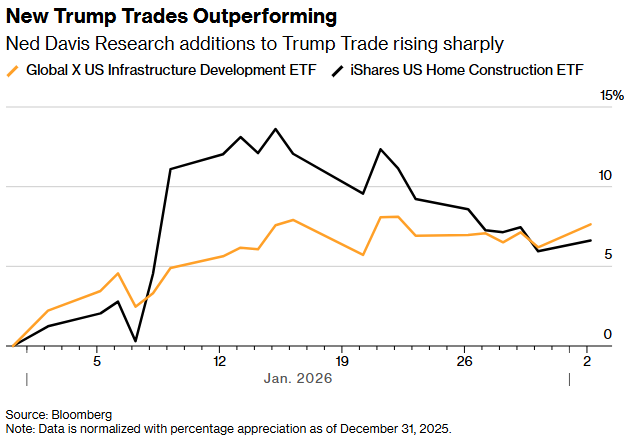
Group 1 - The core focus is on the upcoming U.S. midterm elections and the impact on consumer sentiment, which is currently low according to recent surveys [1] - Investors are particularly interested in financial companies that may benefit from the Trump administration's efforts to lower living costs, including tax reforms and policies aimed at increasing demand [1] - The Trump administration is attempting to lower housing borrowing costs by ordering the purchase of mortgage-backed securities (MBS) [1] Group 2 - Citigroup has launched a "tactical" basket of stocks focusing on fintech companies that cater to low- and middle-income consumers, such as Klarna, Block, and Intuit, which may benefit from policies making credit more accessible [4] - Consumer confidence has dropped to its lowest level since 2014, raising concerns on Wall Street about potential declines in spending, despite actual spending remaining high [4] - The consumer sector has seen a rise in essential goods by 9.2% and discretionary goods by 2.4%, outperforming the S&P 500 index's increase of 1.9% [5] Group 3 - The focus on "affordability" has shifted strategies in trading, moving away from previous focuses like cryptocurrency deregulation [5] - The Ned Davis Research Company has adjusted its trading strategy to include housing construction stocks, infrastructure companies, and a fund betting on a weaker dollar, as economic growth, affordability, and national security are expected to be key themes [5] - Concerns have been raised about the overall market as consumer confidence declines and income growth slows, indicating potential issues ahead [6]

美元债双周报(26年第2周):美国经济数据分化加剧,财政主导风险升温-20260112
Guoxin Securities· 2026-01-12 07:11
1. Report Industry Investment Rating - The investment rating for the US dollar bond market and the US stock market is "Underperform" [1][4] 2. Core Viewpoints - US economic data shows increasing divergence, with employment data dragging down interest - rate cut expectations, while the service sector is strong and the manufacturing sector is in contraction. Trump's order for Fannie Mae and Freddie Mac to buy $200 billion in MBS increases fiscal dominance risk and may steepen the yield curve [1][2] 3. Summary by Related Catalogs 3.1 US Macroeconomic and Liquidity - US December non - farm payrolls increased by 50,000, lower than the expected 65,000, and the annual increase was the weakest since the pandemic. After the release of the weak employment report, the expectation of a Fed rate cut in January almost disappeared, and the first rate cut is expected to be postponed to June, with an annual rate cut of about 50 basis points [1] - The December ISM manufacturing PMI fell to 47.9, contracting for the tenth consecutive month, while the ISM services PMI rose to 54.4, the highest in nearly a year [2] - Trump's order for Fannie Mae and Freddie Mac to buy $200 billion in MBS may accelerate the steepening of the US Treasury yield curve, and long - term interest rates are under pressure [2] 3.2 Exchange Rate - The report may analyze the trends of non - US currencies in the past year and recent changes, as well as the relationship between the US dollar index and other factors such as the 10 - year US Treasury yield and the RMB index [53][59][61] 3.3 Chinese - funded US Dollar Bonds - The report shows the return trends of Chinese - funded US dollar bonds since 2023 (by level and industry), as well as the yield and spread trends of investment - grade and high - yield Chinese - funded US dollar bonds [67][69] 3.4 Rating Actions - In the past two weeks, the three major international rating agencies took one downgrading action on a Chinese - funded US dollar bond issuer. On December 30, 2025, Moody's downgraded Vanke's rating from Caa2 to Ca [75][76] 3.5 Investment Recommendations - Adopt a "short - duration core + steepening satellite" configuration. Focus on 3 - 5 - year investment - grade bonds for stable coupon income, long the 2s10s spread to capture curve - steepening opportunities, increase TIPS allocation to hedge against service - sector inflation stickiness, and strictly control exposure to US Treasuries over 10 years [3] - In the next two weeks, focus on December CPI data and public statements by Fed officials [3]
伯恩斯坦拉响警报:流动性泛滥催生“全面泡沫“,AI仅是冰山一角
智通财经网· 2026-01-08 23:40
Core Viewpoint - Richard Bernstein Advisors (RBA) warns that excess liquidity is driving asset prices to levels far beyond fundamental support, indicating a "broad-based bubble" in the market [1] Group 1: Market Conditions - The current market bubble extends beyond artificial intelligence (AI) to include cryptocurrencies, meme stocks, SPACs, investment-grade bonds, and high-yield bonds [1] - The RBA's Deputy Chief Investment Officer, Mike Kantoropoulos, attributes this valuation frenzy to loose monetary and fiscal policies [1] Group 2: Concerns Regarding AI - Kantoropoulos expresses particular concern for credit investors regarding the AI boom, noting that if AI succeeds, bondholders cannot share in the excess returns, and if it fails, investors will incur losses [1] - The market is increasingly focused on the hundreds of billions of dollars that tech giants are committing to AI infrastructure, much of which will be raised through the U.S. debt market [1] - Major tech companies like Microsoft, Alphabet, Amazon, and Meta are expected to increase capital expenditures by 34% to approximately $440 billion over the next year [1] Group 3: Investment Strategy - RBA has completely exited the corporate bond market, having previously been overweight in this area a year ago [1] - Kantoropoulos questions the rationale behind investors' willingness to finance potentially outdated technology for up to 40 years [1] Group 4: Credit Market Insights - As of Wednesday, the U.S. high-grade credit risk premium rose to 78 basis points, remaining below 90 basis points since May of the previous year [2] - Kantoropoulos warns that if the Federal Reserve's rate cuts do not meet market expectations, credit spreads may widen further this year [2] - Given the thin levels of corporate bond spreads, RBA is shifting its focus to collateralized loan obligations (CLOs), mortgage-backed securities (MBS), high-quality floating-rate debt, and European equities [2] - Kantoropoulos highlights the attractiveness of high-quality European stocks due to fiscal stimulus, supportive monetary policy, and accelerating earnings growth [2]
停止缩表的时机透露信号 联邦基金利率仍是美联储优选工具
Sou Hu Cai Jing· 2025-10-30 19:48
Core Viewpoint - The Federal Reserve's decision to halt balance sheet reduction indicates a greater reliance on the federal funds rate as the primary tool for implementing monetary policy and assessing liquidity in the financial system [1] Group 1 - The Federal Reserve will stop reducing its Treasury holdings starting December 1 [1] - Short-term money market rates have remained elevated for several weeks prior to this decision [1] - The Fed plans to continue reducing its mortgage-backed securities (MBS) holdings and reinvest maturing funds into Treasury securities [1]
美国贝莱德太霸道!俄乌冲突没结束就抢乌能源,连皇室资产也要管
Sou Hu Cai Jing· 2025-09-23 03:21
Core Insights - BlackRock, a major player in the financial industry, has assets comparable to the GDP of both the US and China, and has significant influence over well-known tech giants like Apple, Microsoft, and Tencent [1][3] - The company's rise is attributed to its founder Larry Fink, who transitioned from a political ambition to a successful finance career, notably inventing mortgage-backed securities (MBS) in the 1980s, which transformed banking practices [2][3] - Following the 2008 financial crisis, BlackRock capitalized on the situation, managing to expand its assets significantly while other financial institutions faltered [3][5] Company Overview - BlackRock's assets under management surged to $27 trillion, making it the largest asset management firm globally [3] - The firm has become a preferred partner for governments, managing substantial pension funds and collaborating with royal families [5] - BlackRock developed the Aladdin system, a powerful risk management tool utilized by various financial institutions and tech companies, enhancing its market insight and predictive capabilities [5][11] Recent Developments - During the COVID-19 pandemic, the US government directly entrusted $45 billion to BlackRock, which subsequently received $4 trillion in rescue funds from the Federal Reserve, doubling its asset management to $10 trillion [7] - In 2023, BlackRock signed a controversial deal with Ukraine, providing financial support in exchange for strategic resources if the country is unable to repay [9] - The firm has been strategically increasing its investments in key sectors, such as real estate and energy, particularly in the aftermath of disasters like the Hawaii wildfires [11] Influence and Power - BlackRock, along with Vanguard and State Street, controls over $20 trillion in assets, with significant stakes in 80% of S&P 500 companies and 44% of US-listed firms [13] - The company's influence extends beyond finance, as it has absorbed numerous former government officials, allowing it to impact national policies [11][15] - The perception of BlackRock as a "nation within a nation" highlights its ability to profit from crises and leverage its capital and data for further expansion [15]

特朗普:正认真地考虑让房利美和房地美上市
Zhong Guo Xin Wen Wang· 2025-05-23 01:41
Core Viewpoint - The U.S. President Trump is seriously considering the public listing of Fannie Mae and Freddie Mac, indicating that the timing seems right due to their strong performance and cash generation [1]. Group 1: Company Overview - Fannie Mae and Freddie Mac, collectively known as "the GSEs," were publicly listed on the New York Stock Exchange in 1970 and 1989, respectively [1]. - Both companies faced significant losses during the 2007 subprime mortgage crisis, leading to a government takeover in 2008 [1]. Group 2: Market Implications - Trump's comments have sparked interest among hedge funds and investors who are calling for the government to release the GSEs from conservatorship, which could yield unexpected benefits for shareholders, including the government [2]. - Critics warn that reducing government support for the GSEs could lead to increased caution among investors regarding mortgage-backed securities (MBS), potentially raising mortgage rates for homebuyers [2]. - The Federal Housing Finance Agency (FHFA) is reportedly considering layoffs within its departments as discussions about the GSEs' future continue [2].