
泰国SET指数

Search documents
亚洲股市普涨,“高市交易”下日股再创新高,金银下挫,美元企稳人民币走强
Sou Hu Cai Jing· 2026-02-10 02:53
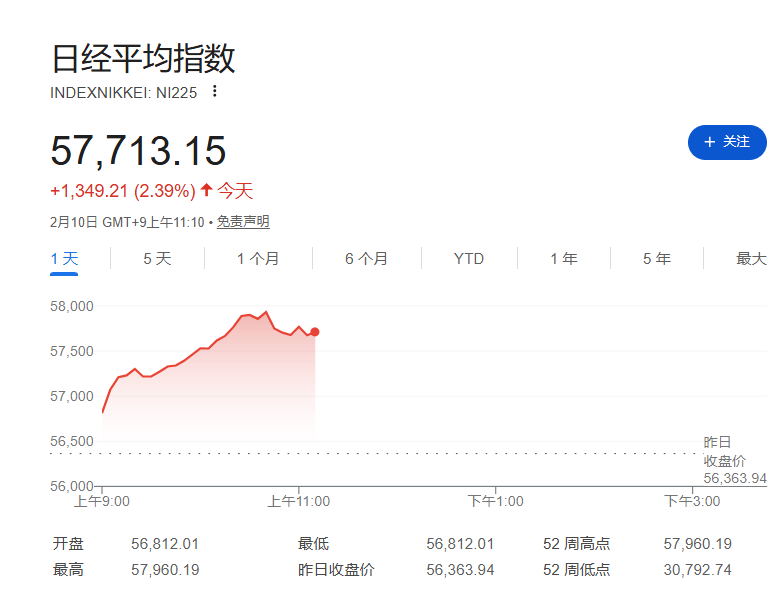
Core Viewpoint - The Asian stock markets continued their strong performance, led by Japan, following Prime Minister Fumio Kishida's election victory, which boosted investor confidence and led to significant gains in the Nikkei 225 index [1][2]. Market Performance - The Nikkei 225 index surpassed the 57,000-point mark, rising by 2.64% to reach a new historical high [6]. - The Topix index also increased by 1.08%, setting a new record [2]. - The KOSPI index in South Korea rose by 1.21%, nearing its historical closing high [4][5]. - The S&P/ASX 200 index in Australia gained 0.39%, aiming for a third consecutive day of increases [4][5]. Currency and Commodity Markets - The offshore RMB strengthened, breaking the 6.91 mark against the USD for the first time since May 2023, currently reported at 6.9094 [9]. - The US dollar index stabilized around 96.97 after a significant drop, which was the largest single-day decline in two weeks [7]. - Gold prices fell by 1% to $5,016.56 per ounce, while silver dropped by 2.5% to $81.31 per ounce [10]. - WTI crude oil futures decreased by 0.1% to $64.15 per barrel [14].

泰铢创下逾4周低点 泰国股市下跌
Mei Ri Jing Ji Xin Wen· 2026-02-02 04:12
Group 1 - The Thai baht has declined for the fourth consecutive day, indicating a weakening currency trend [1] - The USD/THB exchange rate has increased by 0.2% to 31.6410, potentially reaching the highest closing level since January 2, 2026 [1] - The Thai SET index has dropped by 0.7% to 1,316.30, marking the largest decline since January 12, 2026 [1]
泰铢下跌 泰国股市上涨
Xin Lang Cai Jing· 2025-12-30 04:38
Group 1 - The Thai baht has declined for the second consecutive day, while the domestic stock market has seen an increase [1] - The USD/THB exchange rate rose by 0.3% to 31.535, indicating a weakening of the Thai baht [1] - The SET index in Thailand increased by 0.1% to 1,255.77, potentially breaking a three-day losing streak [1] Group 2 - A MACD golden cross signal has formed, indicating positive momentum for certain stocks [2]
海外高频 | 美国就业数据走弱,金银价格延续上涨 (申万宏观·赵伟团队)
赵伟宏观探索· 2025-09-08 01:30
Group 1 - The core viewpoint of the article highlights the weakening U.S. employment data, which has led to an increase in expectations for interest rate cuts by the Federal Reserve [2][54][62] - The S&P 500 index rose by 0.3%, while the Hang Seng Index increased by 1.4% during the week [2][3] - The U.S. 10-year Treasury yield fell by 13.0 basis points to 4.1%, and the dollar index decreased by 0.1% to 97.74 [2][3] Group 2 - The article notes that the U.S. added only 22,000 jobs in August, significantly below the expected 75,000, with the unemployment rate rising to 4.3% [62][73] - The ADP reported an increase of 54,000 jobs in August, also below the expected 68,000 [62] - Job openings in July were reported at 7.181 million, lower than the expected 7.382 million, indicating a weakening demand in the labor market [62] Group 3 - The article discusses the performance of various sectors, with communication services, consumer discretionary, and healthcare sectors showing increases of 5.1%, 1.6%, and 0.3% respectively in the S&P 500 [7] - In the Hang Seng Index, healthcare, materials, and consumer discretionary sectors rose by 7.1%, 6.6%, and 3.6% respectively [10] - Conversely, energy, financials, and utilities sectors in the S&P 500 saw declines of 3.5%, 1.7%, and 1.1% respectively [7] Group 4 - The article highlights that the market is now shifting from rate cut expectations to recession trading due to the disappointing employment data [72] - The Federal Reserve's expectation for a 50 basis point rate cut in September has increased following the weak employment figures [54][62] - The article emphasizes the importance of upcoming CPI data and the potential for further adjustments in employment figures [54][62]


特朗普“周末加班”,美股期货小幅低开,黄金微涨,比特币涨1%
Hua Er Jie Jian Wen· 2025-07-14 00:13
Core Viewpoint - The announcement of a 30% tariff on imports from Mexico and the EU by President Trump has led to increased market pressure and heightened risk aversion, resulting in declines in U.S. stock futures and slight increases in gold, the dollar, and Bitcoin [1][11]. Market Reactions - U.S. stock futures opened lower, with the S&P 500 futures down by 0.4% [1]. - The Dow Jones Industrial Average futures fell by 200.50 points, or 0.45%, while the S&P 500 and Nasdaq futures also experienced declines of 0.47% and 0.46%, respectively [2]. - Asian markets reacted with the Nikkei 225 index down 0.3% and the South Korean KOSPI remaining flat [3]. Commodity and Currency Movements - Gold prices increased by 0.5%, marking the fourth consecutive day of gains, although the increase has moderated [3]. - The U.S. dollar and Japanese yen saw slight increases against major currencies [6]. - Bitcoin experienced a temporary rise of about 1% before retreating from its recent highs [9]. Economic Context - Analysts warn that the 30% tariff is punitive and may have a more significant impact on the EU than on the U.S. itself [11]. - Upcoming economic data releases, including China's Q2 GDP and U.S. June CPI, are expected to be focal points for the market [12]. - The recent tariff announcement disrupts the previously optimistic sentiment surrounding trade negotiations [14]. Market Sentiment and Future Outlook - The market's resilience is being tested as Trump's trade threats complicate accurate pricing in financial markets [13]. - Some analysts believe that the market may overlook the trade conflict until tariffs are fully implemented, drawing lessons from past experiences [14]. - Discussions around potential changes in Federal Reserve leadership due to Trump's criticisms of Powell add further uncertainty to the market [15].
