港股通互联网ETF基金

Search documents
南向资金周五净流入超100亿!关注港股通系列ETF高弹性机会
Mei Ri Jing Ji Xin Wen· 2026-02-27 07:59
Group 1 - The core viewpoint of the articles highlights a significant rebound in the Hang Seng Technology Index, driven by a substantial inflow of southbound capital into the Hong Kong stock market, with a net inflow of over 10.3 billion HKD by mid-afternoon on February 27 [1][2] - Southbound capital, which refers to mainland funds investing in Hong Kong stocks through the Stock Connect programs, has shown a notable recovery in February, with daily net inflows exceeding 10 billion HKD on multiple occasions [2] - The net buying amount of southbound capital for 2025 is projected to reach 1.4 trillion HKD (approximately 200 billion USD), marking a 73.89% increase year-on-year and the highest annual record since the launch of the Stock Connect in 2014 [2] Group 2 - The current valuation of Hong Kong technology stocks is considered reasonable, and the market is viewed as having a low level of crowding, making it an attractive opportunity for investors [1] - The influx of southbound capital is expected to play a crucial role in the valuation recovery of Hong Kong technology assets in 2025, with Goldman Sachs predicting that net buying may reach new highs in 2026 [2] - Investors are encouraged to focus on Hong Kong Stock Connect-related ETFs, which provide low-threshold access and flexibility for A-share investors, with specific ETFs like the Hong Kong Stock Connect Technology ETF and Internet ETF featuring major stocks such as Alibaba, Tencent, and Meituan [2]
2月26日左侧资金和景气策略资金分别在布局哪些ETF?
Mei Ri Jing Ji Xin Wen· 2026-02-27 05:10
Group 1 - The A-share market is experiencing active trading, but the index faces pressure at 4150 points, impacting investor sentiment [1] - The focus of investment is shifting towards traditional physical assets, with foreign investment banks proposing the HALO strategy (Heavy Assets, Low Obsolescence) to redefine asset value in the AI era, emphasizing sectors like electric grids, petrochemicals, and non-ferrous metals [1] - Despite the shift, technology remains attractive, as evidenced by the inflow into the Hang Seng Technology Index, which hit a year-to-date low, prompting a surge of investors looking to "buy the dip" [1] Group 2 - On February 26, the top net inflow was seen in Hang Seng Technology-related ETFs, with a total net inflow of 2.507 billion yuan across 13 ETFs, the largest being the Hang Seng Technology Index ETF (513180.SH) [1] - Other ETFs with significant net inflows included securities ETFs, electric grid equipment ETFs, and gold ETFs, with the electric grid equipment ETF (159326.SZ) alone seeing over 900 million yuan in net inflow on that day, reflecting the HALO strategy [2] - According to Wang Bo from Huaxia Fund, the current market conditions favor "景气策略" (prosperity strategy), "动量策略" (momentum strategy), and "高共识资产" (high consensus assets), with expectations of continued market improvement and a bullish outlook ahead of important meetings in March [2]
百度股价绩后震荡回升,市场对“AI烧钱而不赚钱”的担忧有所减轻
Mei Ri Jing Ji Xin Wen· 2026-02-27 03:01
Core Insights - Baidu's Q4 and full-year financial report highlights significant growth in AI business, with AI revenue surpassing 40% of total revenue, and continued strong growth in intelligent cloud services [1] - The company is advancing the independent listing of its self-developed chip company, Kunlun [1] - Baidu's stock price showed volatility post-earnings, reflecting mixed performance among constituents of the Hang Seng Internet ETF [1] Financial Performance - In Q4, Baidu's AI new business revenue reached 11.3 billion yuan, accounting for 43% of total general business revenue, up from 39% in the previous quarter [1] - The monthly active users of Baidu's AI application, Wenxin Assistant, are projected to reach 202 million by the end of Q4 2025 [1] Strategic Direction - Baidu plans to integrate Baidu Wenku and Baidu Netdisk to accelerate AI application innovation [1] - The company emphasizes that application is more important than the model, as the value of the model is realized through its application [1] Market Context - Industry analysts note a shift in the valuation anchor for Hong Kong tech giants from traditional advertising and traffic-based growth to AI infrastructure and service provision, which adds valuation flexibility [1] - Baidu's stock had previously surged by 40% at the end of last year but has recently faced adjustments alongside the Hang Seng Tech Index [1] Investment Opportunities - Investors can leverage the Hang Seng Internet ETF and other mainland-listed ETFs to capture recovery opportunities among Hong Kong internet giants [2] - Baidu is considering upgrading its secondary listing in Hong Kong to a "dual primary listing" to attract mainland capital [2]
资金回归理性定价?MiniMax、智谱股价回调,关注港股大型科技公司补涨机会
Mei Ri Jing Ji Xin Wen· 2026-02-25 06:50
Group 1 - The core viewpoint of the articles highlights a contrasting performance between large tech companies like Alibaba and Tencent, which are experiencing a stock price recovery, and AI startups MiniMax and Zhiyu, which have seen significant stock price declines after their initial public offerings [1] - The market appears to be returning to rational pricing after a brief speculative surge in small-cap model companies, indicating that large Chinese tech giants are severely undervalued and may represent a bottoming opportunity for investors [1] - The Hang Seng Technology Index shows a significant discount compared to the A-share technology indices, reaching historical highs, suggesting a potential for recovery similar to past instances in 2022 [1] Group 2 - There has been a notable inflow of funds into Hong Kong tech-related ETFs, such as the Hang Seng Technology Index ETF and the Hang Seng Internet ETF, indicating a strategic accumulation of shares in major tech companies like Alibaba and Tencent [2] - These ETFs are listed on mainland stock exchanges and cover a basket of Hong Kong tech giants, reflecting investor confidence in the sector despite recent volatility [2] - The focus of the Hong Kong Stock Connect ETFs is on eligible stocks, excluding non-Hong Kong Stock Connect companies, which may influence investment strategies [2]
中芯国际(00981)因行使根据2014以股支薪奖励计划所授予的受限制股份单位而发行1.66万股
Zhi Tong Cai Jing· 2026-02-13 11:04
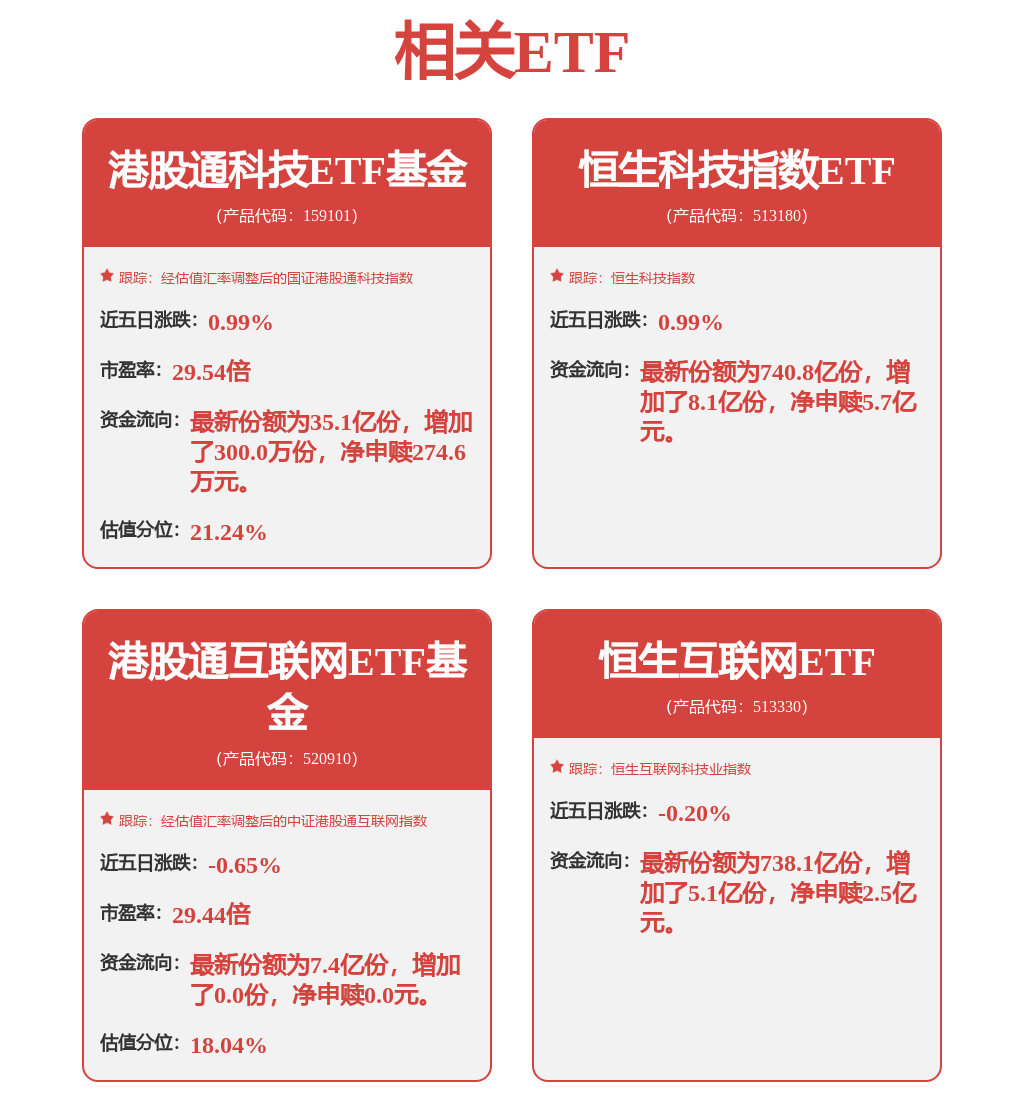
Group 1 - Core viewpoint: SMIC (00981) announced the issuance of 16,600 shares due to the exercise of restricted stock units granted under the 2014 share-based compensation plan on February 13, 2026 [1] Group 2 - Related ETF: The Hong Kong Stock Connect Technology ETF (Code: 159101) tracks the adjusted CSI Hong Kong Stock Connect Technology Index, with a recent five-day change of +0.99% and a P/E ratio of 29.54 times [3] - Fund flow: The latest share count is 3.51 billion, an increase of 3 million shares, with a net subscription of 274.6 million [3] - Related ETF: The Hang Seng Technology Index ETF (Code: 513180) tracks the Hang Seng Technology Index, also with a recent five-day change of +0.99% [3] - Fund flow: The latest share count is 74.08 billion, an increase of 810 million shares, with a net subscription of 570 million [3] - Related ETF: The Hong Kong Stock Connect Internet ETF (Code: 520910) tracks the adjusted CSI Hong Kong Stock Connect Internet Index, with a recent five-day change of -0.65% and a P/E ratio of 29.44 times [4] - Fund flow: The latest share count is 740 million, with no change in shares and no net subscription [4] - Related ETF: The Hang Seng Internet ETF (Code: 513330) tracks the Hang Seng Internet Technology Index, with a recent five-day change of -0.20% [5] - Fund flow: The latest share count is 73.81 billion, an increase of 510 million shares, with a net subscription of 250 million [5]


南向资金节前维持温和流入,机构:恒生科技或是持股过节的好选择
Mei Ri Jing Ji Xin Wen· 2026-02-12 01:41
Group 1 - The core viewpoint of the articles highlights a significant net inflow of southbound funds into Hong Kong's stock market, amounting to HKD 48.2 billion on February 11, with a cumulative net inflow of HKD 590.8 billion since the beginning of February, marking the second-largest inflow for the month of February compared to previous years [1] - Southbound funds refer to the capital from mainland investors investing in stocks listed on the Hong Kong Stock Exchange through the Stock Connect programs [1] - Analysts from China International Capital Corporation and China Merchants Securities suggest that the current market conditions present a buying opportunity, particularly for stocks that have significantly corrected due to external or individual stock factors, with a price target for the Hang Seng Index set between 28,000 and 29,000 points [1] Group 2 - The relative valuation of Hong Kong technology stocks compared to A-share technology stocks is at a historical low, indicating a potential for a rebound [1] - The current price-to-earnings (PE) ratio of the Hang Seng Technology Index is at the 24.3 percentile since its inception, suggesting that if it returns to the median level, the index could rise to 7,431 points, representing a 39% increase [1] - The trend in the industry shows a flourishing development of large models, indicating a positive outlook for the sector [1]
港股触底反弹?节后行情怎么走?
Xin Lang Cai Jing· 2026-02-11 02:44
Core Viewpoint - The recent adjustment in the Hong Kong technology sector is primarily due to market misinterpretation of rumors regarding an increase in the internet value-added tax, combined with investors' tendency to realize profits as the year-end approaches, leading to a decrease in risk appetite [4][10]. Group 1: Market Performance - The Hang Seng Technology Index has decreased by 6.45% recently, reflecting the overall pressure on the Hong Kong tech sector [5]. - Historical data indicates that the Hong Kong market typically exhibits a "red envelope market" trend around the Chinese New Year, with performance generally improving post-holiday [8][9]. Group 2: Investment Opportunities - The current Hong Kong market presents a notable investment window, driven by low valuation levels and expectations of improved liquidity [10]. - The Hang Seng Index's current price-to-earnings (P/E) ratio is 12.20, which is below its historical average of 11.55, indicating a potential safety margin for investors [12]. - In January 2026, net inflows from southbound funds reached approximately 689.71 billion HKD, three times the inflow from the previous month, suggesting strong investor interest [14]. Group 3: Seasonal Trading Strategies - The trading mechanism around the Chinese New Year creates opportunities for arbitrage, as the Hong Kong market will be open for two and a half more days than the A-share market during the holiday [7]. - Investors are encouraged to consider positioning in Hong Kong ETFs before the holiday, as potential price increases post-holiday could allow for T+0 selling opportunities [6][7].

港股通互联网ETF基金(520910)跌幅持续收窄,机构称“春季躁动”驱动下或存在阶段性修复机会
Sou Hu Cai Jing· 2026-02-03 06:32
Group 1 - The Hong Kong stock market showed mixed performance on February 3, with the Hang Seng Index rising by 0.2%, while the Hang Seng Tech Index and the National Enterprises Index fell by 1.32% and 0.22% respectively [1] - The decline in tech stocks was attributed to investor concerns over potential increases in value-added tax (VAT) for internet service companies, following a VAT hike for Chinese telecom stocks [1] - Institutions believe that the concerns regarding tax increases for internet companies are exaggerated and lack solid evidence, noting that any tax hikes would contradict current policies aimed at promoting consumption [1] Group 2 - GF Securities indicated that the global dollar cycle is at a peak and is now in a decline phase, while the RMB has transitioned from depreciation to a mild appreciation, creating a favorable revaluation window for Chinese equity assets [2] - The report suggests embedding currency logic into asset allocation, focusing on "core manufacturing assets + beneficiaries of appreciation" in A-shares, and prioritizing sectors sensitive to import costs and high-quality liquid stocks in Hong Kong [2] - The Hong Kong Stock Connect Internet ETF (520910) tracks the CSI Hong Kong Stock Connect Internet Index, focusing on leading internet companies such as Alibaba, Tencent, Meituan, and Kuaishou, which are expected to benefit from AI penetration [2]

Moltbook、元宝引爆海内外AI社交,全球AI应用商业化加速落地
Mei Ri Jing Ji Xin Wen· 2026-02-02 02:42
Group 1 - The AI social platform Moltbook has gained significant traction overseas, amassing 1.5 million AI agents engaging in discussions across thousands of forum sections within a few days [1] - Tencent's AI platform Yuanbao launched a cash red envelope activity on February 1, leading to a surge in downloads and topping the iPhone app rankings on the same day [1] - Yuanbao's public beta version allows users to create or join "groups" where the Yuanbao AI can interact with users, enhancing the social experience through integrated content from Tencent's ecosystem [1] Group 2 - Open-source securities suggest that the interactions between AI agents on Moltbook and the social dynamics created by Yuanbao indicate a strong foundation for human-like interactions, paving the way for rapid user and traffic growth in AI social platforms [2] - The Hong Kong Stock Connect Internet ETF (520910) was launched on February 2, focusing on leading internet companies in Hong Kong, which are expected to benefit from the ongoing acceleration of AI integration [2] - The current landscape of Hong Kong stocks includes core assets in AI, covering the entire industry chain from computing power to software applications, positioning them as pioneers in the revaluation of Chinese assets this year [2]

2026年AI投资首站:如何抢占先机?
Sou Hu Cai Jing· 2026-01-06 06:56
Core Viewpoint - The launch of the Huaxia CSI Hong Kong Stock Connect Internet ETF Fund coincides with a pivotal moment for the Hong Kong internet sector, which is positioned at the intersection of AI technological transformation and value underestimation [3]. Group 1: Market Context - The technology sector in the Hong Kong market is known for its high volatility, with an annual volatility rate of approximately 35% [3]. - Since the low point in October 2022, the CSI Hong Kong Stock Connect Internet Index has shown more significant gains compared to other internet indices, indicating a potential rebound as global tech competition reshapes [3]. - The current market cycle is favorable for the launch of the ETF, reflecting the fund's confidence in the market's trajectory [3]. Group 2: AI Core Assets - The global shift towards AI is transforming economies and lifestyles, with China's tech innovation being crucial for high-quality economic development [4]. - The ETF's constituent stocks are key players in the AI wave, covering various segments of the AI industry, including model and cloud services (Alibaba, Tencent), hardware (Xiaomi, Lenovo), and software applications (Meitu, Kingdee) [4]. Group 3: Investment Opportunities - The AI model and cloud services segment is expected to see accelerated growth due to advancements in model iteration and cloud service demand [5]. - The consumer electronics hardware segment is poised for growth driven by low-cost, high-performance AI hardware applications across devices like smartphones and wearables [5]. - AI applications in advertising are enhancing user targeting and increasing revenue efficiency for companies like Tencent, creating a positive feedback loop of improved efficiency and revenue growth [5]. Group 4: Financial Environment - The easing of liquidity pressures is anticipated as the IPO activity in the first half of 2025 has created significant unlocking pressure, with December's unlocking scale reaching approximately 126 billion HKD [9]. - The expected decline in unlocking scale to below 50 billion HKD in January 2026 may alleviate market liquidity pressures [9]. - Domestic capital inflow through the Stock Connect reached a historical high of over 1.38 trillion HKD in 2025, providing a solid foundation for the Hong Kong market [11]. Group 5: Stock Buybacks and Valuation - Major Hong Kong internet companies are actively repurchasing shares, indicating their intrinsic value, with buyback amounts reaching approximately 157.9 billion HKD by the end of November 2025 [12]. - The current valuation metrics for the tracked index, with a P/E ratio of 24.7 and a P/S ratio of 3.34, suggest potential for valuation recovery as they are positioned at the lower end of historical ranges [15]. Group 6: ETF Characteristics - The Huaxia CSI Hong Kong Stock Connect Internet ETF focuses on industry leaders, allowing investors to participate in the growth of top internet companies without the need for individual stock selection [14]. - The ETF comprises 30 major internet firms, with the top five stocks accounting for approximately 58% of the weight, reflecting the "stronger stronger" reality of the internet sector [14].