
玉露香梨

Search documents
从“外人”到“亲人” 第一书记的振兴答卷
Xin Hua She· 2026-02-26 00:04
Core Insights - The article highlights the transformative impact of community leadership in rural development, particularly through the efforts of a female village leader in Shanxi Province, who has successfully improved infrastructure and agricultural practices in her village [1][2][3] Group 1: Infrastructure Development - The village leader, You Bianqing, successfully advocated for the construction of a 3.8-kilometer asphalt road, significantly improving access to the village and changing residents' perceptions of her leadership [1][2] - The newly built roads have eliminated the previous difficulties in transportation, allowing villagers to seek assistance from the village committee more readily [2] Group 2: Agricultural Innovation - Recognizing the limitations of traditional farming, the village leader introduced new fruit tree varieties, including peaches and cherries, to diversify agricultural production and enhance income [2] - In 2025, through a combination of offline exhibitions and online marketing, the village generated over 1 million yuan in sales from fruits and other agricultural products [2] Group 3: Community Transformation - The village has undergone a significant transformation, with the removal of traditional waste piles and the introduction of new public facilities such as community centers and recreational areas [3] - The village leader is exploring further opportunities for economic development, including the establishment of a branch crushing factory and cold storage for seasonal fruit sales [3]
山西太原刘家堡:古村年味浓
Jing Ji Ri Bao· 2026-02-23 02:11
Core Viewpoint - Liujiabao Village has transformed from a place with idle resources into a vibrant community by revitalizing its cultural heritage, agricultural practices, and tourism, leading to economic growth and improved livelihoods for its residents [1][4]. Group 1: Cultural and Economic Revitalization - The village boasts over 100 intangible cultural heritage projects, more than 100 workshops, 60 types of cultural products, 30 types of local cuisine, and over 10 guesthouses, showcasing a diverse cultural landscape [1]. - The local government has effectively utilized idle land, housing, and labor, turning them into profitable resources, with agriculture as the foundation, culture as the essence, and tourism as the pathway [1][4]. - Young people in the village, like Guo Panyi, are now able to earn substantial incomes (around 70,000 to 80,000 yuan annually) through traditional crafts such as lion dancing, which were previously undervalued [2]. Group 2: Employment and Community Development - Residents like Wang Fang have found stable employment opportunities close to home, allowing them to balance work and family life while earning a steady income [2][3]. - Entrepreneurs such as Guo Ximei have leveraged the village's cultural environment to expand their businesses, with products now reaching international markets, thus contributing to local economic growth [3]. - The integration of historical culture, intangible heritage, agriculture, and tourism has created a cohesive development model that supports both social and economic benefits for the community [3][4]. Group 3: Agricultural Initiatives - The village has implemented large-scale agricultural projects, including a tomato industry park, a pear industry park, and a butterfly orchid base, focusing on professional and sustainable agricultural practices [3]. - The local government emphasizes the importance of combining agriculture with cultural and tourism initiatives, creating a comprehensive development strategy that enhances the quality of life for residents [4].
新春走基层丨山西太原刘家堡:古村年味浓
Jing Ji Ri Bao· 2026-02-23 00:05
Core Insights - Liujiabao Village has transformed from a place with idle resources into a vibrant community by revitalizing its land, labor, and cultural heritage, leading to economic growth and community engagement [1][4] Group 1: Cultural and Economic Revitalization - The village boasts over 100 intangible cultural heritage projects, more than 100 workshops, 60 types of cultural products, 30 types of local cuisine, and over 10 guesthouses, showcasing a diverse cultural landscape [1] - The local government has effectively utilized idle land and resources, turning them into profitable ventures, with agriculture as the foundation, culture as the essence, and tourism as the pathway [1][4] - Young artisans like Guo Panyi are now able to earn substantial incomes, with lion dance performances generating annual earnings of 70,000 to 80,000 yuan, reflecting a shift in perception towards traditional crafts as viable sources of income [2] Group 2: Employment and Community Impact - Local artisans, such as Wang Fang, have found stable employment opportunities close to home, allowing them to balance work and family life while earning a steady income [3] - Entrepreneurs like Guo Ximei have leveraged the village's cultural environment to expand their businesses, with products reaching international markets, thus contributing to the local economy [3] - The integration of agriculture, culture, and tourism has created a sustainable model for community development, enhancing both social and economic benefits for villagers [3][4]
古村年味浓
Xin Lang Cai Jing· 2026-02-22 23:06
Core Insights - Liujiabao Village has transformed from a place with idle resources into a vibrant community by revitalizing its land, culture, and labor, leading to economic growth and community engagement [1][4] Group 1: Cultural and Economic Revitalization - The village boasts over 100 intangible cultural heritage projects, more than 100 workshops, 60 types of cultural products, 30 varieties of local cuisine, and over 10 guesthouses, showcasing a diverse cultural landscape [1] - The local government has effectively utilized idle land and resources, turning them into profitable ventures, with agriculture as the foundation, culture as the essence, and tourism as the pathway [1][4] - Young people in the village, like Guo Panyi, are now able to earn a living through traditional crafts such as lion dancing, which was previously considered unprofitable [2] Group 2: Employment and Community Development - Residents like Wang Fang have found stable employment opportunities close to home, allowing them to balance work and family life while earning a steady income [3] - Entrepreneurs such as Guo Ximei have leveraged the village's cultural environment to expand their businesses, with products now reaching international markets [3] - The integration of agriculture, culture, and tourism has created a sustainable model for community development, enhancing both social and economic benefits for the villagers [3][4]
小年纳福,山西屯汇市场供货忙
Sou Hu Cai Jing· 2026-02-11 07:43
Core Viewpoint - Shanxi Tunhui Agricultural Products Wholesale Market has initiated a comprehensive supply guarantee mode for the Spring Festival, ensuring sufficient supply, stable prices, and quality control of agricultural products during the holiday season [1][5]. Group 1: Supply and Demand Management - The market is a key hub for agricultural product supply in Taiyuan, focusing on organizing sources, price stabilization, and quality supervision to secure the supply for the New Year [1]. - The trading area is bustling with activity, featuring a variety of seasonal vegetables and fruits, including cabbage, radishes, potatoes, and popular fruits like sugar oranges and Yunnan peppers, catering to the festive shopping needs of citizens [3]. Group 2: Operational Strategy - During the Spring Festival, the market will maintain normal operations, optimize merchant operating hours, and enhance service guarantees while preparing emergency plans for adverse weather and sudden changes in supply and demand [5]. - Merchants are committed to providing ample supply, affordable prices, and attentive service to meet the peak consumption demands of the New Year [5].

南宁市场在售的高价“网红黑梨”,是什么来头?专家揭秘
Xin Lang Cai Jing· 2026-01-15 23:33
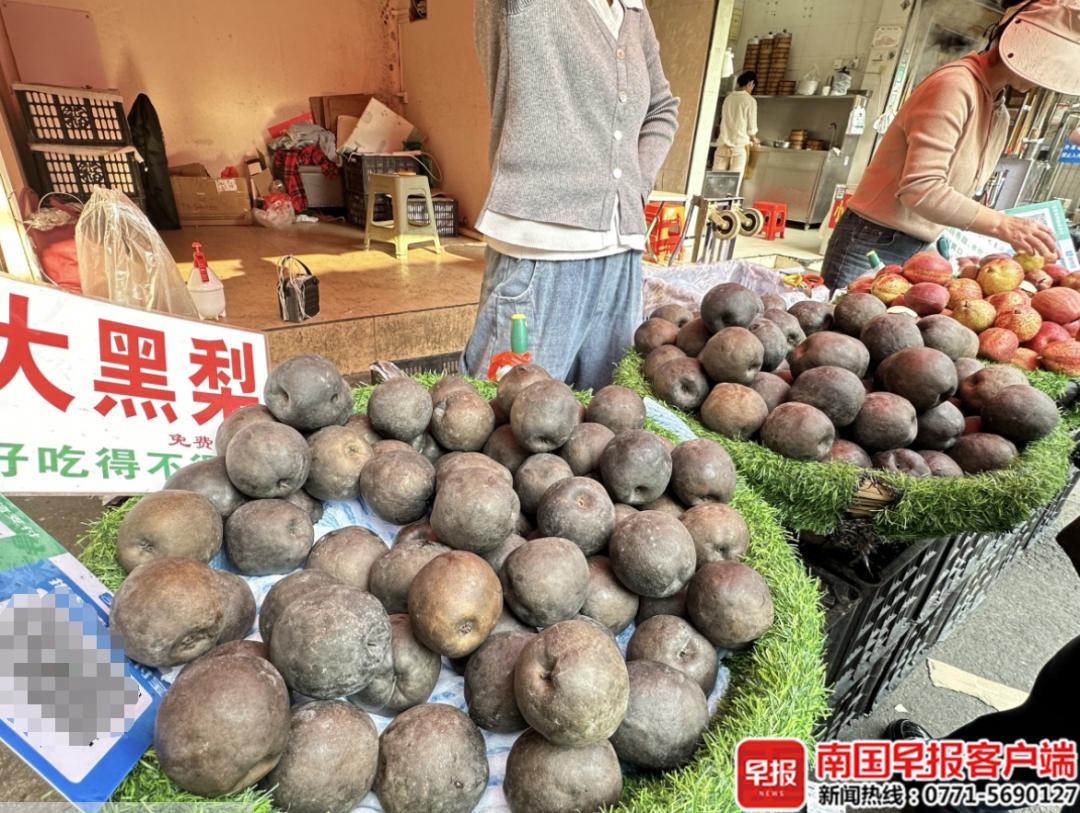
Core Viewpoint - The recent emergence of "Daliangshan Black Pear" in Nanning's market, priced up to 30 yuan per kilogram, has sparked consumer curiosity and interest in this unique fruit, which is not a native variety but rather a treated version of existing pear types [1][5]. Pricing and Market Analysis - The black pear is priced based on size, with smaller ones costing 24 yuan per kilogram and larger ones reaching 30 yuan per kilogram [3]. - Consumers have shown willingness to purchase despite the high price, with some expressing surprise at the cost during transactions [5]. Product Characteristics - The black pear features a rough surface with a sticky texture, differing significantly from regular pears. Upon peeling, the inner flesh is white and has a moderate sweetness [3][5]. - Experts confirm that the black skin results from high-temperature steam treatment rather than being a distinct variety [5][6]. Historical Context and Varietal Information - The market has seen similar black pears labeled as "Zang Wuli" or "Black Diamond Pear" since 2021, but their origins and specific varieties remain unclear [6]. - The only known black pear variety in China, the Uli pear from Tibet, has inferior quality compared to the treated pears currently sold [6]. Quality Assessment and Health Implications - Research indicates that the black pears sold are likely varieties such as Huangguan, Cuiguan, or Yulu pears, which undergo either repeated freezing or high-temperature treatment to achieve their color [8]. - Experts assert that the short-term high-temperature treatment does not harm the fruit's flesh, and as long as the skin is not rotten, it poses no health risks when consumed [8].
山西寿阳:一颗梨“炖”出乡村振兴新希望
Zhong Guo Xin Wen Wang· 2026-01-14 08:43
Core Viewpoint - The article highlights the vibrant activities in the rural revitalization efforts in Shouyang County, Shanxi Province, particularly focusing on a food processing company that has recently launched a new production line to enhance the local economy and agricultural practices [1][3]. Group 1: Production and Economic Impact - A new production line at a food processing company in Shouyang County is currently in trial operation, showcasing a busy and organized environment [3]. - The production line processes Yulu fragrant pears by cleaning, peeling, pitting, and cutting them, then combining them with other ingredients for sterilization and packaging, ensuring product quality and safety [3]. - The village of Shanghu is a key area for standardized production of green food raw materials, with 2,150 acres dedicated to Yulu fragrant pear cultivation [3]. Group 2: Challenges and Solutions - Farmers have historically faced challenges in selling pears due to poor appearance and market saturation, which has limited the development of the pear industry [3]. - The local work team and village leadership have focused on transforming unattractive pears into stewed pear products to increase their value and support the collective economy [5]. Group 3: Financial and Employment Benefits - In 2025, the village secured 700,000 yuan in county-level support and contributed 80,000 yuan to convert an idle school building into a standardized factory, establishing a production line with an annual capacity of approximately 20 tons of stewed pears [5]. - The project is expected to generate an additional 50,000 yuan for the village collective annually, increase individual farmer income by 300 yuan, and create over 10 job opportunities [5]. - Workers, such as Gao Qiaobian, report earning over 3,600 yuan per month while being able to care for their families, illustrating the positive impact on local livelihoods [5]. Group 4: Future Prospects - The company aims to expand the market for stewed pear products, providing high-quality pear offerings to consumers [6].


金融生根 梨香满园
Di Yi Cai Jing· 2026-01-14 06:54
Core Insights - The article highlights the success of the Yulu fragrant pear industry in Shanxi Province's Fenxi County, which has become a significant source of income for local residents, transforming their economic situation through a complete industrial chain from cultivation to sales [1][2] Group 1: Industry Development - The Yulu fragrant pear is recognized for its unique qualities, such as thin skin, thick flesh, high juice content, and sweet taste, making it a valuable product for local farmers [1] - The "Fengdengyuan" cooperative, established by Liu Dingshan, produces approximately 500,000 pounds of pears annually, providing members with both wages and dividends through a model of land dividends and local employment [1] - The cooperative's success has attracted young people back to the area, contributing to local economic revitalization [1] Group 2: Financial Support and Collaboration - Postal Savings Bank has played a crucial role in supporting the cooperative by providing tailored credit solutions to alleviate financial pressures associated with the initial investment in pear cultivation [1][2] - The bank's initiatives extend beyond loans, including the appointment of financial cadres to local government positions to enhance financial management and support local industries [2] - The bank has also invested in local infrastructure and community services, such as equipment for a toy factory and improvements in education and healthcare facilities, demonstrating a comprehensive approach to community development [2]

江苏省泰州市海陵区市场监管局食品安全监督抽检结果公示(2025年11月)
Zhong Guo Zhi Liang Xin Wen Wang· 2026-01-12 08:32
Summary of Key Points Core Viewpoint The food safety supervision and sampling results from the Hai Ling District Market Supervision Bureau indicate that out of 93 batches of food tested in November 2025, 90 batches were found to be compliant, while 3 batches were deemed non-compliant, which have been processed according to regulations [3]. Group 1: Sampling Results - A total of 93 batches of food were sampled, covering 14 categories including restaurant food, nuts, starch products, and beverages [3]. - 90 batches were compliant with safety standards, resulting in a compliance rate of approximately 96.8% [3]. - 3 batches were identified as non-compliant and have undergone the necessary follow-up procedures [3]. Group 2: Non-compliant Items - The non-compliant items included the presence of substances such as Mefenamic acid and Mefenamic acid manganese salt, which are broad-spectrum bactericides with low acute toxicity [4]. - The presence of Thiamethoxam, a new class of insecticide, was also noted, which is used for pest control in various crops [4]. - Dehydroacetic acid and its sodium salt, a broad-spectrum food preservative, were found in excess, which can pose health risks with long-term consumption [4].
让非遗在田园中“活”起来
Xin Lang Cai Jing· 2025-12-21 20:41
Core Viewpoint - Liujiabao Village has transformed from a "hollow village" into a vibrant "intangible cultural heritage (ICH) town" by integrating agriculture, cultural tourism, and ICH, leading to significant economic and social improvements for the community [1][2][3]. Group 1: Village Transformation - Liujiabao Village, once known for its poor living conditions and lack of infrastructure, has undergone significant environmental improvements since 2020, including the removal of over 40 illegal constructions and the installation of more than 400 solar streetlights [2][3]. - The village has established a model of "agriculture + cultural tourism + ICH" to revitalize its economy, developing modern agricultural bases and promoting cultural activities to attract visitors [2][3]. Group 2: Economic Impact - During the Spring Festival and ICH cultural festival in 2024, Liujiabao received 670,000 visitors, with total annual visitors exceeding 4 million, leading to an ICH-related industry output value surpassing 20 million yuan [3]. - The collective economic income of the village increased from 170,000 yuan in 2021 to 1.91 million yuan, while the per capita income of villagers rose from less than 10,000 yuan to 28,000 yuan [3]. Group 3: Cultural and Community Development - The village has implemented a plan to revitalize idle resources, attracting ICH projects with a "three-year rent-free" policy, resulting in over 100 ICH projects established in various courtyards [4][5]. - The activation of ICH culture has not only enhanced the village's brand but also inspired entrepreneurial spirit among villagers, leading to the establishment of local businesses and job creation [6][7]. Group 4: Youth Engagement - The return of young people to the village has been facilitated by the establishment of ICH workshops and educational programs, allowing them to find development opportunities without migrating to urban areas [7]. - New community facilities such as elderly canteens and libraries have emerged, contributing to a vibrant and harmonious village atmosphere where residents actively participate in cultural and social activities [7].