
谷歌 TPU

Search documents
英伟达产业链观点更新
2025-12-29 01:04
Key Points Summary Industry Overview - The focus is on the semiconductor and computing power industries, particularly in the context of domestic substitution and advancements in technology [1][3]. Core Insights and Arguments - **Domestic Substitution Acceleration**: Domestic equipment manufacturers are enhancing capabilities and expanding cooperation, significantly increasing the domestic substitution rate in semiconductor equipment, especially in applications at the semiconductor level [1]. - **Surge in Computing Power Demand**: Applications such as mobile phones and smart terminals are driving a surge in computing power demand, with liquid cooling and power systems becoming critical components [1][6]. - **Catalysts for Overseas Computing Power Supply Chain**: The overseas computing power supply chain is expected to experience multiple catalysts in Q1 2026, with Nvidia's COWS wafer production capacity projected to grow by 60%-70% in 2026 and by 50%-60% in 2027 [1][7]. - **Profit Forecast for Zhongji Xuchuang**: Market expectations for Zhongji Xuchuang's profit in 2026 are around 35 billion to 40 billion RMB, potentially doubling to 70 billion to 80 billion RMB if Nvidia and Google maintain high growth in 2027 [1][9]. - **Focus on Large Models**: The market is particularly interested in OpenAI's GPT and XAI's Grok large models, with expectations that a new generation of large models will be released in Q1 2026, which could validate the Scaling Law [2][10]. Important but Overlooked Content - **Investment Targets in North America**: Recommended investment targets include optical module-related companies such as NewEase, Zhongji Xuchuang, Yuanjie Technology, and Tianfu Communication, with NewEase showing significant potential due to its relatively small stock price increase [4][11]. - **Liquid Cooling System Price Increase**: The price of liquid cooling systems corresponding to Nvidia's GT300 chip is approximately $1,500, which is expected to rise to $4,000 with the upgrade to Ruby 200, indicating a clear logic of simultaneous price and volume increase [4][12]. - **Key Subfields in the Semiconductor Industry**: Notable subfields include measurement detection, coating and developing, packaging equipment, and materials, with significant market potential due to low penetration rates [5]. - **Future Trends in Computing Power**: The computing power sector is expected to be a major focus over the next three to ten years, with critical supporting facilities like liquid cooling and power systems [6]. - **Investment Recommendations**: The highest certainty investment directions in the overseas computing power supply chain include the optical module industry, with a focus on NewEase, Zhongji Xuchuang, Yuanjie Technology, and Tianfu Communication, as well as the liquid cooling sector led by Yingweike [13].

AI手机加速迭代,ASIC市场火热
2025-12-08 00:41
Summary of Key Points from Conference Call Industry Overview - The conference discusses the emerging AI mobile phone market, particularly focusing on the development of AI assistants and the competition between customized architecture chips (ASICs) and general-purpose GPUs, primarily from companies like NVIDIA and Google [1][3][9]. Core Insights and Arguments - **AI Mobile Phones**: The introduction of the Doubao phone marks the initial phase of AI mobile phones, showcasing AI assistants that can perform tasks through natural language commands, similar to an upgraded version of Apple's Siri. Major companies like Apple, Samsung, and Google are expected to follow suit by 2026 [1][12]. - **ASIC vs. GPU**: Customized architecture chips (ASICs) are designed to accelerate specific algorithms at the cost of generality, while NVIDIA's GPUs maintain flexibility for a broader range of developers. In the short term, ASICs are not expected to completely replace GPUs, as both will drive the evolution of AI infrastructure [1][5][9]. - **Investment Trends**: Global investment in AI computing power is accelerating, with significant capital expenditures expected from major cloud service providers (CSPs) in North America, potentially reaching $600 billion by 2026, which raises concerns about funding gaps in the coming years [3][11]. - **NVIDIA's CUDA Toolkit Update**: The release of CUDA toolkit version 13.1 is the most significant update in 20 years, introducing Python-level abstractions for Tensor Core functions, enhancing usability for developers and addressing the needs of large model development [1][8]. Additional Important Insights - **Challenges for AI Mobile Phones**: AI mobile phones face challenges such as heat dissipation, battery life, and memory limitations when running small to medium parameter models. Future solutions may involve distilling high-parameter models into smaller ones [1][13]. - **Apple's Hardware Innovations**: Apple is gradually adopting steel-shell battery technology, which offers greater capacity and safety, expected to extend to more models by 2026. However, Apple is perceived to be lagging behind Android in hardware upgrades necessary for AI capabilities [4][15][14]. - **Voice Interaction and Acoustic Technology**: The demand for high-performance MEMS microphones is increasing to enhance voice interaction accuracy in AI mobile phones. This trend is expected to drive innovation in the acoustic sector, with significant investments anticipated [4][16]. - **Earphone Market Growth**: The earphone market is poised for growth, with new products expected to integrate sensors, enhancing user engagement and driving industry competition [4][17]. - **AI Glasses Market Potential**: AI glasses are seen as an ideal medium for information interaction, with several manufacturers planning to test the market with new products in the coming months. The long-term outlook suggests that glasses with display capabilities will become a trend [18][19]. Investment Opportunities - Key investment opportunities include advancements in AI mobile products from major OS ecosystems like Apple and Google, hardware innovations in response to rising storage costs, and new device forms such as earphones and glasses that enhance user interaction [20].
市场整固后有望延续反弹,科技修复仍有空间
Haitong Securities International· 2025-11-30 13:03
Investment Focus - The market's initial correction is largely complete, and a rebound is expected, particularly in the technology sector [1][8] - U.S. equities rebounded, improving global risk appetite, with Hong Kong and A-shares stabilizing and moving higher, led by the tech sector [1][8] External Liquidity - External liquidity continues to improve, with U.S. September retail sales slowing and PPI below expectations, supporting a December rate cut probability rising to 86% [2][9] - The U.S. Dollar Index fell below 100 to 99.4, while the RMB strengthened to 7.07, with other assets like Bitcoin and gold also experiencing mild rebounds [2][9] Technology Sector - The market focused on developments related to Google, with positive feedback on products like Gemini 3.0 Pro and Nano Banana, and Meta considering significant TPU purchases from Google [3][10] - Google shares rose 7%, while NVIDIA experienced a slight decline of about 1% amid improving liquidity [3][10] - The tech sector in Hong Kong and A-shares saw notable rebounds but have not fully recovered from previous losses, with the ChiNext Index recovering most of its declines [3][10] Real Estate Sector - Vanke faced declines in bond prices due to concerns over large-scale maturities, but some bonds rebounded, indicating no extreme liquidation [4][11] - The sensitivity of the equity market to negative news regarding Vanke is diminishing, with the AH-listed property stocks ending the week higher, suggesting stabilization in the real estate sector [4][11] - The CSRC announced a pilot program for commercial property REITs, aimed at enhancing liquidity in the commercial real estate sector [4][11] Market Activity and Fund Flows - The market experienced a low-volume rebound, with A-share turnover falling to RMB 1.6 trillion and Hong Kong turnover dropping to HKD 150 billion [5][12] - The short-selling ratio in Hong Kong decreased to 12%, below historical averages, while A-share equity ETFs recorded net outflows of RMB 12.4 billion [5][12] - Margin financing turned to a net inflow of RMB 10.6 billion, indicating a re-leveraging phase in the market [5][12] Summary - The market stabilized and rebounded, remaining in a low-volume consolidation phase, with expectations for continued rebound trends [6][13] - The technology sector is expected to continue its rebound, with a focus on the Hang Seng Tech Index and STAR-board names linked to domestic compute infrastructure [6][13] - The real estate sector is stabilizing, with recommendations to watch leading developers with solid fundamentals for rebound opportunities [6][13]

通信行业2025年12月投资策略:海外财报验证AI高景气度,谷歌TPU竞争力提升
Guoxin Securities· 2025-11-30 12:54
Market Overview - The communication sector outperformed the market in November, with the communication index rising by 1.85% while the CSI 300 index fell by 2.46%, ranking 6th among 31 primary industries [12][16] - Notable stocks in the sector included Changguang Huaxin (up 58.52%), Tengjing Technology (up 49.66%), and Guangke Technology (up 36.11%) [12][24] AI Infrastructure Growth - The financial reports from major North American tech companies indicate a sustained high demand for computing power, particularly driven by AI investments. NVIDIA reported a significant revenue increase of 62% year-on-year for Q3 2025, with data center revenue growing by 66% [30][31] - Capital expenditures (CAPEX) from major cloud service providers (CSPs) reached nearly $120 billion in Q3 2025, with a year-on-year growth rate exceeding 50%. TrendForce revised the expected growth rate for global CSPs' capital expenditures in 2025 from 61% to 65% [2][30] Competitive Landscape - Google has enhanced its TPU capabilities with the introduction of Ironwood, its most powerful and efficient accelerator to date. This development raises concerns about NVIDIA's market position, although NVIDIA maintains a strong foothold in the AI infrastructure space through its GPU and CUDA ecosystem [3][62] - Meta plans to integrate Google's TPU chips into its data centers by 2027, potentially worth billions, indicating a shift in competitive dynamics within the AI hardware market [3][57] Investment Recommendations - Continued focus on AI computing infrastructure, edge computing, and commercial aerospace is advised. Key areas for investment include optical devices and modules, communication equipment, and liquid cooling technologies [4][69] - The three major telecom operators are considered important assets for long-term investment due to their stable operations and increasing dividend payouts [4][69] Company Performance Insights - NVIDIA's Q3 2025 revenue reached $57 billion, with a notable increase in data center revenue, affirming the strong demand for AI-related hardware [31][33] - Google's Q3 2025 revenue surpassed $102 billion, driven by growth across all major business segments, including a 34% increase in cloud revenue [36][38] - Microsoft reported a 18% increase in revenue for Q3 2025, with significant investments in AI and cloud services, indicating a robust growth trajectory [41][42] - Amazon's cloud business, AWS, achieved a 20% revenue growth in Q3 2025, with expectations for increased capital expenditures in the coming years [51][53] - Meta's Q3 2025 revenue was $51.24 billion, but net profit declined significantly due to increased costs, prompting a rise in capital expenditure forecasts [46][50]
谷歌TPU逆袭英伟达,创始人一夜之间跃升全球第二、第三富豪
Xin Lang Cai Jing· 2025-11-26 05:34
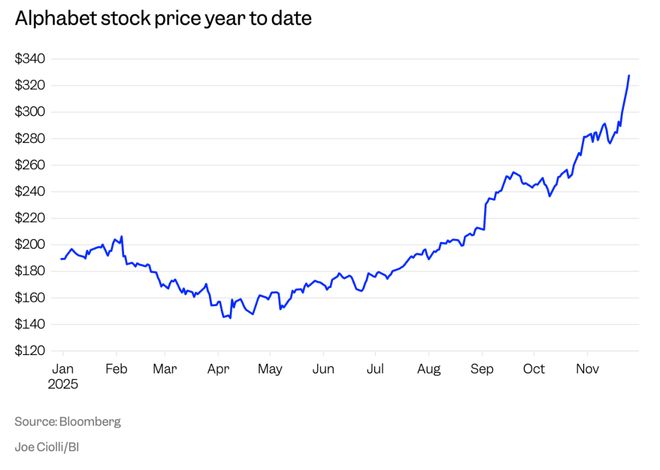
Core Insights - Alphabet's stock price surged 2.4% to $326, reaching a historical high, with a cumulative increase of over 11.5% in the past five trading days and 22% in the last month [1] - As of November 24, Alphabet's market capitalization was approximately $3.84 trillion, making it the third-largest company globally, just behind Nvidia and Apple [1] - The stock price increase has significantly boosted the wealth of its founders, Larry Page and Sergey Brin, placing them as the second and third richest individuals globally, respectively [4] AI Breakthroughs - The primary driver behind the stock surge is the release of the new AI model, Gemini 3, which has received widespread acclaim for its performance, surpassing OpenAI's ChatGPT-5 in several tests [7] - Additionally, Google's AI chip business is experiencing a major breakthrough, with reports that Meta Platforms is considering using Google's AI chips in its data centers, potentially worth billions for Google [10] Competitive Landscape - Nvidia has responded to concerns about Google's AI chip potentially disrupting its market dominance, asserting that its technology remains a generation ahead [10][11] - Despite Google's advancements, Nvidia continues to hold over 90% of the AI chip market share, emphasizing the competitive nature of the industry [11] Strategic Developments - Google has been developing its TPU chips for over a decade, which are now being used to train the Gemini models, positioning them as a strong alternative to Nvidia's offerings [16] - The potential deal with Meta could allow Google to capture about 10% of Nvidia's annual revenue, further solidifying its position in the AI hardware market [10] Financial Performance - Google's search revenue increased by 15% in the third quarter, indicating that its core business remains robust despite concerns about AI impacting its advertising revenue [20] - Warren Buffett's Berkshire Hathaway has invested approximately $4.3 billion in Alphabet, signaling strong confidence in the company's future prospects [18]


谷歌TPU逆袭英伟达,创始人一夜之间跃升全球第二、第三富豪
机器之心· 2025-11-26 05:12
Core Viewpoint - Google's stock price has surged significantly, driven by advancements in artificial intelligence, particularly the launch of the Gemini 3 model and potential AI chip deals with Meta [2][9][11]. Stock Performance - As of November 25, Alphabet's stock price reached $326, marking a 2.4% increase and a historical high. The stock has seen a cumulative increase of over 11.5% in the past five trading days and 22% in the last month [2]. - Alphabet's market capitalization is approximately $3.84 trillion, making it the third-largest company globally, just behind Nvidia and Apple [2]. Wealth Impact - The surge in stock price has significantly increased the wealth of Google's founders, with Larry Page and Sergey Brin now ranked as the second and third richest individuals globally, surpassing Jeff Bezos [5]. AI Breakthroughs - The core drivers of Google's stock increase are two major advancements in AI: the impressive performance of the Gemini 3 model and a potential deal for Google's AI chips with Meta [9][11]. - Gemini 3 has received widespread acclaim for its speed and capabilities, outperforming OpenAI's ChatGPT-5 in several benchmarks [9][10]. AI Chip Developments - Google's latest TPU chip, "Ironwood," is reported to be the most powerful and energy-efficient custom chip to date, with a potential multi-billion dollar deal with Meta for its use in data centers [10][11]. - This deal could allow Google to capture about 10% of Nvidia's annual revenue, establishing a competitive position in the AI hardware market [11]. Cloud Computing and AI Demand - Google's cloud AI infrastructure head indicated that the company needs to double its computing power every six months to meet the explosive demand for AI services, aiming for a 1000-fold increase in computing power over the next 4-5 years [12]. Competitive Landscape - Nvidia has responded to concerns about Google's AI chip potentially disrupting its market dominance, asserting that its technology remains a generation ahead [14][15]. - Despite Google's growing attention in the AI chip space, Nvidia still holds over 90% of the AI chip market share [15]. Strategic Shifts - Google's successful turnaround in the AI race is attributed to the launch of Gemini 3, which has restored market confidence and attracted industry leaders back to its products [19][20]. - The company has been promoting its TPU chips through cloud services, which may pose a long-term threat to Nvidia's market position [22]. Legal and Financial Developments - A recent antitrust ruling allowed Google to maintain its search business structure, alleviating concerns about potential disruptions to its revenue streams [23]. - Warren Buffett's Berkshire Hathaway has invested approximately $4.3 billion in Alphabet, signaling strong confidence in the company's future [24]. Search Business Resilience - Google's search advertising revenue increased by 15% in the third quarter, indicating that its core business remains robust despite the rise of AI technologies [25].

资产配置日报:等待反弹的理由-20251124
HUAXI Securities· 2025-11-24 15:22
Core Insights - The market has established a foundation for a rebound after a week of adjustments, with structural risks significantly alleviated. The concentration of trading volume has decreased to around 40%, below the historical average of 45%, and the proportion of stocks with prices above their 95th historical percentile has dropped to 12%, below the historical average of 15% [2][3] - The technology sector is not expected to weaken completely, as evidenced by the rebound in tech stocks and the ongoing narrative surrounding technological advancements, such as Gemini 3 and Google's TPU, which have drawn attention to Google's supply chain [2][3] - The market currently lacks strong reasons for a significant rebound, primarily due to two prevailing concerns: the instability of the US stock market and the deteriorating Sino-Japanese relations, which may hinder risk appetite recovery [2][3] Market Performance - The A-share market saw a slight increase of 0.62%, with a total trading volume of 1.74 trillion yuan, a decrease of 243.2 billion yuan compared to the previous week. The Hang Seng Index rose by 1.97%, and the Hang Seng Tech Index increased by 2.78% [1] - Southbound capital saw a net inflow of 8.571 billion HKD, with Alibaba receiving a net inflow of 4.066 billion HKD, and Tencent and Kuaishou receiving net inflows of 1.167 billion HKD and 819 million HKD, respectively [1] Bond Market - The bond market continues to experience low trading volumes, with the number of transactions for 10-year government bonds and 10-year policy bank bonds declining to 220 and 972, respectively. The trading activity of 10-year government bonds has been surpassed by 7-year government bonds [4] - The overall performance of 5-7 year government bonds and local government bonds has been better, likely due to institutional behavior. Despite net redemptions in pure bond funds, the redemption pressure is not significant, primarily driven by banks seeking to secure profits as year-end approaches [4][5] Credit Market - As of late November, credit spreads across various types and maturities have compressed to very low levels, with spreads generally within the 25th percentile since 2021. This thin spread protection has led investors to reassess credit pricing, resulting in adjustments in lower-rated bonds [5] - The market is expected to remain in a narrow fluctuation pattern until a new catalyst emerges, with the current environment suggesting that leveraging and coupon payments may be necessary to navigate this "boring period" [5] Commodity Market - The commodity market is showing signs of mild recovery, although significant differentiation between sectors remains. Precious metals have seen reduced declines, while industrial metals have shown mixed performance [6] - The market experienced a small net inflow of 200 million yuan, contrasting with a significant net outflow of 8.5 billion yuan the previous trading day. Agricultural products and black chain indices have attracted substantial capital, while non-ferrous and new energy sectors faced reductions [6]
Al之光一新架构.新技术.新时代:光模块更新
2025-09-24 09:35
Summary of Conference Call Notes Industry and Company Involved - The discussion primarily revolves around the **optical module market** and key players such as **Google**, **NVIDIA**, **Oracle**, **Amazon**, and other leading companies in the AI and technology sectors [1][2][3][4][5]. Core Insights and Arguments - **Strong Demand in Q3**: Significant demand for GB200 and low-priced products, with notable orders for Google TPU, indicating a positive outlook for leading companies like 易中天, 沪电, 胜宏, and 深南 [1][2]. - **Market Catalysts**: Events involving Oracle, NVIDIA, CPX, and NVIDIA's investment in OpenAI have acted as catalysts for the market, suggesting a potential for stock valuations of leading companies like 旭创 to exceed 20 times, with a possibility of reaching 30 times in a bull market [1][2]. - **Google's Competitive Edge**: Google’s TPU is not only open for external procurement but is also attracting interest from major players like Microsoft, OpenAI, Meta, and Apple, highlighting Google's strong position in large models and its ecosystem [3][4]. - **Future of Amazon in AI**: Although Amazon has been slower to enter the AI space, its substantial capital expenditure indicates potential for significant advancements in the future [4]. - **Oracle's Role**: As a key player in the AI sector, Oracle's upcoming demand from the 星际之门 project is expected to significantly boost related industries such as optical modules, switches, PCBs, and liquid cooling by 2026 [4]. Other Important but Potentially Overlooked Content - **Market Trends in Optical Modules**: The optical module market's growth will be driven by overall industry trends, technological innovations, application expansions, and changes in market demand and competition [5]. - **Investment Opportunities**: Investors are encouraged to monitor the developments in AI strategies of major companies and related supply chain opportunities, particularly in light of the competitive landscape and technological advancements [3][4].
AI产业的进一步推演——模型,芯片的下一步
2025-09-23 02:34
Summary of Key Points from the Conference Call Industry Overview - The AI industry is undergoing significant structural changes, with increased collaboration and competition among companies, notably highlighted by Nvidia's investment in Intel and Oracle's $450 billion order, indicating a shift in market dynamics [1][3][4] - The AI sector in the US stock market shows a mixed performance, with Nvidia's stock stagnating while Oracle's announcement sparked market enthusiasm, reflecting a focus on the commercialization of AI and the cloud service ecosystem [1][4] Core Insights and Arguments - AI capital expenditure is projected to reach $400 billion in 2025, while revenues are only expected to be $30 billion, indicating a heavy reliance on external financing to support infrastructure development [6][7] - The competition in the model segment is intensifying, with Google's TPU showcasing economic advantages over Nvidia's GPUs, positioning Google Cloud as a potential leader in the enterprise market [1][8][14] - The trend is shifting from high-performance computing to cost-effective and customized chip solutions, as cloud providers seek to break Nvidia's monopoly [11][12] Notable Developments - The partnership between OpenAI and Oracle may be influenced by political factors, as it aligns with US government initiatives, while also allowing OpenAI to diversify its partnerships beyond Azure [8] - The emergence of new models like Meta's Grok 4 and Gemini indicates a competitive landscape where traditional models like ChatGPT 5 are underperforming [8][14] - The AI industry is moving towards more complex applications requiring tailored solutions, emphasizing the need for effective technology application in specific scenarios [9] Investment Opportunities and Risks - In the consumer application space, companies face challenges due to market saturation and price wars, while enterprise applications show a more stable competitive landscape [10] - The investment landscape is shifting, with companies like Coreweave leveraging financing for computational investments, making data center construction more attractive amid anticipated interest rate cuts [5][6] - The AI sector's evolution necessitates a reassessment of investment strategies, particularly in light of the changing dynamics between US and Chinese companies in the AI field [15][27] Additional Insights - The AI industry's capital expenditure significantly exceeds its revenue, leading to a reliance on external funding sources for infrastructure development [6][7] - The increasing complexity of application scenarios in AI necessitates comprehensive solutions that integrate hardware and software effectively [9] - The competitive landscape in the AI sector is evolving, with established companies needing to adapt to new entrants and changing consumer demands [10][15]


申万宏源研究晨会报告-20250915
Shenwan Hongyuan Securities· 2025-09-15 00:44
Group 1: Market Overview - The current market indicates increased pressure in the bond market, with risks surpassing the influences of fundamentals and liquidity [2][13] - The bond market adjustment is largely seen as a preparation for a potential bull market around the end of 2024 [2][13] - Observations are needed for signals indicating a turning point in market sentiment, particularly regarding deposit rates and credit spreads [13] Group 2: Company Analysis - Jianfa Hecheng (建发合诚) - Jianfa Hecheng is positioned for growth under the Jianfa Group, with expected net profits of 122 million, 140 million, and 160 million yuan for 2025-2027, reflecting year-on-year growth rates of 27.4%, 14.7%, and 14.3% respectively [2][19] - The company is enhancing its construction business through collaboration with its major shareholder, with significant associated transaction amounts projected for the coming years [14][15] - The shift towards urban renewal and business extension is seen as a key opportunity for growth in the current market environment [15] Group 3: Industry Trends - Cloud Computing - The cloud computing market is witnessing a divergence in capital expenditure (Capex) expectations, with major cloud providers expected to collectively exceed 350 billion yuan in FY25, marking a 54% year-on-year increase [16][17] - Emerging cloud computing firms are benefiting from high growth in remaining performance obligations (RPO), with Oracle reporting a 359% year-on-year increase in RPO [17][20] - The competition landscape is evolving with the introduction of ASIC chips, which are becoming increasingly relevant in AI applications [18][20] Group 4: Automotive Industry Insights - The automotive sector is experiencing a shift towards high-end and intelligent electric vehicle manufacturing, with companies like Jianghuai Automobile collaborating with tech giants like Huawei [25][27] - The company anticipates significant revenue growth with the launch of its high-end brand, aiming for a notable increase in sales volume in the coming years [27] - The overall automotive market is seeing fluctuations in sales and material costs, with a focus on maintaining competitive positioning amid changing consumer demands [32][34]