
ABN产品

Search documents
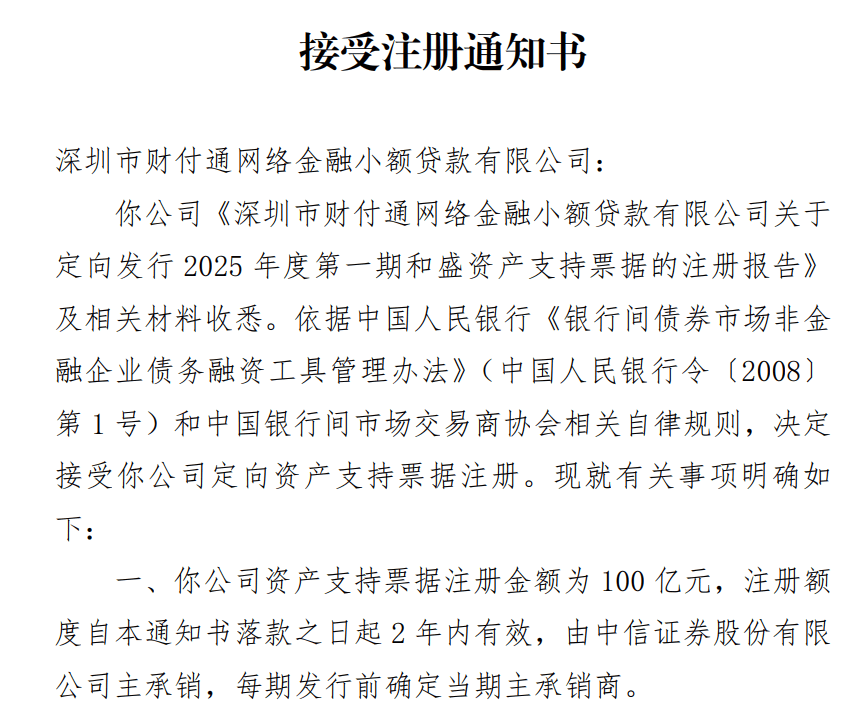
100亿!财付通小贷再获大额融资
Sou Hu Cai Jing· 2025-12-30 01:44
Group 1 - The main financing methods for Tencent's microloan company, WeChat Pay Microloan, are the issuance of Asset-Backed Securities (ABS) and Asset-Backed Notes (ABN) products, with a total of 450 billion yuan in ABN products registered over the past two years and over 200 billion yuan issued this year [2] - WeChat Pay Microloan was established in October 2013 and is primarily owned by Tencent Holdings, with a registered capital increase from 10.5 billion yuan to 15 billion yuan in November this year, making it the second largest in the industry after Douyin's Zhongrong Microloan at 19 billion yuan [2] - The main product under Tencent is "Fenfu," which started a limited rollout in 2020 and is still invitation-only, with a loan balance expected to reach approximately 120 billion yuan by the end of June 2025 [2] Group 2 - As of June 30, 2025, WeChat Pay Microloan's total assets were 15.355 billion yuan, a decrease of 5.52% from the beginning of the year [3] - In the first half of 2024, WeChat Pay Microloan achieved revenue of 662 million yuan, a year-on-year increase of 30.2%, while net profit was 6.8 million yuan, a year-on-year decrease of 56.38%, indicating a situation of increasing revenue but declining profit [3]


阅峰 | 光大研究热门研报阅读榜 20251221-20251227
光大证券研究· 2025-12-28 00:20
Group 1 - The article discusses the rapid growth of the brain-machine interface industry, driven by both policy and technology, indicating a potential market worth billions [3][4]. - It highlights the integration of medical and consumer sectors, suggesting that companies like Xiangyu Medical and Weisi Medical may benefit from the implementation of medical insurance payments and increasing rehabilitation demands [4]. - The report emphasizes the strong commercial viability and high technological barriers of invasive and semi-invasive technology leaders such as Xinwei Medical and Brain Tiger Technology [4]. Group 2 - The insurance sector is experiencing a shift towards equity investments, with a record 9.3% of stock assets among five listed insurance companies, the highest in nearly a decade [9]. - Projections for the insurance industry indicate potential stock scale increments of 1.7 trillion, 2.4 trillion, and 3.1 trillion yuan under pessimistic, neutral, and optimistic scenarios for 2025-2027 [9]. - The article suggests that the upward trend in the equity market will significantly enhance investment returns for insurance companies [9]. Group 3 - The report on the real estate market indicates a 15.1% year-on-year decline in residential land transaction area, while the average transaction price per square meter increased by 9.4% [18]. - It notes that first-tier cities experienced a 29.5% increase in average transaction price, reflecting regional disparities in the real estate market [18]. - Recommendations include companies like Poly Development and China Merchants Shekou, as well as property service firms such as China Resources Mixc Life and Greentown Service, which are expected to benefit from long-term growth [18]. Group 4 - The article on high-end manufacturing exports highlights improvements in November due to the fading high base effect and strong seasonal replenishment demand from overseas [27]. - It suggests that new trade agreements between China and the U.S. may lead to a marginal recovery in exports to the U.S., with companies like Quan Feng Holdings being potential beneficiaries [27]. - The report also points out rapid growth in exports to emerging markets in Africa and Latin America, recommending companies like Anhui Heli [27]. Group 5 - The analysis of ABN products indicates that they still hold a yield advantage over some ordinary credit bonds, despite a lack of significant premium compared to other asset-backed securities [15]. - In a market with scarce high-yield assets, ABN products are positioned as a viable option for enhancing returns, while their valuation volatility is generally lower than that of ordinary credit bonds [15]. - This characteristic provides a degree of resilience against overall industry shocks, aiding in the optimization of investment portfolio stability [15].

研选 | 光大研究每周重点报告 20251220-20251226
光大证券研究· 2025-12-27 00:04
Group 1: Market Overview - The A-share bull market is not showing significant warning signals of a peak, and future performance remains promising [4][5] - The factors leading to the peak of a bull market can be categorized into three main types: policy and external environment factors, fundamental factors, and market trading factors [4] Group 2: Credit Bond Research - ABN products currently do not show significant premium compared to other asset-backed securities, but they still have a yield advantage over some ordinary credit bonds [6] - In a context of scarce high-yield assets, ABN products can serve as a direction for enhancing returns, with lower valuation volatility compared to ordinary credit bonds, providing stability in investment portfolios [6] Group 3: Insurance Sector Insights - In a low-interest-rate environment, equity assets have become crucial for insurance companies to enhance investment returns, supported by regulatory policies that encourage equity market entry [7] - As of the end of the first half of 2025, the stock asset proportion of five listed insurance companies reached 9.3%, the highest in nearly a decade, with expectations for further increases in the third quarter [7] - Projected stock scale increments for the insurance industry from 2025 to 2027 are estimated at 1.7 trillion, 2.4 trillion, and 3.1 trillion under pessimistic, neutral, and optimistic scenarios, respectively [7]

4倍LPR降息压力,小贷行业“生死突围”
Xin Lang Cai Jing· 2025-12-25 08:55
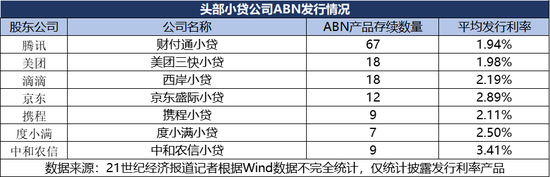
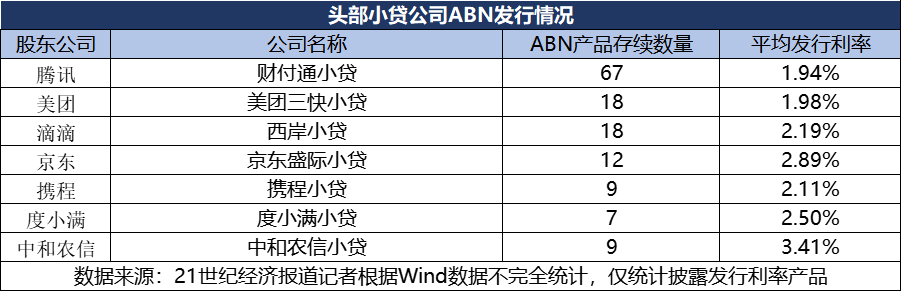
Core Viewpoint - The recently issued guidelines by the People's Bank of China and the Financial Regulatory Administration aim to lower the comprehensive financing costs for small loan companies, mandating that new loans should not exceed four times the one-year Loan Prime Rate (LPR) by the end of 2027, effectively targeting a cap of around 12% [1][3][4]. Group 1: Guidelines and Implementation - The guidelines require small loan companies to clearly disclose the comprehensive financing costs of loans, which include interest, guarantee fees, and insurance fees, and must be presented in an annualized format [3][16]. - New loans with comprehensive financing costs exceeding 24% must be immediately halted, and short-term loans (up to one month) are allowed a maximum cost of 24% [3][5]. - By the end of 2026, the proportion of new loans exceeding four times the LPR should significantly decrease, with a complete reduction to this cap by the end of 2027 [4][17]. Group 2: Industry Impact and Trends - The issuance of these guidelines is expected to accelerate the "clearing out" of the small loan industry, particularly affecting those companies involved in self-operated and joint lending businesses [2][15]. - The guidelines signal a shift in the value of small loan licenses, likely reducing the scale of new business and making these licenses less attractive to lending platforms [11][23]. - The regulatory environment is tightening, with a focus on ensuring that small loan companies operate within defined risk parameters, leading to a potential reduction in the number of such companies [12][24][25]. Group 3: Financing Cost Dynamics - The average issuance rates for asset-backed notes (ABN) among leading small loan companies show significant variation, with Tencent's small loan company having the lowest average rate at 1.94% and others like Chongqing Zhonghe Agricultural Credit at 3.41% [8][21]. - The pressure to meet the new 12% cap on financing costs poses challenges for many small loan companies, especially those that rely on self-operated loans or joint loans [19][20]. - The competitive landscape is shifting, with larger financial institutions like banks and consumer finance companies expected to play a more dominant role in the market, potentially sidelining smaller players [11][23].
深度丨4倍LPR降息压力,小贷行业“生死突围”
2 1 Shi Ji Jing Ji Bao Dao· 2025-12-25 08:48
Core Viewpoint - The recent issuance of guidelines by the People's Bank of China and the Financial Regulatory Bureau marks a significant policy shift aimed at reducing the comprehensive financing costs in the microloan industry, with a target to lower these costs to within four times the one-year Loan Prime Rate (LPR) by the end of 2027 [1][3][4]. Group 1: Policy Implementation - The guidelines require microloan companies to clearly disclose the comprehensive financing costs of loans and to gradually reduce these costs, with new loans exceeding a 24% cost immediately halted [1][3]. - By the end of 2027, all new loans must have a comprehensive financing cost capped at approximately 12%, based on the current one-year LPR of 3% [1][4]. - The guidelines emphasize the need for local financial management institutions to monitor the lending activities of microloan companies closely [1][3]. Group 2: Industry Impact - The guidelines are expected to accelerate the "clearing out" of the microloan industry, particularly affecting companies that engage in self-operated and joint lending businesses [2][11]. - The value of microloan licenses is anticipated to decline significantly, leading to a reduction in new business scale for microloan companies [11]. - The guidelines will likely enhance the role of licensed financial institutions, such as banks and consumer finance companies, in providing inclusive financial services [11][12]. Group 3: Regulatory Environment - The guidelines signal a strong regulatory stance, prohibiting regulatory arbitrage and requiring local financial management institutions to focus on the growth of short-term loans [5][12]. - There is an ongoing effort to strengthen the regulation of local financial organizations, with a goal to phase out non-compliant institutions over the next three years [12][13]. - The number of microloan companies has already decreased significantly, with the latest data showing a reduction to 4,863 companies and a loan balance of 722 billion yuan [13].
光大证券晨会速递-20251224
EBSCN· 2025-12-24 00:39
Core Insights - The report highlights that ABN products currently do not exhibit significant premium compared to other asset-backed securities, but they still maintain a yield spread advantage over certain ordinary credit bonds, making them a viable option for enhancing returns in a market with scarce high-yield assets [2] - ABN products generally experience lower valuation volatility than ordinary credit bonds, providing a degree of resilience against overall industry shocks, which aids in optimizing portfolio stability [2] Market Overview - The A-share market showed a trend of initial decline followed by recovery, with major indices experiencing a contraction in trading volume compared to the previous week. The net inflow of funds into equity ETFs reached 55.353 billion yuan, with large-cap thematic ETFs being the primary direction for net inflows [3] - Following the Central Economic Work Conference in December, market trading sentiment has improved, and the funding situation has shown continuous improvement, laying a foundation for further market upward movement [3] Market Data Summary - The closing values and percentage changes for major indices are as follows: - Shanghai Composite Index: 3919.98 (+0.07%) - CSI 300: 4620.73 (+0.20%) - Shenzhen Component Index: 13368.99 (+0.27%) - ChiNext Index: 3205.01 (+0.41%) [4] - In the commodity market, gold closed at 1014.24 (+1.34%), while copper and zinc showed slight declines [4] Valuation and Rating System - The report outlines a rating system for companies and industries, with categories ranging from "Buy" (expected return exceeding 15% over 6-12 months) to "Sell" (expected return lagging by over 15%) [5]

识微知著:ABN产品要点与市场观察——信用债品种研究系列之一,基本面驱动或为当前主要交易方向——金融工程市场跟踪周报20251222:晨会速递-20251224
EBSCN· 2025-12-23 23:34
Core Insights - The report highlights that ABN products currently do not exhibit significant premium compared to other asset-backed securities, but they still maintain a yield spread advantage over certain ordinary credit bonds, making them a viable option for enhancing returns in a market with scarce high-yield assets [2] - ABN products generally experience lower valuation volatility than ordinary credit bonds, providing a degree of resilience against overall industry shocks, which can help optimize the stability of investment portfolios [2] Market Overview - The A-share market showed a trend of initial decline followed by recovery, with major indices experiencing a slight increase in trading volume compared to the previous week. The net inflow of funds into equity ETFs reached 55.353 billion yuan, with large-cap thematic ETFs being the primary direction for net inflows [3] - Following the Central Economic Work Conference in December, market trading sentiment has improved, and the funding environment has shown continuous improvement, laying a foundation for further market upward movement [3] Market Data Summary - The closing values and percentage changes for major indices are as follows: - Shanghai Composite Index: 3919.98 (+0.07%) - CSI 300: 4620.73 (+0.20%) - Shenzhen Component Index: 13368.99 (+0.27%) - Small and Medium-sized Enterprises Index: 8111.91 (+0.35%) - ChiNext Index: 3205.01 (+0.41%) [4] - In the futures market, the closing values for stock index futures showed positive changes, with IF2601 at 4591.20 (+0.89%) [4] - Commodity market data indicates that gold closed at 1014.24 (+1.34%) and crude oil at 2483 (+1.02%), while copper and zinc experienced slight declines [4] Valuation and Rating System - The report outlines a rating system for companies and industries, categorizing them into five levels: Buy, Accumulate, Neutral, Reduce, and Sell, based on expected investment returns relative to market benchmarks over the next 6-12 months [5]
【光大研究每日速递】20251224
光大证券研究· 2025-12-23 23:04
Group 1 - The article discusses the current market environment for ABN products, highlighting that their premium over other asset-backed securities is not significant, but they still offer a yield advantage over some ordinary credit bonds [5] - ABN products are positioned as a potential investment direction to enhance returns, especially in a context where high-yield assets are scarce [5] - The valuation volatility of ABN products is generally lower than that of ordinary credit bonds, providing a degree of resilience against overall industry shocks, which can help optimize portfolio stability [5] Group 2 - Financial and real estate theme funds have shown superior performance, while TMT theme funds have experienced a net value decline [6] - There was a significant inflow of funds into stock ETFs, with a net inflow of 55.353 billion yuan, primarily directed towards large-cap broad-based ETFs and Hong Kong stock ETFs [6] - The central economic work conference has positively influenced market trading sentiment, leading to improved funding conditions and laying a foundation for further market upward movement [6] Group 3 - Infrastructure investment has declined, but certain sub-sectors continue to grow rapidly, with a focus on stabilizing investment and emphasizing project quality and implementation during the 14th Five-Year Plan period [7] - Major engineering projects will remain a key focus within traditional infrastructure sectors [7] Group 4 - China Shenhua's acquisition of coal mining, coal power, coal chemical, and logistics services from the State Energy Group is valued at 133.6 billion yuan, with a PB/PE of 1.5/17.0 times [7] - Post-transaction, the company's coal production capacity is expected to increase by 57%, and its recoverable coal reserves will rise by 98%, enhancing profitability [7] - The company has committed to maintaining a dividend payout ratio of no less than 65% from 2025 to 2027, indicating strong investment value [7]


“百亿级”小贷竞速:财付通小贷增资至150亿元
Zhong Guo Jing Ying Bao· 2025-11-27 13:07
Core Insights - The tightening regulation in the micro-lending industry has led to a competitive landscape where companies with substantial registered capital are gaining an advantage, resulting in increased industry differentiation [1][5] - Tencent's subsidiary, Shenzhen Financial Payment Network Micro Loan Co., Ltd. (referred to as "Financial Payment Micro Loan"), has raised its registered capital by 4.4 billion to 15 billion, ranking second in the industry [1][2] Company Developments - Financial Payment Micro Loan has completed its sixth capital increase in five years, growing from an initial 300 million to 15 billion [2] - The latest capital increase was supported by Tencent through two entities, with Tencent Network contributing 4.25 billion and Tencent Computer contributing approximately 224 million [2] - Recent changes in the company include a new general manager and a relocation of its registered address to Tencent Digital Building [3] Industry Trends - The micro-lending industry is experiencing a "Matthew Effect," where larger companies are consolidating resources while smaller firms are exiting the market due to stricter regulations [5][6] - The capital increase by leading micro-lending firms is seen as a proactive response to regulatory expectations, enhancing their capital strength and business development potential [5][6] - Analysts suggest that smaller micro-lending institutions should focus on niche markets and improve their risk management and technological capabilities rather than competing on scale [6]