
AI PC

Search documents
ODM行业专题研究:智能终端迭代加速,ODM渗透持续提升
Guoyuan Securities· 2026-03-26 11:07
[Table_Main] 行业研究|信息技术|技术硬件与设备 证券研究报告 ODM 行业专题研究报告 2026 年 03 月 26 日 [Table_Title] 智能终端迭代加速,ODM 渗透持续提升 ——ODM 行业专题研究 [Table_Summary] 报告要点: 消费电子跃升迭代,ODM 体系持续扩张 行业发展与技术特点:ODM 是面向品牌商提供从产品研发设计到生 产交付的完整产业链。智能产品行业在 3G/4G/5G 演进与存量竞争加 剧背景下,产业分工逐步细化,早期以 IDH/EMS 为主,随后具备研 发、制造、管理与资金实力的服务商向 ODM 转型,以覆盖研发设计 到生产交付的全流程需求。 市场规模与竞争格局:消费电子 ODM 出货量持续增长,且头部集中 度较高。弗若斯特沙利文的数据显示,全球消费电子 ODM 出货量由 2020 年 853.5 百万个增长至 2024 年 976.9 百万个,并预计 2029 年 增至 1473.0 百万个;2024 年全球消费电子 ODM 行业前三名合计市 占率为 56.9%,智能手机 ODM 行业前三名合计市占率为 75.1%。 行业壁垒:ODM 行业壁垒主 ...



新一代智能终端蓝皮书:从“人工智能+终端”到人工智能终端
中国信通院· 2026-03-19 01:41
Investment Rating - The report does not explicitly provide an investment rating for the industry Core Insights - The new generation of intelligent terminals is transitioning from "AI + terminal" to "AI terminal," marking a significant evolution in technology and user interaction [7][16] - AI terminals exhibit four distinct characteristics: cognitive collaboration, scenario anticipation, intention-driven services, and service symbiosis, which signify a shift from passive tools to active partners in user interaction [8][17] - The industry is experiencing explosive growth, with AI mobile phones, AI PCs, and AI wearables becoming mainstream products, supported by advancements in hardware and software integration [20][28] Summary by Sections 1. Policy and Technology Drivers - The development of AI terminals has become a global consensus, with major economies implementing strategic plans to enhance AI capabilities in various sectors [24][26] - China's national AI strategy emphasizes the importance of AI terminals in fostering high-quality development and creating a modern industrial system [26][27] 2. "Four New" Characteristics - AI terminals are evolving to provide proactive services through enhanced cognitive understanding and multi-modal interactions [17][18] - The integration of hardware and software technologies is crucial for realizing the "four new" capabilities of AI terminals [9][18] 3. Hardware Evolution - The industry standard for AI terminals now includes a heterogeneous computing architecture of CPU, GPU, and NPU, which enhances AI processing capabilities [9][18] - Storage technologies have made significant advancements, alleviating previous performance bottlenecks [9][18] 4. Software System Reconstruction - AI operating systems are undergoing a transformation to create a collaborative intelligent hub that integrates local and cloud capabilities [18][19] - The concept of intelligent agents is emerging, allowing AI terminals to autonomously execute complex tasks based on user intent [19][20] 5. Market Penetration and Product Experience - AI mobile phones and PCs are becoming the primary platforms for AI applications, with significant market penetration expected by 2025 [28][29] - The intelligent service capabilities of AI mobile phones have reached an assistant level, integrating deeply with various user scenarios [33][37] 6. Standardization and Evaluation - A comprehensive evaluation framework for AI terminals is being developed to address inconsistencies in intelligent levels and user understanding [29][30] - Various industry associations are collaborating to establish standards that will guide the development and deployment of AI terminals [31][32] 7. Future Outlook - The AI terminal industry is poised for rapid growth, with predictions indicating substantial increases in market penetration and product diversity by 2025 [28][29] - The ecosystem surrounding AI terminals is maturing, with collaboration among chip manufacturers, terminal producers, and software developers becoming increasingly important [20][28]
Dell vs HP: 2 Legacy Tech Giants, 2 Very Different AI Bets
247Wallst· 2026-03-17 11:45
Core Insights - Dell Technologies is significantly outperforming HP in the AI sector, with nearly $10 billion in AI server revenue for FY2025 and a forecast of at least $15 billion for FY2026, while HP's printing segment is declining [1][2][4] - Dell's total revenue for FY2025 reached $95.6 billion, marking an 8% increase, and its earnings grew by 45.4% year over year, contrasting with HP's operating income decline of 16.87% [1][6][7] Growth Trajectory - Dell's AI server business is experiencing robust growth, with a backlog of approximately $9 billion as of February [2][6] - HP's Personal Systems revenue grew by 11% year over year in Q1 FY2026, driven by AI PC sales, but its printing segment has seen a consistent decline [7] Valuation - HP has a trailing P/E of 7x and a forward P/E of 7x, while Dell's trailing P/E is 17x and forward P/E is 12x, indicating a higher valuation for Dell due to its growth prospects [8][9] - HP's price-to-sales ratio is 0.31x compared to Dell's 0.90x, reflecting the structural risks associated with HP's business model [8][9] Yield and Income - HP offers a higher dividend yield of 6.2% with a quarterly dividend of $0.30 per share, while Dell's yield is 1.4% with an annual dividend of $2.52 per share, which was raised by 20% [11] - Despite HP's higher yield, it is accompanied by declining profitability and rising cost pressures [11][12] Long-Term Track Record - Over the past year, Dell shares have appreciated by 63.62% and by 246.71% over five years, while HP shares have decreased by 34.25% in the past year and by 38.61% over five years [13] - This divergence highlights the fundamentally different strategic positions of the two companies in the current market environment [13][14]



半导体行业月报:海外模拟厂商陆续发布涨价函,国内存储模组厂商26Q1业绩超预期-20260313
Zhongyuan Securities· 2026-03-13 09:34
Investment Rating - The report maintains an "Outperform" rating for the semiconductor industry [1]. Core Insights - The semiconductor industry is experiencing a recovery driven by the demand for AI systems, with significant price increases announced by overseas analog chip manufacturers [3]. - Domestic storage module manufacturers reported better-than-expected performance in Q1 2026, with revenue forecasts indicating substantial growth [5]. - The global semiconductor sales continue to grow, with January 2026 sales up 46.1% year-over-year, marking 27 consecutive months of growth [26][27]. Summary by Sections 1. Market Performance - In February 2026, the domestic semiconductor industry underperformed, declining by 1.30%, while the Shanghai Composite Index rose by 0.09% [5][11]. - The semiconductor sector has seen a year-to-date increase of 17.09% as of February 2026 [11]. 2. Global Semiconductor Sales - Global semiconductor sales reached approximately $82.5 billion in January 2026, with a year-over-year increase of 46.1% and a month-over-month increase of 3.7% [26]. - The Asia-Pacific region saw a remarkable year-over-year growth of 82.4% in semiconductor sales [26]. 3. Price Trends - The prices of DRAM and NAND Flash continued to rise, with DRAM prices expected to increase by 90-95% in Q1 2026 and NAND Flash prices by 55-60% [5][33]. - The report highlights that the demand for storage solutions driven by AI applications is expected to sustain the upward price trend in the semiconductor market [5]. 4. Investment Opportunities - The report suggests focusing on domestic semiconductor manufacturers, particularly in the storage module and chip sectors, as they are likely to benefit from the ongoing industry trends [5][6].
消费增长,关键在新场景、新人群、新基建
21世纪经济报道· 2026-03-11 01:17
Core Viewpoint - The article emphasizes the transformation of China's consumption strategy from short-term stimulus to a systematic approach that integrates "new infrastructure, new scenarios, and new demographics" to create a dynamic growth ecosystem for domestic consumption [1][15]. New Scenarios: Creating New Demand through High-Quality Supply - The current challenge in China's economy is the imbalance of "strong supply and weak demand," necessitating innovative supply to lead and create new demand [3][4]. - Key potential scenarios include: - **Smart Economy**: AI is evolving from a tool to a partner, reshaping the service chain and enhancing consumer experiences through intelligent devices [3][4]. - **Low-altitude Economy**: Recognized as an emerging pillar, it expands consumption scenarios into three dimensions, enabling rapid delivery and new experiences [5]. - **Silver Economy**: Focuses on empowering the elderly to transition from being cared for to actively consuming, supported by policies that reduce their financial burdens [5]. New Demographics: Empowering Potential Consumers - The fundamental driver of consumption is the people, with policies aimed at enhancing the consumption capacity of the most constrained groups [6][7]. - For the elderly, policies like pension increases and community care networks are designed to alleviate concerns about healthcare and enable spending on quality of life [7]. - For young families, comprehensive support in education and housing is expected to boost their confidence in long-term consumption planning [7][8]. - Low-income groups and new employment forms are targeted for income growth through policies that enhance earnings and stabilize their financial situations [8][9]. New Infrastructure: Building the Digital Foundation for Consumption Growth - The realization of new scenarios and demographics relies on new infrastructure, forming a three-dimensional, intelligent consumption infrastructure system [10][11]. - **Digital and Intelligent Infrastructure**: Acts as the engine for consumption, providing the necessary computational power and data resources for AI applications [11]. - **Low-altitude Infrastructure**: Essential for the safe and efficient operation of low-altitude consumption scenarios, including logistics and tourism [12]. - **Upgrading Traditional Infrastructure**: Enhancements in logistics and energy stability are crucial for supporting regional consumption ecosystems [12][13]. Systematic Restructuring for Sustainable Consumption Growth - The article outlines a paradigm shift in consumption growth that focuses on building a self-sustaining ecosystem through the integration of new infrastructure, scenarios, and demographics [15][17]. - This approach aims to activate consumer potential not through direct financial incentives but through institutional innovation, technological empowerment, and social security [17].

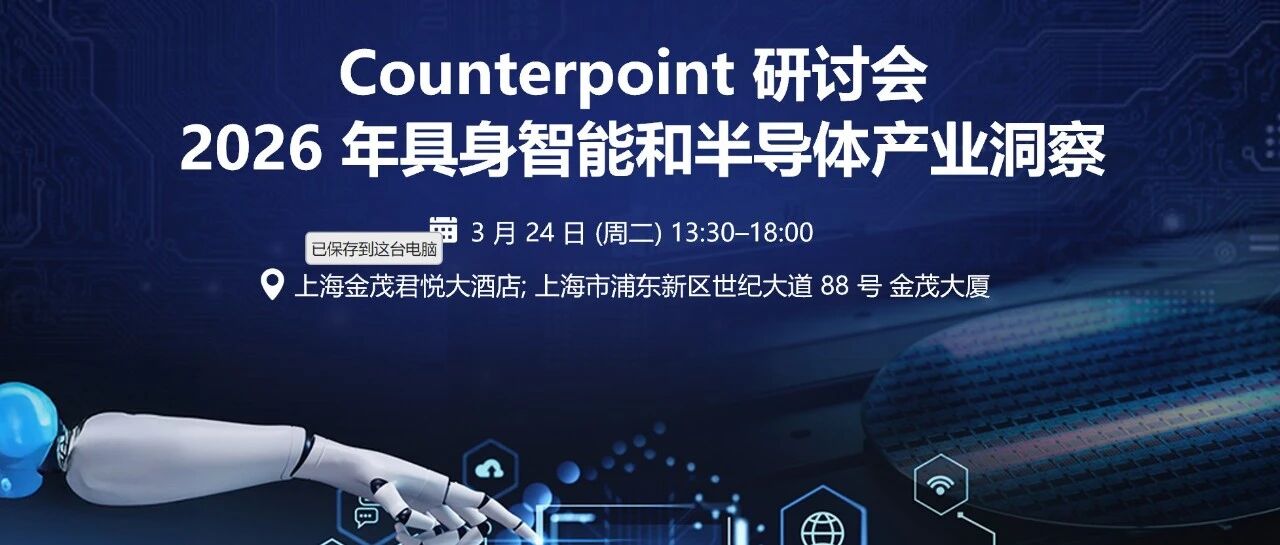
Counterpoint 研讨会2026年具身智能和半导体产业洞察
Counterpoint Research· 2026-03-05 11:25
Core Insights - The article emphasizes the transition of embodied intelligence from concept to commercial application by 2026, focusing on key areas such as smart cities, humanoid robots, and autonomous driving, while identifying growth opportunities within these sectors [5][7]. Group 1: Event Overview - The Counterpoint seminar will take place on March 24, 2026, from 13:30 to 18:00 at the Grand Hyatt Shanghai, aimed at exploring the commercial milestones of embodied intelligence [6]. - The seminar will cover the evolution of AI from generative models to agentic and physical AI, highlighting the shift in industry focus towards computational infrastructure, key chips, advanced manufacturing, and diverse edge devices [5][11]. Group 2: Target Audience - The event is designed for professionals in semiconductor, cloud data centers, automotive electronics/intelligent driving, robotics/intelligent hardware, consumer electronics OEM/ODM, and investment and research sectors [7]. Group 3: Agenda Highlights - The agenda includes various presentations on topics such as the AI ecosystem, humanoid robot brain and computational needs, automotive chip localization, and the impact of AI on consumer electronics, providing insights into market dynamics and strategic opportunities [8]. - Key speakers will discuss the structural impacts of the AI wave on the foundry market, storage industry, and consumer electronics, offering actionable market and strategic insights for 2026 [11]. Group 4: Pricing Information - Ticket prices for the seminar are set at 800 RMB for regular tickets and 500 RMB for early bird tickets until March 17 [12].
联想集团(0992.HK)FY3Q26业绩点评:供应链管理能力彰显 业绩稳健增长
Ge Long Hui· 2026-02-27 22:24
Core Insights - Lenovo Group reported strong performance for FY3Q26, achieving revenue of $22.204 billion, a year-over-year increase of 18%, and an adjusted net profit of $589 million, up 36% year-over-year [1] Group Summaries IDG (Intelligent Devices Group) - IDG achieved revenue of $15.8 billion, a year-over-year increase of 14%, with a record market share of 24.9% for the full year 2025, and a quarterly market share increase of 1 percentage point to 25.2% [2] - The AI PC segment saw high double-digit year-over-year growth, while Motorola's smartphone business reached historical highs in sales and activations [2] - IDG's strong supply chain management and cost control helped mitigate challenges from component shortages and rising costs, leading to stable operating profit margins and revenue growth [2] ISG (Infrastructure Solutions Group) - ISG reported revenue of $5.2 billion, a year-over-year increase of 31%, marking a historical high [2] - The AI server business experienced high double-digit revenue growth, with a backlog of orders amounting to $15.5 billion [2] - The company underwent a strategic restructuring of ISG, incurring a one-time restructuring cost of $285 million, with expectations of annual cost savings exceeding $200 million over the next three years [2] SSG (Solutions and Services Group) - SSG generated revenue of $2.7 billion, a year-over-year increase of 18%, achieving its 19th consecutive quarter of growth [3] - The operating profit margin improved by 1 percentage point, exceeding 22%, with operational services and project solutions accounting for nearly 60% of SSG's total revenue [3] - SSG's growth rate in digital office and AI sectors is double that of the market, contributing to sustainable revenue growth [3] Investment Outlook - The company demonstrated strong resilience against supply chain challenges, with IDG leading the market, and ISG and SSG maintaining rapid growth [3] - Projected net profits for FY26, FY27, and FY28 are $1.757 billion, $2.011 billion, and $2.390 billion, respectively, with corresponding price-to-earnings ratios of 9, 8, and 6 times [3] - The company is expected to expand its leadership in AI PCs and improve profitability post-ISG restructuring, maintaining a "Buy" rating [3]

联想集团(0992.HK)FY3Q26 业绩点评 供应链管理能力彰显,业绩稳健增长
Guolian Minsheng Securities· 2026-02-27 10:30
Investment Rating - The report maintains a "Buy" rating for Lenovo Group [4][6] Core Insights - Lenovo Group demonstrated strong resilience in the face of supply chain challenges, achieving a record revenue of $22.204 billion for FY3Q26, representing an 18% year-over-year growth. Adjusted net profit reached $589 million, up 36% year-over-year [1][4] - All business segments reported double-digit year-over-year growth, with AI-related revenue increasing by 72%, accounting for nearly one-third of total revenue [1][4] - The company is expected to expand its leadership in AI PCs and improve profitability in the ISG segment following strategic restructuring [4] Summary by Relevant Sections IDG (Intelligent Devices Group) - Achieved revenue of $15.8 billion in FY3Q26, a 14% year-over-year increase. The PC market share reached a historic high of 24.9% for 2025, with a quarterly market share increase of 1 percentage point to 25.2% [2] - Motorola's smartphone business set historical highs in sales and activations during the quarter [2] ISG (Infrastructure Solutions Group) - Revenue reached $5.2 billion in FY3Q26, a 31% year-over-year increase, marking a historical high. The AI server business saw high double-digit revenue growth, with a backlog of orders amounting to $15.5 billion [3] - The company expects to achieve annual cost savings of over $200 million over the next three years through strategic restructuring [3] SSG (Solutions and Services Group) - Revenue for FY3Q26 was $2.7 billion, reflecting an 18% year-over-year growth, marking the 19th consecutive quarter of growth. Operating profit margin improved by 1 percentage point to over 22% [3] - The growth rate in digital office and AI-related services is double that of the market, contributing to sustainable revenue growth [3] Financial Forecast - Projected net profit for FY26, FY27, and FY28 is $1.757 billion, $2.011 billion, and $2.390 billion, respectively, with corresponding PE ratios of 9, 8, and 6 times [5][4]
联想集团(00992):FY3Q26业绩点评:供应链管理能力彰显,业绩稳健增长
Guolian Minsheng Securities· 2026-02-27 08:03
Investment Rating - The report maintains a "Buy" rating for Lenovo Group [4][6] Core Insights - Lenovo Group demonstrated strong resilience in the face of supply chain challenges, achieving a record revenue of $22.204 billion for FY3Q26, representing an 18% year-over-year growth. Adjusted net profit reached $589 million, up 36% year-over-year [1][4] - All business segments reported double-digit year-over-year growth, with AI-related revenue increasing by 72%, accounting for nearly one-third of total revenue [1] - The company is expected to expand its leadership in AI PCs and benefit from the strategic restructuring of its ISG business, leading to profit recovery [4] Summary by Relevant Sections IDG (Intelligent Devices Group) - Achieved revenue of $15.8 billion in FY3Q26, a 14% year-over-year increase. The PC market share reached a historic high of 24.9% for 2025, with a quarterly market share increase of 1 percentage point to 25.2% [2] - The AI PC segment saw high double-digit revenue growth, while Motorola's smartphone business set historical highs in sales and activations [2] ISG (Infrastructure Solutions Group) - Revenue for FY3Q26 was $5.2 billion, marking a 31% year-over-year increase and a historical high. The AI server business experienced high double-digit revenue growth, with a backlog of orders amounting to $15.5 billion [3] - The company implemented a strategic restructuring, incurring a one-time restructuring cost of $285 million, which is expected to yield annual cost savings of over $200 million for the next three years [3] SSG (Solutions and Services Group) - Reported revenue of $2.7 billion in FY3Q26, an 18% year-over-year increase, achieving growth for the 19th consecutive quarter. The operating profit margin improved by 1 percentage point, exceeding 22% [3] - The growth rate in digital office and AI-related sustainable development areas is twice that of the market, contributing to sustainable revenue growth [3] Financial Forecast - Projected net profits for FY26, FY27, and FY28 are $1.757 billion, $2.011 billion, and $2.390 billion, respectively, with corresponding PE ratios of 9, 8, and 6 times [5][4]
惠普2026财年Q1营收144.4亿美元超预期,AI PC占比达35%
Xin Lang Cai Jing· 2026-02-25 19:22
Performance Overview - The company reported Q1 FY2026 net revenue of $14.44 billion, a year-over-year increase of 6.9%, exceeding analyst expectations of $13.9 billion [1] - Adjusted EPS for the quarter was $0.81, up 9.5% year-over-year, surpassing market expectations of $0.77 [1] Business Segment Performance - The personal systems segment, which includes laptops and desktops, generated revenue of $10.25 billion, reflecting an 11% year-over-year growth, significantly above the analyst forecast of $9.76 billion [1] - Consumer PC revenue grew by 16%, while commercial PC revenue increased by 9%, with overall shipment volume rising by 12% [1] - AI PCs now account for 35% of the business, contributing to structural improvements [1] Cost and Operational Challenges - The cost of storage chips has risen from 15%-18% of PC material costs in the previous quarter to 35%, with ongoing cost pressures expected throughout the year [2] - The company is responding to these challenges through price increases, expanding its supplier network, optimizing product design, and initiating a multi-year cost reduction plan aimed at saving $1 billion annually by FY2028 [2] Financial Guidance - The company maintains its adjusted EPS guidance for FY2026 in the range of $2.90 to $3.20, with the possibility of performance nearing the lower end of this range due to cost pressures [3] - For Q2, the adjusted EPS is expected to be between $0.70 and $0.76, with the midpoint slightly below market expectations of $0.75 [3] Printing Business Performance - Revenue from the printing segment was $4.2 billion, a year-over-year decline of 2%, with operating profit margins facing challenges, partially offsetting the growth in the PC business [4]