
HBM(高频宽记忆体)

Search documents
台积电,大单不断
半导体芯闻· 2026-03-09 10:34
Core Viewpoint - The explosive growth of the global AI industry has made the stability of the chip supply chain a focal point for major tech giants, with Broadcom successfully securing HBM supply and TSMC's advanced process capacity until 2028, alleviating concerns about potential supply shortages in the AI sector [1][2] Group 1: Broadcom's Strategic Moves - Broadcom has demonstrated strong confidence in maintaining growth momentum by securing necessary production capacity ahead of time, addressing market concerns about supply chain limitations [2] - The company has diversified its customer base and strengthened its supply chain for HBM and wafer foundry services, recognizing the critical need for these components in its operations [2][3] - Broadcom's CEO, Hock Tan, expressed confidence in the company's ability to meet supply chain goals, highlighting the strong demand for ASICs as a key driver [2][3] Group 2: Financial Performance - Broadcom's financial performance reflects the surging demand for customized chips, with Q1 revenue for the 2026 fiscal year reaching $19.31 billion, a 29% increase year-over-year, and AI-related revenue skyrocketing to $8.4 billion, marking a 106% annual growth rate [3] - The company anticipates achieving over $100 billion in AI revenue by 2027, reinforcing its strong profit potential in AI infrastructure [4] Group 3: Competitive Landscape - Broadcom's rise in the ASIC market positions it to compete closely with established players like Nvidia and AMD, with reports indicating that its contract scale in the AI chip sector is approaching that of its competitors [4] - The emergence of ASICs is threatening Nvidia's dominance in the advanced data center infrastructure market, indicating a significant shift in the competitive landscape [4]


魔幻韩国:股市暴涨75%后,生娃的也多了?这碗“AI大补汤”能喝多久?
Sou Hu Cai Jing· 2026-02-27 09:48
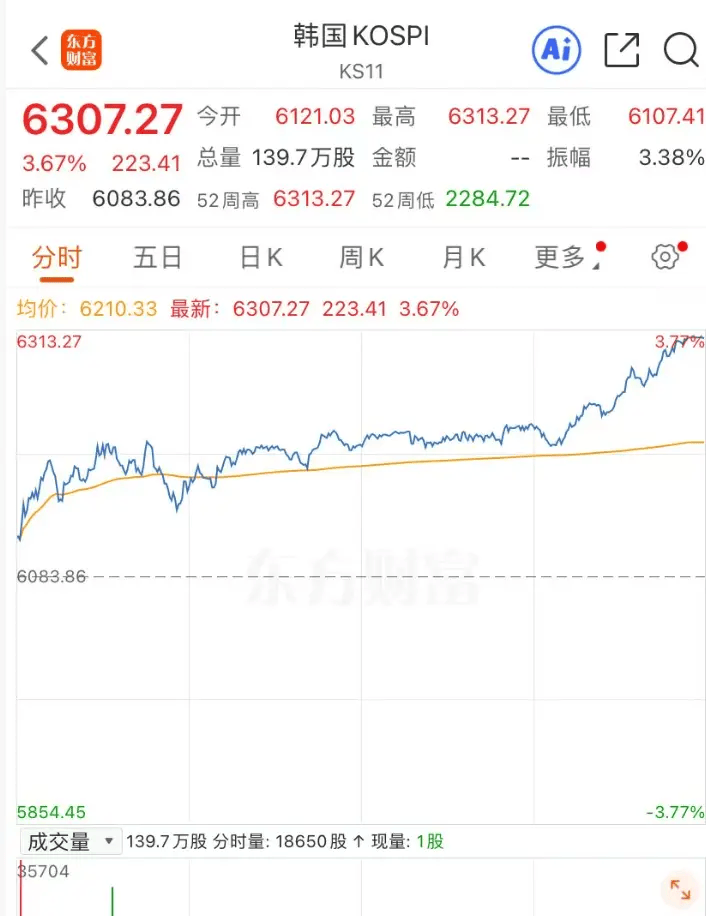
Group 1 - The South Korean stock market has experienced a dramatic surge, with a 75% increase in 2025 and nearly 50% in early 2026, reaching a total market capitalization of $3.76 trillion, making it the ninth largest stock market globally [1][3] - The birth rate in South Korea, which had been declining for seven consecutive years, rebounded in 2025 to 0.8, marking a 15-year high in the number of newborns [3][10] - The primary driver behind these changes is the dominance of South Korean companies, particularly Samsung and SK Hynix, in the high-bandwidth memory (HBM) market, which is crucial for AI technologies [4][5] Group 2 - The profitability of HBM, with margins exceeding 50%, has led to significant financial gains for companies, benefiting employees through stock options and bonuses, thus potentially influencing their decisions to start families [7][8] - The South Korean government has increased subsidies for families with young children, funded by higher tax revenues from the booming stock market, which may also encourage higher birth rates [8][9] - The stock market's performance has improved consumer confidence, leading to a more optimistic outlook on the future, which could influence young people's willingness to have children [9] Group 3 - Despite the temporary increase in birth rates, experts warn that this is a "echo effect" from previous demographic trends rather than a sustainable change driven by economic factors [10][11] - The wealth generated from the stock market has disproportionately benefited a small segment of the population, with high-income individuals seeing a significant increase in financial assets compared to their low-income counterparts [13][15] - Employees in the semiconductor industry, particularly at SK Hynix and Samsung, have received substantial bonuses, while workers in other sectors have not experienced similar financial benefits [16][18] Group 4 - A significant portion of the population feels burdened by housing costs, with 77% of those paying rent or mortgages expressing financial strain, highlighting the disparity between stock market gains and everyday living expenses [20][21] - The rising cost of living, particularly in essential goods, has outpaced stock market gains, leading to a sense of relative deprivation among many young people [22][23] - The current economic environment suggests that while the stock market may be thriving, the underlying issues affecting young people's decisions to have children remain unresolved [24][28]
内存紧缺,被压了三年价的供应商替车企扛住第一波冲击
晚点Auto· 2026-02-12 11:37
Core Viewpoint - The demand for memory chips, driven by AI training and inference, has surged over the past two years, leading to price increases and supply shortages that are impacting the automotive supply chain. The shortage is expected to persist for one to two years, with limited space for domestic alternatives [3][4]. Group 1: Supply Chain Dynamics - The automotive industry is facing a significant supply gap of approximately 30% for memory chips, with suppliers unable to meet the demand from multiple clients simultaneously [5]. - Major memory manufacturers like SK Hynix, Samsung, and Micron have shifted their production focus from traditional DRAM to higher-margin HBM chips due to strong AI demand, resulting in a price increase of over 300% for DDR5 and over 150% for DDR4 since September 2025 [9][10]. - The automotive sector accounts for less than 10% of the global DRAM market, and memory chips only represent about 1% of the total BOM cost for vehicles, leading manufacturers to prioritize higher-paying clients [9][10]. Group 2: Competitive Landscape - Companies that secured memory chip capacity in advance are gaining a competitive edge, as they can protect their clients and navigate the crisis more effectively [5][11]. - Some leading automotive companies have begun switching suppliers to secure stable pricing and supply commitments, but this process is complicated by the need for certification and testing [11]. - The reliance on suppliers for inventory and negotiations means that automotive companies are at a disadvantage during supply crises, as suppliers prioritize clients willing to share cost burdens [11]. Group 3: Future Implications - The ongoing memory supply crisis is likely to lead automotive companies to make more strategic decisions regarding memory configurations in their products, potentially reducing specifications for lower-tier models and freezing certain software functionalities [12]. - Domestic manufacturers like Changxin Storage and Yangtze Memory Technologies are expanding their DRAM production, but the delivery timelines have extended significantly, indicating limited immediate relief for the automotive sector [12].


三大设备巨头,同时预警
半导体行业观察· 2026-02-09 01:18
Core Viewpoint - The semiconductor equipment giants ASML, Lam Research, and KLA have identified that the primary challenge facing chip manufacturers is not a lack of orders, but rather a severe shortage of "wafer fab capacity" and "cleanroom space" [2] Group 1: Semiconductor Equipment Market - The construction of a new wafer fab typically takes over two years, leading to a near saturation of existing facilities, which limits short-term output increases for chip manufacturers [2] - Micron's recent acquisition of a wafer fab from Powerchip in Taiwan for $1.8 billion is a strategic move to bypass the lengthy construction timeline and quickly secure cleanroom space for HBM and DRAM production [2] Group 2: Financial Performance - Lam Research reported revenue of $5.345 billion for Q4 2025, a year-on-year increase of 22.14%, while KLA achieved $3.297 billion in the same period, marking a 7.15% year-on-year growth [3] - Global wafer fab equipment investment (WFE) is projected to reach a historical high of $135 billion in 2026, as cleanroom bottlenecks are expected to ease in the second half of the year [3] - The current "space shortage" is limiting the installation speed of new equipment but is simultaneously driving high-margin orders for existing equipment upgrade services [3] Group 3: Foundry Performance - Despite being a traditional off-peak season, foundries like TSMC are expected to perform well in Q1 due to strong AI demand and a recovery in panel driver IC demand, with TSMC's revenue projected to increase by 4% quarter-on-quarter [5] - TSMC's revenue for Q1 2026 is anticipated to reach between $34.6 billion and $35.8 billion, setting a new historical record [6] - UMC is expected to maintain steady operations with flat wafer shipments and stable average selling prices, outperforming the typical seasonal decline [6]
HBM 之父大胆猜测:NVIDIA 可能买存储公司
半导体芯闻· 2025-11-04 09:48
Core Insights - NVIDIA's CEO Jensen Huang visited South Korea for the first time in 15 years, meeting with key figures from Samsung and Hyundai to strengthen collaboration in memory and AI megafactories [2] - The importance of memory in the AI era is increasing, with experts suggesting that NVIDIA may consider acquiring memory companies like Micron or SanDisk to maintain its leadership in AI [2][3] - Memory bottlenecks are critical issues that need to be addressed for AI inference, with major companies focusing on solutions [3][4] Memory Demand and Types - Memory requirements for AI are categorized into HBM, DRAM, and SSD, with HBM used for real-time data storage, DRAM for short-term memory, and SSD for long-term data [4] - HBM capacity ranges from 10GB to hundreds of GB, DRAM from hundreds of GB to TB, and SSD from TB to PB [4] AI Inference Mechanism - AI inference utilizes a mechanism similar to human brain attention, which involves storing important information (Key and Value) to enhance processing speed [5] - The introduction of KV Cache allows AI models to remember previously processed information, significantly improving response times for ongoing discussions [5]

九月狂飙:当科技不再“画饼”,资本开始“扫货”
Sou Hu Cai Jing· 2025-09-30 09:14
Group 1 - The capital market is entering a practical phase of an industrial revolution driven by policies, technological advancements, and capital investments [1] - New AI regulations have clarified the operational landscape for AI companies, reducing uncertainty and allowing for increased investment in AI applications [2] - Major tech exhibitions in September showcased significant advancements in technology, leading to a reevaluation of the value of domestic alternatives and computing power autonomy [3] Group 2 - The introduction of new vehicles by Huawei has disrupted the automotive market, transforming cars into intelligent terminals and boosting related stocks [4] - The expectation of interest rate cuts by the Federal Reserve is providing a favorable environment for tech growth stocks, attracting foreign investment back to emerging markets [5] - The current technological and policy-driven cycle is characterized by tangible advancements and a clear investment direction, encouraging deeper understanding of underlying technological changes [7]
国内AI芯片面临两大瓶颈
半导体芯闻· 2025-09-12 10:12
Group 1 - The core viewpoint of the article highlights the significant increase in China's AI chip production capacity, projected to triple by 2026, potentially reaching millions or even tens of millions of units annually [2] - By 2026, two leading Chinese AI chip manufacturers are expected to produce over 1 million AI chips each, driven by the establishment of three new wafer fabs aimed at meeting domestic AI chip demand [2] - The strategy aims to reduce reliance on foreign high-end chips and promote domestic production, although the expansion plans face uncertainties due to U.S. restrictions on advanced process equipment and HBM supply [2] Group 2 - Despite the increase in production capacity, it is noted that the HBM inventory imported by mainland companies will be depleted by the end of this year, potentially hindering manufacturers like Huawei from producing over 1 million AI chips next year [2] - Mainland companies originally had the capability to produce over 800,000 certain types of chips annually, but the actual output is limited due to insufficient HBM supply [2]
