LPX机架

Search documents
计算机行业周报:GTC后,算力与物理AI思考-20260321
Shenwan Hongyuan Securities· 2026-03-21 15:24
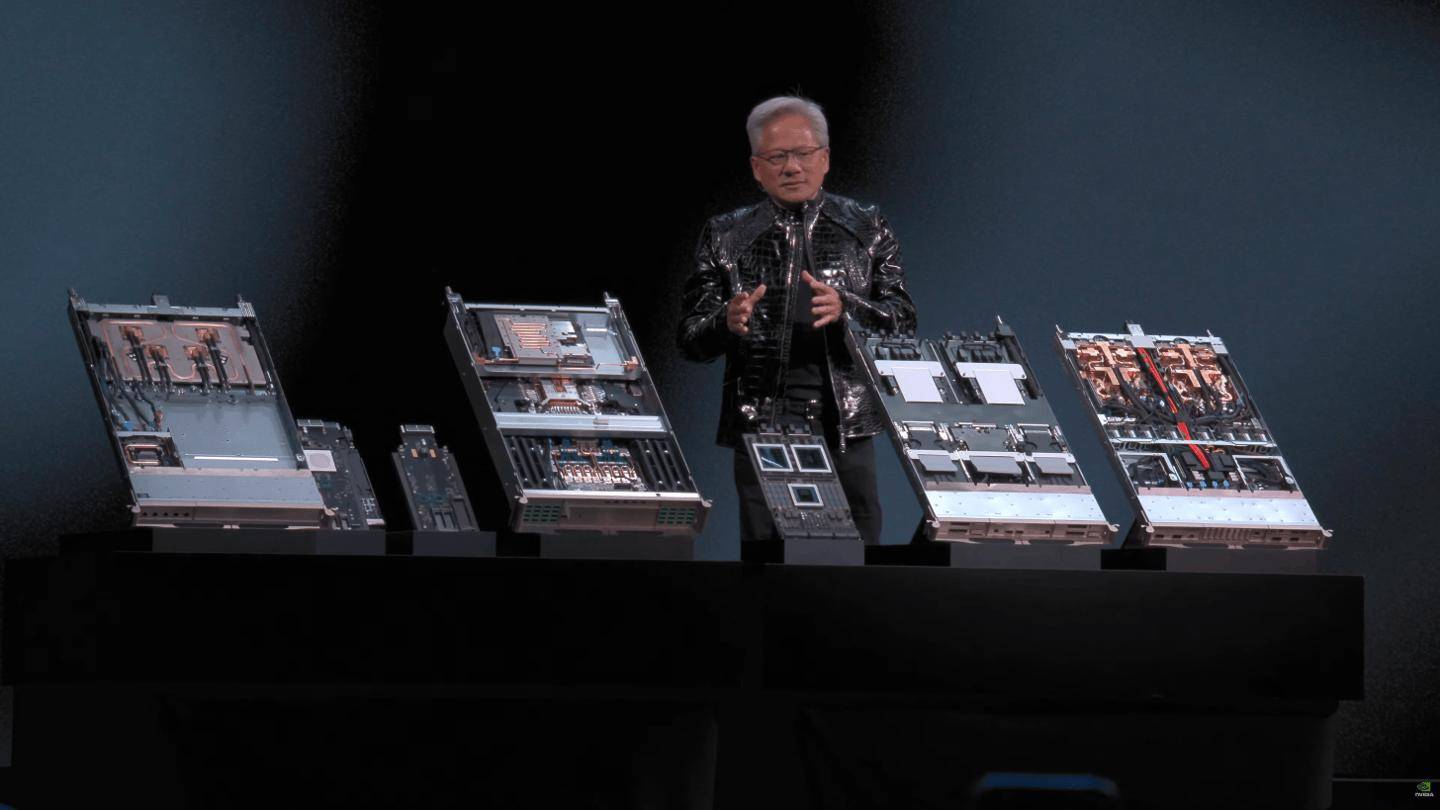
Investment Rating - The report maintains a positive outlook on the computer industry, particularly focusing on AI chip trends and physical AI applications [3][5]. Core Insights - The report highlights the emergence of AI chips tailored for Agentic LLMs, emphasizing the need for low-latency and high-performance computing solutions [5][7]. - NVIDIA's GTC 2026 showcased advancements in AI infrastructure, transitioning from mere computational power to comprehensive real-world applications [34][36]. - The report identifies key companies such as 合合信息, 聚水潭, and 金蝶国际, which are positioned for growth driven by AI and international expansion [55][61]. Summary by Sections AI Chip Trends - The GTC 2026 event revealed a shift towards AI chips designed for Agentic LLMs, with NVIDIA introducing new architectures that enhance collaborative inference capabilities [5][7]. - The introduction of the LPX rack and Groq3 LPU is noted as a significant technological advancement, addressing the performance needs of Agentic LLMs [12][13]. Physical AI Developments - NVIDIA's focus on physical AI is transforming its role from a hardware provider to a platform builder for real-world intelligence, integrating tools for data generation, environment simulation, and model deployment [34][36]. - The report discusses the importance of the DSX framework for optimizing AI factory operations, emphasizing efficiency in energy consumption and computational output [38][40]. Company Updates - 合合信息 reported a revenue of 1.81 billion yuan in 2025, driven by AI and international expansion, with a notable increase in C-end and B-end product offerings [55][56]. - 聚水潭 is recognized as a leading e-commerce SaaS ERP provider in China, with a market share of 24.4% in the e-commerce SaaS ERP sector, indicating strong growth potential [61][62].

华尔街点评GTC:在英伟达的定义里,算力即收入,Token是新的大宗商品
Hua Er Jie Jian Wen· 2026-03-17 12:16
Core Insights - The core message from NVIDIA's annual GTC conference is that the commercial logic of AI computing power is undergoing a fundamental restructuring, with tokens becoming a new commodity and computing power equating to revenue [1] Group 1: Market Outlook - NVIDIA's management has significantly raised the visibility of data center sales from $500 billion (covering until 2026) to over $1 trillion (covering cumulative 2025 to 2027), indicating strong growth potential [1] - Morgan Stanley's report suggests that this new figure implies an upward potential of at least $50 to $70 billion compared to Wall Street's current consensus for data center revenue from 2026 to 2027 [1][2] - The high-confidence purchase orders for Blackwell and Vera Rubin systems have exceeded $1 trillion, doubling from the $500 billion reported in October 2025 [2] Group 2: Demand Structure - Demand is diversified, with approximately 60% coming from hyperscale cloud providers and the remaining 40% from CUDA cloud-native AI companies, NVIDIA cloud partners, sovereign AI, and industrial/enterprise customers [2] - The new $1 trillion outlook aligns closely with Wall Street's previous expectation of around $970 billion for the three-year data center revenue period [2] Group 3: Technological Advancements - NVIDIA emphasized the acceleration of traditional enterprise workloads, announcing collaborations with IBM, Google Cloud, and Dell, and introducing two new CUDA-X foundational libraries [3] - The integration of Groq 3 LPU with Vera Rubin is highlighted as the most important architectural release, enabling high throughput and low latency for advanced workloads [4][5] Group 4: Product Development - NVIDIA's roadmap extends to 2028, with a consistent annual architecture release schedule, including Blackwell (2024), Blackwell Ultra (2025), Rubin (2026), Rubin Ultra (2027), and Feynman (2028) [9] - The Vera CPU is projected to become a multi-billion dollar independent business, with capabilities that significantly enhance AI workloads [8] Group 5: Infrastructure Strategy - NVIDIA is pursuing both copper cable and co-packaged optics (CPO) routes simultaneously, confirming that customers can choose their preferred technology without being locked into a single option [7] - The architecture for Rubin Ultra and Feynman includes advanced features such as chip stacking and custom HBM, enhancing performance for AI workloads [9] Group 6: Market Positioning - Morgan Stanley believes NVIDIA's vertically integrated platform, spanning multiple chips and systems, is difficult to replicate and supports a more sustainable AI capital expenditure cycle than currently anticipated by the market [10]
直击北美AI前线-一线调研反馈及GTC-OFC前瞻
2026-03-16 02:20
Summary of Conference Call Notes Industry Overview - The focus is on the AI hardware sector, particularly in North America, with key players including Celestica, Cisco, and Coherent. The demand for AI hardware is expected to remain strong through 2027-2028 due to corporate AI token allocations and established payment habits [1][3][4]. Key Insights and Arguments - **AI Hardware Demand**: Companies like Celestica and Cisco have seen significant increases in AI-related orders, with Cisco's orders tripling in the past six months. Celestica has revised its capital expenditure plans based on clear order visibility from 2026 to 2028 [3][4]. - **Supply Chain Dynamics**: The supply chain bottlenecks have shifted from GPUs to components like memory, power, and liquid cooling systems. Major cloud service providers (CSPs) are actively securing resources to mitigate risks from potential shortages [3][4]. - **Market Trends**: The Scale Up and Scale Across scenarios are identified as significant growth areas for AI hardware, with expectations for explosive demand for network hardware, including optical devices and switches [5][6]. - **CPO Technology**: Co-Packaged Optics (CPO) is viewed as a long-term trend, but its adoption in Scale Out scenarios is slower than anticipated due to supply chain integration challenges. In contrast, CPO is expected to see more urgent application in Scale Up scenarios [6][9]. - **OCS Positioning**: Optical Circuit Switches (OCS) are transitioning from custom tools for specific cloud vendors to potentially universal components in AI data centers. However, traditional switch manufacturers view OCS as complementary rather than a replacement for Ethernet switches [9][10]. Additional Important Points - **Investment Opportunities**: The current recommendation for the communication sector ranks light communication, AI custom chips, liquid cooling, and switches. The growth in light communication is driven by the rollout of 800G and 1.6T optical modules, while AI custom chips are expected to see increased demand from companies like Google [21]. - **Celestica's Growth Drivers**: Celestica is expanding its capacity in the U.S. and Thailand, with new capacity expected to come online in late 2026. The company anticipates significant revenue potential from cloud-native customers like OpenAI [18][19]. - **Arista's Competitive Edge**: Arista believes its experience in DCI gives it an advantage in Scale Across networks, outperforming competitors in latency, congestion, and load balancing [14]. - **NVIDIA's GTC 2026 Expectations**: Anticipated announcements include the introduction of new architectures and products, particularly focusing on the integration of LPU (Linear Processing Unit) with GPU systems [22][23][24]. This summary encapsulates the key points from the conference call, highlighting the dynamics within the AI hardware industry and the strategic positions of leading companies.
未知机构:广发海外电子通信英伟达NVDABuy指引小幅超预期增-20260228
未知机构· 2026-02-28 02:55
Summary of Conference Call Notes Company Overview - **Company**: NVIDIA (NVDA) - **Industry**: Semiconductor and AI technology Key Points and Arguments - **Earnings Guidance**: NVIDIA's revenue guidance for FY2027 is set at $78 billion, exceeding expectations of $76 billion and consensus of $75 billion, indicating a stable growth trajectory [1][2] - **Gross Margin Target**: The company aims for a mid-75% gross margin for FY2027, which aligns with expectations despite rising operational expenses [1][2] - **Quarterly Performance**: For F4Q26, NVIDIA reported revenue of $68.1 billion, a 20% quarter-over-quarter increase and a 73% year-over-year increase, driven by strong data center growth [3] - **Earnings Per Share (EPS)**: EPS for F4Q26 was $1.62, reflecting a 25% quarter-over-quarter increase and an 81% year-over-year increase [3] - **Operational Changes**: From F1Q27, NVIDIA will include stock-based compensation in its non-GAAP earnings, viewed positively by analysts [3] - **CSP Spending Outlook**: The top five Cloud Service Providers (CSPs) are projected to have capital expenditures nearing $700 billion by 2026, with NVIDIA emphasizing that increased CSP computing power will lead to higher revenue and cash flow [4] Additional Important Insights - **Market Dynamics**: The CEO highlighted that the industry is at a pivotal point for AI, with physical AI expected to be the next wave of innovation [4] - **Upcoming GTC 2026 Conference**: Anticipated to be a significant catalyst for NVIDIA, focusing on new product launches and advancements in AI technology [4] - **Product Development**: Key products mentioned include the LPX architecture and Rubin NVL72, which are expected to enhance NVIDIA's competitive position in the market [4] Adjustments to Forecasts - **EPS Adjustments**: EPS forecasts for FY2027 and FY2028 have been adjusted by -1% and +1% respectively, with a target price revised to $292 based on a 33x FY2027 P/E ratio [2]
补齐AI推理拼图:英伟达黄仁勋揭秘Groq LPU整合路线图
Sou Hu Cai Jing· 2026-02-27 03:45
Core Insights - NVIDIA's CEO Jensen Huang announced a $20 billion acquisition of Groq, which is expected to play a revolutionary role in NVIDIA's AI strategy, comparable to the acquisition of Mellanox [1] - The integration of Groq is aimed at addressing the latency issues in the AI inference phase, as the industry moves towards an Agentic AI era requiring ultra-low latency and rapid response [1] - NVIDIA currently dominates the AI model training market with its Hopper and Blackwell architectures, but needs Groq's technology to set industry standards in the decoding phase, which is highly sensitive to latency [1] Strategic Layout - Groq is expected to enhance NVIDIA's capabilities in AI inference, particularly in achieving ultra-low latency decoding, which is critical for multi-agent collaboration [1] - The AI industry is accelerating towards a multi-agent collaborative environment, necessitating advancements in response speed and latency [1] Technical Implementation - NVIDIA aims to fully leverage Groq's hardware potential, specifically its Language Processing Unit (LPU) that utilizes on-chip SRAM to provide internal bandwidth of tens of TB per second [2] - This technology has been adopted by other industry leaders like Cerebras and Microsoft, allowing AI agents to perform complex logical reasoning in seconds, thus overcoming computational bottlenecks in multi-agent collaboration [2] Hardware Deployment - GF Securities predicts that NVIDIA will unveil a hybrid computing solution called "LPX Rack" at the GTC conference, which is expected to integrate 256 LPU units within a single rack [4] - The LPU units will connect using a native quasi-synchronous inter-chip protocol, while LPU and GPU connections are anticipated to utilize NVLink Fusion technology for efficient processing of massive KV cache offloads during the prefill phase [4]