
Momenta R6强化学习大模型

Search documents
城市NOA“向下走”
Zhong Guo Jing Ying Bao· 2026-01-25 03:31
Core Insights - The implementation of a 128 TOPS chip for city NOA (Navigate On Autopilot) has been successfully launched, challenging the previous consensus that a minimum of 200 TOPS was required for such technology, indicating a shift towards mainstream adoption in the market [1] - A report by the China Automotive Industry Economic and Technological Research Institute forecasts that by November 2025, the cumulative sales of passenger cars equipped with city NOA will reach 3.129 million units, with a penetration rate of 15.1%, an increase of 5.6 percentage points from 2024 [1] - The trend shows that city NOA is moving from high-end vehicles to mainstream passenger cars, with over 68.9% of city NOA-equipped vehicles priced below 300,000 yuan [1] Market Penetration - In 2024, the penetration rate of NOA in the domestic automotive market is projected to be 7.3%, with city NOA at 1.52%, indicating a significant increase in adoption within a year [3] - By November 2025, 15 out of every 100 passenger vehicles are expected to be equipped with city NOA, marking a rapid scale-up in its market presence [3] Competitive Landscape - The focus of the industry has shifted from highway NOA to city NOA, with the latter being more complex to implement [4] - Over 78.3% of city NOA-equipped vehicles sold by November 2025 are expected to be self-developed by automakers, indicating a strong market position for companies that invest in in-house technology [4] Key Players - Notable brands in the self-developed city NOA segment include Tesla, NIO, Xpeng, Li Auto, and Xiaomi, each leveraging their unique technological capabilities to enhance their offerings [5] - Approximately 21.7% of city NOA-equipped vehicles are developed in collaboration with third-party suppliers, with traditional automotive brands making up 64.4% of these partnerships [5] Supplier Dynamics - The market for third-party city NOA suppliers is dominated by Momenta and Huawei, which together account for about 80% of the market share [6] - By November 2025, Momenta is expected to have a leading position with 414,400 units, while Huawei's HI model will account for approximately 19.76% of the third-party supplier market [6] Future Outlook - The upcoming mandatory national standard for intelligent connected vehicles is expected to set a clear safety baseline and further promote the marketization of related technologies [7] - The integration of end-to-end large models is seen as a key driver for the acceleration of city NOA, enhancing safety and user experience [8] - By 2030, city NOA is projected to become a mainstream feature in advanced driver assistance and autonomous driving systems, with significant market penetration expected in the 150,000 to 200,000 yuan price range [6][9]
奇瑞、上汽、蔚来集体入股,Momenta系芯片公司成资本新宠
Jing Ji Guan Cha Wang· 2026-01-24 06:20
Core Insights - New chip design company Xinxin Hangtu has completed a new round of financing, increasing its registered capital to 18.7169 million yuan, with investors including major automotive companies and investment firms [2] - Xinxin Hangtu is closely related to Momenta, as it was independently financed from the Momenta chip project, with key personnel from Momenta involved in its operations [3] - The investment from multiple automotive companies reflects a strategy to secure long-term partnerships and competitive advantages in the chip and smart driving sectors [4] Company Overview - Xinxin Hangtu focuses on integrated circuit chip design and services, particularly in the development of autonomous driving chips [2] - The company has launched a high-performance single-core chip, BMCX7, designed for urban NOA applications, featuring a computing power of 272 TOPS [3] Industry Trends - Automotive companies are diversifying their investments in technology firms to establish stable partnerships and enhance competitiveness, as seen with the investments in Xinxin Hangtu [4] - The trend of self-research in chip development is growing, with companies like NIO and XPeng developing their own chips to gain core technology and competitive advantages [6] - The domestic chip industry is experiencing rapid growth, with a projected increase in the localization rate of smart cockpit SOCs to over 10% in 2024, up from less than 3% previously [6] Challenges - The high-end automotive chip market is still dominated by imported chips, indicating significant room for growth for domestic chips [7] - Domestic chip manufacturers face challenges in achieving self-sufficiency in supply chains and must focus on developing high-cost performance products amid rapid technological changes [7]



2025年超300万辆,城市NOA规模化加速,华为、Momenta成「双强格局」
3 6 Ke· 2026-01-20 02:46
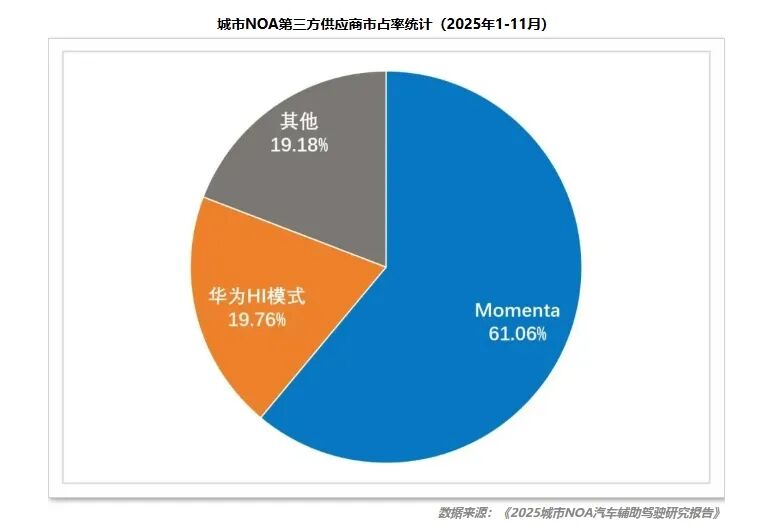
Core Insights - The report indicates that the cumulative sales of passenger cars equipped with urban NOA functions in China reached 3.129 million units from January to November 2025, marking a significant expansion in the industry [1][2] - The urban NOA market is characterized by a "dual strong" pattern dominated by Huawei and Momenta, which together hold approximately 80% of the third-party supplier market share [1][3] Group 1: Market Overview - The penetration rate of urban NOA-equipped passenger cars in China was 15.1% of the insured passenger car volume from January to November 2025, an increase of 5.6 percentage points compared to 2024 [2] - The report highlights that the urban NOA market has entered a phase of large-scale popularization, with profound changes in market structure and competitive factors [1][3] Group 2: Competitive Landscape - The market is driven by both self-research by car manufacturers and partnerships with third-party suppliers, with domestic brands accounting for 81.1% of the sales of urban NOA-equipped passenger cars [3] - Momenta leads the third-party supplier market with a total of 414,400 units equipped with urban NOA, representing about 61.06% of the third-party supplier share, while Huawei's HI model has approximately 134,100 units, accounting for about 19.76% [3][4] Group 3: Technological Advancements - The report emphasizes that algorithm, data loop capability, and mass production experience are critical factors determining the market position and development speed of auxiliary driving suppliers [6][8] - Momenta's R6 reinforcement learning model is noted as the first in China to achieve mass production based on an end-to-end architecture, enhancing safety and efficiency [8] Group 4: Future Trends - The urban NOA is expected to accelerate systemic changes in intelligent driving technology routes, core architectures, and industrial ecosystems, extending applications from highway NOA to urban NOA [9] - The competitive landscape is evolving with a focus on end-to-end models, pushing for integrated system architecture and the maturation of vehicle-road-cloud collaboration and regulatory standards [9]
八成市场,两家瓜分:智能驾驶第三方赛道马太效应显现,Momenta、华为占据头部
Di Yi Cai Jing Zi Xun· 2026-01-19 02:34
Core Insights - The report indicates that by November 2025, the cumulative sales of passenger cars equipped with urban NOA (Navigation Assisted Driving) in China reached 3.129 million units, marking a shift from high-end differentiation to mainstream adoption [1][3] Group 1: Market Dynamics - Urban NOA has transitioned from niche to mainstream, impacting vehicle delivery schedules, user experience, and brand risks [3] - The market is maturing rapidly, leading to a clear "Matthew Effect," where leading players dominate the market [6][16] - Momenta and Huawei's HI model together hold over 80% of the urban NOA third-party supplier market, with Momenta leading at approximately 61.06% market share [3][12] Group 2: Competitive Landscape - The industry is witnessing a dual-leader scenario, with Momenta and Huawei establishing a strong competitive position [13][16] - Momenta's urban NOA deployment reached 414,400 units from January to November 2025, reinforcing its leadership in the third-party supplier market [12][22] - Collaborations with major automotive brands like BMW and Mercedes-Benz highlight the importance of ongoing technological iteration and reliability in the competitive landscape [15][20] Group 3: Technological Advancements - The evolution of urban NOA is driven by three mechanisms: algorithmic advancement, data feedback loops, and accumulated trust through reliability [9][10][12] - Momenta's R6 reinforcement learning model exemplifies the shift towards advanced algorithms that enhance decision-making capabilities beyond human replication [9] - The data advantage gained through large-scale deployment leads to exponential growth in algorithm training effectiveness, making it difficult for latecomers to catch up [11] Group 4: Global Expansion - Momenta is actively expanding its global footprint, partnering with Southeast Asian platforms and international automotive brands to promote Chinese smart driving technology [18][20] - The adaptability of Chinese smart driving solutions to various global markets is attributed to the complex urban traffic conditions in China, which serve as a robust training environment [19] Group 5: Future Outlook - The Ministry of Industry and Information Technology predicts that by 2030, the integration of advanced driving assistance and connected features will create a trillion-level value increment for the automotive industry [21] - Urban NOA is expected to evolve from a high-end feature to a fundamental capability in new vehicles, influencing user experience and brand trust [21][22] - The competition in urban NOA is likened to a marathon, with Momenta's comprehensive capabilities making it difficult for competitors to replicate [22][23]
Momenta:2025年公司在第三方NOA供应商市场的市占率超60%
Zheng Quan Ri Bao Wang· 2026-01-15 04:02
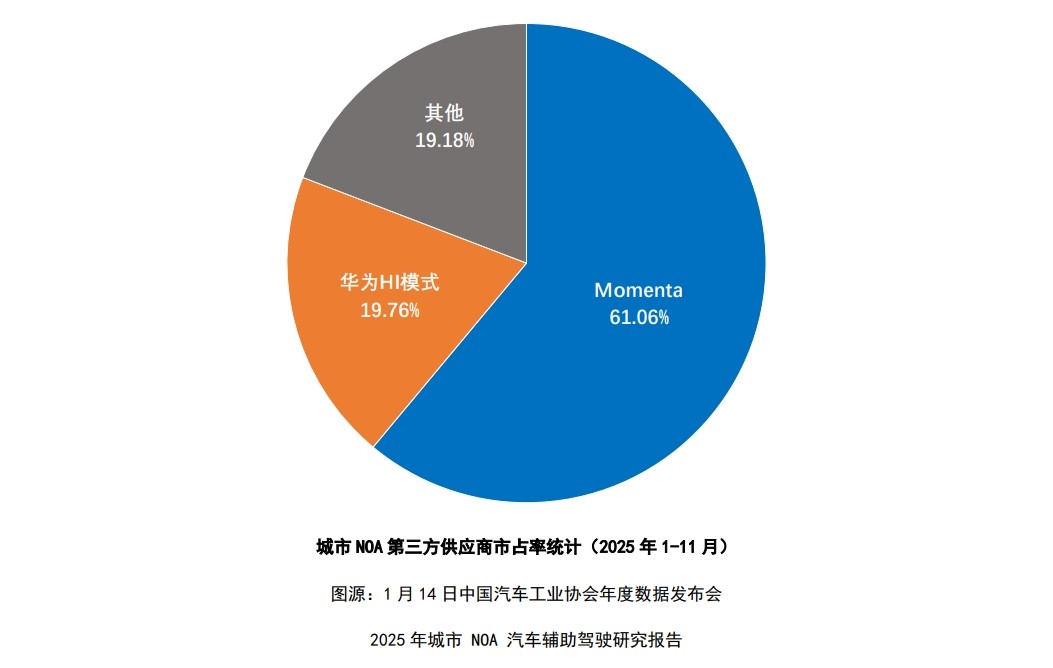
Group 1 - The report released by the China Automotive Industry Association indicates that from January to November 2025, the cumulative sales of passenger cars equipped with urban NOA (Navigation on Autopilot) reached 3.129 million units, with vehicles using Momenta's NOA system accounting for 414,400 units, representing approximately 61.06% of the third-party supplier market share [1] - Momenta has established partnerships with eight out of the top ten global automotive manufacturers, covering major domestic passenger car companies, which highlights its significant market presence and influence [1] - The report emphasizes that third-party technology suppliers like Momenta are providing a "Chinese solution" for the global intelligent driving industry, attracting collaboration from well-known automotive brands from Germany, the United States, Japan, and South Korea, thereby enhancing China's voice in the global automotive industry value chain [1] Group 2 - Momenta's core technology route is based on "reinforcement learning + end-to-end architecture," and it employs a dual-track product strategy of mass production assistance and scalable autonomous driving, leveraging vast data for continuous algorithm iteration [2] - The company has developed a multi-dimensional cooperation ecosystem with automakers, including SAIC, GAC, BYD, Mercedes-Benz, BMW, Audi, and Toyota, focusing on technology co-research and customized solutions [2] - Momenta's R6 reinforcement learning model is the first in China to achieve mass production based on an end-to-end foundation, officially entering production in the third quarter of 2025 [2]
智驾“中国方案”双强格局:Momenta与华为NOA合计占比超80%
Guan Cha Zhe Wang· 2026-01-15 03:50
Core Insights - The report highlights the rapid expansion of the urban NOA (Navigation Assisted Driving) market in China, with cumulative sales reaching 3.129 million units from January to November 2025, accounting for 15.1% of passenger car insurance volume, an increase of 5.6 percentage points compared to the entire year of 2024 [1][2] Industry Overview - The urban NOA technology is becoming a core configuration in automotive intelligence, with 2025 identified as a key year for its commercialization [2] - The market is characterized by a "dual strong" pattern among third-party urban NOA suppliers, with Momenta and Huawei leading, together holding over 80% of the market share [1][2] Company Performance - Momenta's urban NOA deployment reached 414,400 units, representing 61.06% of the third-party supplier market, with partnerships covering major domestic passenger car manufacturers and 8 out of the top 10 global automakers [2] - Huawei's HI model achieved a deployment of 134,100 units, accounting for 19.76% of the third-party supplier market [2] - Domestic brands excelled in the urban NOA segment, with related model sales reaching 2.5373 million units, making up 81.1% of the total [2] Competitive Landscape - Global automotive brands such as Mercedes-Benz, BMW, Audi, Cadillac, Buick, and Toyota are accelerating their urban NOA strategies through collaborations with leading Chinese intelligent driving suppliers [2] - The report indicates that the "Chinese solution" for intelligent driving, developed by companies like Huawei and Momenta, is attracting deep cooperation from renowned automotive brands in Germany, the US, Japan, and South Korea, enhancing China's influence in the global automotive value chain [2] Technological Advancements - The report suggests that as high-level assisted driving enters a phase of large-scale implementation, key factors determining supplier market position include algorithm strength, data loop capabilities, and experience in large-scale production [3][5] - The urban NOA is driving systemic changes in the intelligent driving sector, with applications extending from highway NOA to urban environments, and a shift towards integrated system architectures [3][5] Future Outlook - The report predicts that the integration of multimodal models and end-to-end technologies, along with continuous upgrades to computing platforms, will further enhance the safety experience of urban NOA [5] - Competition in the industry is shifting from a focus on individual technical metrics to a comprehensive competition based on product experience, technological limits, and scalability, with leading companies building systematic advantages through algorithms, data loops, and large-scale production [5]


中汽协2025城市NOA报告发布:Momenta第三方供应商市场市占率超60%
Zhong Jin Zai Xian· 2026-01-15 03:01
Core Insights - The report highlights the rapid growth of the urban NOA (Navigation on Autopilot) market in China, with a cumulative sales of 3.129 million passenger cars equipped with urban NOA from January to November 2025, achieving a penetration rate of 15.1%, an increase of 5.6 percentage points compared to the entire year of 2024 [3][4]. Group 1: Market Dynamics - The urban NOA market is characterized by a "dual strong" pattern among third-party suppliers, with Momenta and Huawei leading the market, together accounting for over 80% of the market share among third-party suppliers [3][4]. - Momenta has a leading position with 414,400 units of urban NOA equipped vehicles, representing approximately 61.06% of the third-party supplier market, while Huawei's HI model has around 134,100 units, accounting for about 19.76% [3][4]. Group 2: Competitive Landscape - Domestic brands have shown significant strength, with sales of urban NOA-equipped vehicles reaching 2.5373 million units, making up 81.1% of total sales, indicating their innovation and competitiveness in the smart connected vehicle sector [4]. - Global automotive brands are increasingly collaborating with leading domestic third-party suppliers to enhance their smart driving capabilities, with notable partnerships including Mercedes-Benz, BMW, Audi, Cadillac, Buick, and Toyota [4]. Group 3: Technological Advancements - The report emphasizes that algorithms, data closed-loop capabilities, and experience in large-scale production are critical factors determining the market position and development speed of autonomous driving suppliers [4][5]. - The end-to-end large model has become the core engine for the iteration of NOA auxiliary driving technology, promoting a shift from modular architecture to an integrated perception and planning system [5][6]. Group 4: Future Trends - The competition among autonomous driving suppliers is evolving from a focus on single technical indicators to a comprehensive capability that includes product experience, technological potential, and scalability [7]. - The integration of multi-modal models and end-to-end technology, along with continuous upgrades of computing platforms, is expected to enhance the safety experience of urban NOA technology [6][7].
城市NOA第三方智驾供应商Momenta市占率超60% 中国智驾全球竞争力跃升
Jing Ji Guan Cha Bao· 2026-01-05 23:57
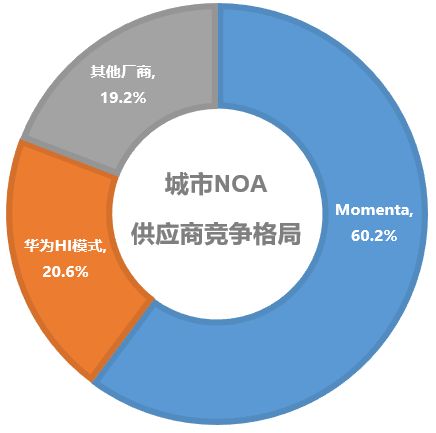
Core Insights - The popularization of intelligent driving in China is entering a critical phase in 2025, transitioning from "production accumulation" to a "scale explosion" cycle [1] - The penetration rate of urban NOA (Navigation on Autopilot) hardware in domestic passenger cars has reached 2.392 million units in the first ten months of 2025, marking a year-on-year increase of 62.8% [1] - Third-party intelligent driving suppliers like Momenta and Huawei are gaining market leadership and global recognition, enhancing the competitiveness of China's intelligent driving supply chain [1] Market Share Analysis - From January to October 2025, Momenta and Huawei's HI model together captured over 80% of the urban NOA third-party intelligent driving supplier market, with Momenta holding a market share of 60.2% and Huawei at 20.6% [3] - Leading suppliers have achieved rapid technological iteration and efficient replication across models and brands due to early production layouts and scalable engineering capabilities [3] Trends in Adoption - The acceleration of urban NOA penetration in 2025 is driven by three factors: technological maturity, increased supply, and awakened demand [5] - Domestic brands like BYD, Geely, and Chery are key drivers of this penetration, implementing a "main model standard configuration" strategy to bring advanced driving features to lower-priced vehicles [5] - Global brands such as Toyota, Nissan, and Mercedes-Benz are collaborating with top Chinese intelligent driving suppliers to enhance their smart transformation, indicating the global recognition of China's intelligent driving solutions [5] Competitive Focus - The competition in urban NOA has shifted from "whether features are available" to "experience is king," with a focus on providing a safe and reassuring high-level driving experience [5] - Momenta is leveraging "reinforcement learning + end-to-end architecture" combined with production data to enhance the driving experience, with its R6 model being the first to achieve mass production based on reinforcement learning [5][6] Strategic Positioning - 2025 is a pivotal year for urban NOA in China, marking the transition from "usable" to "user-friendly" and from niche markets to widespread adoption [6] - Leading suppliers like Momenta and Huawei are not only enhancing domestic market experiences but also actively participating in the global restructuring of the intelligent driving supply chain, providing a "Chinese solution" for the global automotive industry's smart transformation [6]
20万元级“豪华堆料王”登场,铂智7成2025广马“最美领航车”
Zhong Guo Qi Che Bao Wang· 2025-12-21 14:16
Core Viewpoint - GAC Toyota's new electric vehicle, the Platinum 7, is positioned as a luxury flagship model in the electric sedan market, showcasing advanced technology and design while being accessible at a competitive price point of around 200,000 yuan [1][11]. Group 1: Product Features - The Platinum 7 features a length exceeding 5 meters, a wheelbase over 3 meters, and a width close to 2 meters, directly competing with high-end luxury models like Porsche Panamera and Bentley Flying Spur [3]. - It incorporates the latest Toyota design language, achieving a classic sedan proportion with a 1.3 golden aspect ratio, exuding an executive presence on the road [3]. - The vehicle includes a HarmonySpace 5 cockpit with intuitive smartphone-like interactions and over 150 voice control functions, enhancing user experience [6]. Group 2: Technology and Performance - The Platinum 7 is equipped with a comprehensive intelligent driving assistance system powered by Momenta R6, utilizing 27 high-spec sensors and 3 billion kilometers of real-world data for full-scenario coverage [6]. - It features a dual-chamber air suspension and SDC dampers, allowing real-time adjustment of damping to filter road bumps effectively, providing superior handling [8]. - The car is powered by Huawei's DriveONE electric drive system, offering seamless acceleration and braking experiences [6]. Group 3: Luxury and Comfort - The interior is designed for comfort, featuring NASA-recommended zero-gravity seats that alleviate fatigue during long rides [8]. - High-quality materials are used throughout, including Nappa leather seats and a Yamaha 7.1.4 surround sound system, aiming to redefine luxury in mainstream sedans [10]. - The vehicle's sound insulation is comparable to the Mercedes EQS, ensuring a quiet and relaxing cabin environment [10]. Group 4: Market Position and Strategy - GAC Toyota has been a partner of the Guangzhou Marathon for 11 years, showcasing its commitment to the local market and the development of electric vehicles [11]. - The launch of the Platinum 7 marks a significant step in GAC Toyota's strategy to strengthen its electric vehicle offerings in China, following the success of the Platinum 3X model [11]. - The Platinum 7 is currently available for blind booking and is part of a nationwide promotional tour across 131 cities, with an official launch planned for the first quarter of 2026 [11].
