Server DRAM

Search documents
存储追踪(2 月):尽管受春节假期影响,价格依然保持坚挺-MEMORY TRACKER (Feb) Price stayed robust despite CNY
2026-03-06 02:02
Summary of Global Memory Industry Conference Call Industry Overview - The conference call focused on the global memory market, specifically DRAM and NAND sectors, highlighting price trends and market dynamics for February 2026. Key Points on DRAM Prices - **Spot Prices**: - PC DRAM spot prices increased by 6-7% month-over-month (MoM) in February, although the pace of growth slowed due to the Chinese New Year (CNY) holiday [2][18]. - Server DDR5 prices rose by 16% MoM, while DDR4 prices remained unchanged [2][18]. - **Contract Prices**: - DRAM contract prices in February were up 92% compared to 4QCY25, with specific increases of 107% for PC, 97% for Server, 89% for Mobile, and approximately 80% for Consumer segments [3][6]. - The overall contract price increase for DRAM is expected to continue into 2QCY26, driven by sustained server demand despite anticipated contractions in PC and Mobile demand [3][6]. Key Points on NAND Prices - **Spot Prices**: - NAND wafer spot prices saw a robust increase of 17-25% MoM in February [4][22]. - **Contract Prices**: - NAND wafer contract prices rose by 15-25% MoM, with increases of 97-133% compared to 4QCY25 [5][25]. - The contract price for eMMC/UFS used in Mobile is expected to increase by 95% quarter-over-quarter (QoQ) in 1QCY26 due to supply shortages [5][25]. Market Dynamics - **Demand Trends**: - While PC and Mobile segments are expected to experience demand contraction due to price elasticity, server demand is likely to remain under fulfilled, supporting continued price increases [3][6][14]. - The overall memory market is anticipated to see a moderation in price increases towards the end of CY26 as demand from consumer segments declines significantly [6][20]. - **Investment Implications**: - Companies such as Samsung Electronics, SK hynix, Micron, and SanDisk are rated as outperformers with respective price targets of KRW 140,000, KRW 750,000, USD 330.00, and USD 1,000.00 [8][9][10][12]. Additional Insights - **Resistance from Module Makers**: - There is increasing hesitation among module makers regarding price hikes, which may impact future price trends [6][20]. - **Long-term Outlook**: - Despite short-term price increases, the long-term outlook for memory prices may be cautious due to rising competition, particularly from Chinese manufacturers [25][20]. Conclusion - The global memory market is currently experiencing significant price increases in both DRAM and NAND sectors, driven by strong server demand and supply constraints. However, potential demand contractions in consumer segments may lead to moderated price growth in the latter part of the year.

存储器追踪 -1 月价格 parabolic 式上涨延续-MEMORY TRACKER (Jan) Parabolic price hike continues
2026-02-10 03:24
Summary of Global Memory Market Analysis Industry Overview - The analysis focuses on the **memory market**, specifically **DRAM** and **NAND** segments, highlighting significant price increases in January 2026 compared to previous quarters [1][2][3][4][5][6]. Key Insights on DRAM Prices - **DRAM Contract Prices**: - January 2026 contract prices surged by **86%** compared to 4QCY25, with a **50%+** month-over-month increase [2][3][6]. - Specific increases included **98%** for PC DRAM, **90%** for Server DRAM, **89%** for Mobile DRAM, and **60%** for Consumer DRAM [3]. - The demand from Cloud Service Providers (CSP) is a primary driver, while PC and smartphone demand is expected to weaken later in 2026 [3][6]. - **Spot Prices**: - PC DRAM spot prices increased by **27%** month-over-month in January for both DDR4 and DDR5, with Server DDR5 experiencing a **110%** spike [2][3][6]. - The overall trend indicates a robust demand despite potential future contractions in PC and smartphone markets [3][6]. Key Insights on NAND Prices - **NAND Contract Prices**: - January 2026 contracts indicated a **74%** quarter-over-quarter increase for 1QCY26 [4][20]. - The average NAND wafer contract price rose by approximately **30%** month-over-month and **75%** compared to 4QCY25 [5][20]. - Mobile NAND prices are expected to rise by **60%** quarter-over-quarter in 1QCY26 due to supply shortages [5][20]. - **Spot Prices**: - NAND wafer spot prices increased by **17-25%** month-over-month, indicating strong demand despite some hesitance from module customers [4][22]. Investment Ratings and Price Targets - **Samsung Electronics**: Rated **Outperform** with a price target of **KRW 140,000** [8]. - **SK hynix**: Rated **Outperform** with a price target of **KRW 750,000** [9]. - **Micron**: Rated **Outperform** with a price target of **US$ 330.00** [10]. - **KIOXIA**: Rated **Underperform** with a price target of **JPY 7,000.00** [11]. - **SanDisk**: Rated **Outperform** with a price target of **US$ 1,000.00** [12]. Additional Considerations - The analysis suggests that while prices are expected to remain elevated due to CSP demand, a moderation in price increases is anticipated as PC and smartphone demand contracts significantly [6][14]. - The overall memory price trajectory is projected to level off towards the end of 2026, with potential declines starting in 2027 [6][20]. Conclusion - The memory market is experiencing unprecedented price hikes driven by strong demand from CSPs and lean inventories in the PC and mobile sectors. However, caution is advised as demand may weaken later in the year, impacting future pricing trends [6][20].
全球经济 - 人工智能进口热潮下的宏微观视角-Global Economic Briefing-AI Imports in Overdrive, Macro and Micro Perspectives
2026-02-05 02:21
Summary of Key Points from the Conference Call Industry Overview - The focus of the conference call is on the **AI-linked imports** and their implications for the **US economy** and **investment landscape**. - AI-linked imports now represent approximately **17%** of total US imports, a significant increase from **6%** two years ago, with an annualized rate of about **$550 billion** as of Q4 2025 [7][11][15]. Core Insights and Arguments - **Investment Growth**: AI spending is expected to contribute approximately **3 percentage points (pp)** to nonresidential fixed investment by **2027** [7][48]. - **Import Dynamics**: The increase in AI-linked imports is attributed to the need for advanced hardware, including GPUs, servers, and other IT equipment, which are primarily sourced from Taiwan and Mexico [17][23][24]. - **Economic Impact**: The contribution of AI-related spending to GDP growth is nuanced; while it directly contributes to growth, the offset from imports limits its overall impact on GDP [41][48]. - **Productivity Gains**: AI investment is projected to add between **0.41% to 0.43%** to real GDP growth in **2026-2027**, with only about **10%** of firms currently utilizing AI technology regularly, indicating significant room for growth [49][50]. Geographical Concentration of AI Imports - **Taiwan** is the largest direct source of AI-linked imports, accounting for about **40%** of the total, primarily due to its leadership in chip fabrication [17][24]. - **Mexico** has emerged as a significant assembly hub, with **25%** of AI-linked imports, reflecting a shift in the supply chain dynamics [17][24]. - **ASEAN countries** collectively account for another **25%** of AI-linked imports, with Vietnam, Indonesia, and Thailand playing key roles [17]. Challenges and Considerations - The complexity of tracking AI-related capital expenditure (capex) is highlighted, as much of the investment is reflected in imports rather than domestic production [51][53]. - The **tariff environment** is favorable for AI-related imports, with low average applied rates, which has facilitated uninterrupted growth in import volumes [28]. - The **memory supply chain** is identified as a critical bottleneck for AI performance, with significant implications for future investment and productivity [58][61]. Future Outlook - The call emphasizes the expectation of continued acceleration in AI capabilities and adoption, necessitating further investment in data and systems integration [56]. - The **US policy agenda** is anticipated to support domestic manufacturing and supply chain resilience, which could influence future investment dynamics [67]. - Key debates for 2026 will revolve around the ROI of AI technology, productivity impacts, and the competitive landscape between US and Chinese AI solution providers [64]. Additional Insights - The **shift in supply chains** away from China has been ongoing since 2018, with increasing reliance on other Asian economies for technology products [33]. - The **memory market** is expected to experience a significant upcycle, driven by AI and hyperscale data center growth, with major players like **Samsung Electronics** and **SK hynix** positioned favorably [60][61]. This summary encapsulates the critical insights and projections discussed during the conference call, focusing on the implications of AI-linked imports for the US economy and investment landscape.
研报 | 2026年第一季度存储器价格全面上涨,各类产品季增幅度将创历史新高
TrendForce集邦· 2026-02-02 09:01
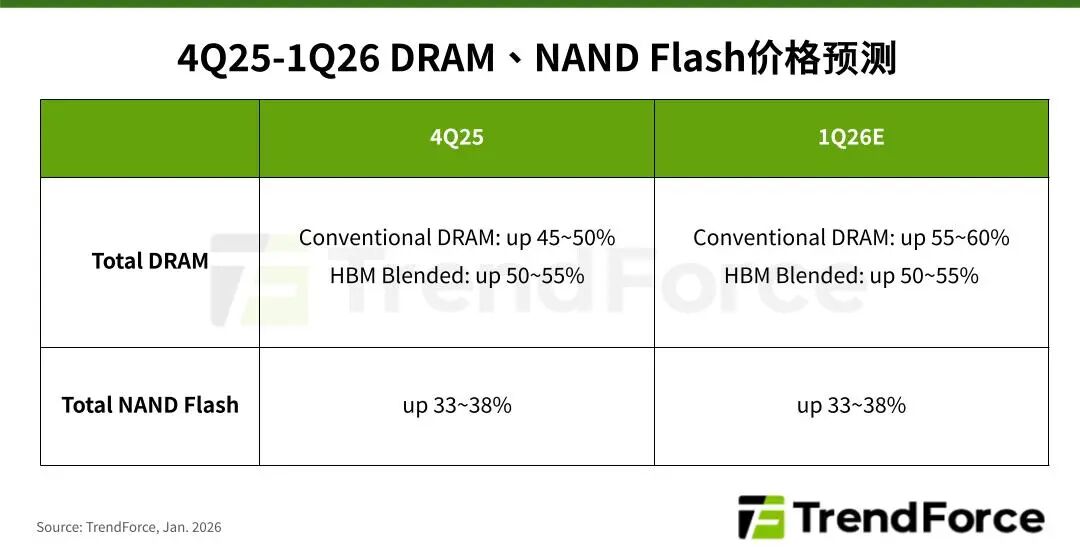
Core Viewpoint - The demand for AI and data centers is intensifying, leading to a significant imbalance in the global memory supply and demand, resulting in increased pricing power for manufacturers [3][4]. Price Adjustments - The price forecast for Conventional DRAM contracts has been revised from a quarterly increase of 55-60% to 90-95%, while NAND Flash contract prices have been adjusted from 33-38% to 55-60% for Q1 2026 [3][4]. - Specific price increases for various DRAM types are as follows: - PC DRAM: Expected to increase by 105-110% [6]. - Server DRAM: Anticipated to rise by 88-93% [6]. - Mobile DRAM (LPDDR4X): Projected to increase by 88-93% [6]. - Total DRAM: Conventional DRAM expected to rise by 90-95% [6]. - Total NAND Flash: Expected to increase by 55-60% [6]. Market Insights - The PC DRAM market is experiencing a supply shortage, with prices expected to rise over 100% in Q1 2026, marking a historical high [8]. - The Server DRAM market is seeing significant price increases, with expectations of a 90% rise due to strong demand from North American and Chinese cloud service providers [8]. - The Mobile DRAM market is also facing a supply-demand gap, leading to anticipated price increases of around 90% for both LPDDR4X and LPDDR5X [9]. NAND Flash Market Dynamics - Despite high demand for NAND Flash, manufacturers are prioritizing DRAM production due to better profit prospects, which is constraining new NAND Flash capacity [9]. - Short-term capacity bottlenecks are expected to persist, limiting the ability to meet demand [9]. Enterprise SSD Demand - The demand for high-performance storage devices is surging, particularly from North American cloud service providers, leading to a forecasted price increase of 53-58% for Enterprise SSDs in Q1 2026, the highest quarterly increase on record [10].

TrendForce集邦咨询:预计2026年第一季度各类存储器产品价格全面持续上涨
Zhi Tong Cai Jing· 2026-01-05 09:23
Group 1: DRAM Market Insights - The first quarter of 2026 is expected to see a significant increase in PC DRAM prices due to tightened supply from manufacturers, despite a slowdown in overall demand for PC units [2] - Server DRAM demand is projected to grow substantially as cloud service providers (CSPs) increase their purchases, with a forecasted price increase of over 60% in the first quarter [3] - Mobile DRAM supply remains tight, leading to strong purchasing power from brands, with expectations of rising contract prices for LPDDR4X and LPDDR5X [3] - Graphics DRAM prices are expected to rise due to supply constraints, despite a conservative demand outlook influenced by NVIDIA's sales target adjustments [3] - Consumer DRAM customers are willing to pay higher prices for prioritized supply in the first quarter, as supply continues to lag behind demand [3] Group 2: NAND Flash Market Insights - The NAND Flash market is anticipated to grow significantly, driven by AI applications, with Enterprise SSD demand expected to surpass mobile applications for the first time by 2026 [4] - Client SSD demand is projected to decline in the first quarter due to reduced laptop shipments and capacity downgrades in lower-end models, yet contract prices are expected to increase by at least 40% [4] - The supply of NAND Flash products is tightening as manufacturers prioritize high-margin products, leading to increased prices for Enterprise SSDs [4] - eMMC/UFS demand is showing signs of weakness due to inventory adjustments, although Chromebook shipments are benefiting from government projects [5] - NAND Flash wafer supply is constrained as manufacturers focus on high-margin product lines, resulting in continued price increases despite weak demand in consumer markets [5]
晶圆代工、存储涨价,珂玛科技、有研硅等走强,半导体设备ETF(561980)本周四连阳
2 1 Shi Ji Jing Ji Bao Dao· 2025-12-26 03:10
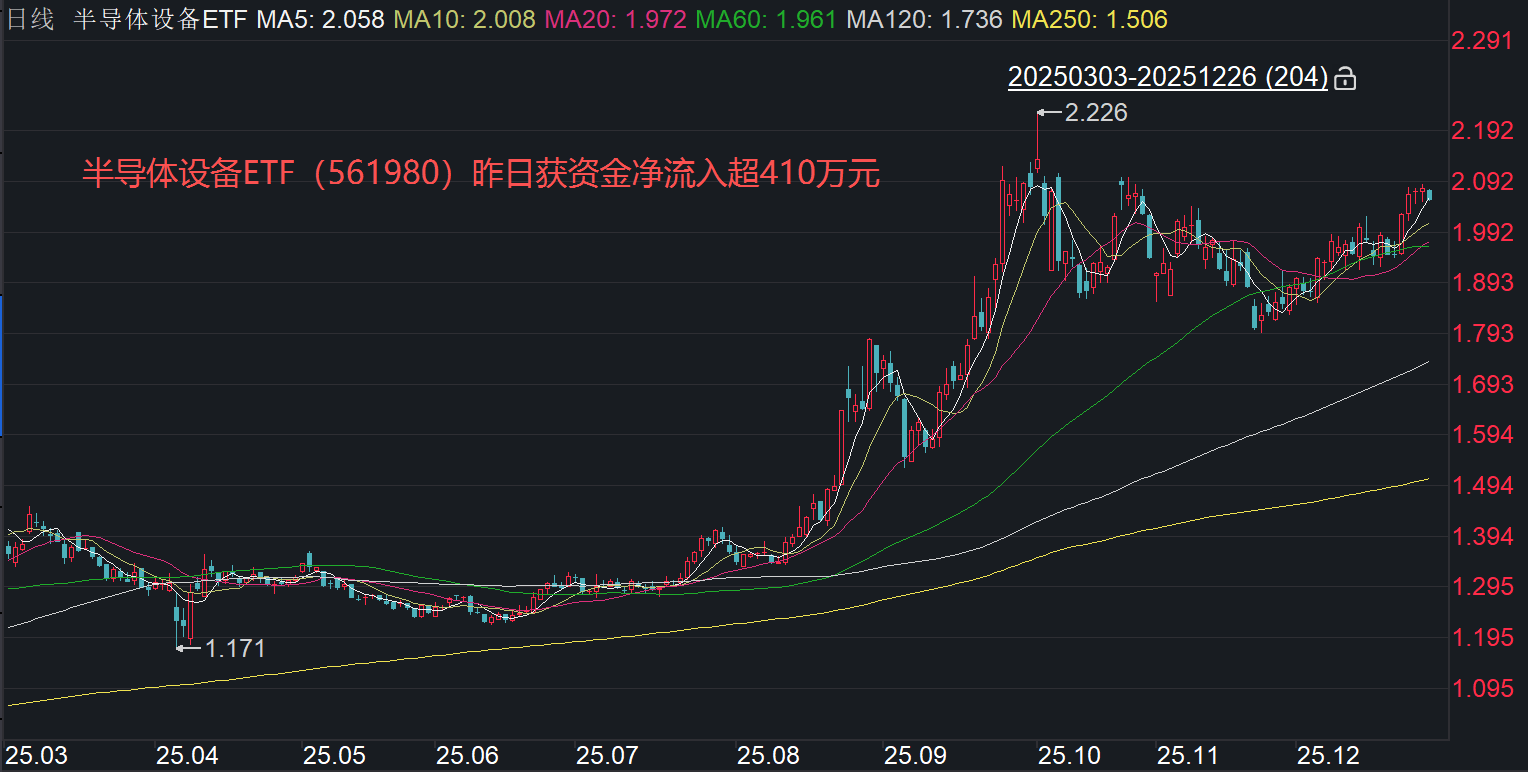
Group 1 - Semiconductor foundries are set to initiate a new round of price increases, with SMIC notifying downstream customers of a price hike of approximately 10% focused on the 8-inch BCD process platform [1][3] - The storage price surge is spreading, with major suppliers like Samsung and SK Hynix raising HBM3E prices by nearly 20% for the upcoming year [1] - The semiconductor equipment ETF (561980) has recorded four consecutive days of gains, although it experienced mixed performance among constituent stocks, with some companies like Kema Technology and Yiyuan Silicon rising over 2% [1] Group 2 - Open Source Securities highlights that the supply-side capacity gap, combined with growing demand from AI and other sectors, signals an upward price cycle for semiconductors, with foundry prices and storage chips beginning to rise [3] - The high capacity utilization rates of foundries like SMIC and Hua Hong are driven by strong demand from industries such as 5G, AI, and new energy [3] - According to Galaxy Securities, the contract prices for Server DRAM are expected to rise by 18-23% in Q4 2025, driven by global cloud service providers expanding data center capacities [5] Group 3 - The semiconductor equipment ETF (561980) tracks the China Securities Semiconductor Index, with over 54% of its components related to equipment, and more than 72% focused on semiconductor equipment, materials, and integrated circuit design [4] - The top ten companies in the index, including key players like Zhongwei Company and North Huachuang, account for nearly 80% of the index's concentration [4] - The semiconductor equipment sector is considered the cornerstone of the semiconductor industry, with significant growth opportunities anticipated due to the expansion of storage and domestic production capabilities [5]


海力士明年全系列存储芯片订单已售罄 存储芯片或迎来超级周期(附概念股)
Zhi Tong Cai Jing· 2025-10-30 00:29
Group 1 - The storage sector in the U.S. stock market has seen significant gains, with SanDisk rising over 16%, Western Digital over 13%, Seagate Technology over 19%, and Micron Technology over 2% [1] - SK Hynix reported a 62% increase in profits, indicating a substantial rise in demand for storage chips driven by the construction of global AI infrastructure [1] - In Q3, SK Hynix achieved a record operating profit of 11.4 trillion KRW (approximately 8 billion USD), slightly exceeding analyst expectations, with sales reaching 24.5 trillion KRW [1] Group 2 - SK Hynix's stock rose by up to 5% in Seoul, reflecting positive market sentiment [2] - According to TrendForce, the contract prices for Server DRAM are expected to strengthen due to the expansion of data centers by global cloud service providers, leading to an overall increase in DRAM prices [2] - The demand for servers is projected to remain strong into 2026, with DDR5 contract prices expected to rise throughout the year, potentially outperforming HBM3e starting in Q1 2026 [2] Group 3 - Morgan Stanley predicts that the storage chip industry is likely to enter a "super cycle" driven by the AI boom [3] Group 4 - Relevant Hong Kong-listed companies in the storage chip sector include Bawen Storage (IPO application submitted), Jingshun Technology (IPO application), SMIC (00981), Hua Hong Semiconductor (01347), and Shanghai Fudan (01385) [4]
港股概念追踪|海力士明年全系列存储芯片订单已售罄 存储芯片或迎来超级周期(附概念股)
智通财经网· 2025-10-30 00:23
Group 1 - The storage sector in the US stock market has seen significant gains, with SanDisk rising over 16%, Western Digital over 13%, Seagate Technology over 19%, and Micron Technology over 2% [1] - SK Hynix reported a 62% increase in profits, indicating a substantial rise in demand for storage chips driven by the construction of global AI infrastructure [1] - In Q3, SK Hynix achieved a record operating profit of 11.4 trillion KRW (approximately 8 billion USD), slightly exceeding analyst expectations, with sales reaching 24.5 trillion KRW [1] Group 2 - SK Hynix's stock rose by up to 5% following the announcement of its profit growth [2] - According to TrendForce, the contract prices for Server DRAM are expected to strengthen due to the expansion of data centers by global cloud service providers, leading to an overall increase in DRAM prices [2] - The demand for servers is projected to remain strong into 2026, with DDR5 contract prices expected to rise throughout the year, potentially outperforming HBM3e starting in Q1 2026 [2] Group 3 - Morgan Stanley predicts that the storage chip industry is likely to enter a "super cycle" due to the AI boom [3] Group 4 - Relevant Hong Kong stocks in the storage chip sector include Bawen Storage (IPO application submitted), Jingshun Technology (IPO application), SMIC (00981), Hua Hong Semiconductor (01347), and Shanghai Fudan (01385) [4]
机构:DRAM供应吃紧推高DDR5合约价
Zheng Quan Shi Bao Wang· 2025-10-29 12:49
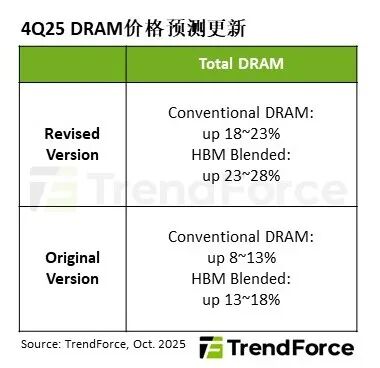
Group 1 - The core viewpoint of the reports indicates that the Server DRAM contract prices are expected to rise significantly due to the expansion of data centers by global cloud service providers (CSPs) [1] - TrendForce has revised its forecast for the fourth quarter Conventional DRAM price increase from 8%-13% to 18%-23%, with potential for further upward adjustments [1] - The report anticipates a 4% year-over-year increase in Server shipments in 2026, driven by CSPs adopting high-performance computing architectures, which will increase DRAM capacity per server [1] Group 2 - The price gap between HBM3e and DDR5 is projected to narrow significantly by 2026, with DDR5 expected to outperform HBM3e in profitability starting in the first quarter of 2026 [2] - Due to competitive capacity between HBM3e and DDR5, suppliers may increase Server DDR5 supply to strengthen their profit base [2] - The pricing strategies and capacity allocation between DDR5 and HBM will be critical variables influencing the market direction in the near future [2]
TrendForce:预计2026年DDR5合约价持续上涨 首季起获利表现将优于HBM3e
智通财经网· 2025-10-29 10:17
Core Insights - The Server DRAM contract prices are expected to rise significantly in Q4 2025 due to increased demand from global cloud service providers (CSPs) expanding their data center capacities [1] - The DDR5 contract prices are projected to maintain an upward trend throughout 2026, with a notable increase in the first half of the year [4] - The price gap between DDR5 and HBM3e is expected to narrow, leading to better profitability for DDR5 starting in Q1 2026 [4][5] Price Adjustments - The revised forecast for Conventional DRAM prices has been adjusted from an original increase of 8-13% to a new range of 18-23% [2] - HBM blended prices are also expected to rise, with the new forecast indicating an increase of 23-28% [2] Market Demand and Supply Dynamics - The shipment volume of servers is anticipated to grow by approximately 4% year-on-year in 2026, driven by CSPs adopting high-performance computing architectures [4] - The demand for DRAM is expected to exceed initial forecasts, leading to a continued supply shortage [4] Competitive Landscape - The competition among major suppliers in the HBM3e market is intensifying, which may lead to a decrease in contract prices for HBM3e due to existing inventory levels among buyers [4] - Suppliers may increase the supply of Server DDR5 to strengthen their profit margins as the profitability structure shifts [5] - Future capacity allocation and pricing strategies between DDR5 and HBM will be critical variables influencing market trends [5]