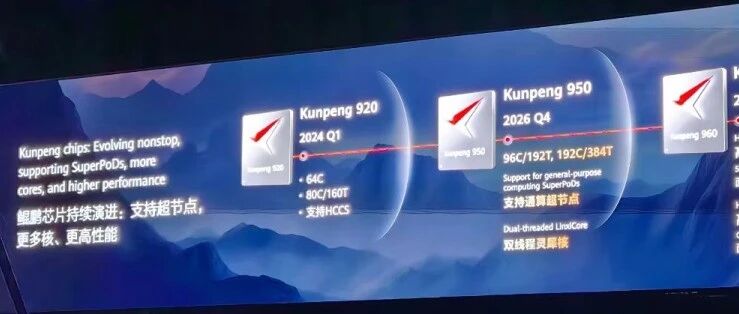
TaiShan 950超节点

Search documents
华为超节点赶超英伟达:驾驭“光”很关键
Guan Cha Zhe Wang· 2026-02-10 03:20
Core Insights - The emergence of SuperPods as a new AI computing infrastructure has become a focal point in the industry since 2025, with Huawei's Ascend 384 SuperPod leading the way in performance metrics compared to foreign competitors [1][3] - The demand for computing power is far from being met, with token consumption expected to exceed trillions daily in China, highlighting the inadequacy of simply stacking servers to address the computing gap [3][4] Group 1: SuperPod Characteristics - SuperPods are not merely about stacking chips; they represent a fundamental restructuring of traditional computing architectures, enabling equal interconnectivity among CPUs, NPUs, and memory units [4][6] - Key features of a true SuperPod include high bandwidth to eliminate communication delays, low latency, and the ability to form a logically unified system through unified memory addressing [6][7] Group 2: Efficiency and Performance - SuperPods can significantly enhance computing efficiency, with potential model utilization rates increasing from 30% to 45%, effectively a 50% improvement, which can help mitigate the limitations of chip manufacturing processes [7][8] - The architecture of SuperPods differs from traditional systems, as Huawei employs optical communication technology, allowing for greater scalability and interconnectivity compared to NVIDIA's copper-based systems [8][9] Group 3: Innovation and Ecosystem - Huawei's systematic innovation in chip design, optical components, and foundational protocols has positioned it uniquely in the market, leveraging over 20 years of experience in optical technology [9][12] - The company is also developing general computing SuperPods, with the TaiShan 950 SuperPod set to launch in Q1 2026, aimed at replacing various server applications [11][12] Group 4: Software and Community Engagement - The success of SuperPods relies not only on hardware but also on a robust software ecosystem, including open-source initiatives like CANN and openEuler, which are crucial for fostering industry collaboration [14] - Huawei has engaged a large developer community, with 3.8 million registered developers for Kunpeng and nearly 4 million for Ascend, emphasizing the importance of open-source collaboration in the AI era [14]



华为打造“最强超节点”,这项全球领先技术很关键
Guan Cha Zhe Wang· 2026-02-10 03:10
Core Viewpoint - The emergence of SuperPod as a new AI computing infrastructure has become a focal point in the industry since 2025, with Huawei's Ascend 384 SuperPod leading the way in performance metrics compared to foreign competitors [1][3]. Group 1: SuperPod Concept and Advantages - SuperPod is not merely about stacking chips; it represents a fundamental restructuring of traditional computing architecture, enhancing communication efficiency among CPU, NPU, and memory units [4][6]. - The key advantages of SuperPod over traditional clusters include significantly improved computational efficiency, with potential model computing utilization rates increasing from 30% to 45%, equating to a 50% performance boost [7][8]. Group 2: Technical Challenges and Innovations - Building a true SuperPod is complex; Huawei's Ascend 384 SuperPod consists of 12 computing cabinets and 4 bus cabinets, while NVIDIA's NVL72 system is confined to a single cabinet due to architectural differences [8]. - Huawei employs optical communication technology for interconnection, allowing for greater scalability beyond single cabinet limitations, while traditional systems face constraints with electrical signal transmission [8][9]. Group 3: Systematic Innovation and Ecosystem Development - Huawei's systematic innovation includes proprietary chip development, optical device capabilities, and foundational protocols, enabling the creation of SuperPods that leverage full optical interconnectivity [9][12]. - The company is also developing general computing SuperPods, such as the TaiShan 950, which aims to replace various server applications by 2026 [9][11]. - A robust software ecosystem, including open-source initiatives like CANN and openEuler, is essential for the operation of SuperPods, with a focus on collaborative development within the industry [14].

计算筑基,华为以硬核技术与千行万业共同智创未来
Huan Qiu Wang Zi Xun· 2025-12-23 09:20
Core Insights - The article emphasizes the critical role of data, algorithms, and computing power as the three foundational pillars of artificial intelligence (AI) [1] - Huawei's report predicts that by 2035, the total computing power in society will increase by 100,000 times compared to 2025, indicating a historic transformation in computing infrastructure to meet the exponential demand from AI applications [1] - Huawei is actively promoting the innovation of computing infrastructure and the intelligent transformation of industries through its strategic initiatives and partnerships [1][2] Group 1: Computing Infrastructure Innovation - Huawei has introduced the industry's largest super node, the Ascend 384 super node, which can provide up to 300 PFLOPs of dense BF16 computing power, optimizing the requirements for model training and inference [3] - The company is also applying the super node concept to general computing with the TaiShan 950 super node, achieving a 2.9 times performance improvement without database modifications and enhancing memory utilization by 20% [3] - Huawei is committed to building a robust foundation for digital economic development by investing in key areas such as computing, storage, and connectivity [4] Group 2: AI Application and Industry Transformation - AI is rapidly reshaping various industries, and Huawei is implementing its "All Intelligence" strategy to integrate AI technology with the real economy [5] - The company has successfully applied AI in its own R&D, manufacturing, and supply chain processes, significantly enhancing productivity and operational efficiency [6] - In collaboration with local industries, Huawei is driving the intelligent transformation of key sectors such as government, healthcare, electricity, steel, transportation, and finance [6][7] Group 3: Collaborative Ecosystem Development - Huawei is establishing innovation centers in Hunan to support the development of a national-level advanced manufacturing industry cluster in computing [4][9] - The company has developed a replicable and scalable reference architecture for industry intelligence transformation, which includes intelligent perception, connectivity, foundational platforms, and AI models [8] - Huawei is collaborating with local universities and research institutions to foster a cooperative ecosystem that promotes technological innovation and application [9]
华为一口气发布多款芯片
半导体行业观察· 2025-09-19 01:29
Core Viewpoint - Huawei is leading a new paradigm in AI infrastructure with its innovative supernode interconnection technology, emphasizing the importance of computing power in artificial intelligence development [2][3]. Group 1: Ascend Chip Development - Huawei has made significant progress in its Ascend chip series, with the upcoming Ascend 950 series expected to enhance AI computing capabilities [3][4]. - The Ascend 950 series includes two chips: Ascend 950PR and Ascend 950DT, which will improve training efficiency and inference throughput [5][6]. - The Ascend 950PR chip targets inference prefill and recommendation scenarios, while the Ascend 950DT focuses on inference decode and training, with significant improvements in memory bandwidth and capacity [6][7]. Group 2: Supernode Products - The Atlas 950 supernode, based on the Ascend 950DT chip, will support 8192 Ascend 950DT chips, significantly increasing computing power and interconnection bandwidth [9][10]. - The Atlas 960 supernode, set to launch in 2027, will further enhance performance with a maximum support of 15488 cards, doubling the capabilities of the Atlas 950 [11][12]. - The Atlas 950 SuperCluster will consist of 64 Atlas 950 supernodes, achieving a total computing power of 524 EFLOPS, making it the world's strongest computing cluster [21][22]. Group 3: Interconnection Technology - Huawei has developed a new interconnection protocol, "Lingqu," to support large-scale supernode architectures, enhancing reliability and bandwidth [20][23]. - The interconnection technology addresses challenges in long-distance, high-reliability connections and aims to achieve TB-level bandwidth with low latency [19][20]. - The Lingqu protocol will be open for industry partners to foster collaboration and innovation in interconnection technology [20][23].
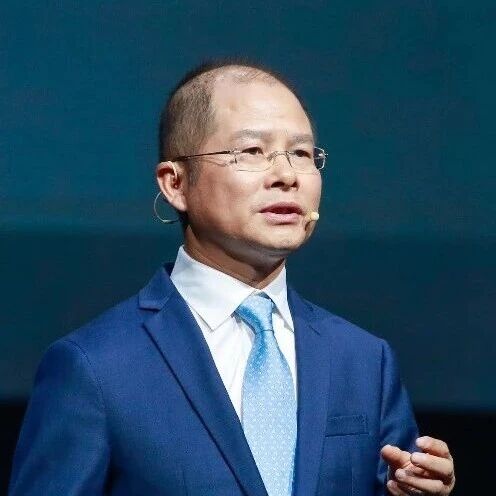
徐直军,最新发声!
中国基金报· 2025-09-18 13:23
Core Viewpoint - Huawei's rotating chairman Xu Zhijun announced that the Ascend chips will evolve at a pace of "almost doubling computing power every year" over the next three years [4][5]. Group 1: Ascend Chip Development - Huawei has planned three series of Ascend chips: Ascend 950, Ascend 960, and Ascend 970, with more specific chips in development [5][6]. - The Ascend 950 series includes Ascend 950PR and Ascend 950DT, featuring significant improvements such as support for low-precision formats, increased vector computing power, and a bandwidth of 2TB/s, which is 2.5 times that of the Ascend 910C [5][7]. - The Ascend 960 is expected to launch in Q4 2027, with specifications that double those of the Ascend 950, including support for a proprietary HiF4 data format [6][7]. - The Ascend 970 is still under discussion, with preliminary plans indicating a doubling of computing power and bandwidth compared to the Ascend 960 [7]. Group 2: Super Nodes and Clusters - Huawei will launch three super node products: Atlas 950, Atlas 960, and TaiShan 950, along with a new interconnect protocol called Lingqu [9][10]. - Xu emphasized that super nodes are becoming the dominant product form for AI infrastructure, functioning as a single logical computer composed of multiple physical machines [9]. - The Atlas 950 SuperCluster will be 2.5 times larger than the current largest cluster, xAI Colossus, and will have 1.3 times its computing power, making it the strongest computing cluster globally [10]. - By Q4 2027, Huawei plans to introduce the Atlas 960 SuperCluster, further increasing the scale to a million card level [10].
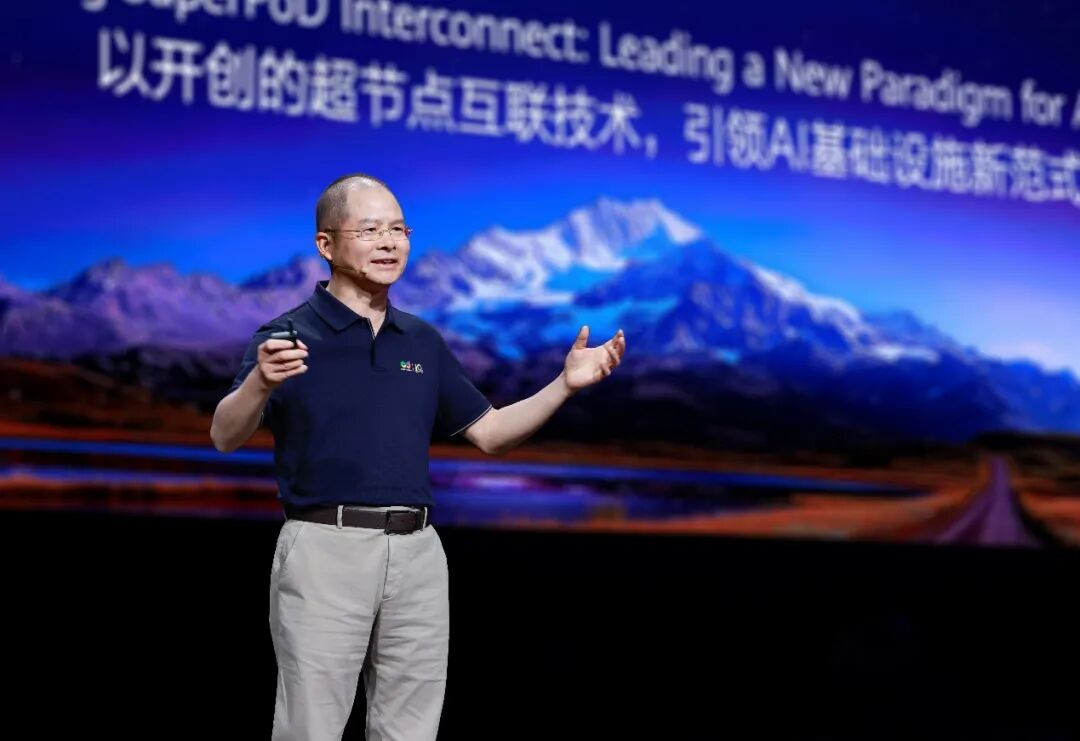
华为徐直军,罕见公开华为AI算力版图,新超节点已超越英伟达
2 1 Shi Ji Jing Ji Bao Dao· 2025-09-18 10:48
Core Insights - Huawei's Vice Chairman Xu Zhijun unveiled the company's AI computing power roadmap at the HC 2025 conference, detailing the evolution of the Ascend chip series over the next three years, with a focus on doubling computing power annually [3][4] Group 1: AI Computing Power Development - The Ascend 950 series will launch in Q1 2026, followed by the Ascend 960 in 2027 and the Ascend 970 in 2028, with significant advancements in low-precision data formats, vector computing power, interconnect bandwidth, and self-developed HBM [3][4] - The Atlas 950 and Atlas 960 supernode products were introduced, with the Atlas 950 featuring 8192 cards and an FP8 computing power of 8E FLOPS, set to launch in Q4 2026, significantly surpassing NVIDIA's concurrent offerings [3][4] Group 2: Expansion into General Computing - Huawei is extending its supernode concept to general computing with the TaiShan 950 supernode, which aims to outperform traditional databases and high-end servers by achieving a 2.9x performance boost without requiring database modifications [4] - The self-developed "UnifiedBus" interconnect protocol will be open-sourced from version 2.0, promoting a truly open supernode ecosystem [4] Group 3: Market Reaction and Collaborations - Following the announcements, Huawei's computing power concept stocks surged, with companies like Fenghuo Communication hitting the daily limit, and others like Xingtuxinke and Xinghuan Technology seeing significant gains [6][9] - Companies in the Huawei ecosystem, such as Fenghuo Communication and Xingtuxinke, are actively collaborating with Huawei on various AI solutions and have received certifications for their compatibility with Huawei's Ascend platform [9] Group 4: Industry Outlook - Analysts from Zhongyin Securities noted a rising industry sentiment, with domestic computing power expected to see significant growth, driven by high utilization rates in wafer manufacturing and semiconductor equipment orders [10]
华为披露芯片路线图,详情披露
半导体芯闻· 2025-09-18 10:40
Core Viewpoint - Huawei is leading a new paradigm in AI infrastructure with its innovative supernode interconnection technology, emphasizing the importance of computing power in artificial intelligence development [2][8]. Summary by Sections Ascend Chip Development - Huawei has committed to the monetization of Ascend hardware and plans to open-source its CANN compiler and virtual instruction set interface by December 31, 2025 [2]. - The Ascend 950 series, including Ascend 950PR and Ascend 950DT, is set to significantly enhance computing power and efficiency compared to previous models [3][4]. - The Ascend 950 chip will support new data formats and achieve a computing power of 1 PFLOPS for FP8 and 2 PFLOPS for FP4, with interconnect bandwidth increased to 2 TB/s [5][6]. Upcoming Chip Releases - The Ascend 950PR chip is targeted for Q1 2026, focusing on inference prefill and recommendation scenarios, while the Ascend 950DT will be released in Q4 2026, emphasizing inference decode and training [6][7]. - The Ascend 960 chip, expected in Q4 2027, will double the specifications of the Ascend 950, enhancing performance for training and inference [7]. - The Ascend 970, planned for Q4 2028, aims to further upgrade performance metrics across various specifications [7]. Supernode Products - The Atlas 950 supernode, based on the Ascend 950DT, will support 8192 Ascend 950DT chips, achieving FP8 computing power of 8 EFLOPS and interconnect bandwidth of 16 PB/s, set to launch in Q4 2026 [9][10]. - The Atlas 960 supernode, launching in Q4 2027, will support 15488 cards, with FP8 computing power reaching 30 EFLOPS and interconnect bandwidth of 34 PB/s [11]. Interconnection Technology - Huawei has developed a new interconnection protocol, "Lingqu," to support large-scale supernodes, enhancing reliability and bandwidth while reducing latency [18][19]. - The Atlas 950 SuperCluster, consisting of 64 Atlas 950 supernodes, will achieve a total FP8 computing power of 524 EFLOPS, launching alongside the Atlas 950 supernode in Q4 2026 [20]. Future Directions - Huawei aims to continue evolving its supernode and cluster products to meet the growing demands for AI computing power, with a focus on both AI and general computing applications [12][21].