WTI期货

Search documents
访日游客如减少,或引发日元进一步贬值
日经中文网· 2026-03-21 00:33
Group 1 - The article highlights that rising oil prices are increasing outbound travel costs globally, potentially leading to a 6% decrease in foreign tourists visiting Japan by the end of 2026 if WTI crude oil prices remain around $100 per barrel [2][5]. - The depreciation of the yen and appreciation of the dollar are exacerbated by rising oil prices, with the yen trading at around 158 yen per dollar, and predictions suggest it may reach 160 yen per dollar soon [2][4]. - Concerns about Japan's trade deficit are growing due to reliance on imported energy, which increases payment costs as oil prices rise, leading to increased selling of yen and buying of dollars [4][9]. Group 2 - The article notes that if oil prices remain high, there could be a reduction in yen buying pressure due to decreased inbound tourism demand [5]. - The increase in oil prices has led to higher airline fuel costs, with prices rising from $99.4 per barrel to $175 within a few weeks, prompting some airlines to raise fuel surcharges [7]. - The travel surplus, which has been a buffer against service account deficits, is narrowing, with January's travel surplus down 10.4% year-on-year, attributed to yen depreciation and reduced Chinese tourist numbers [8][9].


基础化工行业投资策略周报:美伊地缘延续,化工品涨价持续-20260308
GF SECURITIES· 2026-03-08 09:28
Core Insights - The report highlights the ongoing geopolitical tensions between the US, Israel, and Iran, which are impacting oil supply and transportation, leading to price increases in chemical products [5][12]. - The chemical industry is experiencing a price increase across various products, with 58% of the 336 tracked products showing price increases [5][24]. - The report suggests a positive outlook for the chemical industry, driven by cyclical recovery and technological advancements, recommending attention to specific sectors and companies [12][13]. Industry Overview - From March 2 to March 6, the SW basic chemical sector declined by 0.56%, outperforming the Wind All A Index by 1.74 percentage points, with some sub-sectors like oil and gas extraction showing positive performance [12][13]. - The chemical industry typically follows a five-year cycle, characterized by phases of profit growth, capacity expansion, profit decline, and capacity reduction or demand improvement [12]. - The report emphasizes the importance of capital expenditure trends, anti-involution strategies, and global technological revolutions as key factors influencing the industry's future [12]. Data Tracking Industry Trends - The basic chemical sector's performance from March 2 to March 6 indicates a slight decline, but it has outperformed the broader market index [13]. Macro Data - The report includes various macroeconomic indicators, such as industrial value-added growth rates and real estate market performance, which are crucial for understanding the chemical industry's health [20][22]. Downstream Data - The report tracks downstream performance in sectors like real estate and automotive, which are significant consumers of chemical products [22][23]. Price and Price Spread Volatility - Significant price increases were noted in products like liquid chlorine, Asian diesel, and phthalic anhydride, while declines were observed in lithium hexafluorophosphate and polysilicon [24][40]. - Among the 336 tracked products, 195 saw price increases, while 118 remained stable, and 23 experienced declines, indicating a robust pricing environment for many chemicals [24][40]. Recommendations - The report suggests focusing on cyclical companies such as Wanhua Chemical, Hualu Hengsheng, and Luxi Chemical, as well as growth sectors like synthetic biology and lubricants [12]. - Companies involved in anti-involution strategies, such as PTA and polyester filament, are highlighted as potential investment opportunities [12].
化工行业呈现“东升西落”,我国化工企业全球竞争力持续增强,石化ETF(159731)迎布局机遇
Mei Ri Jing Ji Xin Wen· 2026-02-02 02:48
Group 1 - The China Petroleum and Chemical Industry Index fell by 3.48% as of February 2, with nearly all constituent stocks declining, led by companies such as Luxi Chemical, Huafeng Chemical, and Yangnong Chemical [1] - The largest ETF tracking the index (159731) has seen a net inflow of funds for 18 consecutive trading days, totaling 1.351 billion yuan, with the latest share count reaching 1.594 billion and total assets at 1.661 billion yuan [1] - As of January 30, the US dollar index stood at 97.12, down 0.39 percentage points week-on-week [1] Group 2 - Brent crude oil futures settled at $70.69 per barrel, up 7.30% week-on-week, while WTI futures settled at $65.21 per barrel, up 6.78% [1] - NYMEX natural gas futures closed at $4.42 per million British thermal units, down 17.50% week-on-week, while Northeast Asia LNG prices were at $12.10 per million yen, up 6.86% [1] - Everbright Securities believes that the chemical industry is experiencing a recovery trend, supported by macro data and policy guidance, with leading companies gaining competitive advantages [1] Group 3 - The petrochemical ETF (159731) and its linked funds (017855/017856) closely track the China Petroleum and Chemical Industry Index, focusing on the "big energy" security logic [2] - The ETF not only benefits from the profit recovery of downstream chemical products but also locks in the value of upstream energy resources through a high allocation to major oil companies, providing stronger performance resilience during rising oil price cycles [2]
原油:油价收复前日部分失地 周末前交易员对伊朗风险仍存警惕
Xin Lang Cai Jing· 2026-01-16 21:21
Group 1 - Oil prices ended a volatile week with a slight increase, as traders assessed tensions in Iran and broader market sentiment [1][5] - WTI futures for February delivery rose by 0.4%, settling at $59.44 per barrel, after experiencing a significant drop of 4.6% on Thursday, marking the largest decline since June [1][5] - Brent futures for March delivery increased by 0.6%, with a settlement price of $64.13 per barrel [2][6] Group 2 - President Trump expressed respect for Iran's decision to cancel the execution of protesters, which lowered market expectations for an immediate U.S. response to the violent protests in Iran [2][6] - The U.S. is strengthening its military presence in the Middle East, with at least one aircraft carrier heading to the region and additional military assets expected to be deployed in the coming days and weeks [2][6] Group 3 - Traders typically hedge bearish bets before weekends during periods of heightened geopolitical risk [3][7] - Warren Patterson, head of commodity strategy at ING, noted that while the risk of immediate U.S. intervention in Iran has diminished, it still exists, which may keep the market alert in the short term [3][7] - If the U.S. does not respond promptly, the risk premium may dissipate, leading to a more bearish fundamental outlook [3][7] Group 4 - Uncertainty regarding the prospects for a ceasefire between the U.S. and Ukraine will pose a significant challenge for oil prices [4][8]
大宗商品综述:油价小涨 金价下跌 基本金属全线走低
Xin Lang Cai Jing· 2026-01-16 21:21
Oil Market - Oil prices ended a volatile week with a slight increase, as traders assessed tensions in Iran and broader market sentiment [2][12] - WTI futures for February delivery rose by 0.4% to settle at $59.44 per barrel, recovering from a 4.6% drop earlier in the week, the largest decline since June [2][12] - Brent futures for March delivery increased by 0.6%, settling at $64.13 per barrel [2][13] - President Trump's comments regarding Iran's decision to cancel the execution of protesters reduced market expectations for immediate U.S. intervention [13][14] - The U.S. is increasing its military presence in the Middle East, with at least one aircraft carrier deployed and more military assets expected in the coming days [13][14] - Traders typically hedge bearish bets before weekends during periods of heightened geopolitical risk [14] Precious Metals - Gold prices declined as President Trump expressed reservations about Kevin Hassett's nomination as the next Federal Reserve Chairman, adding uncertainty to the selection process [4][16] - Following Trump's remarks, the dollar narrowed its losses, and U.S. Treasury yields rose, leading to a 1.7% drop in gold prices [5][17] - Gold spot prices fell by 0.66% to $4,585.61 per ounce, while silver spot prices decreased by 3.25% to $89.4164 per ounce [17] Base Metals - Base metal prices on the London market experienced significant declines at the end of a dramatic week [18][19] - Benchmark futures for copper, tin, zinc, and aluminum all fell, with LME copper down 2.3% to $12,803 per ton and LME tin down 7.8% to $47,982 per ton [20] - The sell-off in the Shanghai market contributed to the speed and characteristics of the market movements, with traders likely closing long positions rather than driven by new demand or macro signals [19][20]
大宗商品综述:原油上涨 伦铜走低 白银续跌
Xin Lang Cai Jing· 2026-01-08 22:40
Group 1: Oil Market - Crude oil prices increased as traders assessed multiple geopolitical risks that could lead to premiums, while also evaluating U.S. controls on Venezuelan oil [2][14] - WTI crude oil rose by 3.2%, settling at $57.76 per barrel, with prices continuing to climb post-settlement [15] - Brent crude oil for March delivery settled up 3.4% at $61.99 per barrel [16] Group 2: Base Metals - Copper prices fell, with LME copper down 1.39% to $12,720.5 per ton, as the dollar reached a two-week high [6][18] - A recent study by S&P Global indicated that the competition in artificial intelligence and increased defense spending could exacerbate the anticipated copper supply shortage [5][17] Group 3: Precious Metals - Silver prices declined for the second consecutive day, with a potential sell-off of silver futures worth approximately $6.8 billion expected due to annual commodity index rebalancing [10][22] - Following a nearly 4% drop the previous day, silver saw a further decline of 5.5%, driven by passive tracking funds selling to match new index weight requirements [10][22] - Gold prices stabilized, with spot gold rising by 0.48% to $4,477.65 per ounce [12][23]
石油化工行业周报:长丝淡季不淡,基本面较为坚挺-20251207
Shenwan Hongyuan Securities· 2025-12-07 15:24
Investment Rating - The report maintains a "Positive" outlook on the petrochemical industry, particularly highlighting the resilience of polyester filament in the off-season [3]. Core Insights - The demand for polyester filament has remained strong, with downstream textile operating rates reaching a high of 69.45% in early November and maintaining around 90% for polyester filament production [4][5]. - Inventory levels for polyester filament and downstream fabrics are relatively low, indicating a healthy supply-demand balance [7][8]. - Profitability for polyester filament has improved significantly since September, with expectations for further profit increases in Q4 [9][10]. Summary by Sections Polyester Filament Sector - Polyester filament has entered a demand peak since September, with downstream textile operating rates consistently high, peaking at 69.45% [4][5]. - As of December 5, the operating rate for polyester filament was 90.15%, indicating strong production levels [4][5]. - Inventory levels for polyester filament (POY/FDY/DTY) are at 16.3/21.2/24.3 days, remaining low compared to the annual average [7][8]. Upstream Sector - Brent crude oil prices increased to $63.75 per barrel, reflecting a 0.87% rise from the previous week [18]. - The number of active oil rigs in the U.S. increased to 549, indicating a slight uptick in drilling activity [29]. Refining Sector - The comprehensive price spread for major refined products in Singapore decreased to $19.06 per barrel, down by $0.57 from the previous week [54]. - Domestic refining margins are expected to improve as oil prices stabilize [51]. Investment Recommendations - The report recommends focusing on high-quality companies in the polyester filament sector, such as Tongkun Co., and bottle-grade PET producers like Wankai New Materials [12]. - It also suggests monitoring large refining companies like Hengli Petrochemical and Rongsheng Petrochemical due to expected improvements in cost structures [12]. - For upstream exploration and production, companies like CNOOC and offshore oil service firms are highlighted for their potential performance improvements [12].



隔夜美股 | 本周三大指数均录得涨幅 现货黄金跌破4200美元关口
智通财经网· 2025-12-05 23:11
Market Overview - The three major U.S. indices closed higher, with the Dow Jones up 104.05 points (0.22%) at 47954.99, the Nasdaq up 72.99 points (0.31%) at 23578.13, and the S&P 500 up 13.28 points (0.19%) at 6870.40, reflecting a positive week for the markets [1] - European markets showed mixed results, with Germany's DAX30 up 133.70 points (0.56%) at 24028.06, while the UK FTSE 100 down 44.62 points (0.46%) at 9666.25, and the French CAC40 down 7.29 points (0.09%) at 8114.74 [2] Oil Market - WTI crude oil for January delivery settled at $60.08 per barrel, up 0.69%, while Brent crude for February delivery settled at $63.75 per barrel, up 0.49%, indicating ongoing risk premiums amid stalled peace negotiations between Russia and Ukraine [3] - OPEC's average daily production in November remained stable at slightly above 29 million barrels, with UAE increasing production by 60,000 barrels to 3.61 million barrels per day, offset by slight reductions from other OPEC members [3] Cryptocurrency Market - Bitcoin fell over 3% to $89285.08, and Ethereum also dropped over 3% to $3029.27, reflecting a bearish trend in the cryptocurrency market [4] Precious Metals - Spot gold decreased by 0.23% to $4199.2, having reached a high of $4259.42 during the session, indicating volatility in the precious metals market [5] Economic Indicators - The core PCE price index for September rose by 0.2% month-over-month, with a year-over-year increase of 2.8%, suggesting a potential for the Federal Reserve to consider interest rate cuts in the upcoming meeting [6] - Consumer confidence in the U.S. slightly improved, with the index rising 2.3 points to 53.3, although overall sentiment remains cautious due to high inflation pressures [7] Corporate News - Netflix's acquisition of Warner Bros for $720 billion has driven global M&A activity to $3.3 trillion this year, a 37% increase from 2024, positioning it as one of the best years for M&A since 2021 [9]


每日投行/机构观点梳理(2025-10-24)
Jin Shi Shu Ju· 2025-10-24 15:53
Group 1: Gold Market Outlook - Morgan Stanley predicts that the average gold price will exceed $5,000 per ounce by Q4 2026, with a long-term target of $6,000 per ounce by 2028, based on expected investor demand and central bank purchases [1] - The analysis highlights that the current market consolidation is a healthy phenomenon, reflecting a supply-demand imbalance with high buyer interest and limited sellers [1] - The report emphasizes that gold remains a strong investment amid concerns over inflation, currency devaluation, and the Federal Reserve's interest rate cuts [1] Group 2: U.S. Economic Indicators - Barclays anticipates that the upcoming U.S. CPI data will need to be significantly higher than expected to alter the market's view on the Federal Reserve's interest rate cuts [2] - Morgan Stanley and Bank of America expect the Federal Reserve to end its balance sheet reduction earlier than previously forecasted due to rising borrowing costs in the dollar financing market [3] - The market is divided on when the Fed will conclude its quantitative tightening, with some institutions predicting an end in October while others expect a later conclusion [3] Group 3: Risk Assets and Inflation - State Street Global Advisors warns that investor optimism towards high-risk assets may be excessive, with expectations of rising inflation impacting the Federal Reserve's decisions [4] - Dutch International Group notes that the credit spread for U.S. corporate bonds is tightening, making them less attractive compared to euro-denominated bonds, amid rising risks [5] - Citigroup highlights that the recent rise in oil prices due to U.S. sanctions on Russia provides a hedging opportunity for producers, although geopolitical premiums may not last [6] Group 4: Japanese Economic Policy - Morgan Stanley suggests that the market's cooling expectations for a Bank of Japan rate hike this month may be overstated, indicating a potential rebound for the yen [7] - Dutch International Group points out that rising inflation in Japan could pave the way for a rate hike by the Bank of Japan in December, with consumer price inflation accelerating to 2.9% in September [8] Group 5: Cryptocurrency and AI Transition - Guojin Securities reports that overseas cryptocurrency mining companies are transitioning to AI data centers, leveraging low electricity costs and approved power quotas [8] - The report suggests focusing on companies with clear AI expansion plans and undervalued market positions during this transition [8] Group 6: U.S. Tariff and Inflation Outlook - CITIC Securities predicts that the U.S. Supreme Court will expedite the ruling on Trump's tariff legality, with potential implications for U.S.-China negotiations [9] - Minsheng Securities warns that rising core inflation in the U.S. could lead to a more cautious approach from the Federal Reserve regarding interest rate cuts, with inflation pressures expected to increase in Q4 [10]



华尔街先知Yardeni:油价下跌将推动10年期美债收益率降至3.75%
Hua Er Jie Jian Wen· 2025-10-21 07:38
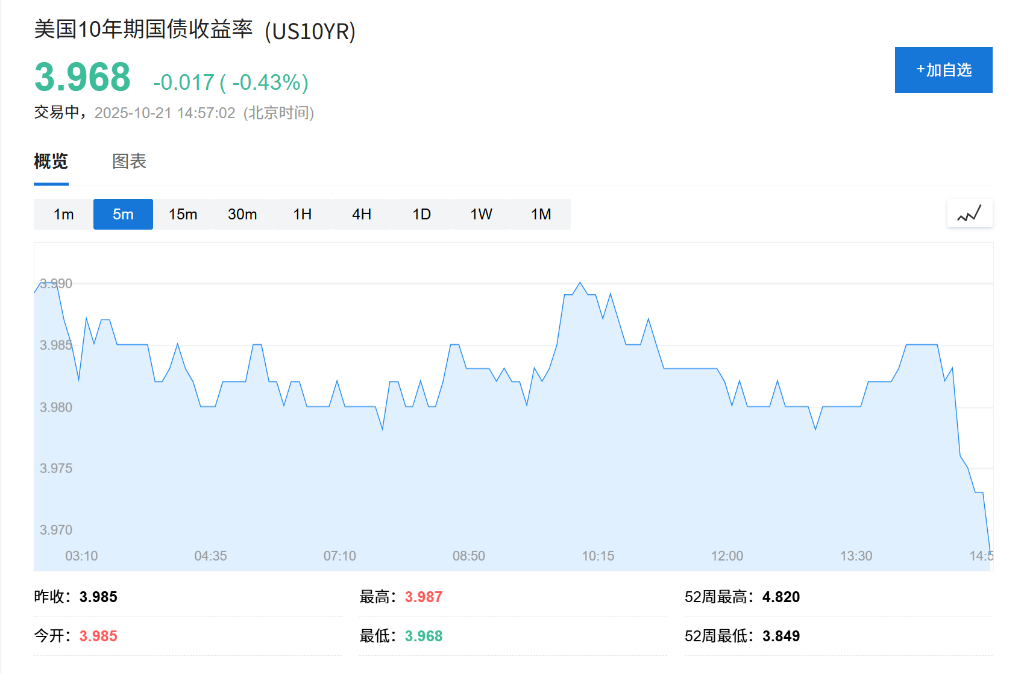
Group 1 - Ed Yardeni predicts that declining oil prices may push the benchmark 10-year U.S. Treasury yield back to levels not seen in over a year, potentially reaching 3.75% if the Federal Reserve lowers interest rates next week [1] - The prediction is based on the long-term correlation between oil prices and Treasury yields, where oil prices influence inflation, which in turn affects the interest rate market [1] - The recent rally in U.S. Treasuries has been supported by expectations of Fed rate cuts and concerns over regional bank risks, with the 10-year Treasury yield hovering around 3.96% and a cumulative decline of approximately 17 basis points this month [1] Group 2 - The simultaneous rise of U.S. Treasuries and equities is noted as a "rare" market moment, indicating traders are betting on a "Goldilocks" scenario where economic growth slows enough to curb inflation without leading to a recession [3][7] - The decline in oil prices, attributed to a worsening oil surplus and concerns over a global economic slowdown, has pushed WTI crude oil prices down to below $57 from a high of $80 per barrel earlier this year [4] - Lower energy prices are expected to further support Treasury performance, creating a favorable market environment for investors [7]