
高位震荡

Search documents
上游增产去库,双焦高位震荡
Tong Guan Jin Yuan Qi Huo· 2026-03-30 01:18
Report Date - The report was published on March 30, 2026 [1] Report Title - The report is titled "Upstream Production Increase and Inventory Reduction, Double Coking Coal and Coke at High-Level Volatility" [2] Investment Rating - No investment rating was provided in the report Core Views - Downstream: Last week, blast furnace复产 accelerated, molten iron production continued to increase, and raw material demand was good. Steel mills maintained coke production. Although in-plant inventory increased, the available days of coke changed little [3][7] - Middle stream: Due to the price increase of coking coal, coking profit declined but remained in a good profit state. Coking enterprises were actively operating. Although coke production increased significantly, downstream purchasing was strong, and inventory continued to decline. The national average profit per ton of coke was +21 (compared to the previous week, -17) yuan/ton. Last week, the capacity utilization rate was 74.86% (+0.55); the daily average coke production was 64.76 (+0.52) tons, and the coke inventory was 90.05 (-4.18) tons [3][8] - Upstream: Domestic coal mines were operating well, production increased compared to the previous week, sales were smooth, and inventory decreased. Last week, the approved capacity utilization rate of 523 coking coal mine samples was 89.2%, a week-on-week increase of 0.6%. The daily average raw coal production was 198.1 tons, a week-on-week increase of 1.2 tons; the raw coal inventory was 523 tons, a week-on-week decrease of 13.6 tons; the daily average clean coal production was 78.6 tons, a week-on-week decrease of 1.2 tons; the clean coal inventory was 222.8 tons, a week-on-week decrease of 31.3 tons [3][8] - Overall: The geopolitical conflict in the Middle East pushed up oil prices, the spot market sentiment was good, and the price increase expectation of coal and coke was strong. Upstream coal mine production increased steadily, the production rhythm of coking enterprises accelerated. Driven by the recovery of downstream demand, the shipment speed of double coking coal and coke increased, and upstream inventory decreased. Downstream blast furnace molten iron production continued to recover, and the willingness to replenish raw material inventory increased. Driven by demand, upstream production increased and inventory decreased. Supported by the fundamentals, it is expected that double coking coal and coke will maintain a high-level volatile trend [3][9] Transaction Data | Contract | Closing Price | Change | Change Rate (%) | Total Trading Volume (lots) | Total Open Interest (lots) | Price Unit | | --- | --- | --- | --- | --- | --- | --- | | SHFE Rebar | 3124 | 1 | 0.03 | 4322964 | 2309613 | Yuan/ton | | SHFE Hot Rolled Coil | 3299 | 2 | 0.06 | 1468357 | 962265 | Yuan/ton | | DCE Iron Ore | 817.0 | 1.5 | 0.18 | 1078183 | 408026 | Yuan/ton | | DCE Coking Coal | 1219.0 | 48.0 | 4.10 | 7330872 | 669897 | Yuan/ton | | DCE Coke | 1752.0 | 11.5 | 0.66 | 148101 | 46589 | Yuan/ton | [5] Market Review - Last week, coking coal and coke futures fluctuated upward. Supply and demand both increased, the interference from the overseas Middle East situation increased, and the spot market sentiment was good [7] - Downstream: Last week, blast furnace复产 accelerated, molten iron production continued to increase, and raw material demand was good. Steel mills maintained coke production. Although in-plant inventory increased, the available days of coke changed little. Last week, the profitability rate of steel mills was 43.29%, an increase of 0.87 percentage points compared to the previous week and a decrease of 10.39 percentage points compared to the same period last year; the daily average molten iron production was 231.09 tons, an increase of 2.94 tons compared to the previous week and a decrease of 6.19 tons compared to the same period last year. The daily average coke production was 47.28 (compared to the previous week, -0.03) tons, and the capacity utilization rate was 86.4% (+0.06). The coke inventory was 691.67 (+3.49) tons, and the available days of coke were 12.75 days [7] - Middle stream: Due to the price increase of coking coal, coking profit declined but remained in a good profit state. Coking enterprises were actively operating. Although coke production increased significantly, downstream purchasing was strong, and inventory continued to decline. The national average profit per ton of coke was +21 (compared to the previous week, -17) yuan/ton. Last week, the capacity utilization rate was 74.86% (+0.55); the daily average coke production was 64.76 (+0.52) tons, and the coke inventory was 90.05 (-4.18) tons [8] - Upstream coal mines: Domestic coal mines were operating well, production increased compared to the previous week, sales were smooth, and inventory decreased. Last week, the approved capacity utilization rate of 523 coking coal mine samples was 89.2%, a week-on-week increase of 0.6%. The daily average raw coal production was 198.1 tons, a week-on-week increase of 1.2 tons; the raw coal inventory was 523 tons, a week-on-week decrease of 13.6 tons; the daily average clean coal production was 78.6 tons, a week-on-week decrease of 1.2 tons; the clean coal inventory was 222.8 tons, a week-on-week decrease of 31.3 tons [8] - Port inventory: The inventory of imported coking coal at 16 ports across the country was 478.10 tons, a decrease of 2.93 tons; the inventory of coke at 18 ports across the country was 289.51 tons, an increase of 20.88 tons [8] - Overall: The geopolitical conflict in the Middle East pushed up oil prices, the spot market sentiment was good, and the price increase expectation of coal and coke was strong. Upstream coal mine production increased steadily, the production rhythm of coking enterprises accelerated. Driven by the recovery of downstream demand, the shipment speed of double coking coal and coke increased, and upstream inventory decreased. Downstream blast furnace molten iron production continued to recover, and the willingness to replenish raw material inventory increased. Driven by demand, upstream production increased and inventory decreased. Supported by the fundamentals, it is expected that double coking coal and coke will maintain a high-level volatile trend [9] Industry News - US President Trump said that the US had "strong" talks with Iran and had formed the main points of an agreement, and would suspend attacks on its energy facilities for 5 days. Trump said that the US was in consultation with Iran to reach a broader agreement, and the US and Iran "might reach an agreement within 5 days or even less time." However, Iran has repeatedly denied having talks with the US. The Iranian Foreign Ministry said that Trump's relevant statements were aimed at reducing energy prices and buying time for military operations [10] - The US government proposed a 15-point conflict-ending plan to Iran through Pakistan, covering nuclear programs, missile capabilities, and regional issues. It is understood that the US is considering promoting a one-month ceasefire to conduct further negotiations on the above terms [10] - US President Trump said that the attack on Iranian energy facilities would be postponed for another 10 days until 8 pm on April 6, 2026, Eastern Time. Trump also denied being eager to reach an agreement with Iran and said that the US military operations against Iran were continuing, insisting that it was Iran that sought to restart negotiations [10] - Pan Gongsheng, the governor of the People's Bank of China, said at the China Development Forum 2026 on March 22 that China would continue to implement a moderately loose monetary policy. A variety of monetary policy tools such as the deposit reserve ratio, policy interest rates, and open market operations would be comprehensively used to maintain sufficient liquidity [10] - On March 27, the US and Israel launched air strikes on the Khuzestan Steel Plant and the Mobarakeh Steel Plant in Isfahan, Iran. The power plant supporting the Mobarakeh Steel Plant was also attacked. It is expected that a rigid supply gap of 5-5.5 million tons per year will be formed in the short term, with the most prominent gaps in the three categories of plates, billets, and long products [10] - On March 28, two major aluminum plants in the Middle East were attacked. The plant of Bahrain Aluminium Company was attacked by Iran, and property losses were being evaluated. Emirates Global Aluminium, one of the world's largest aluminum producers, was also attacked by Iran. It is understood that the aluminum products exported from the Middle East account for about 10% of the global supply, which may have a certain impact on the market [10] - US Vice President Vance said that the US had no intention of staying in Iran and would withdraw soon after handling current affairs [10] - The US military's rapid victory plan for ground warfare in a few weeks was exposed. The Pentagon has launched a "sharp knife beheading" tactic, aiming at the oil lifeline of Iran, Kharg Island, without occupying territory or waging a long-term war, in an attempt to replicate the "42-day defeat of Iraq" myth [10] Related Charts - The report includes 22 charts, covering the spot price trends of coking coal and coke, daily average production, capacity utilization rate, inventory, coke available days, ton coke profit, and monthly spread seasonal trends [12][13][14]
橡胶甲醇原油:多空分歧出现能化高位震荡
Bao Cheng Qi Huo· 2026-02-25 11:03
Report Industry Investment Rating - No relevant content provided Core Views of the Report - On Wednesday, the domestic Shanghai rubber futures contract 2605 showed a trend of increasing volume and open interest, strong operation, and a significant rise in closing price. The closing price rose 2.10% to 17,240 yuan/ton, and the premium of the 5 - 9 spread narrowed to 130 yuan/ton. The rubber market has re - entered a bullish trend, and it is expected that Shanghai rubber futures may maintain a moderately bullish oscillatory trend [6]. - On Wednesday, the domestic methanol futures contract 2605 showed a trend of increasing volume and open interest, oscillating weakly, and slightly closing lower. The highest price reached 2,292 yuan/ton, the lowest dropped to 2,248 yuan/ton, and the closing price slightly decreased 0.88% to 2,249 yuan/ton. The discount of the 5 - 9 spread widened to 38 yuan/ton. The rising geopolitical risks in the Middle East are pitted against the increasing supply pressure of domestic methanol. It is expected that methanol futures may maintain an oscillatory consolidation trend [7]. - On Wednesday, the domestic crude oil futures contract 2604 showed a trend of increasing volume and open interest, high - level oscillation, and slightly closing lower. The highest price reached 495.9 yuan/barrel, the lowest dropped to 484.8 yuan/barrel, and the closing price slightly decreased 0.33% to 488.3 yuan/barrel. As geopolitical risks in the Middle East heat up again, the crude oil premium has significantly increased. It is expected that oil prices may maintain a high - level oscillatory trend [7]. Summary by Relevant Catalogs 1. Industry Dynamics Rubber - As of February 23, 2026, the total inventory of natural rubber in bonded and general trade in Qingdao was 667,700 tons, a week - on - week increase of 61,000 tons or 10.05%. The bonded area inventory was 110,800 tons, an increase of 12%; the general trade inventory was 556,900 tons, an increase of 9.67%. The inbound rate of Qingdao's natural rubber sample bonded warehouses increased by 6.8 percentage points, and the outbound rate decreased by 1.38 percentage points; the inbound rate of general trade warehouses increased by 2.65 percentage points, and the outbound rate decreased by 4.36 percentage points [9]. - As of February 13, 2026, the capacity utilization rate of China's semi - steel tire sample enterprises was 56.40%, a week - on - week decrease of 15.69 percentage points and a year - on - year decrease of 8.88 percentage points; the capacity utilization rate of all - steel tire sample enterprises was 40.55%, a week - on - week decrease of 19.90 percentage points and a year - on - year decrease of 13.74 percentage points. During the Spring Festival, most tire enterprises shut down, and the overall capacity utilization rate of sample enterprises will be at the annual low [9]. - In January 2026, China's automobile production and sales were 2.45 million and 2.346 million respectively. Production increased 0.01% year - on - year, sales decreased 3.2% year - on - year, and both decreased 25.7% and 28.3% month - on - month respectively. Specifically, the passenger car market declined. In January, the production and sales of passenger cars were 2.062 million and 1.988 million respectively, a year - on - year decrease of 4.1% and 6.8% respectively, and a month - on - month decrease of 28.4% and 30.2% respectively. The commercial vehicle market continued to improve. In January, the production and sales of commercial vehicles were 388,000 and 359,000 respectively, a year - on - year increase of 29.9% and 23.5% respectively, and a month - on - month decrease of 6.8% and 15.6% respectively [10]. - In January 2026, China's Logistics Prosperity Index (LPI) was 51.2%, a slight month - on - month decrease of 1.2 percentage points, still in the expansion range above 50%. In January 2026, China's heavy - truck market sold about 100,000 vehicles, basically the same as in December 2025, and a significant year - on - year increase of about 39% compared with 72,200 vehicles in the same period of the previous year. It is expected that the wholesale sales of the heavy - truck industry in the first quarter of this year will increase slightly year - on - year [10]. Methanol - As of the week of February 13, 2026, the average domestic methanol operating rate remained at 87.30%, a slight week - on - week decrease of 0.68%, a slight month - on - month increase of 0.50%, and a significant year - on - year increase of 6.11%. The average weekly methanol production in China reached 2.0568 million tons, a slight week - on - week decrease of 430 tons, a small month - on - month increase of 21,400 tons, and a small increase of 80,600 tons compared with 1.9762 million tons in the same period of the previous year [11]. - As of the week of February 13, 2026, the domestic formaldehyde operating rate remained at 26.66%, a small week - on - week decrease of 2.03%. The dimethyl ether operating rate remained at 6.62%, a small week - on - week decrease of 1.10%. The acetic acid operating rate remained at 79.92%, a small week - on - week decrease of 1.17%. The MTBE operating rate remained at 55.83%, a small week - on - week decrease of 2.32%. The average operating load of domestic coal (methanol) to olefins plants was 80.21%, a small week - on - week increase of 1.21 percentage points and a small month - on - month increase of 1.62%. As of February 13, 2026, the domestic methanol - to - olefins futures contract profit was - 71 yuan/ton, a small week - on - week decrease of 30 yuan/ton and a significant month - on - month increase of 173 yuan/ton [11]. - As of the week of February 13, 2026, the methanol inventory in ports in East and South China remained at 942,700 tons, a small week - on - week decrease of 18,700 tons, a significant month - on - month decrease of 101,800 tons, and a small year - on - year increase of 43,600 tons. As of the week of February 12, 2026, the total inland methanol inventory in China was 340,300 tons, a small week - on - week decrease of 28,100 tons, a significant month - on - month decrease of 110,600 tons, and a significant year - on - year decrease of 159,800 tons compared with 500,100 tons in the same period of the previous year [12]. Crude Oil - As of the week of February 6, 2026, the number of active oil drilling rigs in the United States was 412, a small week - on - week increase of 1 and a decrease of 68 compared with the same period of the previous year. The average daily crude oil production in the United States was 13.713 million barrels, a significant week - on - week increase of 498,000 barrels per day, a small year - on - year increase of 219,000 barrels per day, and at a historical high [12]. - As of the week of February 6, 2026, the U.S. commercial crude oil inventory (excluding strategic petroleum reserves) reached 428.8 million barrels, a significant week - on - week increase of 8.53 million barrels and a small year - on - year increase of 969,000 barrels. The crude oil inventory in Cushing, Oklahoma, reached 25.113 million barrels, a small week - on - week increase of 1.071 million barrels; the U.S. Strategic Petroleum Reserve (SPR) inventory reached 415.212 million barrels, a slight week - on - week decrease of 0.1 million barrels. The U.S. refinery operating rate remained at 89.4%, a small week - on - week decrease of 1.1 percentage points, a small month - on - month decrease of 5.9 percentage points, and a small year - on - year increase of 4.4 percentage points [13]. - As of February 17, 2026, the average net long non - commercial positions in WTI crude oil futures were 141,343 contracts, a significant week - on - week increase of 23,529 contracts and a significant increase of 68,529 contracts or 94.12% compared with the January average of 72,814 contracts. As of February 17, 2026, the average net long positions of Brent crude oil futures funds were 250,016 contracts, a slight week - on - week decrease of 526 contracts and a significant increase of 65,570 contracts or 35.55% compared with the January average of 184,446 contracts [13]. 2. Spot Price Table | Variety | Spot Price | Change from Previous Day | Futures Main Contract | Change from Previous Day | Basis | Change | | --- | --- | --- | --- | --- | --- | --- | | Shanghai Rubber | 17,000 yuan/ton | + 200 yuan/ton | 17,240 yuan/ton | + 210 yuan/ton | - 240 yuan/ton | - 10 yuan/ton | | Methanol | 2,260 yuan/ton | - 12 yuan/ton | 2,249 yuan/ton | - 36 yuan/ton | + 11 yuan/ton | + 24 yuan/ton | | Crude Oil | 471.2 yuan/barrel | - 0.7 yuan/barrel | 488.3 yuan/barrel | - 5.0 yuan/barrel | - 17.1 yuan/barrel | + 4.3 yuan/barrel | [15] 3. Relevant Charts - The report lists various charts related to rubber (such as rubber basis, 5 - 9 spread, inventory, and tire开工率), methanol (such as methanol basis, 5 - 9 spread, inventory, and methanol - to - olefins开工率), and crude oil (such as crude oil basis, inventory, and net position changes), but no specific data analysis of the charts is provided [16][29][42]
豆粕、豆油期货品种周报2026.02.02-02.06-20260202
Chang Cheng Qi Huo· 2026-02-02 01:06
Report Summary 1. Report Industry Investment Rating - Not provided in the report 2. Core Views - **豆粕期货**: The soybean meal futures are expected to maintain a range - bound pattern. Brazil's soybean harvest is abundant and gradually hitting the market, leading to significant global supply pressure. Domestic downstream demand is weak, while high oil - mill operation rates and low breeding profits suppress consumption growth. However, Argentina's drought and the continuous reduction of domestic soybean meal inventory provide bottom support [6]. - **豆油期货**: The soybean oil futures price is expected to continue a wide - range fluctuation. As the oil - mill operation rate recovers, soybean oil supply is becoming looser, and terminal consumption is weak, with inventory pressure still existing. But the US biodiesel policy expectations and international crude oil price fluctuations support the soybean oil futures price [29]. 3. Summary by Directory 豆粕期货 - **中线行情分析** - The soybean meal futures are in a range - bound stage. The 4th - week oil - mill soybean actual crushing volume is 2.1021 million tons, the operation rate is 57.83%, and the soybean meal inventory is 898,600 tons. Pay attention to South American weather, Brazil's new - crop arrival rhythm, and domestic breeding demand [6]. - **品种交易策略** - **上周策略回顾**: The soybean meal futures price was in a sideways trend last week, with a slightly bearish capital sentiment. The M2605 was expected to be in a range - bound pattern, with an expected operating range of 2700 - 2800 [9]. - **本周策略建议**: The soybean meal futures price is currently in a sideways trend, with a strongly bearish capital sentiment. The M2605 is expected to be in a weak - range fluctuation, with an expected operating range of 2700 - 2800 [10]. - **相关数据情况** - Data includes soybean meal weekly output, weekly inventory, apparent consumption, weekly inventory days, basis, and oil - meal ratio. The data sources are Wind, Mysteel, and the Great Wall Futures trading consulting department [19][21][24] 豆油期货 - **中线行情分析** - The soybean oil futures are in a wide - range fluctuation stage. The 125 oil - mills' actual soybean oil output in the 4th week is 39,940 tons, and the national key - area commercial soybean oil inventory is 956,000 tons. Pay attention to the US biodiesel policy, crude oil trends, and domestic demand [29]. - **品种交易策略** - **上周策略回顾**: The soybean oil futures price was in an upward trend last week, with a slightly bullish capital sentiment. The Y2605 was expected to continue a slightly bullish range - bound pattern [32]. - **本周策略建议**: The soybean oil futures price is in an upward trend, with a slightly bullish capital sentiment. The Y2605 is expected to be in a high - level range - bound stage [32]. - **相关数据情况** - Data includes soybean oil weekly output, weekly inventory, basis, trading volume, soybean weekly arrival volume, weekly inventory, weekly crushing volume, weekly operation rate, weekly port inventory, and Brazil's premium. The data sources are Wind, Mysteel, and the Great Wall Futures trading consulting department [42][45][47]
铜:强预期对峙弱现实,高位震荡格局未改
Ning Zheng Qi Huo· 2026-01-19 09:11
Report Summary 1. Report Industry Investment Rating No information provided. 2. Core View - Last week, the copper market oscillated at a high level and broke through the previous high in the game between "strong expectation" and "weak reality." The macro - situation is divided at home and abroad, and the fundamentals show a typical multi - empty tug - of war. The copper price is still in an oscillating pattern. Looking forward, the copper price is expected to maintain a high - level oscillation pattern, and the fluctuation risk may intensify [2]. 3. Summary by Relevant Catalogs Market Review and Outlook - Macro - situation: There is a differentiation between domestic and overseas. Domestic active fiscal and monetary policies boost market confidence, while overseas, the Federal Reserve signals a suspension of interest - rate cuts, and geopolitical disturbances create a complex background. - Fundamentals: On the supply side, the strike crisis at Chilean copper mines continues, and the raw material shortage pattern remains. On the demand side, high prices continuously suppress spot purchases, and the market rationally revises the expectation of copper consumption in emerging fields such as AI. Although there is policy - driven stocking demand in the photovoltaic field, the overall consumption shows "weak reality" characteristics. - Future trend: The copper price is expected to maintain a high - level oscillation pattern, with potential for intensified fluctuation risks. "Strong expectations" such as long - term supply bottlenecks, global green - transition demand, and a macro - loose environment provide bottom support, while "weak reality" pressure from high - price negative feedback, geopolitical and overseas - policy uncertainties will continue to cause disturbances [2]. Attention Factors - Attention should be paid to the latest Sino - US economic data and downstream demand changes [3]. This Week's Fundamental Data Weekly Changes | Indicator | Unit | This Week's Latest | Last Week's Same Period | Weekly Change Amount | Weekly Change Rate | Frequency | | --- | --- | --- | --- | --- | --- | --- | | Electrolytic copper price (≥99.95%): Shanghai | Yuan/ton | 101,770 | 100,330 | 1,440 | 1.44% | Weekly | | Electrolytic copper premium/discount (≥99.95%): Shanghai | Yuan/ton | - 110 | - 45 | - 65 | - 144.44% | Weekly | | Clean copper concentrate forward - spot comprehensive index (TC) | US dollars/dry ton | - 46.4 | - 45 | - 1.4 | - 3.11% | Weekly | | Oxygen - free copper rod price | Yuan/ton | 102,770 | 101,500 | 1,270 | 1.25% | Weekly | | LME copper inventory | Tons | 143,575 | 138,975 | 4,600 | 3.31% | Weekly | | SHFE copper inventory | Tons | 213,515 | 180,543 | 32,972 | 18.26% | Weekly | [3] 1. Futures Market Review - The report shows the price trends of Shanghai copper, London copper (LME Copper 3), and the Shanghai - London ratio (unadjusted for exchange rate) through relevant charts, with data sources from Boyi Master and Ningzheng Futures [5][6][7]. 2. Supply Situation Analysis - The report presents relevant data on copper concentrate forward - spot prices, crude copper spot processing average prices, copper concentrate port inventories, domestic electrolytic copper production, electrolytic copper and scrap copper price - change trends, and the main - market refined - scrap price difference through multiple charts, with data sources from the Steel Union Terminal and Ningzheng Futures [12][13][16]. 3. Demand Situation Analysis - The report shows data on 1 electrolytic copper premium/discount in Shanghai, copper product prices, copper product capacity utilization rates, refined copper rod trading volumes, Yangshan copper bonded - area premiums, and electrolytic copper warehouse - receipt bill - of - lading premiums through relevant charts, with data sources from iFinD, the Steel Union Terminal, and Ningzheng Futures [21][23][30]. 4. Inventory Situation Analysis - The report presents data on electrolytic copper spot inventories and the inventories of three major futures exchanges through relevant charts, with data sources from the Steel Union Terminal and iFinD [32].
ATFX:避险情绪持续发酵,黄金刷新历史高点后警惕波动加剧
Sou Hu Cai Jing· 2026-01-15 09:52
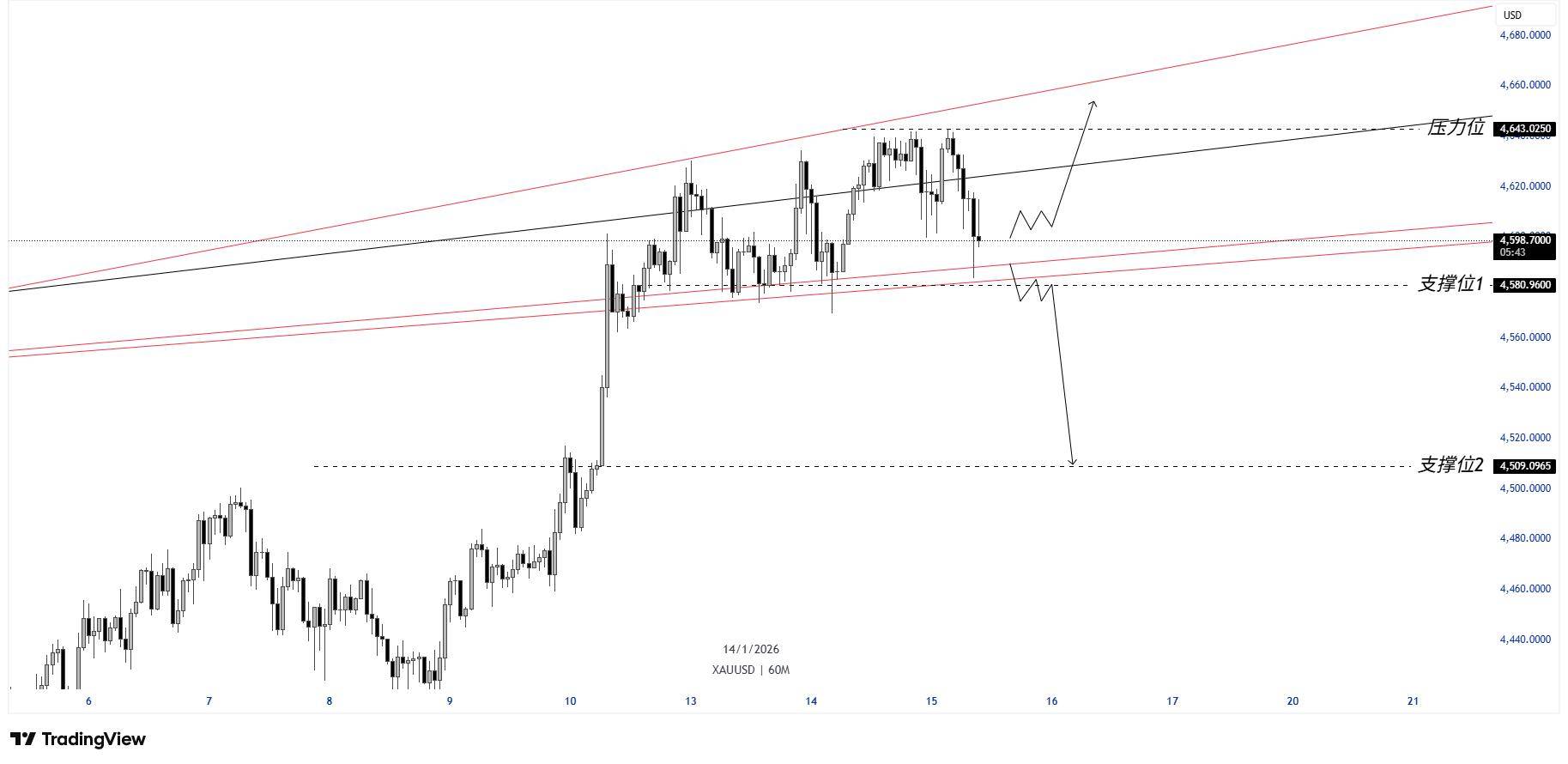
Core Viewpoint - The precious metals market is experiencing significant upward movement, with both gold and silver reaching historical highs, indicating that risk aversion remains elevated amid ongoing global uncertainties [1]. Macroeconomic Factors - Geopolitical risks, increasing political and institutional uncertainties in the U.S., and divergent monetary policy outlooks are collectively undermining market confidence in traditional risk assets and credit systems, leading to a continued flow of funds into non-sovereign assets like gold [2]. - A marginal decline in inflation data and a decrease in U.S. Treasury yields have contributed to lower real interest rates, further reducing the opportunity cost of holding gold, thus providing mid-term support for gold prices [2]. Technical Analysis - Gold prices surged to around $4,642 this week, operating within a clear upward channel, although short-term signs of high-level fluctuations and pullback pressures have emerged [4]. - The key support area is identified between $4,600 and $4,580; if this region holds, prices may consolidate at high levels before testing the resistance above $4,640 again. Conversely, a drop below this support could lead to deeper corrections, potentially targeting $4,510 [4]. - The current market behavior aligns more with "high-level fluctuations in a strong trend" rather than a trend reversal, consistent with the absence of substantial relief in the underlying fundamentals [4]. Silver and Other Precious Metals - Silver is outperforming gold, reflecting that market sentiment has not entirely shifted to defense but is in a phase of both risk aversion and speculation, with its industrial properties and capital inflow amplifying volatility [4]. - Platinum and palladium are also showing strength, indicating a shift from singular risk-averse trades to a more diversified allocation across the precious metals sector, suggesting that the trend remains intact but with increased volatility [4]. Investment Strategy - The structural bull market framework for gold remains intact as long as geopolitical, U.S. political risks, and monetary policy uncertainties do not significantly ease. However, the current phase emphasizes the importance of trading rhythm, with prices likely to release risk through fluctuations or periodic pullbacks at high levels [4].

张津镭:黄金大涨后显乏力 CPI夜或定短线方向
Xin Lang Cai Jing· 2026-01-13 08:12
Group 1 - The gold market experienced a significant surge on January 13, with prices opening above the key $4600 level and reaching a high of $4629 before closing at $4597, marking a strong bullish trend on the daily chart [1][7] - The market is at a critical juncture, balancing long-term bullish trends against short-term correction risks, indicating potential for volatile price movements [1][7] - A sharp decline occurred early in the session, with gold prices quickly dropping below $4580, reflecting profit-taking pressure after a rapid ascent [1][7] Group 2 - The core logic for safe-haven investments remains intact, driven by concerns over the independence of the Federal Reserve amid investigations into its chairman, as well as ongoing geopolitical tensions in Iran and Venezuela [2][8] - Any price adjustments in the gold market should be viewed as opportunities for positioning long-term bullish strategies, with a focus on key support levels around $4560 and potential gaps at $4520-10 [2][8] - The market sentiment is not extremely bearish, as indicated by the limited pullback below $4600, suggesting that traders should remain cautious about technical pressures [2][8] Group 3 - The current trading environment for gold has shifted from a "buy and hold" strategy based on macroeconomic beliefs to a "short-term trading" approach focused on price fluctuations and market sentiment [3][9] - It is recommended that traders maintain a majority of their capital on the sidelines while engaging in small-scale trading between support at $4550-4560 and resistance at $4600-4610, with strict stop-loss measures [3][9] - Patience and calmness are emphasized as key factors for survival and profitability in the current market conditions, with a focus on waiting for clearer signals at more comfortable support levels like $4520-4500 before making significant investments [3][9] Group 4 - Day trading recommendations suggest short positions at $4590-4592 with a stop-loss at $4601, targeting levels around $4550-4500, while also considering long positions if prices rebound above $4600 [4][10] - If prices drop to $4550 without breaking, there is potential for a reversal into long positions, continuing to monitor high-level fluctuations [4][10] Group 5 - Key economic data and events to watch include the NFIB Small Business Confidence Index and various Consumer Price Index (CPI) reports scheduled for January 13, which may impact market sentiment [5][11]
短纤:高位震荡20251231瓶片
Guo Tai Jun An Qi Huo· 2025-12-31 02:06
Report Summary 1. Report Industry Investment Rating No investment rating information is provided in the report. 2. Core View The short - fiber and bottle - chip markets are expected to be in a high - level shock state as of December 31, 2025. The short - fiber futures showed a relatively strong shock, and the bottle - chip market's trading atmosphere slightly recovered with upstream raw materials rising [1][2]. 3. Summary by Related Catalogs 3.1 Fundamental Tracking - **Short - fiber**: For short - fiber futures, the prices of short - fiber 2601, 2602, and 2603 were 6700, 6564, and 6556 respectively, with changes of 18, 24, and - 104 compared to the previous day. The short - fiber主力持仓量 increased by 35898 to 223942, and the主力成交量 decreased by 12854 to 185172. The short - fiber华东现货价格 rose by 10 to 6.540, and the short - fiber产销率 increased by 1% to 55% [1]. - **Bottle - chip**: For bottle - chip futures, the prices of bottle - chip 2601, 2602, and 2603 were 5850, 6040, and 6050 respectively, with changes of 62, 18, and 22 compared to the previous day. The bottle - chip主力持仓量 increased by 1087 to 39111, and the主力成交量 decreased by 23164 to 45895. The bottle - chip华东现货 price and bottle - chip华南现货 price remained unchanged at 6035 and 6080 respectively [1]. 3.2 Spot News - **Short - fiber**: The short - fiber futures were in a relatively strong shock. The factory's spot quotes remained stable, with the semi - bright 1.4D mainstream quotes in the range of 6650 - 6700. The trading volume was still low, and the downstream purchased on demand. As of 3:00 pm, the average sales - to - production ratio was 55% [1]. - **Bottle - chip**: The upstream raw materials fluctuated and closed higher. The polyester bottle - chip factory quotes were mostly stable. The trading atmosphere in the polyester bottle - chip market slightly recovered, and the orders from December to February were mostly traded at 6000 - 6100 yuan/ton ex - factory, with some slightly lower at 5960 - 5980 yuan/ton ex - factory [2]. 3.3 Trend Intensity The short - fiber trend intensity and bottle - chip trend intensity were both 0, indicating a neutral state for the day - session main - contract futures price fluctuations on the report day [2].
《有色》日报-20251127
Guang Fa Qi Huo· 2025-11-26 23:30
1. Report Industry Investment Ratings No relevant content provided. 2. Core Views of the Reports Industrial Silicon - The price of industrial silicon is expected to remain in a low - level oscillation. In November, the supply and demand of the industrial silicon market will both decline, with a larger decline in supply. However, due to the large supply base and the replenishment of the spot market by cancelled warehouse receipts, there is still expected to be inventory accumulation pressure. The main price fluctuation range is expected to be between 8,500 - 9,500 yuan/ton [1]. Polysilicon - It is expected to maintain a high - level range oscillation. The market is in a situation of both supply and demand decline, with inventory accumulation expected in each link, but strong spot support. The backwardation market structure will remain. For trading strategies, try to go long at around 50,000 for futures; hold or take profit on sell put options for options, and consider buying straddles if volatility decreases [2]. Tin - With strong fundamentals, a bullish view on tin prices is maintained. Hold previous long positions and pay attention to macro - end changes and the recovery of supply in Myanmar [4]. Aluminum - Alumina is expected to maintain a bottom - level oscillation, with the main contract operating in the range of 2,700 - 2,850 yuan/ton. Whether the market can rebound depends on the actual production cut scale of existing enterprises and the inventory inflection point. Electrolytic aluminum is expected to maintain a high - level oscillation, with the Shanghai aluminum main contract operating in the range of 21,100 - 21,700 yuan/ton. Focus on overseas monetary policy trends and domestic inventory destocking rhythm [6]. Zinc - Zinc prices are expected to oscillate. The supply - side pressure has gradually eased, and the demand side has shown a structural improvement. However, the terminal demand has remained stable, and there is limited upward momentum. The main reference range is 22,200 - 22,800 yuan/ton [7]. Copper - In the medium - to - long - term, the supply - demand contradiction supports the upward movement of the bottom center of copper prices. Pay attention to macro - drivers such as overseas interest - rate cut expectations. The main reference range is 85,500 - 87,500 yuan/ton [8]. Nickel - The macro - situation is temporarily stable, and the fundamentals remain weak. However, due to upstream production cuts and low valuations, the market may oscillate and repair. In the medium term, the abundant supply will still restrict the upward space of prices. The main reference range is 116,000 - 120,000 yuan/ton [9]. Aluminum Alloy - The price of ADC12 is expected to maintain an oscillating pattern in the short term, with the main contract operating in the range of 20,300 - 20,900 yuan/ton. Pay attention to the improvement of scrap aluminum supply and the change in downstream procurement rhythm [11]. Stainless Steel - The policy - driven effect is difficult to be directly transmitted in the short term, cost support is weakening, and the fundamental structure has not improved significantly. There is still pressure on the supply - side steel mill production schedule and social inventory, and the demand is weak in the off - season. It is expected to oscillate, with the main operating range of 12,300 - 12,700 yuan/ton [13]. Lithium Carbonate - The market is expected to oscillate and adjust in the short term, with the main reference range of 90,000 - 95,000 yuan. Although the market has a bullish sentiment, there is limited substantial new driving force [15]. 3. Summaries According to Relevant Catalogs Spot Prices and Basis - **Industrial Silicon**: The spot prices of various grades of industrial silicon remained stable on November 25, 2025, while the basis of some varieties decreased. For example, the basis of East China oxygen - containing S15530 industrial silicon decreased by 20 yuan to 540 yuan, with a decline of 3.57% [1]. - **Polysilicon**: The spot price of polysilicon remained stable, while the price of battery cells decreased. The main contract of polysilicon futures closed at 54,730 yuan/ton, up 1,415 yuan/ton [2]. - **Tin**: The spot prices of SMM 1 tin and Yangtze River 1 tin increased by 1,700 yuan/ton on November 26, 2025, with a rise of 0.58%. The LME 0 - 3 spread increased by 18.32 US dollars/ton, with a rise of 19.15% [4]. - **Aluminum**: The price of SMM A00 aluminum increased by 80 yuan/ton on November 26, 2025, with a rise of 0.37%. The price of alumina in various regions remained stable [6]. - **Zinc**: The price of SMM 0 zinc ingot increased by 20 yuan/ton on November 26, 2025, with a rise of 0.09%. The import loss was - 4,312 yuan/ton, a decrease of 32.69 yuan/ton [7]. - **Copper**: The price of SMM 1 electrolytic copper increased by 375 yuan/ton on November 26, 2025, with a rise of 0.43%. The refined - scrap price difference increased by 378.62 yuan/ton, with a rise of 13.42% [8]. - **Nickel**: The price of SMM 1 electrolytic nickel increased by 800 yuan/ton on November 26, 2025, with a rise of 0.68%. The price of 8 - 12% high - nickel pig iron decreased by 2 yuan/ton, with a decline of 0.22% [9]. - **Aluminum Alloy**: The price of SMM aluminum alloy ADC12 remained stable on November 26, 2025. The refined - scrap price difference of some regions changed, such as the refined - scrap price difference of Foshan crushed primary aluminum increased by 80 yuan/ton, with a rise of 4.57% [11]. - **Stainless Steel**: The price of 304/2B (Wuxi Hongwang 2.0 coil) remained stable at 12,700 yuan/ton on November 26, 2025, while the price of 304/2B (Foshan Hongwang 2.0 coil) increased by 100 yuan/ton, with a rise of 0.79% [13]. - **Lithium Carbonate**: The prices of SMM battery - grade lithium carbonate, industrial - grade lithium carbonate, etc. decreased slightly on November 26, 2025. For example, the price of SMM battery - grade lithium carbonate decreased by 100 yuan/ton, with a decline of 0.11% [15]. Monthly Spreads - Different contracts of various metals showed different changes in monthly spreads. For example, in industrial silicon, the spreads of contracts such as 2512 - 2601 remained unchanged; in tin, the spread of 2601 - 2602 increased by 450 yuan/ton, with a rise of 107.14% [1][4]. Fundamental Data Production - **Industrial Silicon**: In November, the national industrial silicon production is expected to decline to around 400,000 tons. In October, the national industrial silicon production was 452,200 tons, a month - on - month increase of 7.46%. The production in Xinjiang increased by 15.94%, while that in Yunnan and Sichuan decreased [1]. - **Polysilicon**: The monthly production in October was 134,000 tons, a month - on - month increase of 3.08%. The weekly production was 27,100 tons, a week - on - week increase of 1.12% [2]. - **Tin**: In October, SMM refined tin production was 16,090 tons, a month - on - month increase of 53.09%. The average operating rate was 66.81%, a month - on - month increase of 53.23% [4]. - **Aluminum**: In October, alumina production was 778,530 tons, a month - on - month increase of 2.39%; electrolytic aluminum production was 374,210 tons, a month - on - month increase of 3.52% [6]. - **Zinc**: In October, refined zinc production was 617,200 tons, a month - on - month increase of 2.85% [7]. - **Copper**: In October, electrolytic copper production was 1,091,600 tons, a month - on - month decrease of 2.62% [8]. - **Nickel**: In October, China's refined nickel production was 35,600 tons, a month - on - month increase of 0.84% [9]. - **Aluminum Alloy**: In October, the production of recycled aluminum alloy ingots was 645,000 tons, a month - on - month decrease of 2.42%; the production of primary aluminum alloy ingots was 286,000 tons, a month - on - month increase of 1.06% [11]. - **Stainless Steel**: In October, the production of Chinese 300 - series stainless steel crude steel (43 enterprises) was 1,787,000 tons, a month - on - month decrease of 0.72% [13]. - **Lithium Carbonate**: In October, lithium carbonate production was 92,260 tons, a month - on - month increase of 5.73% [15]. Import and Export - Different metals have different import and export trends. For example, the import of refined tin in October decreased by 58.55% month - on - month, and the export decreased by 15.33% month - on - month; the import of electrolytic aluminum in October increased by 0.61% month - on - month, and the export decreased by 15.18% month - on - month [4][6]. Operating Rate - The operating rates of different industries also vary. For example, the national operating rate of industrial silicon in October was 68.12%, a month - on - month increase of 9.98%; the operating rate of aluminum profiles was 52.10%, a week - on - week decrease of 0.95% [1][6]. Inventory Changes - Different metals have different inventory trends. For example, the social inventory of industrial silicon increased by 0.37% week - on - week; the SHEF inventory of tin decreased by 0.46% week - on - week [1][4].
A股:周五缩量跌破4000点,不管现在几成仓,周一开盘请听我一句
Sou Hu Cai Jing· 2025-11-16 22:11
Core Viewpoint - Global stock markets have entered a correction phase, with major indices in the US and Europe declining, leading to a cautious sentiment in emerging markets. This backdrop has resulted in a similar adjustment in the A-share market, where the Shanghai Composite Index briefly reached a ten-year high before falling back below the 4000-point mark, indicating a shift to a "high-level fluctuation and weakening" phase [1]. Market Structure on Friday - The market reached a high of approximately 4030 points, marking a ten-year peak, but subsequently fell back, closing below 4000 points. The daily candlestick formed a "small bearish line with a long upper shadow," indicating significant selling pressure in the 4000-4030 range and a weakening bullish sentiment [2]. - Approximately 3300 stocks declined, while fewer than 2000 stocks rose, highlighting a structural market condition where the index's new high corresponds with a majority of stocks declining [3]. - Around 89 stocks hit the daily limit up, indicating that while there are still hotspots, the overall profit-making effect is limited to a few strong themes and leading stocks [4]. - Sectors such as pharmaceuticals, forestry, certain electrical appliances, and coking coal showed structural strength, while semiconductors and some consumer sectors experienced notable pullbacks, reflecting rapid sector rotation and a lack of solid main lines [5][6]. Volume and Moving Averages - Trading volume fell below 2 trillion, significantly lower than the volume levels observed when the index previously broke through 4000 points [7]. - The high-level volume contraction indicates insufficient willingness for new capital to enter the market, with more existing funds engaged in trading, leading to a cooling of short-term bullish expectations [8]. - The index closed below the 5-day and 10-day moving averages, signaling a clear short-term trend weakening. The breach of these averages typically indicates a transition from a strong upward trend to a phase of adjustment or consolidation [11]. Potential Market Scenarios for Monday - Two probable scenarios for Monday's market performance are outlined: 1. **Scenario One**: A low open followed by a rebound, potentially closing with a small bullish line if blue-chip stocks stabilize and high-growth sectors see capital inflow [13][14]. 2. **Scenario Two**: A low open followed by continued weak fluctuations, possibly closing with a small bearish line if previous strong sectors lack sustained capital support [16][18]. Defensive Strategies - Investors are advised to maintain a defensive posture, controlling overall positions to around 50% or lower, especially as the index fluctuates around the 4000-point mark [20]. - Focus on reducing exposure to high-flying stocks that have moved far from their moving averages, while considering defensive sectors with solid fundamentals and stable cash flows [22]. - The current high-level fluctuation phase suggests avoiding aggressive trading and instead waiting for clearer market direction before increasing positions [23].

固收、宏观周报:A股建议关注困境反转的周期行业-20251111
Shanghai Securities· 2025-11-11 07:49
Report Information - Report Date: November 11, 2025 [1] - Analyst: Zhang Hesheng [1] - Tel: 021 - 53686158 [1] - E - mail: zhanghesheng@shzq.com [1] - SAC Number: S0870523100004 [1] Market Performance Summary Stock Market - **U.S. Stocks**: Over the past week (20251103 - 20251109), the Nasdaq, S&P 500, and Dow Jones Industrial Average changed by -3.04%, -1.63%, and -1.21% respectively, and the Nasdaq China Technology Index changed by -3.39% [2] - **Hong Kong Stocks**: The Hang Seng Index changed by 1.29% during the same period [2] - **A - shares**: The wind All - A Index changed by 0.63%. Among different indices, the CSI A100, CSI 300, CSI 500, CSI 1000, CSI 2000, and wind Micro - cap stocks changed by 0.94%, 0.82%, -0.04%, 0.47%, 0.88%, and 3.16% respectively. In terms of sector styles, most indices in Shanghai and Shenzhen markets rose, while the North Securities 50 Index changed by -3.79%. Among 30 Citic industries, 17 industries rose and 13 fell, with electric power and new energy, steel, petrochemicals, coal, and basic chemicals leading the gains with weekly increases of over 3.0%. Grid equipment, photovoltaic, carbon neutrality, new energy, coal, environmental protection, and Hong Kong stock dividend ETFs led with weekly increases of over 4% [3] Bond Market - **Chinese Treasury Bonds**: In the past week (20251103 - 20251109), the 10 - year Treasury bond futures main contract fell by 0.22% compared to October 31, 2025. The yield of the 10 - year active Treasury bond increased by 1.88 BP to 1.8142%. Yields of all maturity varieties increased, and the yield curve shifted upward [4] - **Funding and Leverage**: As of November 7, 2025, R007 was 1.4677%, down 2.46 BP from October 31, 2025; DR007 was 1.4130%, down 4.21 BP, and the spread between them widened. The central bank's open - market operations had a net withdrawal of 1572.2 billion yuan in the past week. The bond market leverage level increased, with the 5 - day average of inter - bank pledged repo volume increasing from 6.70 trillion yuan on October 31, 2025, to 7.97 trillion yuan on November 7, 2025 [5][7] - **U.S. Treasury Bonds**: In the past week (20251103 - 20251109), long - term U.S. Treasury bond yields rose while short - term yields fell. As of November 7, 2025, the 10 - year U.S. Treasury bond yield remained unchanged at 4.11% compared to October 31, 2025. The yield curve became steeper [8] Currency and Commodity Markets - **Exchange Rates**: The U.S. dollar index decreased by 0.18% in the past week (20251103 - 20251109), and the U.S. dollar depreciated against the euro, pound, and yen. The U.S. dollar exchange rate against the offshore and onshore RMB increased slightly [9] - **Gold Prices**: Gold prices continued to fall in the past week (20251103 - 20251109). London gold spot prices decreased by 0.43% to $3994.10 per ounce, and COMEX gold futures prices decreased by 0.01% to $3995.20 per ounce. Domestic gold prices also fell, with Shanghai gold spot down 0.38% to 918.03 yuan per gram and futures down 0.16% to 919.02 yuan per gram [10] Outlook and Recommendations - **A - shares**: A - shares are likely to maintain a high - level oscillation. It is recommended to focus on investment opportunities in sectors such as electric power and new energy, photovoltaic, coal, steel, chemicals, chips, computing power, and artificial intelligence [11] - **Bond Market**: High risk appetite is not conducive to the bond market, but the high absolute yield has long - term allocation value [11] - **Gold**: Although the long - term upward trend of gold prices remains unchanged, there is a lack of short - term catalysts for growth, and it is likely to decline slightly or move sideways [11]