2 1 Shi Ji Jing Ji Bao Dao

Search documents
鲁春丛:加速“AI+制造” 以工业智能体破解应用落地难题
2 1 Shi Ji Jing Ji Bao Dao· 2026-02-24 12:47
Core Insights - The current phase of the industrial revolution is characterized by intelligence, aiming for either full automation or human-machine collaboration [1][2] Group 1: Industrial Development - By 2025, China's industrial added value is projected to reach 41.7 trillion yuan, with manufacturing contributing 34.7 trillion yuan, maintaining a GDP share of around 25% [2] - China's manufacturing sector is expected to remain the largest globally for 16 consecutive years, supported by a comprehensive industrial system that provides a fertile ground for AI applications [2] Group 2: Smart Manufacturing Strategy - The "T-shaped strategy" for smart manufacturing emphasizes deep integration of IT and OT technologies, facilitating horizontal integration across different manufacturing stages and vertical integration within manufacturing systems [3] - This strategy aims to achieve comprehensive data connectivity, supporting intelligent decision-making through a thorough integration of industry-specific processes and technologies [3] Group 3: AI and Manufacturing Integration - Five key tasks are proposed to advance the "AI + manufacturing" initiative, including building smart infrastructure, enhancing industrial connectivity, and developing high-quality industrial data sets [4][5] - The initiative also focuses on creating industrial intelligent systems that can autonomously perceive, analyze, and execute decisions, addressing the challenges of data utilization and application [5] Group 4: Security Measures - A comprehensive security framework is necessary to mitigate risks associated with AI integration in manufacturing, including establishing safety management mechanisms and enhancing risk monitoring capabilities [6] - Specific recommendations include using certified devices, isolating industrial control networks from AI application networks, and ensuring the traceability of training data [6]
全国旅游第一大省,彻底爆了
2 1 Shi Ji Jing Ji Bao Dao· 2026-02-24 12:46
当春运大潮仍以"返乡"为主旋律,一股逆向流动的团圆暖流正悄然改写着马年春节的人口流向版图。 越来越多在广东打拼的年轻人不再执着于"千里归乡",而是选择将远方的父母亲人接到岭南过大年;一 批批银发族拎着老家特产,逆着春运洪流南下,在温暖的南国土地上与子女相聚。 2月24日,广东省委书记黄坤明在广东省高质量发展大会上讲话,2月13日,全省铁路旅客发送量刷新春 运历史纪录;2月20日,珠江游旅客量创4.54万人次历史新高;2月21日,港珠澳大桥车流量创2.95万车 次历史新高;2月23日,白云机场(600004)、深圳机场(000089)旅客吞吐量双双突破历史纪录,喜 人的数据见证着广东发展的蓬勃气象,彰显着全省上下的奋斗热情。 而记者获悉,相关统计数据显示,2026年春节期间,广东已成为全国"反向过年"最热门目的地之一,广 州、深圳、珠海等城市凭借舒适气候、丰富年味、便捷服务,吸引着全国各地的家庭前来团圆,让这个 春节的岭南大地,既有"粤味"烟火气,更有跨越山海的团圆情。 2026年春节期间,广东省在线旅游市场延续强劲增长态势,接待人次同比 2025 年春节增长23.7%,旅 游消费金额同比增长21.5%。 在全 ...
反击禁令!大疆起诉美国联邦通信委员会
2 1 Shi Ji Jing Ji Bao Dao· 2026-02-24 12:46
美国东部时间2月20日,中国无人机巨头大疆创新正式向美国第九巡回上诉法院提起上诉,挑战美国联 邦通信委员会(FCC)将大疆及所有外国制造无人机列入"受管制清单"的不当决定。 这一法律行动被视为大疆对美方国家安全指控的直接反击。 (文章来源:21世纪经济报道) 2025年12月22日FCC宣布,将大疆以及所有非美国制造的无人机及其关键零部件纳入"对美国国家安全 构成不可接受风险"的清单。由此,新款无人机将无法获得FCC设备授权,进而被禁止在美国销售和推 广。据了解,此举源于2025财年《国防授权法》要求,表面针对"数据安全隐患",实质上切断了外国无 人机新品进入美国的通道。 作为全球民用无人机绝对龙头,大疆自2012年起将技术重心拓展至农业领域。如今其Agras系列已广泛 应用于农林牧渔全场景:精准喷洒农药、播撒肥料种子、承重吊运物资,甚至作物健康巡检。据媒体报 道,一台农业无人机在相同时间内,农药喷洒效率较人工提升约50倍,肥料播撒效率更是人工的10-20 倍。 12月23日,就美国联邦通信委员会这一举动,外交部发言人林剑在例行记者会上表示,中方坚决反对美 方泛化国家安全概念,划设歧视性清单,无理打压中国企业 ...
培育钻石概念大涨 机构称钻石散热潜在市场空间广阔丨A股明日线索
2 1 Shi Ji Jing Ji Bao Dao· 2026-02-24 12:44
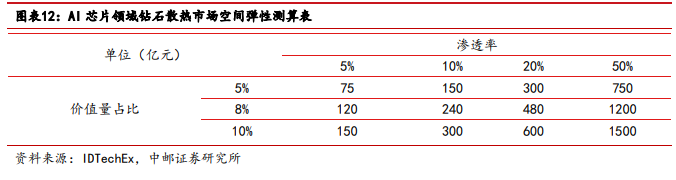
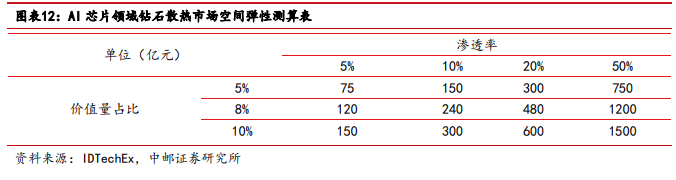
Group 1: AI Chip Market and Diamond Heat Sinks - The potential market space for diamond heat sinks in the AI chip sector is vast, with estimates suggesting a market range of 7.5 billion to 150 billion RMB by 2030, depending on penetration rates and value share [1][2] - Huanghe Xuanfeng has successfully developed an 8-inch diamond heat sink, marking a significant milestone in the commercialization of functional diamonds for high-end chip cooling applications [1] - The production workshop for diamond heat sinks is set to commence mass production in February 2023, indicating a shift from laboratory development to large-scale commercial application [1] Group 2: Related Companies in Diamond Technology - Guoji Jinggong has been focusing on diamond functional applications since 2015, with expected revenue from heat sinks and optical windows projected to exceed 10 million RMB by 2025 [3] - World has extensive R&D in CVD diamond preparation and is one of the few companies mastering the entire CVD diamond growth technology [3] - Sifangda is a leading CVD diamond manufacturer in China, capable of mass-producing large-sized diamond substrates and films [3] - Power Diamond has launched semiconductor heat sink materials with applications in AI chips and new energy sectors [3] - Huifeng Diamond's products are still in the research phase and have not yet generated revenue [3] Group 3: Transformer Market Dynamics - The transformer sector is experiencing a surge in demand due to the rapid growth of AI and data centers, with many factories operating at full capacity and orders extending to 2027 [5] - China has become the world's largest transformer producer, accounting for approximately 60% of global production capacity [5] - The U.S. market is facing a projected 30% supply gap for power transformers by 2025, indicating a significant opportunity for companies with strong distribution channels and quick delivery capabilities [5] Group 4: Glass Fiber Price Increases - Glass fiber manufacturers are expected to initiate a second round of price increases of 10% to 15% due to rising costs and supply constraints, potentially doubling prices by the end of the year [6][7] - The shift in production focus from traditional electronic cloth to specialty glass fiber cloth is causing a supply shortage in the traditional electronic cloth market [6] Group 5: Optical Fiber Market Growth - The demand for high-performance optical fibers is increasing significantly due to the AI wave, with G.652.D single-mode optical fiber prices reaching a near seven-year high of 35 RMB per core kilometer [9] - The industry is experiencing a confirmed upward price trend, with expectations for continued price increases as demand from telecom operators rises [9] Group 6: Coal Market Trends - The coal sector is seeing positive trends with a significant reduction in inventory and a favorable supply outlook, leading to optimistic coal price forecasts post-holiday [10] - The domestic coal supply has been at a low operational rate, while import volumes remain low, contributing to a favorable market environment [10]


鞍钢、包钢未披露碳排 6家ESG强信披钢企环保投入缩减16%
2 1 Shi Ji Jing Ji Bao Dao· 2026-02-24 12:43
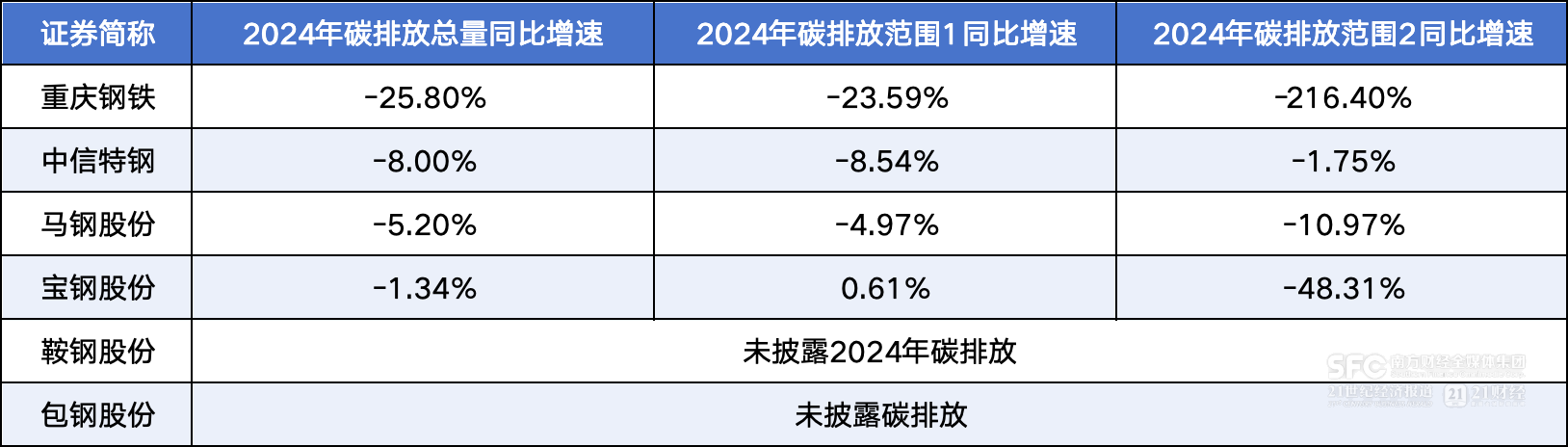
Core Viewpoint - The steel industry is facing dual regulatory scrutiny regarding ESG carbon emissions disclosures as it is now included in the national carbon market, with several companies needing to report their greenhouse gas emissions by March 31 and ESG reports by April 30 [1][2]. Group 1: Carbon Emissions Disclosure - A total of 232 steel companies are required to submit their 2025 greenhouse gas emissions reports to provincial environmental departments by March 31 [1]. - Six listed steel companies, including Baosteel, Baogang, Ansteel, Maanshan Steel, Chongqing Steel, and CITIC Special Steel, are mandated to disclose their 2025 ESG reports by April 30 [1]. - As of February 24, 2024, Ansteel and Baogang have not disclosed their 2024 carbon emissions totals [1][2]. - The steel industry accounts for approximately 15% of the national carbon emissions, making the task of energy conservation and carbon reduction challenging [2]. Group 2: Environmental Investment - The total environmental investment by the six listed steel companies decreased by about 16% year-on-year, totaling 24.654 billion yuan [1][8]. - Baosteel had the highest environmental investment at 10.075 billion yuan, followed by Ansteel at 5.597 billion yuan and Baogang at 3.771 billion yuan [8]. - Chongqing Steel's environmental investment dropped nearly 40.79% year-on-year, marking the highest decline among the companies [8]. Group 3: Carbon Emission Reduction Performance - Four of the six steel companies reported a year-on-year decrease in total carbon emissions for 2024, with Chongqing Steel showing the highest reduction at 25.80% [3][10]. - CITIC Special Steel reported a 0.33% decrease in carbon emissions per ton of steel for 2024, while Ansteel's carbon emissions per ten thousand yuan of output decreased by 1.4% [10]. Group 4: ESG Governance and Management - The establishment of a dedicated carbon neutrality executive position at China Baowu Steel Group reflects the industry's need for enhanced governance in ESG matters [11][12]. - Five of the six steel companies have incorporated ESG indicators into their executive compensation assessments, with Baosteel providing detailed metrics for evaluation [12][13]. - The integration of ESG metrics into executive pay is seen as a complex task, requiring clear definitions and measurable targets to ensure accountability [13].





鞍钢、包钢未披露碳排,6家ESG强信披钢企环保投入缩减16%
2 1 Shi Ji Jing Ji Bao Dao· 2026-02-24 12:41
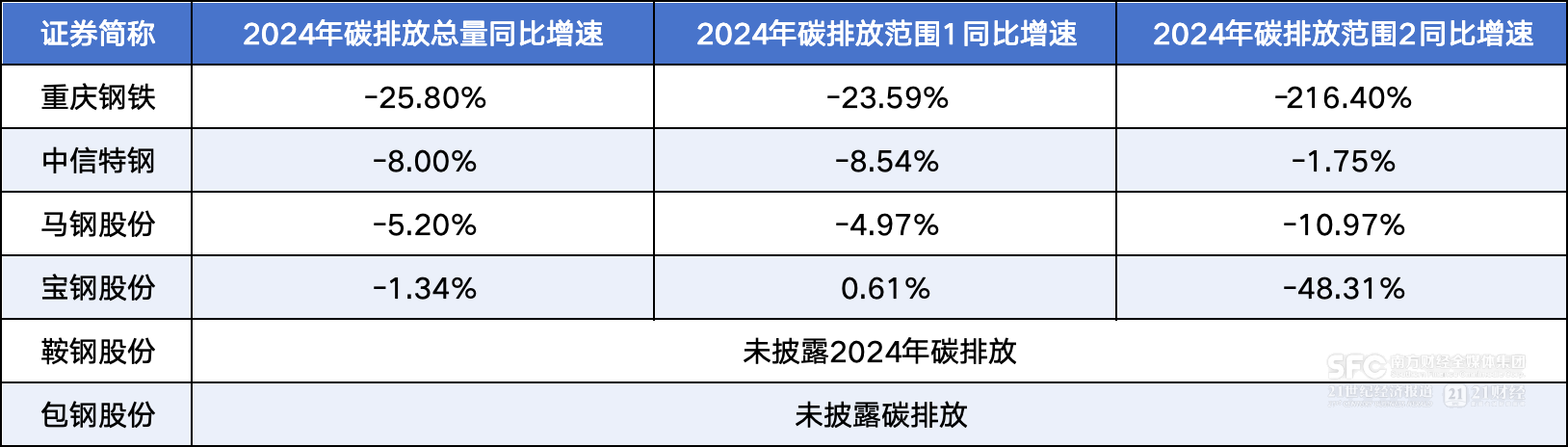
Core Viewpoint - The inclusion of the steel industry in the national carbon market has led to increased scrutiny on carbon emissions disclosures, with several companies facing dual regulatory requirements for ESG reporting [1][2]. Group 1: Carbon Emission Disclosure - A total of 232 steel companies are required to submit their greenhouse gas emission reports for 2025 by March 31, with six listed companies needing to disclose their ESG reports by April 30 [1]. - Among the six listed steel companies, Angang Steel and Baogang Steel have not disclosed their 2024 carbon emissions [2][3]. - The carbon emissions from the steel industry account for approximately 15% of the national total, highlighting the significant challenges in energy conservation and carbon reduction [2]. Group 2: Environmental Investment - The total environmental investment by the six listed steel companies decreased by approximately 16% year-on-year, amounting to 24.654 billion yuan [6][7]. - Baosteel made the highest environmental investment at 10.075 billion yuan, while Chongqing Steel saw the largest reduction in investment, nearly halving to 0.887 billion yuan [7][8]. Group 3: Carbon Emission Reduction Performance - Four of the six steel companies reported a year-on-year decrease in total carbon emissions for 2024, with Chongqing Steel showing the highest reduction at 25.80% [3][9]. - The carbon emission intensity for several companies, including CITIC Special Steel and Baosteel, also showed a downward trend, indicating progress in reducing emissions per ton of steel produced [9]. Group 4: ESG Integration in Management - Five of the six listed steel companies have integrated ESG indicators into their executive compensation assessments, with Baosteel specifying the weight of ESG-related metrics in performance evaluations [10][12]. - The establishment of a dedicated Chief Carbon Neutrality Officer at Baowu Steel Group reflects a strategic approach to managing carbon emissions and sustainability efforts [12].

培育钻石概念大涨,机构称钻石散热潜在市场空间广阔丨A股明日线索
2 1 Shi Ji Jing Ji Bao Dao· 2026-02-24 12:40
Group 1: AI Chip Market and Diamond Heat Sinks - The AI chip sector has significant potential for diamond heat sink applications, with estimates suggesting a market size ranging from 7.5 billion to 150 billion RMB by 2030, depending on penetration rates and value share [1][2] - Huanghe Xuanfeng has developed an 8-inch diamond heat sink that is set to enter mass production, marking a milestone for functional diamonds transitioning from laboratory to commercial applications [1][3] - Companies involved in diamond heat sink production include Guojijin Engineering, World, Sifangda, Power Diamond, and Huifeng Diamond, each with unique technological advantages and market positions [2][3] Group 2: Transformer Market Dynamics - The transformer manufacturing sector in China is operating at full capacity due to increased demand from AI and data centers, with some orders extending to 2027 [4][5] - China is the world's largest transformer producer, accounting for approximately 60% of global production capacity, which has led to a surge in transformer prices and demand [4][5] - Guojin Securities predicts a 30% supply gap for power transformers in the U.S. by 2025, indicating a prolonged mismatch between supply and demand until 2030 [6] Group 3: Glass Fiber Price Increases - Glass fiber manufacturers are expected to initiate a second round of price increases due to rising costs and supply constraints, with planned monthly adjustments of 10% to 15% [7][8] - The price of traditional electronic cloth has been raised significantly, reflecting a broader trend of price hikes in the glass fiber sector since 2025 [7][8] - Companies like Zhongcai Technology and Honghe Technology are adapting their product lines to focus on high-performance glass fiber products, which are increasingly in demand [9][10] Group 4: Optical Fiber Market Growth - The demand for high-performance optical fibers is surging due to the AI wave, with G.652.D single-mode optical fiber prices reaching a near seven-year high of 35 RMB per core kilometer [11] - The optical fiber industry is experiencing a confirmed upward price trend, driven by increased demand from telecom operators and a tightening supply of G.652D fibers [11] - Major optical fiber manufacturers are expected to benefit from this price increase, with recommendations for companies like Changfei Optical Fiber and Hengtong Optic-Electric [11] Group 5: Coal Market Trends - The coal market is experiencing optimistic price trends due to unexpected inventory reductions and favorable supply conditions [12][13] - Domestic coal production has been at a low average operating rate, while import volumes remain low, contributing to a tightening supply situation [13] - Key coal companies to watch include China Shenhua, China Coal Energy, and Yanzhou Coal Mining, which are positioned to benefit from the current market dynamics [13]
佳都科技陈娇:推动“智造+服务”融合,打造交通强国广东范式
2 1 Shi Ji Jing Ji Bao Dao· 2026-02-24 12:39
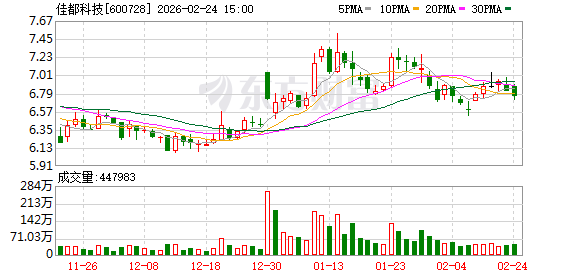
Core Insights - The conference focused on the collaborative development of manufacturing and service industries in Guangdong, aiming to enhance productivity and create new advantages for the province [2] - The company, Jiadu Technology, has positioned itself as a leader in the smart transportation sector, leveraging its 30 years of experience in Guangdong [3] - Jiadu Technology emphasizes the deep integration of manufacturing and service sectors, describing it as a symbiotic relationship rather than a simple addition [3] Group 1: Company Overview - Jiadu Technology has developed a comprehensive suite of smart transportation solutions covering subways, urban rail, and city roads, with operations extending nationwide and internationally [3] - The company has achieved deep integration across three levels: technology foundation, intelligent systems, and product matrix, enhancing its operational capabilities [3] - Jiadu Technology has launched the first domestic operating system for the transportation industry, "Jiaotong Jiahong," and the world's first AI model for transportation, "Jiadu Zhixing," now in its V3.0 version [3] Group 2: Industry Trends - The collaboration between manufacturing and service sectors is shifting the industry focus from mere construction to high-value operations, reflecting Guangdong's transition from a manufacturing province to a stronghold of intelligent manufacturing [4] - The ongoing high-quality development conferences in Guangdong highlight the province's commitment to a consistent strategic vision, fostering a favorable business environment [4]

沪金、沪银马年“开门红” 多家金店宣布近期将涨价
2 1 Shi Ji Jing Ji Bao Dao· 2026-02-24 12:31
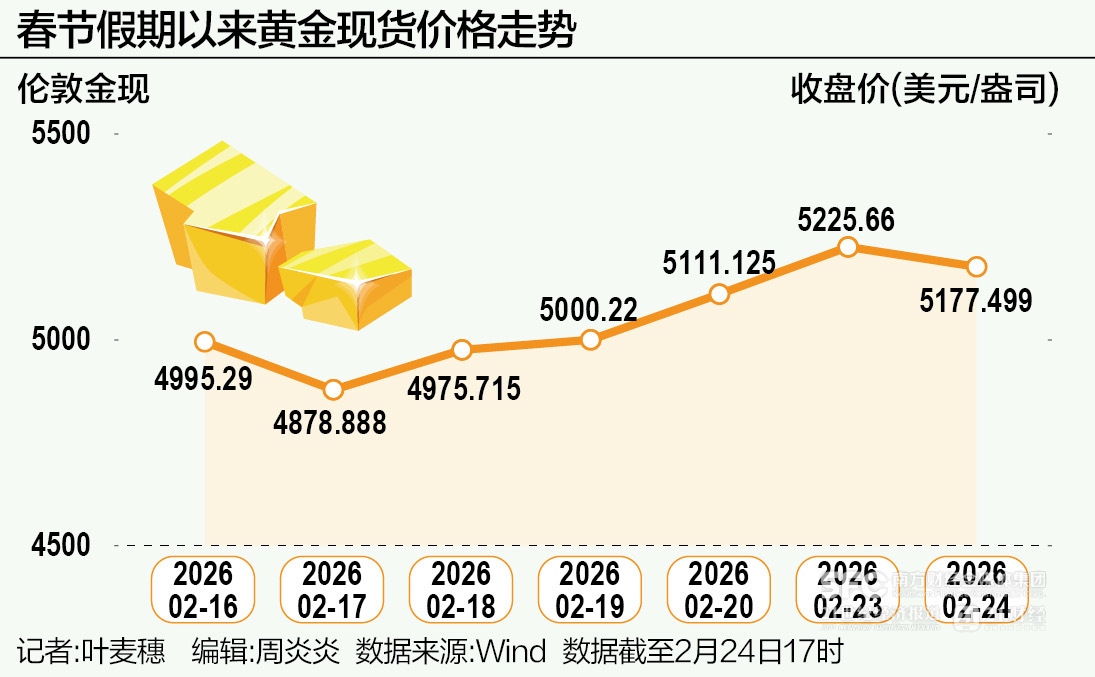
Market Trends - During the Spring Festival holiday, gold and silver experienced significant price fluctuations, with gold prices dropping on February 16 and 17, followed by a five-day increase from February 18 to 23 due to uncertainties in U.S. trade policies and escalating tensions in Iran [1][5] - Silver showed even more volatility, with a cumulative increase of nearly 17% during the holiday, including a notable 8.19% surge on February 20 [3][5] Consumer Behavior - The Spring Festival is a peak consumption period for precious metals, with consumers showing strong interest in gold purchases, including significant single transactions of nearly 80,000 yuan [4] - Younger consumers, particularly those born after 1995, are becoming the main force in gold consumption, favoring small, creatively designed gold items as gifts [4] Price Adjustments - Following the holiday, domestic gold and silver prices saw a rebound, with Shanghai gold futures rising by 3.5% and silver by 12.7% [5] - Several gold retailers announced price increases, with some stores indicating potential hikes of 15% to 30% for certain products [9][8] Global Demand and Supply - The World Gold Council's report indicates that global gold demand is expected to exceed 5,000 tons by 2025, driven by investment demand and geopolitical tensions [6][7] - Central bank gold purchases remain high, with a total of 863 tons expected in 2025, although the pace has slowed compared to previous years [7] Geopolitical Factors - The resurgence of U.S. tariffs and tensions with Iran are contributing to increased demand for gold as a safe-haven asset, with market participants reacting to geopolitical uncertainties [5][6] - The Federal Reserve's mixed signals regarding interest rates are also influencing gold prices, with a potential decrease in rates expected to support gold in the long term [5][6] Investment Sentiment - A recent survey indicated that buying gold remains one of the most crowded trades among fund managers, with 50% indicating a bullish stance on gold [11] - However, some analysts express concerns that gold prices may have become detached from rational valuations, warning of potential corrections in the future [12]
金美信获批增资至10亿,国美控股清空股权
2 1 Shi Ji Jing Ji Bao Dao· 2026-02-24 12:31
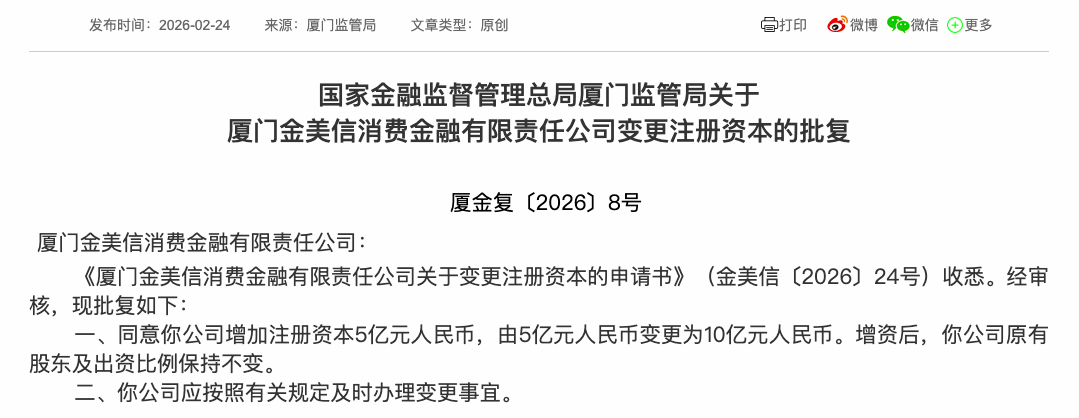
Group 1 - The core point of the article is that Xiamen Jinmeixin Consumer Finance Co., Ltd. has received approval to increase its registered capital from 500 million to 1 billion yuan, maintaining the original shareholders and their respective stakes [1][3] - The capital increase follows a significant adjustment in the company's shareholding structure, where China Trust Commercial Bank acquired a 16% stake and Jin Yuan Jin Kong acquired a 17% stake from Gome Holdings, leading to Gome's complete exit [3] - After the shareholding adjustment, both remaining shareholders now hold 50% each, contributing 250 million yuan each to the new capital [3] Group 2 - As of December 2024, Jinmeixin Consumer Finance reported total assets of 5.516 billion yuan, total liabilities of 4.702 billion yuan, and total equity of 814 million yuan, with a net profit of 20.56 million yuan, all meeting regulatory requirements [3] - Since the implementation of the "Consumer Finance Company Management Measures" in 2024, there has been a surge in capital increases among consumer finance institutions, driven by regulatory minimum thresholds and market expansion considerations [4] - At least seven consumer finance institutions have completed capital increases in 2025, with several companies raising their registered capital to 1 billion yuan, while others have seen significant increases in their capital [4]