Zheng Quan Shi Bao

Search documents
监管执法威慑不断提升 贵州资本市场生态不断净化
Zheng Quan Shi Bao· 2026-01-13 18:13
Core Viewpoint - Guizhou Securities Regulatory Bureau is committed to implementing the new "National Nine Articles" and enhancing regulatory measures to ensure the stable operation of the capital market, with a focus on combating financial fraud and improving market integrity [1][2]. Group 1: Regulatory Actions - In 2025, Guizhou Securities Regulatory Bureau conducted inspections on 111 companies and took 31 administrative regulatory measures along with 63 daily regulatory measures [1]. - Two financial fraud cases were seriously investigated, with proposed penalties amounting to 194 million yuan for two listed companies and 20 responsible individuals, including potential 5 to 10-year bans from the securities market for four individuals [1]. Group 2: Focus on Financial Fraud - Financial fraud is identified as a significant threat to market integrity and is met with a "zero tolerance" policy by the Guizhou Securities Regulatory Bureau, which aims to enhance the comprehensive punishment of such activities [1]. - The bureau emphasizes the importance of maintaining the principles of fairness, openness, and honesty in the market, which are essential for investor trust [1]. Group 3: Strengthening Oversight - The bureau plans to strengthen oversight of intermediary institutions such as sponsors, audit firms, law firms, and trustees, ensuring they fulfill their responsibilities diligently and improve their professional quality [1]. - A three-tier defense system is being established, focusing on corporate compliance, external audit supervision, and administrative regulation to enhance the governance structure of industry institutions [2]. Group 4: Future Directions - The Guizhou Securities Regulatory Bureau will continue to implement decisions from the central government and regulatory bodies, focusing on risk prevention, strict regulation, and promoting high-quality development in the capital market [2]. - The bureau aims to enhance regulatory effectiveness and protect investors' legitimate rights and interests while ensuring the stability of the capital market [2].
江苏省推进“人工智能+”行动方案 力争2030年产业规模超万亿元
Zheng Quan Shi Bao· 2026-01-13 18:13
Group 1 - Jiangsu has a solid industrial foundation, rich data resources, a concentration of scientific and educational talent, broad application scenarios, and strong innovation potential in the development of the artificial intelligence industry [1] - The "Artificial Intelligence+" Action Plan sets three development goals for 2027, 2030, and 2035, aiming to transition Jiangsu from a major province in AI applications to an innovation-driven province [1][2] - The plan emphasizes the integration of AI into six key areas: scientific research, industrial development, quality improvement in consumption, public services, social governance, and international cooperation, while also focusing on emerging industries such as humanoid robots, low-altitude economy, intelligent driving, biomedicine, and new energy [1] Group 2 - By 2027, Jiangsu aims for over 70% application penetration of new-generation intelligent terminals and intelligent agents, with rapid growth in the industry scale [2] - By 2030, the application penetration is expected to exceed 90%, with the formation of a number of domestically leading large models and large-scale commercial application scenarios, targeting an AI industry scale exceeding 1 trillion yuan [2] - By 2035, Jiangsu plans to establish itself as a leading innovation source and industrial high ground in the "Artificial Intelligence+" sector, entering a new stage of intelligent economy and society development [2]
银行资本补充需求居高不下 “二永债”发行规模创历史新高
Zheng Quan Shi Bao· 2026-01-13 18:11
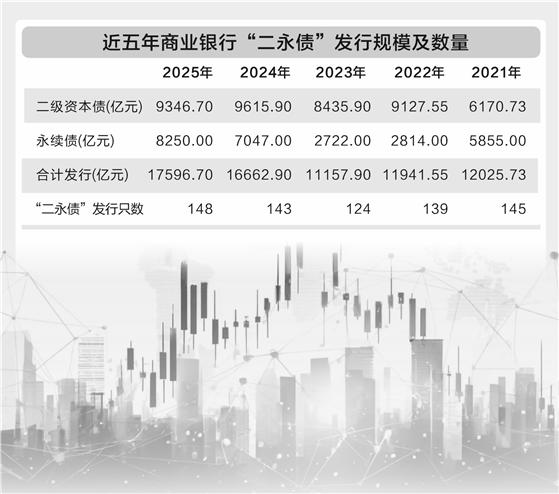
Group 1 - The core viewpoint of the articles highlights the significant increase in capital replenishment activities among commercial banks, particularly through the issuance of secondary capital bonds and perpetual bonds, with a record issuance scale of approximately 1.76 trillion yuan in 2025 [2][3][4] - As of January 13, 2025, 39 banking institutions have received regulatory approval for changes in registered capital, primarily involving city commercial banks, rural commercial banks, and rural credit cooperatives [2] - The trend of "redeeming old for new" is prevalent, where banks are opting to redeem higher-interest perpetual bonds and replace them with new bonds at lower interest rates, thereby optimizing their liability structure and reducing interest costs [4][5] Group 2 - The issuance of secondary capital bonds saw a total of approximately 934.67 billion yuan in 2025, a year-on-year decrease of 2.8%, while perpetual bonds reached 825 billion yuan, reflecting a year-on-year increase of about 17% [3] - Large and medium-sized banks dominate the issuance of these bonds, with state-owned banks and joint-stock banks accounting for about 80.4% of the total issuance [3][4] - The capital replenishment needs of banks are expected to continue into 2026, with capital adequacy ratios for state-owned and joint-stock banks showing a decline compared to the beginning of 2025 [7][8] Group 3 - A total of 36 small and medium-sized banks have received approval for capital increase or targeted fundraising plans in 2025, indicating a shift towards equity financing due to operational pressures [5][6] - Some smaller banks face challenges in capital replenishment due to issues such as governance and shareholder dispersion, leading to increased pressure on capital adequacy ratios [6] - Analysts suggest that regulatory requirements for capital replenishment tools should be adjusted to better suit the needs of small and medium-sized banks, including relaxing financial metrics and regulatory ratings [7][8]

创业者眼中的大湾区“快创新、快制造”产业链
Zheng Quan Shi Bao· 2026-01-13 18:11
相较于海外同行,深圳硬件企业的产品迭代速度很快——半年到一年即可完成一次迭代。乐其创新是一 家为全球影像创作活动提供解决方案的公司,有上千个在售SKU(最小存货单位),这些商品要高频迭 代,更需要一个强大产业链支撑。 证券时报记者:如何平衡"用户个性化需求"与"规模化生产效率"? 周阳:平衡核心源于三大系统的协同发力。一是需求管理系统,通过社媒专业社群、VOC(用户声 音)采集、线下展会等多渠道收集需求,再按"场景共性""可产品化程度""影像场景生态适配性"分级筛 选,避免需求碎片化造成资源浪费;二是资源管理系统,依托"壹起创Co-Create"平台搭建创新机构、创 客、供应链伙伴资源库,快速匹配筛选后的需求,联动产业协同创新中心实现产品转化;三是"快制 造"系统,凭借标准化生产流程与柔性供应链,实现日均1.6款新品研发、21天产品开发闭环,年创新产 品超500款。通过"自建工厂组装+核心零部件分布式供应"模式,兼顾个性化定制与规模化量产。 证券时报记者:深圳及大湾区的制造业配套,对企业发展起到多大作用? 周阳:大湾区制造业配套是"快创新、快制造"的核心支撑。"一键全开"液压三脚架的落地就是典型案 例。曾有户 ...

“尽力而为量力而行”:公租房扩围如何稳步覆盖新市民?
Zheng Quan Shi Bao· 2026-01-13 18:11
Core Viewpoint - The State Council's recent meeting emphasizes the need to address the housing issues of the unregistered permanent population by expanding the public rental housing (公租房) guarantee scope, improving education policies for migrant children, and ensuring basic public services based on residence [1][2]. Group 1: Public Rental Housing Expansion - The expansion of public rental housing guarantees will no longer be limited to registered residents but will include those holding residence permits who meet certain criteria, such as being from "double-difficult" families [2][3]. - Local governments are encouraged to assess their financial capabilities and housing resources to gradually include the unregistered permanent population in the public rental housing guarantee scope [1][3]. Group 2: Financial and Policy Implications - The inclusion of non-registered populations in public rental housing will require adjustments in fiscal policies and land allocation mechanisms, particularly in how fiscal transfers are linked to permanent population numbers [4]. - The expansion of public rental housing guarantees is expected to enhance the consumption potential of long-term urban residents, thereby stimulating domestic demand [4]. Group 3: Implementation Strategies - Local governments should establish reasonable criteria for prioritizing applicants, such as the duration of residence permit holding and employment in essential urban services [3]. - The increase in the scope of guaranteed public rental housing will necessitate a corresponding rise in supply, which can be aligned with ongoing efforts to convert existing commercial housing into affordable housing [3].
工业互联网平台高质量发展行动方案发布 三年后基本建成新一代平台生态 推动企业把握“人工智能+制造”发展机遇
Zheng Quan Shi Bao· 2026-01-13 18:10
Core Viewpoint - The Ministry of Industry and Information Technology has released the "Action Plan for Promoting the High-Quality Development of Industrial Internet Platforms (2026-2028)", aiming for significant advancements in industrial internet platforms by 2028, including the establishment of over 450 influential platforms and a connectivity of over 120 million industrial devices [1][2]. Group 1: Development Goals - By 2028, the industrial internet platform ecosystem is expected to achieve a penetration rate of over 55%, with a focus on creating a new generation of platforms characterized by ubiquitous connectivity, intelligent integration, deep collaboration, and open-source development [1]. - The plan emphasizes the growth of a multi-layered platform system that includes specialized, industry-specific, and collaborative platforms [1]. Group 2: Strategic Focus Areas - The action plan promotes differentiated development among platforms, encouraging companies to focus on quality and efficiency rather than sheer scale [1]. - It highlights the role of artificial intelligence in enhancing platform capabilities, leveraging existing advantages in industrial data aggregation and application ecosystem cultivation [1]. - The plan stresses the importance of application scenarios as a bridge between technology and industry, aiming to enhance service capabilities and promote deeper integration of information technology and industrialization [2].
促进银发经济发展 八部门发文培育养老服务经营主体 推动大数据、人工智能、北斗技术运用到老年人健康监测和个性化服务等场景
Zheng Quan Shi Bao· 2026-01-13 18:10
Core Viewpoint - The Ministry of Civil Affairs and eight other departments issued measures to cultivate the elderly care service industry and promote the silver economy, proposing 14 specific initiatives to enhance the elderly care system in China and address the challenges of an aging population [1][2]. Group 1: Policy Measures - The measures focus on brand development, supply-demand platform construction, and optimizing the development environment for elderly care services [1]. - By the end of 2024, the elderly population aged 60 and above in China is expected to exceed 310 million, highlighting the urgency of developing a suitable elderly care system [1]. - The measures aim to optimize the supply of elderly care services and age-friendly products, encouraging community-supported home care through chain operations [1]. Group 2: Consumer Protection and Regulation - The measures emphasize enhancing elderly individuals' risk recognition and self-protection capabilities while addressing issues of elder abuse and misleading marketing practices [2]. - There is a focus on regulating administrative oversight to minimize disruptions to normal operations of elderly care institutions, promoting a "double random, one public" regulatory approach [2]. Group 3: Technological Innovation - Technological innovation and supply optimization are identified as key drivers to address labor shortages in elderly care and improve service efficiency and quality [2]. - The measures promote the application of big data, artificial intelligence, and Beidou technology in health monitoring and personalized services for the elderly [2]. - Support for the development of elderly care robots and smart devices is encouraged to enhance the quality of elderly care services [3].
智能硬件创新赋能出口升级 细分赛道深圳领跑全球
Zheng Quan Shi Bao· 2026-01-13 18:10
Core Insights - The rise of consumer hardware innovation in Shenzhen, driven by companies like DJI, has significantly boosted the export of electromechanical products, which reached 15.4 trillion yuan in the first three quarters of 2025, marking a 4.5% increase and accounting for 75.7% of Shenzhen's total exports [1] - The emergence of the smart hardware industry, including products like 3D printers and translation headsets, is reshaping global industrial competition and enhancing the "Shenzhen Creation" brand [1] Group 1: 3D Printing Industry - TuoZhu Technology has become a leading player in the desktop 3D printing market, holding over 80% market share in China, with its flagship product, Bambu Lab X1, simplifying operations for ordinary users [2][3] - The launch of MakerWorld, a 3D model community, has connected creators with users, achieving nearly 10 million monthly active users and over one million models [3] - China exported 3.491 million 3D printers (excluding parts) in the first three quarters of 2025, nearing the total export of 3.778 million units for 2024, with four of the top five global consumer 3D printing companies based in Shenzhen [3] Group 2: Translation Technology - TimeSpace Pot's translation headset utilizes real-time simultaneous translation technology, addressing the need for seamless cross-language communication [4] - The company achieved a breakthrough in dual-direction simultaneous translation, allowing for efficient communication without waiting for complete sentences [4][5] - The headset's design focuses on precise sound capture, utilizing multiple microphones to filter out background noise, enhancing translation accuracy [5] Group 3: Smart Kitchen Appliances - Tiger One Technology is innovating in the traditional kitchen appliance sector by integrating "cooking science" to simplify cooking processes [6][8] - The company has developed a new oven that automatically adjusts temperature based on food data, and its air fryer has become a top seller on Amazon [8] - Tiger One's proprietary technology has led to a gross margin increase from 58% to 64%, with projected revenues of $70-80 million in 2025, representing over 300% growth [8] Group 4: Shenzhen Hardware Innovation Ecosystem - The growth of companies like TuoZhu, TimeSpace Pot, and Tiger One exemplifies the rise of Shenzhen's hardware innovation sector, which focuses on user needs and technological advancements [9] - These companies are enhancing the autonomy and completeness of Shenzhen's manufacturing chain, contributing to a robust hardware innovation ecosystem [9]
内存、金属、电池涨价潮共振 车企打响供应链成本“防御战”
Zheng Quan Shi Bao· 2026-01-13 18:06
Core Insights - The automotive industry is facing unprecedented supply chain cost pressures driven by rising prices of memory chips, metals, and batteries, which are significantly impacting manufacturing costs [1][4] - The demand for storage chips in modern electric vehicles is growing exponentially, with high-end models requiring between 64GB to 256GB, potentially reaching terabyte levels by 2030 [3][8] - The competition for resources between the automotive sector and emerging industries like AI and energy storage is intensifying, leading to a supply-demand imbalance for critical components [5][10] Memory Chip Supply Crisis - By 2026, the automotive industry may face a memory chip supply crisis, with a predicted supply satisfaction rate of less than 50% [2] - The global DRAM market is experiencing its strongest price surge, with prices for DDR4 and DDR5 chips increasing by 200-300% over the past year [2][8] - The automotive sector's transition to smart vehicles has made storage chips essential, as they support various functions from infotainment to autonomous driving systems [2][3] Rising Material Costs - The prices of key metals such as copper, silver, and lithium have been on the rise, contributing to increased manufacturing costs for vehicles [3][4] - The cost increase for raw materials is being passed down to battery production, further straining automotive manufacturers [3][7] - The automotive industry is struggling to balance supply chain resilience with cost control amid these pressures [1][4] Competitive Resource Allocation - The automotive industry is in a "disproportionate competition" with AI companies for high-end memory resources, as AI applications are prioritizing these components [5][6] - Major memory manufacturers are focusing on fulfilling orders from AI clients, which are often more profitable than those from the automotive sector [5][6] - Predictions indicate that by 2027, approximately 70% of global DRAM capacity will be allocated to AI, significantly reducing availability for traditional industries like automotive [5][6] Supply Chain Adjustments - Automotive companies are actively seeking ways to mitigate cost pressures through supply chain optimization and technology transformation [10][11] - Some companies are exploring partnerships with local suppliers and signing long-term contracts to secure better pricing and availability [10][11] - The ongoing supply chain challenges may lead to a significant restructuring of the automotive industry, with a focus on building more resilient and self-sufficient supply systems [11][12]

工业互联网产业规模持续增长 二〇二五年预计超1.6万亿
Zheng Quan Shi Bao· 2026-01-13 18:04
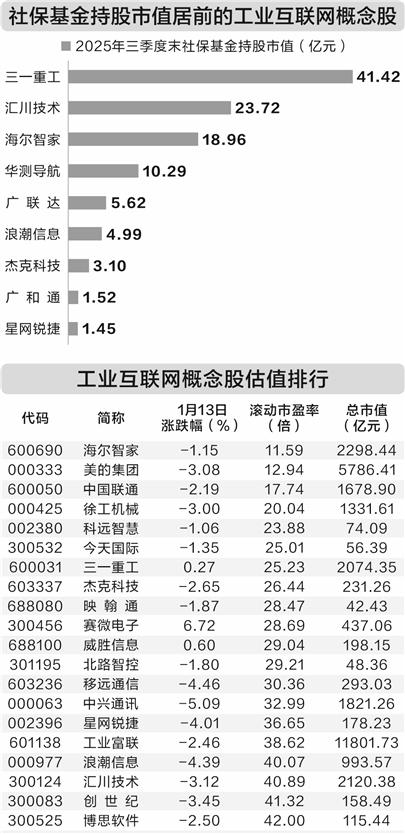
1月13日,工业和信息化部印发《推动工业互联网平台高质量发展行动方案(2026—2028年)》,方案 对2028年的目标提出具体规划,包括培育超450家具有一定影响力的平台,工业设备连接数突破1.2亿台 (套),平台普及率达到55%以上。 | 46.85 | 简称 | 1月13日 | 溪司市空室 | 总市值 | | --- | --- | --- | --- | --- | | | | 涨跌幅(%) | (倍) | (亿元) | | 600690 | 海尔智家 | -1.15 | 11.59 | 2298.44 | | 000333 | 美的集团 | -3.08 | 12.94 | 5786.41 | | 600050 | 中国联通 | -2.19 | 17.74 | 1678.90 | | 000425 | 徐工机械 | -3.00 | 20.04 | 1331.61 | | 002380 | 科远智慧 | -1.06 | 23.88 | 74.09 | | 300532 | 今天国际 | -1.35 | 25.01 | 56.39 | | 600031 | 三一重工 | 0.27 | 25.23 | 20 ...