
Guo Ji Jin Rong Bao

Search documents
上海汉得信息技术股份有限公司向港交所提交上市申请书
Guo Ji Jin Rong Bao· 2025-12-29 13:24
据港交所文件:上海汉得信息技术股份有限公司向港交所提交上市申请书。 ...

中国石油:控股股东及子公司累计增持金额约3.9亿元
Guo Ji Jin Rong Bao· 2025-12-29 13:21
Core Viewpoint - China Petroleum announced that its controlling shareholder, China Petroleum Group, along with its wholly-owned subsidiary Fairy King Investments Ltd., will cumulatively increase their holdings of A-shares by 30,000,000 shares and H-shares by 11,896,000 shares from April 8, 2025, to December 29, 2025, representing 0.02% and 0.01% of the company's total share capital, respectively [1] Summary by Category - **Shareholding Increase** - The company plans to increase its A-share holdings by 30,000,000 shares and H-share holdings by 11,896,000 shares [1] - This increase corresponds to amounts of 301,111,201 yuan for A-shares and 89,777,921 yuan for H-shares [1] - **Investment Plan** - The previous plan aimed to invest no less than 2.8 billion yuan and no more than 5.6 billion yuan [1] - The implementation period for this investment plan is from April 8, 2025, to April 7, 2026, and it will continue to be executed thereafter [1]

行业第一也“内卷”,比亚迪供应商冲刺IPO,多次被罚!
Guo Ji Jin Rong Bao· 2025-12-29 13:07
Core Viewpoint - The company, Weitongli Electric Co., Ltd., is preparing for its IPO on the Shenzhen Stock Exchange, aiming to raise 1.594 billion yuan, despite facing challenges in the competitive new energy vehicle market, including price reductions and difficulties in cash collection [1][4]. Group 1: Company Overview - Weitongli specializes in the research, production, and sales of electrical connection products, including hard and flexible connections, contact components, laminated busbars, and synchronous decomposers [3]. - The company ranks first in revenue for hard and flexible connections in the new energy vehicle sector for 2024, and second in laminated busbars [3]. - Weitongli holds 181 authorized patents, including 18 invention patents, indicating a strong focus on technological innovation [3]. Group 2: Financial Performance - The company's revenue for the years 2022 to 2024 shows a compound annual growth rate (CAGR) of 28.98%, while net profit has a CAGR of 54.23% [4]. - Revenue figures for the respective years are 1.437 billion yuan in 2022, 1.699 billion yuan in 2023, and 2.390 billion yuan in 2024, with net profits of 114 million yuan, 187 million yuan, and 271 million yuan [4]. Group 3: Pricing and Cash Flow Challenges - The company anticipates a significant drop in the average selling price of synchronous decomposers due to price reductions starting in the second half of 2025 [6]. - Revenue from synchronous decomposers is projected to be 45.96 million yuan in 2023, 183.08 million yuan in 2024, and 94.04 million yuan in the first half of 2025, with average selling prices decreasing from 29.60 yuan per unit to 17.93 yuan per unit [6]. - Cash flow from operating activities has been negative in the first half of 2025, indicating challenges in cash collection, particularly from new energy vehicle clients [7]. Group 4: Shareholding and Governance - The company's actual controller, Huang Haoyun, holds a 56.57% direct stake and controls 68.33% of the voting rights, indicating a high concentration of ownership [8][10]. - The company has faced multiple administrative penalties in recent years, highlighting issues with internal controls and compliance [10].


上海合合信息科技股份有限公司向港交所提交上市申请书。
Guo Ji Jin Rong Bao· 2025-12-29 13:03
据港交所文件:上海合合信息科技股份有限公司向港交所提交上市申请书。 ...
美企破产“日常化”
Guo Ji Jin Rong Bao· 2025-12-29 12:08
Group 1 - The number of bankruptcy filings in the U.S. has risen to its highest level in nearly 15 years, affecting both businesses and individuals under increasing financial pressure [1][3] - Small businesses are particularly hard-hit, facing rising costs, a tight financing environment, and weakened consumer demand, leading to systemic issues across multiple industries [2][4] - The industrial sector, including manufacturing, construction, and transportation, has experienced the most significant impact, with over 70,000 jobs lost in manufacturing alone within a year [4][5] Group 2 - The non-essential consumer goods sector, such as clothing and furniture, has seen a higher number of bankruptcies compared to other industries, reflecting changes in consumer spending patterns [5] - Over 4,100 retail and dining establishments have closed in 2025, indicating a decline in industry capacity and consumer confidence [5] - The current wave of bankruptcies is becoming a normalized economic adjustment mechanism rather than a crisis event, subtly undermining the resilience of the U.S. economy through impacts on employment stability and community business vitality [5]
从“首店打卡”到“全球创研”,上海商业升级新图景
Guo Ji Jin Rong Bao· 2025-12-29 12:06
Core Insights - The "first store economy" is thriving in Shanghai, contributing to a vibrant consumer market and setting a strong foundation for the city's commercial growth in the new five-year plan [1][2]. Group 1: First Store Economy - Shanghai has seen a surge in new store openings, with 848 new first stores established from January to October this year, including 13 global and Asian first stores [3]. - The restaurant sector is a significant contributor, accounting for nearly 60% of new openings, with 498 new restaurants [3]. - Notable openings include Haidilao's first casual dining hotpot in Shanghai and the Sam's Club store in Pudong, which features extensive electric vehicle charging facilities [2][3]. Group 2: Foreign Investment and R&D - The Shanghai Municipal Commission of Commerce has introduced regulations to encourage foreign R&D centers, categorizing them into conventional, global, and open innovation platforms [4]. - By September 2025, Shanghai aims to have 1,060 multinational regional headquarters and 631 foreign R&D centers, making it the most concentrated city for such institutions in mainland China [4]. - Foreign companies are increasing R&D investments in China to better connect with local consumers and leverage the country's complete industrial and supply chain [5]. Group 3: Innovation and Market Dynamics - The establishment of foreign R&D centers in Shanghai is seen as a way to attract high-end talent and drive technological innovation, contributing to the city's commercial vitality [6]. - Companies like Veolia have successfully integrated local R&D with global operations, showcasing a model of "China R&D, global sharing" [5].
危机四伏的葫芦娃药业何时能脱困?
Guo Ji Jin Rong Bao· 2025-12-29 11:57
Core Viewpoint - Hainan Huluwawa Pharmaceutical (ST Huluwawa) is under investigation by the China Securities Regulatory Commission (CSRC) for suspected violations of information disclosure, leading to a significant drop in stock price and ongoing operational challenges [1][2][4]. Company Overview - ST Huluwawa, established in 2005 and headquartered in Haikou, is recognized as a leading children's pharmaceutical company in China, focusing on pediatric medicines, nutritional supplements, and medical devices [4]. - The company has 54 products in the market, addressing common pediatric diseases, with key products including pediatric cough and asthma granules [4]. Financial Performance - The company reported a revenue of 683 million yuan for the first three quarters of the year, a year-on-year decline of 33.88%, and a net loss attributable to shareholders of 11.21 million yuan [4]. - As of September 30, the company had only 111 million yuan in cash, while short-term borrowings reached 467 million yuan, resulting in a debt ratio of 74%, significantly higher than the industry average of 28% [10]. Regulatory Issues - ST Huluwawa has faced multiple regulatory challenges, including receiving an administrative regulatory decision from the Hainan Securities Regulatory Bureau due to inaccurate information disclosure in its 2023 annual report [6]. - The company was placed under special treatment (ST) status on April 30, 2025, following a negative internal control audit report from its accounting firm, which highlighted issues such as premature revenue recognition and abnormal pricing [6][7]. Management Changes - The company has experienced frequent changes in its executive team, with the founder and long-time executive Liu Jingping resigning and then returning to the role of general manager within a short period [10][11]. - The instability in management raises concerns about the company's governance and future direction, especially in light of the ongoing investigation [11]. Market Challenges - The pharmaceutical market is highly competitive, with factors such as medical insurance cost control and drug procurement policies adversely affecting the company's performance [10]. - Sales of core products, particularly respiratory medications, have halved, leading to a significant decline in competitiveness [10].

严重财务造假,或强制退市!对中介同步核查!
Guo Ji Jin Rong Bao· 2025-12-29 11:52
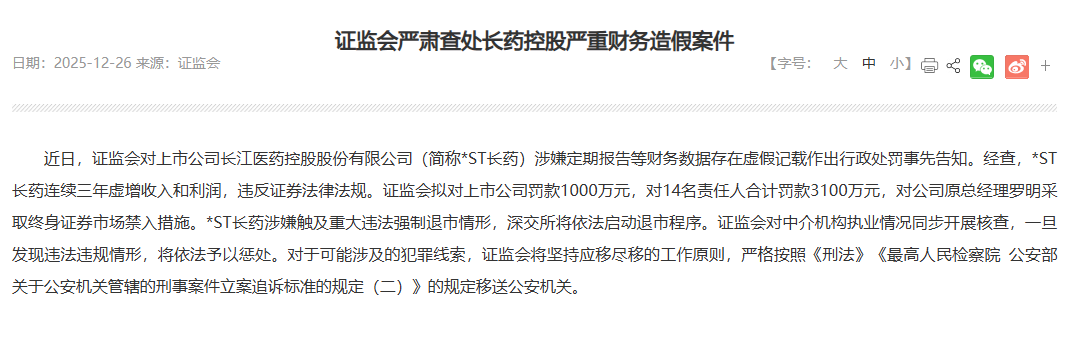
12月26日晚间,证监会对上市公司长江医药控股股份有限公司(下称*ST长药)涉嫌定期报告等财务数据存在虚假记载作出行政处罚事先告知。证监会 还将对中介机构执业情况同步开展核查。 此前,公司已于11月7日被证监会立案调查。从立案调查到出具告知书仅用一个月,体现出监管效率进一步提升。据统计,今年触及重大违法强制退市 公司数量已创历年新高。 由于*ST长药涉嫌触及重大违法强制退市情形,深交所将依法启动退市程序。公司股票于12月29日(星期一)起被叠加实施退市风险警示。 12月26日,*ST长药收跌3.92%,每股报1.47元,总市值5.1亿元。 连续三年财务造假 经查,*ST长药2021年、2022年、2023年连续三年虚增收入和利润,违反证券法律法规。证监会拟对公司罚款1000万元,对14名责任人合计罚款3100万 元,对公司原总经理罗明采取终身证券市场禁入措施,对当事人杨正辉采取10年证券市场禁入措施。 *ST长药前身为康跃科技,成立于2001年。2014年8月,公司在深交所创业板上市,彼时主营业务为内燃机零部件的研发、生产和销售。 2020年11月,*ST长药通过支付现金方式收购湖北长江星医药股份有限公司(下 ...
全面回暖!并购上会家数接近翻倍!重大重组交易量超前六年总和!
Guo Ji Jin Rong Bao· 2025-12-29 11:52
2025年的中国资本市场,并购重组无疑是最具活力的关键词之一。 从央国企千亿级的战略整合,到中小市值企业围绕产业链的"补链强链",一场以产业升级为核心、形式日趋多元化的并购浪潮贯穿全年,并有望在未来 数年内持续升温。 数量显著增长 2025年,中国并购市场在数量和规模上均实现了显著增长。 Wind数据显示,按照首次公告日统计,今年前11个月,共有1750家上市公司披露了2168起并购事件,较去年同期的1569家、2056起有所提升。 另据统计,年内A股公司披露的并购重组事件总计达4044单,其中构成重大资产重组的项目有147单,同比激增44.12%。 反映在宏观指标上,中国并购综合指数自2024年四季度政策出台后快速攀升,至2025年第三季度已达125.9点,同比增幅35.5%。 其中,科创板的表现尤为亮眼,2025年至今发布的重大重组交易为36单,不仅远超2024年全年水平,更是超过2019年至2024年六年的总和,呈现爆发式 增长。 根据上交所披露的数据,"科八条"实施至今,科创板上市公司累计新披露并购交易156单,其中发股/可转债类交易40单、现金重大类交易9单,覆盖半 导体、生物医药、软件等多个硬科技 ...

深圳能源:子公司拟投资68亿建设项目
Guo Ji Jin Rong Bao· 2025-12-29 11:47
Core Viewpoint - Shenzhen Energy announced an investment in a compressed air energy storage project aimed at promoting renewable energy consumption and aligning with national policies and company development strategies [1] Investment Details - The total investment for the project is 6.822 billion yuan, with 1.394 billion yuan funded by the company's own resources [1] - The remaining investment will be financed through external funding [1] - The company plans to increase its capital in Northern Holdings by 1.392 billion yuan to support the project [1] Project Objectives - The project is designed to occupy a critical node in the power system, facilitating the integration of renewable energy [1] - It aligns with national policies promoting renewable energy and supports the company's strategic development [1]
