Jin Rong Shi Bao

Search documents
金价银价,上涨!
Jin Rong Shi Bao· 2025-12-01 07:51
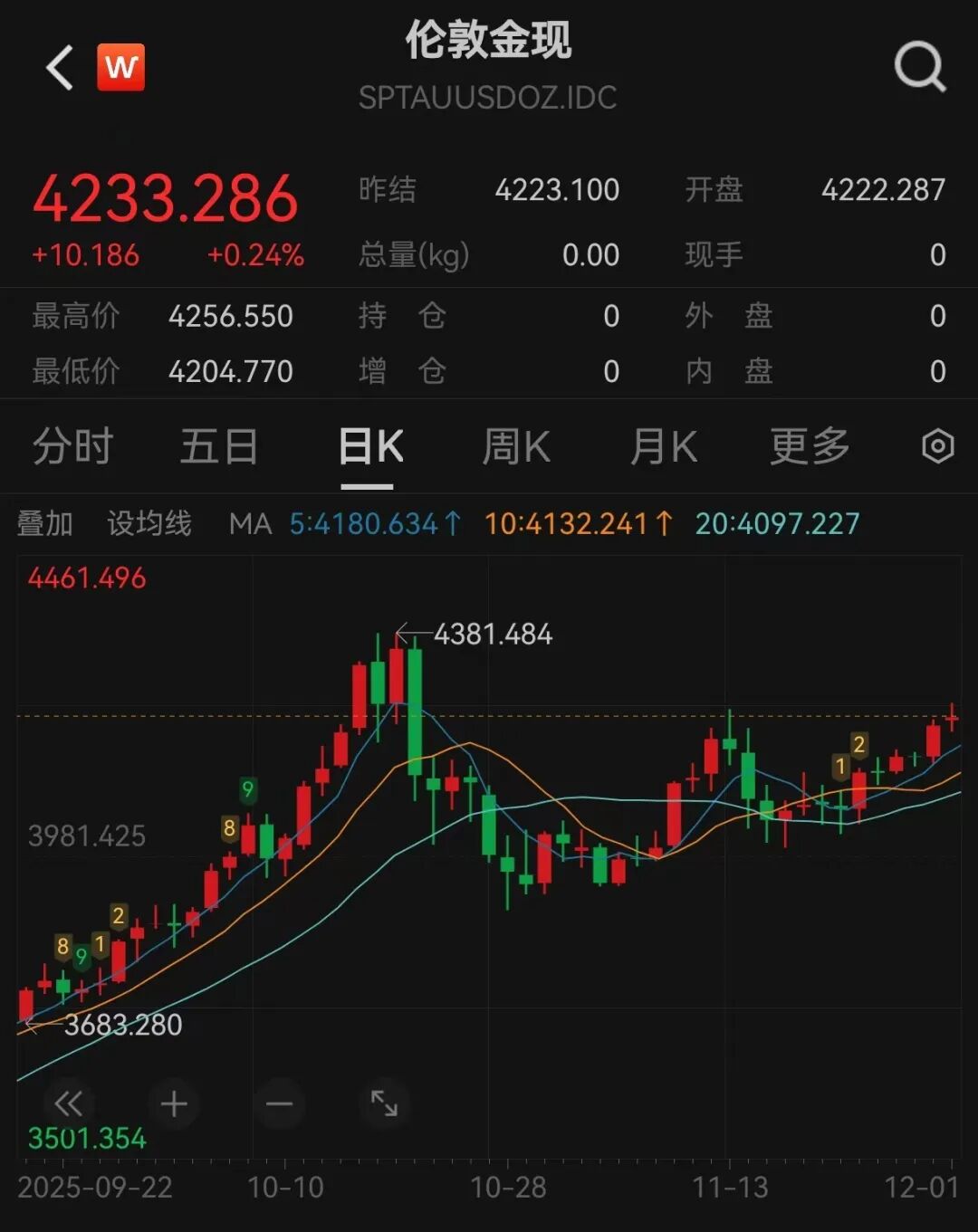
11月28日晚间至29日凌晨,国际金价持续走高,现货黄金、COMEX黄金价格均重新站上4200美元/盎司。截至12月1日14时15分,现货黄金报4233.28美元/ 盎司,COMEX黄金期货同步上涨,报4266.6美元/盎司。 国内市场跟进上涨,实时金价小程序显示,截至12月1日13时23分,水贝黄金价格为957元/克,周大福、周生生、周大生(002867)、老凤祥等品牌首饰 金克价超1300元,最高克价达1336元/克;资本市场上,黄金ETF及黄金股ETF也同步迎来上涨,资金配置热情持续释放。 | 品牌黄金价格 | | 最新: 2025.12.01 13:23 | | | --- | --- | --- | --- | | 日期 | 名称 | 价格 | 涨跌 | | 12.01 | 水贝黄金 | 956.9 元/克 | 实时 | | 12.01 | 周大福 | 1328元/克 | 持平 | | 12.01 | 周生生 | 1336元/克 | 涨6 | | 12.01 | 六福珠宝 | 1326元/克 | 持平 | | 12.01 | 我幸堂 | 1326元/克 | 持平 | | 12.01 | 潮宏基 | ...

中信集团、招商银行、兴业银行、浦发银行、上海银行、青岛银行迅速驰援!
Jin Rong Shi Bao· 2025-12-01 07:11
Core Viewpoint - The financial institutions in Hong Kong have rapidly mobilized to provide support and aid following the fire incident at Hong Kong's Tai Po Wang Fuk Court, demonstrating a commitment to disaster relief and community support [1]. Group 1: Contributions from Financial Institutions - CITIC Group has pledged HKD 15 million to support rescue efforts, victim relocation, and post-disaster reconstruction, while also organizing teams to deliver essential supplies and encouraging employee blood donations [2]. - China Merchants Bank has committed HKD 10 million for disaster relief and has established emergency service channels to provide immediate financial support to affected citizens [3]. - Industrial Bank has donated HKD 10 million to the designated "Tai Po Wang Fuk Court Relief Fund" to assist with medical care for the injured and support for the families of victims [4]. - Pudong Development Bank has also contributed HKD 10 million to the Bai Yulan Charity Foundation for emergency relief and reconstruction efforts, while organizing volunteer teams to assist affected residents [5]. - Shanghai Bank has donated HKD 10 million to the Bai Yulan Charity Foundation, with funds arriving promptly to support rescue and recovery efforts, and has mobilized employees for volunteer work [6]. - Qingdao Bank has opened a cross-border RMB donation "green channel" to facilitate donations to the affected area, waiving remittance fees for quicker support [7].




明令禁止!这些属于商业银行违规收费行为
Jin Rong Shi Bao· 2025-12-01 04:38
Core Viewpoint - The State Administration for Market Regulation has revised and issued the "Enforcement Guidelines for Commercial Bank Charging Behavior," which detail prohibited charging behaviors and emphasize compliance with regulations in banking fees [1][2]. Summary by Sections Prohibited Charging Behaviors - The guidelines specify that commercial banks must not fabricate syndicate loan fees, charge commitment fees while collecting loan interest, or force clients to obtain guarantees for fees [1]. - Banks are required to adhere to the "Standards for Classification of Small and Medium Enterprises" and inform clients about fee reduction policies [1]. Principles of Charging Behavior - Commercial banks must follow four principles: legality and compliance, equality and voluntariness, separation of interest and fees, and price matching quality [2][3]. Pricing Transparency - Banks must strictly implement clear pricing regulations, displaying service items, content, fee standards, applicable objects, effective dates, and complaint methods prominently [4]. - New or increased market-adjusted pricing must be publicly announced three months in advance [4]. Implementation of Discounts - Banks are required to actively inform clients about existing discount measures and notify them before the expiration of these measures [5]. - For fees related to small and medium enterprises, banks must verify classifications and ensure the implementation of reduction policies [5]. Definition of Violations - The guidelines outline specific behaviors that constitute violations for both government-guided and market-adjusted pricing, including exceeding price limits and unauthorized fee structures [6][7]. Unreasonable Fees - Fees charged for syndicate loans that do not meet the defined characteristics or for commitment fees after funds have been disbursed are deemed unreasonable [8]. - Charges for electronic banking services that are not needed by the client or for AI and big data services without actual demand are also classified as unreasonable [9].
建立健全安全高效的金融可信数据空间
Jin Rong Shi Bao· 2025-12-01 03:33
Core Viewpoint - The construction of a trusted financial data space is essential for ensuring the secure and efficient flow of financial data, enhancing financial services, and supporting the high-quality development of China's financial sector [1][2][16]. Group 1: Necessity of Building a Trusted Financial Data Space - A trusted financial data space provides a credible circulation environment for the market-oriented allocation of financial data elements, enabling orderly value flow while ensuring data remains within its domain [2]. - The rapid digital transformation in finance has led to an increased demand for data sharing and circulation, necessitating a robust framework for data governance and security [2][3]. - The establishment of a trusted financial data space is crucial for optimizing the allocation of financial data elements, addressing issues such as unclear data ownership and lack of pricing mechanisms [2]. Group 2: Security and Risk Management - The trusted financial data space emphasizes privacy protection, utilizing advanced technologies like privacy computing and blockchain to ensure secure and controllable use of financial data [3][6]. - It aims to prevent cross-financial risks through a robust technical foundation that allows for the secure extraction of data value while maintaining data confidentiality [3][6]. Group 3: Supporting Financial Development Initiatives - The trusted financial data space is integral to the successful implementation of key financial initiatives, including technology finance, green finance, inclusive finance, pension finance, and digital finance [3][7]. - It facilitates the integration of data across various sectors, enhancing the ability to assess project benefits and optimize financial services [3][7]. Group 4: Infrastructure and Technological Framework - The trusted financial data space is characterized by a complex ecosystem that integrates advanced technologies, unified standards, and effective governance to provide secure and efficient data circulation services [4][10]. - It relies on a distributed architecture that ensures data authenticity and integrity during cross-institutional flows, supporting innovative business scenarios like cross-border payments and green finance [5][10]. Group 5: Implementation Pathways - The construction of a trusted financial data space requires a phased approach, focusing on high-value scenarios to establish benchmarks and drive broader adoption [8][15]. - Emphasis is placed on building core capabilities and fostering collaboration among various stakeholders to ensure the effective utilization of data resources [8][15]. Group 6: Governance and Regulatory Framework - A multi-faceted governance ecosystem is necessary to clarify the roles and responsibilities of various stakeholders, ensuring effective data sharing and compliance with regulations [14][15]. - The establishment of a clear standard system is crucial for guiding participants in the trusted financial data space, promoting orderly evolution from isolated breakthroughs to coordinated development [11][14].
支付体系服务消费扩容提质的政策探析
Jin Rong Shi Bao· 2025-12-01 03:33
Core Viewpoint - The article emphasizes the importance of expanding domestic demand as a strategic foundation for high-quality economic development, highlighting the role of payment systems in facilitating consumption and reducing transaction barriers [1][4]. Group 1: Importance of Modern Payment Systems - The construction of a modern payment system is crucial for enhancing the compatibility of various payment methods, including cash, cards, mobile payments, and digital currencies, to support consumption growth [2]. - Recent policy documents reflect the government's strategic focus on optimizing the payment environment to promote consumption upgrades [2]. Group 2: Challenges in Consumption Growth - Despite a high contribution rate of consumption to economic growth, issues such as slowing marginal growth and structural differentiation are becoming more pronounced [3]. - Traditional policy tools have limitations, as they often focus on short-term effects without addressing deeper structural constraints in expanding domestic demand [3]. Group 3: Role of Payment Systems in Consumption Decisions - Payment systems significantly influence consumer decision-making by reducing transaction costs and psychological barriers, thus promoting impulse buying and high-frequency consumption [5]. - The convenience of digital payment technologies transforms consumer behavior, making transactions more seamless and immediate [5]. Group 4: Inclusivity and Accessibility of Payment Systems - Payment inclusivity is essential for unlocking the consumption potential of marginalized groups, such as the elderly and disabled, who face barriers to digital payment adoption [6][7]. - Initiatives like voice navigation and offline payment options are critical for integrating these groups into the modern consumption network [7]. Group 5: Fragmentation and Innovation Challenges - The current payment ecosystem is fragmented, with independent systems across various sectors, leading to inefficiencies and increased operational costs for merchants [9]. - There is a mismatch between rapid technological advancements in digital payments and the adaptability of older populations, exacerbating the digital divide [10]. Group 6: Security and Trust Issues - Concerns over data misuse and security risks contribute to a "trust deficit," which can suppress consumer spending [11]. - The potential for data breaches and fraudulent activities creates a defensive consumer mindset, counteracting the positive effects of payment convenience [11]. Group 7: Policy Recommendations - To enhance the payment system's role in boosting consumption, it is essential to break down ecological barriers, bridge the digital divide, and promote cross-domain collaboration [13]. - Establishing a more inclusive payment network and ensuring consumer data protection are vital for fostering trust and encouraging spending [14][16].
落实党的二十届四中全会部署 以服务业数智化促服务消费扩容升级
Jin Rong Shi Bao· 2025-12-01 03:31
Core Viewpoint - The 20th Central Committee of the Communist Party of China emphasizes the importance of "digital intelligence" and "consumption" in the 14th Five-Year Plan, aiming to drive high-quality development in service consumption through the digitalization of the service industry [1][2]. Group 1: Strategic Significance of Service Industry Digitalization - Service industry digitalization is a crucial approach to align with technological revolution trends and cultivate new productive forces, with a focus on integrating AI, big data, and cloud computing [2]. - It meets the growing demand for high-quality, personalized services as consumer preferences shift towards more diverse and enjoyable experiences [3]. - Digitalization supports the construction of a new development pattern and enhances the reliability of domestic circulation, which is vital for China's modernization [4]. Group 2: Challenges and Solutions in Service Consumption - The service industry faces a "low-level equilibrium trap," where there is a mismatch between high demand and insufficient quality supply, particularly in sectors like elderly care and childcare [5]. - Digitalization can optimize service supply and expand coverage, breaking the deadlock between supply and demand [5]. Group 3: Achievements in the 14th Five-Year Plan - Significant advancements in digital infrastructure have been made, with over 459.8 thousand 5G base stations established, enhancing network quality and user experience [6][7]. - The platform economy has thrived, with online retail in service consumption projected to reach approximately 2.44 trillion yuan in 2024, accounting for 15.7% of total online retail [8]. - New consumption scenarios have emerged, integrating online and offline experiences, and enhancing consumer engagement through immersive technologies [9]. Group 4: Directions and Paths for the 15th Five-Year Plan - The focus will be on deepening the integration of technology and service consumption, emphasizing the need for personalized and immersive service experiences [14][16]. - Key measures include breaking institutional barriers to stimulate service supply and fostering a regulatory framework that adapts to new business models [15]. - The plan aims to enhance the quality of service consumption by promoting the integration of modern services with advanced manufacturing and agriculture [16]. Group 5: Policy Environment and Safety Measures - The government aims to optimize fiscal and financial policies to support public services and enhance consumer confidence [17]. - Data security and privacy protection will be prioritized to ensure the safe operation of digitalized services [17]. - There will be an emphasis on improving digital literacy and talent cultivation to support the growth of new service consumption models [17].
最新PMI数据发布!
Jin Rong Shi Bao· 2025-12-01 02:37
Group 1: Manufacturing Sector Overview - The manufacturing Purchasing Managers' Index (PMI) in China for November is reported at 49.2%, showing a slight increase of 0.2 percentage points from the previous month, indicating an improvement in economic conditions [1] - The production index and new orders index for November are at 50.0% and 49.2%, respectively, with increases of 0.3 and 0.4 percentage points, suggesting a recovery in production and demand [1] - The new export orders index rose by 1.7 percentage points to 47.6%, marking the second highest point since April, reflecting strong resilience in exports [1] Group 2: Business Confidence and Expectations - The manufacturing production and business activity expectation index increased by 0.3 percentage points to 53.1%, indicating heightened confidence among manufacturers regarding market developments [2] - Small and medium-sized enterprises (SMEs) showed significant improvement, with their PMIs rising to 49.1% and 48.9%, respectively, while large enterprises saw a decline to 49.3% [2] - High-tech manufacturing continues to expand, with a PMI of 50.1%, remaining above the critical point for ten consecutive months, demonstrating sustained growth in this sector [2] Group 3: Price Trends and Inventory Levels - The purchasing price index for major raw materials increased to 53.6%, while the factory price index rose to 48.2%, indicating a supportive environment for market prices due to improved supply and demand dynamics [3] - The procurement willingness index improved to 49.5%, reflecting a positive shift in purchasing behavior among enterprises [3] - The construction sector's business activity index rose to 49.6%, showing signs of recovery, although it remains below the threshold of expansion [3] Group 4: Service Sector Performance - The service sector's business activity index fell to 49.5%, a decrease of 0.7 percentage points, indicating a return to contraction territory [4] - The new orders index for the service sector dropped to 45.6%, highlighting pressure on demand and insufficient recovery momentum [4] - Despite short-term demand disruptions, the service sector's confidence remains supported, with expectations for recovery as policy benefits are realized [4]
理赔捐赠同步 服务保障并行
Jin Rong Shi Bao· 2025-12-01 02:08
Core Viewpoint - The insurance industry in Hong Kong has rapidly mobilized to support rescue and recovery efforts following a severe fire incident in Tai Po, demonstrating its role as an economic stabilizer and social safety net [1] Group 1: Emergency Response Actions - Multiple insurance companies, including China Life, China Ping An, and China Taiping, activated emergency response plans immediately after the fire, establishing management teams and simplifying claims processes to ensure rapid support for affected clients [2][3] - China Life's overseas branch initiated emergency claims services and proactively contacted policyholders to ensure timely assistance [2] - China Taiping Insurance (Hong Kong) quickly identified affected clients and coordinated with them to assess needs and provide support [3] Group 2: Financial Contributions - Insurance institutions have collectively donated over 60 million HKD to aid in rescue efforts, with AIA Hong Kong contributing 20 million HKD for emergency assistance and community recovery [4] - China Ping An announced a donation of 10 million HKD for emergency relief and recovery efforts, emphasizing its commitment to supporting affected communities [4] - China Taiping and Sunshine Insurance also pledged 10 million HKD each to assist in recovery efforts, showcasing the industry's solidarity with the affected population [5][6] Group 3: Reinsurance Support - Reinsurance companies, such as China Re, played a crucial role in stabilizing market confidence by providing essential support for local insurers in managing disaster-related claims [7] - China Re activated its emergency response mechanism to assist direct insurers in assessing losses and facilitating claims processes [7] - Qianhai Reinsurance established a dedicated task force to support claims services and ensure timely compensation for affected parties [8]




11月份我国制造业PMI小幅回升 市场信心有所增强
Jin Rong Shi Bao· 2025-12-01 02:04
Group 1: Manufacturing Sector Overview - In November, China's Manufacturing Purchasing Managers' Index (PMI) was 49.2%, an increase of 0.2 percentage points from the previous month, indicating an improvement in economic conditions [1] - The production index and new orders index for November were 50.0% and 49.2%, respectively, rising by 0.3 and 0.4 percentage points, with the production index reaching the critical point [1] - The new export orders index increased by 1.7 percentage points to 47.6%, marking the second highest point since April of this year, reflecting strong resilience in exports [1] Group 2: Business Confidence and Expectations - The manufacturing production and business activity expectation index rose by 0.3 percentage points to 53.1%, indicating heightened confidence among manufacturers regarding market developments [2] - Large enterprises' PMI was 49.3%, down 0.6 percentage points, while medium and small enterprises' PMIs were 48.9% and 49.1%, up 0.2 and 2.0 percentage points, respectively, with small enterprises reaching a six-month high [2] - High-tech manufacturing maintained expansion with a PMI of 50.1%, remaining above the critical point for ten consecutive months, while equipment manufacturing and consumer goods sectors saw declines [2] Group 3: Price Trends and Inventory - In November, the purchasing price index and factory price index were 53.6% and 48.2%, respectively, both showing increases from the previous month [3] - The procurement willingness improved, with the procurement volume index at 49.5%, up 0.5 percentage points, while raw material inventory index remained stable at 47.3% [3] - The construction sector showed signs of steady recovery, with the business activity index at 49.6%, a slight increase of 0.5 percentage points, and new orders index rising to 46.1% [3] Group 4: Service Sector Performance - The service sector's business activity index fell to 49.5%, down 0.7 percentage points, indicating a return below the prosperity line [4] - The new orders index for the service sector dropped to 45.6%, reflecting insufficient recovery in market demand [4] - Despite short-term demand disruptions, the service sector's confidence remains supported, with expectations for recovery as policy benefits are released [4]
金融业全力推动消费供需“双向奔赴”
Jin Rong Shi Bao· 2025-12-01 02:03
Core Viewpoint - The article emphasizes the importance of consumption as a stabilizing force in the macroeconomy and a reflection of public welfare, highlighting a new policy aimed at enhancing the adaptability of supply and demand in the consumer market [1] Group 1: Policy Implementation - The "Implementation Plan" issued by multiple government departments focuses on supply-demand adaptability, aiming to lead industrial upgrades through consumption upgrades and better meet diverse consumer needs [1] - Financial support is identified as a key role in promoting consumption, with a focus on enhancing the adaptability and convenience of consumer financial services [1] Group 2: Financial Sector Initiatives - The People's Bank of China has introduced various policies to guide financial institutions in expanding high-quality credit supply in key consumption areas such as food, housing, travel, and entertainment, resulting in a loan balance of 2.79 trillion yuan in service consumption sectors by July, a 5.3% year-on-year increase [2] - Structural monetary policy tools have been created to direct financial resources more precisely to the consumer market, with a total quota of 500 billion yuan for technology innovation and equipment renovation loans established for 2024 [3] Group 3: Consumer Financial Products - Financial institutions are encouraged to innovate high-quality business models to meet the increasingly refined and scenario-based demands of consumers, such as offering one-stop installment services for smart home products [4] - There is a significant potential in the aging population market, prompting financial institutions to design specialized, risk-controlled consumer loans and financial products for elderly consumers [4] Group 4: Inclusive Financial Support - Financial institutions are urged to enhance support for rural consumption markets and address the digital divide faced by elderly consumers, ensuring they have access to quality goods and services [5] - The article stresses the need for financial support to extend beyond the consumer side to the supply side, facilitating technical upgrades and product innovation to meet market demands [5][6] Group 5: Future Outlook - A more mature and precise financial support model for consumption is being constructed, which will continuously nourish the interaction between supply and demand, ultimately driving high-quality economic development in China [6]