
Jin Rong Shi Bao

Search documents
“坐高铁不用自己扛行李了”——评论区为啥炸锅?
Jin Rong Shi Bao· 2026-01-18 23:06
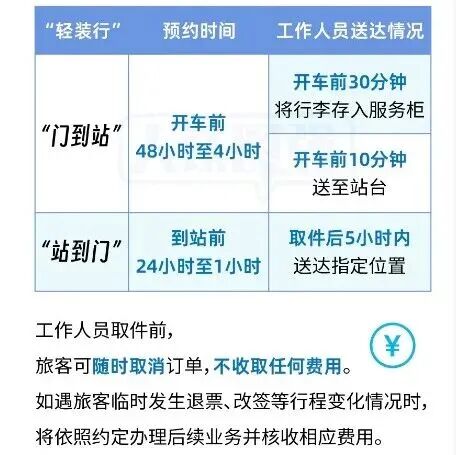
Core Viewpoint - The introduction of the "Light Travel" service by China Railway Express aims to ease the burden of carrying large luggage for travelers during the upcoming Spring Festival travel rush, expanding its coverage to 111 stations across major cities in China [1][18]. Group 1: Service Overview - The "Light Travel" service offers door-to-station and station-to-door luggage transportation within a 35-kilometer radius of the train station, allowing travelers to book services 48 hours to 4 hours before departure or 24 hours to 1 hour before arrival [1][2][8]. - The service is designed to provide a convenient and efficient luggage handling experience, enabling travelers to enjoy a hassle-free journey [8]. Group 2: Booking Process - Travelers can book the "Light Travel" service through the railway 12306 App or WeChat mini-program by selecting the service module and following the booking steps [6][12]. - The booking process includes entering travel details, specifying luggage information, and uploading photos for verification [14]. Group 3: Pricing Structure - The service charges are set at 68 yuan per piece for door-to-station and station-to-destination services, and 98 yuan per piece for door-to-platform and platform-to-destination services [18]. - For business class travelers at select stations, the service fee is also 98 yuan per piece for luggage delivery to the business waiting area [18]. Group 4: Coverage Areas - The service is available in various regions, including Northeast, North, East China, Central, South, Southwest, and Northwest, covering major cities such as Harbin, Beijing, Shanghai, Guangzhou, and Urumqi [18][19][20][21][22][23][24].

周末重磅!央行、金融监管总局下调商业用房购房贷款最低首付款比例
Jin Rong Shi Bao· 2026-01-18 02:41
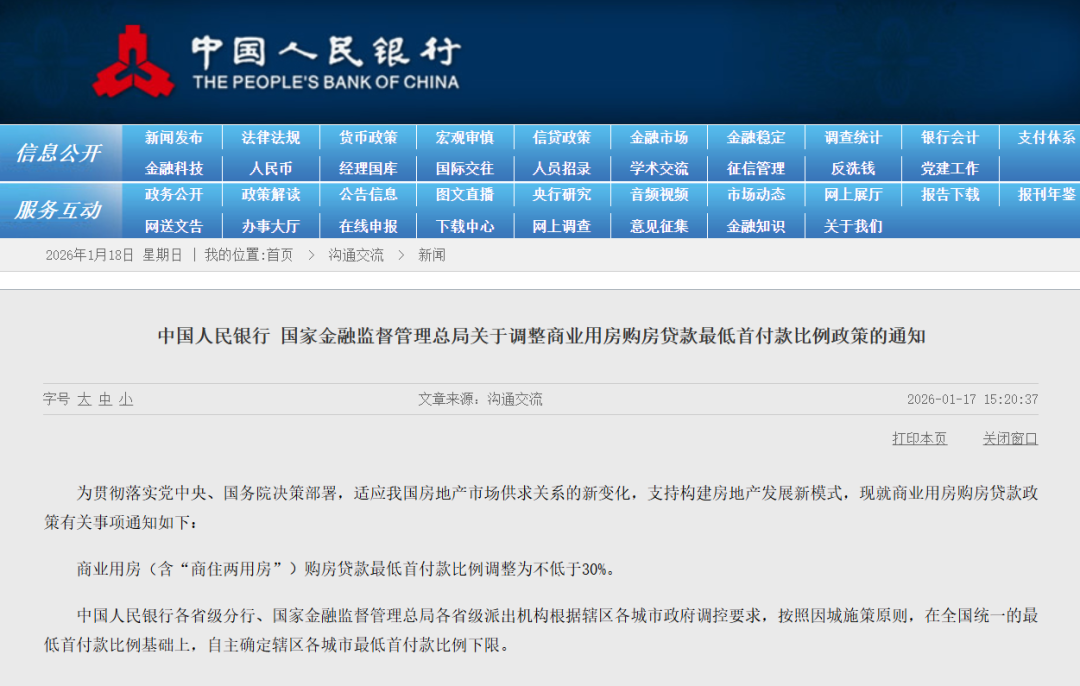
Core Viewpoint - The People's Bank of China and the National Financial Regulatory Administration have announced a policy adjustment to reduce the minimum down payment ratio for commercial property loans to 30%, aimed at stimulating the commercial real estate market and reducing inventory levels [3][4]. Group 1: Policy Changes - The minimum down payment ratio for commercial property loans, including "commercial-residential mixed-use properties," has been adjusted to no less than 30% from the previous 50% [3]. - Local branches of the People's Bank of China and the National Financial Regulatory Administration will determine the minimum down payment ratio based on local government regulations, adhering to the principle of "differentiated policies" [3]. Group 2: Market Context - As of November 2025, there are 52.34 million square meters of unsold office space and 141.05 million square meters of unsold commercial properties in China [3]. - The commercial property market, which includes shops, office buildings, hotels, and commercial complexes, has been experiencing a slower inventory reduction compared to the residential market [4]. Group 3: Expert Opinions - Experts believe that lowering the down payment ratio will significantly reduce the initial financial burden on buyers, particularly benefiting small and medium-sized enterprises and startups [4]. - The adjustment is seen as a coordinated effort with residential market policies and a targeted response to structural issues in the commercial real estate sector [4]. Group 4: Additional Support Measures - Various cities are providing subsidies for purchasing commercial properties, such as a 50% rebate on deed tax in Wuhan and a 10,000 yuan subsidy for purchases over 100 square meters in Nanning [5]. - The short-term effect of the policy is expected to stimulate demand in active commercial areas, while the long-term recovery of the commercial property market will depend on sustained growth in consumption and the service sector [5].
重要会议召开,释放明确信号→
Jin Rong Shi Bao· 2026-01-16 12:47
Core Viewpoint - The 2026 financial regulatory work meeting emphasizes a comprehensive deployment of financial regulation, focusing on risk prevention, strong regulation, and promoting high-quality development to support the "14th Five-Year Plan" [1] Group 1: Risk Prevention and Resolution - The meeting prioritizes the effective resolution of risks in small and medium-sized financial institutions, aiming to manage existing risks and prevent new ones, particularly in the real estate sector [2][3] - A systematic approach will be adopted for risk prevention, focusing on high-risk institutions through coordinated efforts between central and local authorities [2][3] - The regulatory focus will shift from mere scale expansion to substantive risk control, enhancing classification and tiered regulation [3] Group 2: Promoting High-Quality Development - The meeting calls for improving the capacity for high-quality development in the financial sector, emphasizing the need for orderly competition and optimizing institutional layout [4] - The strategy of "reducing quantity and improving quality" will guide the restructuring of financial institutions, focusing on eliminating inefficient and high-risk entities [4][5] - Regulatory measures will target disordered competition, ensuring financial institutions concentrate on their core businesses and adhere to capital constraints [4][5] Group 3: Strengthening Financial Regulation - The meeting outlines the need to enhance and perfect financial regulation, focusing on substantive risks and improving the capacity for lawful regulation [6][7] - The "Golden Supervision Project" will be accelerated, marking a shift towards digital and intelligent regulation to improve risk identification and oversight capabilities [6][7] - The regulatory framework will evolve towards precision, differentiation, and collaboration, ensuring effective consumer protection and preventing cross-market risks [7] Group 4: Enhancing Financial Services for Economic and Social Quality - The meeting emphasizes the need to improve financial services for the economy, focusing on major strategies and sectors, including support for consumer demand and small enterprises [8][9] - Financial institutions will be encouraged to develop integrated financial solutions that link investments in physical assets with human capital [9][10] - Internal mechanisms will be optimized to enhance service delivery, particularly for technology-driven and small enterprises, through improved credit evaluation and risk management [10]
“忽悠式重组”被证监会立案!股价跌停→
Jin Rong Shi Bao· 2026-01-16 07:15
Core Viewpoint - The company Sunflower is under investigation by the Zhejiang Securities Regulatory Bureau for allegedly misleading statements in its restructuring plan, which has raised market concerns regarding the actual production capacity and business model of the targeted assets [1][2]. Group 1: Investigation Details - On January 14, the company received a notice from the China Securities Regulatory Commission (CSRC) regarding the formal investigation due to suspected violations of information disclosure laws [2]. - The investigation is based on the restructuring plan disclosed by the company in September 2025, which involved acquiring 100% of the shares of Zhangzhou Xipu Materials Technology Co., Ltd. and 40% of the shares of Zhejiang Beid Pharmaceutical Co., Ltd. [3]. - The CSRC's investigation aims to maintain order in the mergers and acquisitions market following the discovery of misleading statements in the restructuring proposal [1]. Group 2: Restructuring Plan and Business Model - The restructuring plan aimed to expand the company's business into the high-end semiconductor materials sector, which was expected to create a new growth curve and accelerate the transition to new productive forces [3]. - The targeted company, Xipu Materials, is involved in the research, manufacturing, and sales of high-end semiconductor materials, with products used in key processes of semiconductor manufacturing [3]. - Concerns have been raised regarding the actual production capacity of Xipu Materials' factories, which reportedly do not possess operational capabilities [5]. Group 3: Financial Performance and Market Reaction - In the first three quarters of 2025, the company reported revenue of 19.952 million yuan, a year-on-year decline of 12.09%, and a net profit attributable to shareholders of 1.3062 million yuan, down 53.10% year-on-year [7]. - Following the announcement of the investigation, the company's stock price fell by 20% to 4.96 yuan per share, resulting in a total market capitalization of 6.385 billion yuan [7].
贵金属货币的底层逻辑: 效率、稀缺与制度选择
Jin Rong Shi Bao· 2026-01-16 06:36
Core Insights - The historical evolution of currency has been closely tied to physical commodities, particularly metals like gold, silver, and copper, which have served as the primary basis for monetary systems until the end of the Bretton Woods system [1] - The efficiency of currency as a medium of exchange, unit of account, and store of value is fundamentally linked to its ability to be accepted at face value without the need for due diligence on its actual worth [2][3] - The attributes of precious metals enhance the efficiency of transactions and have played a crucial role in the evolution of monetary systems, making them a preferred choice for currency [3][7] Group 1: Characteristics of Precious Metals - Precious metals fulfill the "no-question-asked" principle, allowing them to be accepted at face value in transactions, which is essential for their role as currency [2] - The properties of silver, such as stability, ease of delivery, and durability, have historically made it a more acceptable medium of exchange compared to other goods [2] - The efficiency of precious metals in fulfilling monetary functions is not merely a reflection of their commodity value but is also tied to their information efficiency in economic transactions [3] Group 2: Macroeconomic Stability and Monetary Policy - The stability of currency supply, particularly for commodity money like precious metals, has been critical for maintaining long-term monetary stability [4] - Historical perspectives, such as those from philosopher Nicole Oresme, emphasize the importance of maintaining the integrity of currency to prevent economic disruptions and loss of public trust [6] - Manipulating the metallic content of currency can lead to significant economic consequences, including reduced foreign trade and uncertainty in domestic transactions [6] Group 3: Historical Context and Market Dynamics - The dominance of metal currency for nearly three millennia is attributed to market forces and technological constraints, making it the optimal choice for exchange [7] - The evolution of currency systems has been driven by the need for efficiency in transactions, with precious metals providing a clear advantage in this regard [3][7]
推动党建与业务深度融合
Jin Rong Shi Bao· 2026-01-16 04:10
Core Viewpoint - The integration of party building work with business operations is a key strategy for the Dazhou branch of the People's Bank of China to lead high-quality business development through high-quality party building [1] Group 1: Mechanism Co-creation - The Dazhou branch focuses on political leadership by combining the spirit of the 20th National Congress with core work, detailing 383 learning items through lists and materials [2] - The branch has incorporated the deep integration of party building and business into key work and management systems, enhancing responsibility through various management methods [2] - In 2025, the Dazhou branch issued 77,000 "small change bags" totaling 28.5065 million yuan to meet residents' needs for small change [2] Group 2: Platform Co-construction - The Dazhou branch promotes 29 key projects under the "Party Building + Risk Tackling" initiative, creating a brand matrix with 11 sub-brands [3] - The branch has conducted 10 promotional activities related to foreign exchange policies, successfully addressing issues for local enterprises [3] - The branch has implemented a "green finance special action," with the national reserve forest project loan balance ranking first in Sichuan province [3] Group 3: Team Co-cultivation - The Dazhou branch has established a "dual mentor" system for talent development, selecting 27 young cadres to serve as party committee members or liaison officers [4] - The branch has organized 15 training sessions covering 223 party workers, emphasizing the importance of integrating party work into core business [4] - The branch has created 17 "Party Member Pioneer Posts" and conducted various activities to promote advanced models and their impact [4]
向日葵“忽悠式重组”被立案调查
Jin Rong Shi Bao· 2026-01-16 04:08
Core Viewpoint - The company Sunflower Health Technology Co., Ltd. is under investigation by the China Securities Regulatory Commission (CSRC) for allegedly misleading statements in its restructuring proposal, which has raised market concerns regarding the actual production capacity and business model of the targeted assets [1][2]. Group 1: Investigation Details - On January 14, the company received a notice from the CSRC regarding the formal investigation due to suspected violations of information disclosure laws [2]. - The investigation is based on the restructuring proposal disclosed on September 22, 2025, which involved acquiring 100% equity of Zhangzhou Xipu Material Technology Co., Ltd. and 40% equity of Zhejiang Beid Pharmaceutical Co., Ltd. [3]. - The CSRC's investigation aims to maintain order in the mergers and acquisitions market following the discovery of potentially misleading statements in the restructuring proposal [1][2]. Group 2: Business Overview - Sunflower primarily focuses on the pharmaceutical sector, developing, manufacturing, and selling drugs related to anti-infection, cardiovascular, and digestive systems [2][3]. - The restructuring proposal aimed to expand the company's business into the high-end semiconductor materials sector, which was expected to create a second growth curve and accelerate the transition to new productive forces [3]. Group 3: Market Reaction and Financial Performance - Following the announcement of the investigation, the company's stock price fell by 20% to 4.96 yuan per share, resulting in a total market capitalization of 6.385 billion yuan [5]. - The company's financial performance has been under pressure, with a reported revenue of 19.952 million yuan for the first three quarters of 2025, a year-on-year decline of 12.09%, and a net profit of 1.3062 million yuan, down 53.10% year-on-year [5].

开年读好书: 寻一场高质量的“远行”
Jin Rong Shi Bao· 2026-01-16 04:06
Group 1 - The 2026 Beijing Book Fair, regarded as a barometer for the Chinese publishing industry, concluded on January 10, attracting over 711 exhibitors and showcasing more than 400,000 titles [1][2] - The event emphasized the integration of high-quality development in the publishing industry and deepening public reading, serving as a platform for industry exchange and collaboration [3][4] - The implementation of the "National Reading Promotion Regulations" starting February 1, 2026, is expected to boost confidence in the publishing sector and promote a reading culture [1][5] Group 2 - The retail market for books is projected to reach a scale of 110.4 billion yuan in 2025, with significant growth in segments related to health, skills, and current affairs [5] - The trend of channel differentiation continues, with content e-commerce (including live streaming and short videos) accounting for 40.53% of the overall retail market, surpassing traditional e-commerce platforms [5] - Young consumers, particularly those born after 2000 and in the 1990s, are showing increased enthusiasm for book purchases, making the beginning of the year a prime time for reading planning and book buying [5] Group 3 - The fair showcased advancements in artificial intelligence and digital publishing, highlighting technologies such as intelligent editing systems and digital reading platforms [6][7] - Various digital products were presented, offering readers a more personalized and immersive learning experience, while also addressing eye protection through innovative reading formats [7][8] - The integration of traditional publishing with technology is seen as a key direction for the industry's digital transformation [7][8] Group 4 - The fair featured a variety of cultural and creative products, with notable items like the "Lu Xun" cultural merchandise gaining popularity among attendees [8][9] - Publishers are increasingly leveraging cultural elements from classic literature to create engaging merchandise, reflecting the enduring appeal of traditional culture [9][10] - The establishment of a cross-border cultural product exhibition area, with 101 booths, indicates a growing synergy between the cultural creative industry and publishing [10]
这年头,情绪竟成“大买卖”
Jin Rong Shi Bao· 2026-01-16 03:36
Core Insights - The rise of "emotional consumption" among the younger generation is driven by the need for emotional healing and stress relief, with a significant market potential projected to grow from 16.3 trillion yuan in 2022 to 23.1 trillion yuan in 2024, and expected to reach 27.2 trillion yuan by 2025 and exceed 45 trillion yuan by 2029 [1][2] Group 1: Emotional Consumption Trends - Emotional consumption is characterized by young consumers seeking products and services that provide immediate emotional satisfaction and companionship, such as blind boxes, emotional toys, and creative cultural products [1][3] - Over 90% of young people recognize the value of emotional consumption, with nearly 60% willing to pay for it, indicating a strong market demand [2][7] - The emotional consumption market is evolving, with physical products and experiential services becoming mainstream, as over 50% of respondents spend between 100-300 yuan monthly on physical goods [7][9] Group 2: Psychological Drivers - The core motivation for the rise in emotional consumption among youth is linked to the need for emotional management and the fulfillment of psychological needs in a high-pressure environment [3][9] - Traditional emotional support systems have weakened, leading young people to seek external products and services for emotional compensation [3][9] - The demand for emotional products is not just about material satisfaction but also about emotional expression, identity construction, and social connection [7][9] Group 3: Market Opportunities - The growth of digital and virtual emotional consumption is notable, with AI-driven products and services gaining traction, such as virtual gifts and emotional chatbots [8][9] - The market for AI toys is projected to see a significant increase, with sales expected to rise by 394.9% in 2025, highlighting the shift towards emotional companionship through technology [9][10] - Companies are encouraged to explore untapped emotional needs and expand consumption scenarios across various sectors, including health, education, and workplace environments [10]

向日葵“忽悠式重组”被立案调查 资产重组终止
Jin Rong Shi Bao· 2026-01-16 03:11
Core Viewpoint - Zhejiang Sunflower (向日葵) is under investigation by the China Securities Regulatory Commission (CSRC) for allegedly misleading statements in its restructuring plan, which has raised market concerns regarding the actual production capacity and business model of the targeted assets [1][2]. Group 1: Investigation Details - On January 14, Zhejiang Sunflower received a notice from the CSRC regarding the formal investigation due to suspected violations of information disclosure laws [2]. - The company announced the termination of its asset restructuring plan, stating it no longer meets the conditions for issuing shares to purchase assets following the CSRC's notice [2][3]. Group 2: Business Overview - Zhejiang Sunflower focuses on the pharmaceutical sector, primarily engaged in the research, manufacturing, and sales of drugs for infections, cardiovascular diseases, and digestive systems [2]. - The restructuring plan aimed to acquire 100% of Zhangzhou Xipu Material Technology Co., Ltd. and 40% of Zhejiang Beid Pharmaceutical Co., Ltd., intending to expand into the high-end semiconductor materials sector [3]. Group 3: Market Reaction and Financial Performance - Following the announcement of the investigation, Zhejiang Sunflower's stock price fell by 20%, closing at 4.96 yuan per share, with a total market capitalization of 6.385 billion yuan [5]. - The company's financial performance has been under pressure, with a reported revenue of 19.952 million yuan for the first three quarters of 2025, a year-on-year decline of 12.09%, and a net profit attributable to shareholders of 1.3062 million yuan, down 53.10% year-on-year [5].