
Jing Ji Wang

Search documents
vivo Y500 Pro正式发布,主打2亿影像“国民小旗舰”
Jing Ji Wang· 2025-11-11 10:05
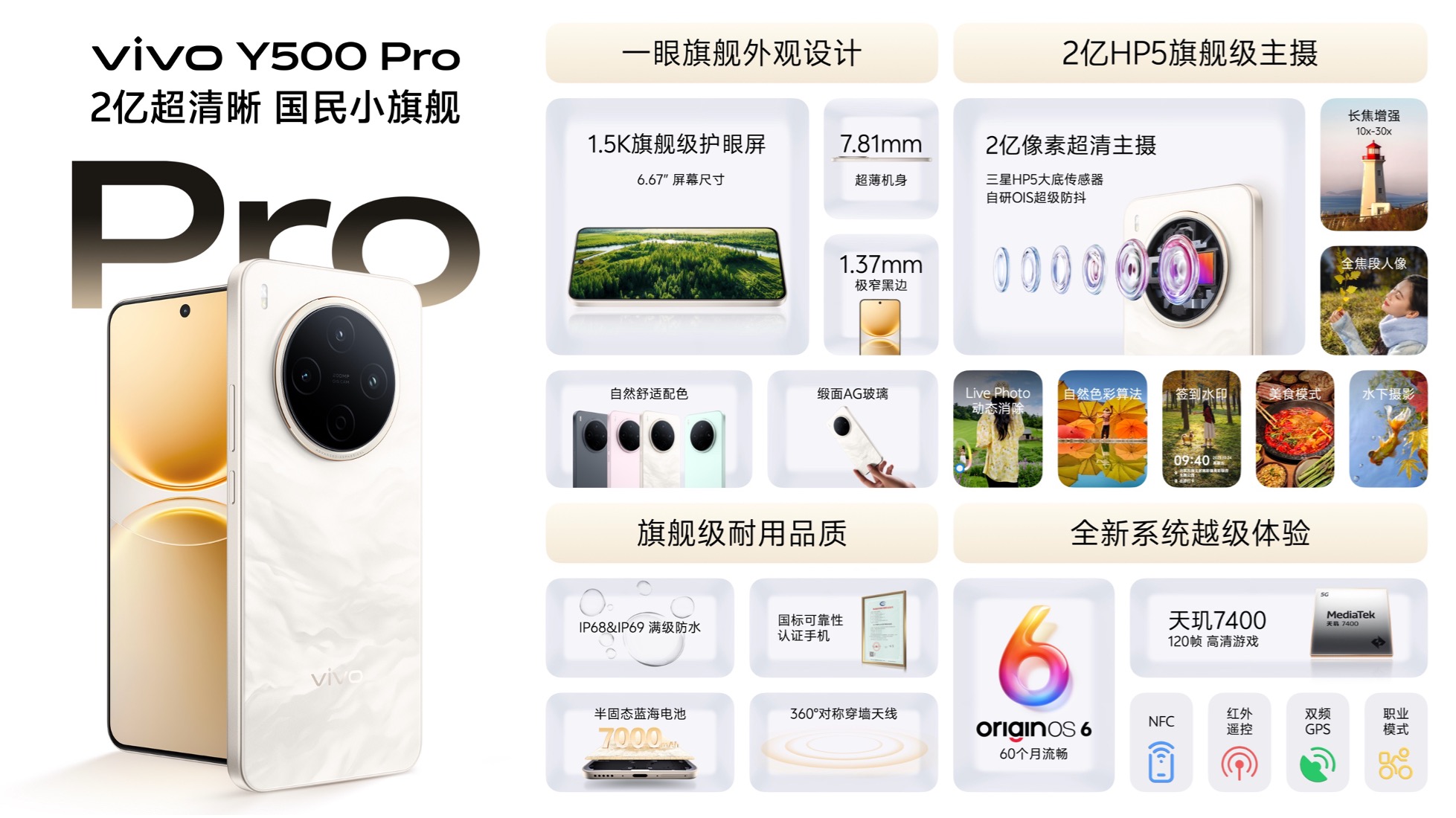
Core Viewpoint - Vivo has launched the new Y500 Pro, a smartphone that combines advanced imaging, design, system performance, durability, and battery life, targeting users who seek quality and practicality [1] Imaging Capabilities - The Y500 Pro features a 200MP HP5 flagship main camera with proprietary OIS technology, enhancing clarity and stability in photography [3] - It offers high-resolution imaging, allowing for detailed captures even after significant cropping, and excels in the 10X-30X zoom range with improved clarity [3] - The front camera is a 32MP professional portrait lens, designed for high-quality selfies and video calls, with additional features for underwater photography and document scanning [3] Design and Display - The smartphone boasts a flagship design with a satin AG glass back and a metal camera module made from aerospace-grade aluminum, available in four stylish colors [5] - It has a 6.67-inch 1.5K eye-care display with ultra-narrow bezels, providing a comfortable viewing experience with personalized brightness and AI sleep mode [5] System Performance - The Y500 Pro runs on the new OriginOS 6, offering a smooth user experience with fast touch response, multi-tasking capabilities, and optimized signal switching [5] - It promises 60 months of smooth performance, enhancing the longevity of the device [5] AI and Security Features - The device includes upgraded AI capabilities for work scenarios, such as writing assistance and group sharing, along with enhanced data security features [6] - Fun interactive themes are also introduced to enhance user experience [6] Durability and Battery Life - The Y500 Pro is recognized for its durability, having received national reliability certification and featuring IP68 and IP69 water resistance [8] - It is equipped with a 7000mAh semi-solid state battery and 90W fast charging, ensuring long-lasting performance even in extreme temperatures [8] Additional Features - The smartphone includes a Dimensity 7400 processor for high-frame gaming, dual-band Beidou and GPS for precise location tracking, and infrared remote control capabilities [8] - It is available in four storage configurations with prices ranging from 1799 to 2599 yuan [9]

收评:沪指跌0.39% 培育钻石、钙钛矿电池概念逆市走强
Jing Ji Wang· 2025-11-11 07:28
Core Viewpoint - The Chinese stock market experienced a decline, with major indices such as the Shanghai Composite Index and Shenzhen Component Index reporting losses, while certain sectors like cultivated diamonds and perovskite batteries showed strong performance [1] Market Performance - The Shanghai Composite Index closed at 4002.76 points, down 0.39%, with a trading volume of 858.36 billion [1] - The Shenzhen Component Index closed at 13289.01 points, down 1.03%, with a trading volume of 1135.22 billion [1] - The ChiNext Index closed at 3134.32 points, down 1.40%, with a trading volume of 506.70 billion [1] Sector Performance - The cultivated diamond concept saw strong gains, with companies like Sifangda and Huanghe Xuanfeng hitting the daily limit [1] - The perovskite battery concept also rose, with Zhonglai Co., Xiexin Integrated, and Guosheng Technology reaching the daily limit [1] - The fluorine concept showed volatility but ended strong, with Yongtai Technology and Furui Shares hitting the daily limit [1] - The solid-state battery concept was actively traded, with Xiongtao Shares and Fangda Carbon hitting the daily limit [1] - The food and beverage sector performed well, with companies like Huanlejia and Sanyuan Shares reaching the daily limit [1] Declining Sectors - The communication equipment, insurance, securities, and aviation sectors reported the largest declines [1]
养老理财试点多维扩容
Jing Ji Wang· 2025-11-11 05:56
Core Insights - The expansion of the pension wealth management pilot program to nationwide coverage is a significant development, allowing investors across the country to access pension wealth management products [2][3] - The pilot program has been in place for over four years, and the market is expected to grow significantly with the inclusion of more qualified institutions [3][4] - The current challenges in the pension wealth management market include a limited number of products and low liquidity, which need to be addressed for further growth [4][5] Group 1: Pilot Program Expansion - The pilot program's duration has been set for three years, with eligibility extended to wealth management companies that have been operational for over three years and meet prudent management criteria [2] - The number of wealth management companies eligible for the pilot has increased, with 29 out of 32 companies having been in operation for the required duration [2] - The fundraising cap for individual wealth management companies has been raised to five times the net capital after deducting risk capital, significantly increasing the potential pilot quota for leading companies [2] Group 2: Market Growth and Competition - The total scale of the pension wealth management market surpassed 100 billion yuan in the first quarter of 2023, indicating steady growth [3] - The market is expected to evolve into a tiered competition landscape, with state-owned banks leading in scale expansion, joint-stock banks focusing on innovation, and city commercial banks deepening regional engagement [3] Group 3: Product Development Challenges - The current selection of pension wealth management products is limited compared to other financial products, with only 37 wealth management products available out of over 1200 personal pension products [4] - The introduction of a mechanism that allows newly issued pension wealth management products to be automatically included in the personal pension product list simplifies the process for investors [4] Group 4: Addressing Liquidity Issues - Investors express a strong preference for liquidity in pension wealth management products, as many face rigid spending needs related to healthcare and retirement [7] - The pilot program allows for flexible design in purchasing, redeeming, and distributing pension wealth management products, which can better meet individual investor needs [7] - Recommendations include establishing a transfer platform for unexpired wealth management products to enhance liquidity and allow for early redemption options [8]
黄金税收新规落地首周观察
Jing Ji Wang· 2025-11-11 05:56
Core Viewpoint - The implementation of new tax regulations on gold has not significantly impacted the supply and pricing of investment gold in Shanghai, with banks reporting stable prices and sufficient supply for customers [1][3][4]. Pricing Stability - The new regulations do not affect the sales prices for end customers, as banks continue to set prices based on market conditions [3][4]. - The regulations classify gold into investment and non-investment categories, with investment gold purchased from banks being minimally affected [3][4]. - Banks can issue special VAT invoices, allowing them to offset VAT costs, resulting in no additional costs for consumers [3][4]. Supply Adequacy - Banks report that the supply of investment gold is stable and sufficient to meet customer demand [4]. - Both Construction Bank and Industrial and Commercial Bank confirm that they have adequate inventory and can fulfill regular purchases [4]. - There has been a slight increase in customer inquiries and purchases since the new regulations were implemented, but the overall market remains stable [4]. Convenience of Gold Accumulation - The process for withdrawing physical gold from accumulation accounts is reported to be convenient, with no restrictions on customers [5][6]. - Customers can easily request physical gold through mobile banking, with various specifications available [6]. - The new regulations encourage investment in gold through bank products and ETFs, as accumulation gold is classified as a financial instrument and is not subject to physical delivery tax [6].


CPI由降转涨 PPI降幅收窄
Jing Ji Wang· 2025-11-11 05:53
Group 1: Consumer Price Index (CPI) - In October, the national Consumer Price Index (CPI) increased by 0.2% both month-on-month and year-on-year, driven by effective domestic demand policies and holiday-related consumption [1][2] - The core CPI, excluding food and energy, rose by 1.2% year-on-year, marking the highest increase since March 2024 and continuing a six-month upward trend [1][2] - Service prices turned from a 0.3% decline to a 0.2% increase, influenced by strong travel demand during the National Day and Mid-Autumn Festival, with hotel accommodation, airfare, and tourism prices rising by 8.6%, 4.5%, and 2.5% respectively [2] Group 2: Producer Price Index (PPI) - The Producer Price Index (PPI) saw a month-on-month increase of 0.1%, marking the first rise of the year, with improvements in supply-demand relationships contributing to price increases in several industries [3] - The PPI year-on-year decreased by 2.1%, but the decline narrowed by 0.2 percentage points compared to the previous month, indicating a continuous trend of narrowing declines for three consecutive months [3] - Key industries such as coal mining, photovoltaic equipment manufacturing, and cement manufacturing experienced price increases, while international commodity prices influenced domestic prices in the non-ferrous metals and petroleum sectors [3]
资生堂进博会打造“美力焕新” 携50余款首秀新品亮相
Jing Ji Wang· 2025-11-10 09:37
Core Insights - Shiseido showcased over 50 new products at the 8th China International Import Expo, highlighting its latest achievements in medical aesthetics innovation, product development, and sustainable practices [1] - The launch of the "Shiseido Medical Aesthetic Cycle" and the RQ PYOLOGY brand, developed by a Chinese team, signifies Shiseido's commitment to local co-creation and innovation in the Chinese market [1][2] Group 1: Product Innovations - The RQ PYOLOGY brand features a core technology called "Triple Recombined Collagen Compound Technology," which precisely repairs all skin layers through a specific ratio of collagen types [2] - RQ PYOLOGY introduces a unique "Skin Rhythm Evaluation System" that quantifies skin conditions across six dimensions, providing consumers with detailed skin status reports [2] - The brand offers a comprehensive medical aesthetic skincare solution covering pre-procedure, intra-procedure, post-procedure, and home care phases, supported by a product system that integrates medical devices and imported cosmetics [2] Group 2: Scientific Approach - The "Shiseido Medical Aesthetic Cycle" aims to create a scientific collaborative system between medical aesthetics and home care, establishing a complete and sustainable skincare lifecycle [3] - Leveraging over 500 active ingredients from Shiseido's research library, the system enhances the synergy between medical aesthetics and daily skincare, ensuring superior efficacy [3] - Shiseido emphasizes its commitment to safety and quality by adhering to a mature operational system and safety standards developed over 20 years in Japan's medical aesthetics business [3]
京东11.11品质守护行动:让消费者购物安心不踩坑
Jing Ji Wang· 2025-11-10 09:31
Core Insights - JD.com is enhancing the quality shopping experience during the 11.11 shopping festival, focusing on quality consumption rather than just promotions [1] - The company has established a quality assurance system in collaboration with various associations, covering categories such as pre-packaged food, down jackets, and more [1] Group 1: Quality Assurance Initiatives - JD.com has partnered with the China Commodity Code Center, the China Automatic Identification Technology Association, and the China Down Industry Association to create a comprehensive quality assurance system for various product categories [1] - The platform is introducing a digital labeling system for pre-packaged foods, allowing consumers to access detailed product information beyond physical labels, including manufacturer qualifications and quality certifications [7] - A "digital ID" system has been implemented for products like power banks and gas stoves, enabling consumers to view complete quality records by clicking on the "quality assurance" label [9] Group 2: AI and Consumer Support - An AI recommendation system has been introduced to help consumers select high-quality down jackets based on specific criteria such as fill power and warmth level [3] - JD.com collaborates with the China Down Industry Association to identify and label high-quality down products, providing consumers with additional assurance through the "China Down Association Recommended" mark [3][5] - The platform aims to educate consumers on product care and selection, enhancing their overall shopping experience [3]

四赴进博,爱尔康全面赋能眼健康解决方案
Jing Ji Wang· 2025-11-10 09:31
Core Insights - Alcon showcased its innovative eye health products and digital treatment solutions at the 8th China International Import Expo, emphasizing its commitment to localizing innovations and expanding professional education resources in China [1] - The company has experienced a transformation from "innovation experience docking" to "innovation ecosystem co-construction" over its 30 years in China, aiming to contribute to the high-quality development of the eye health industry [1] - The aging population in China is driving diverse and customized eye health needs, with increasing prevalence of conditions like cataracts and glaucoma among the elderly [1] Product Innovations - Alcon introduced the Hydrus glaucoma drainage device, a minimally invasive glaucoma surgery (MIGS) solution that offers a three-channel innovative design to lower intraocular pressure with reduced complication risks compared to traditional filtering surgeries [2] - The company also presented advanced surgical technologies, including the Unity integrated phacoemulsification and vitrectomy system, the newly approved Argos biomarker, and the LuxOR Revalia surgical microscope [2] - In the vision care sector, Alcon showcased a range of products featuring patented layered moisture technology, including the Light Clear™ daily disposable toric contact lenses, which enhance comfort for astigmatic patients [2] Collaborations and Market Strategy - At the expo, Alcon signed collaborations with several institutions, including Sun Yat-sen University Eye Center and Hema Eye Hospital, to accelerate the market introduction of innovative products and technologies [2]
伊利奶酪新品亮相进博会 本土企业全方位布局高端乳制品
Jing Ji Wang· 2025-11-10 09:31
Core Insights - The event "2025 China Dairy Quality Creation Conference" hosted by Yili at the China International Import Expo (CIIE) showcases the company's commitment to quality and global collaboration in the dairy industry [1] - Yili is focusing on domestic production of butter, cream, and cheese, which were previously dominated by foreign brands, indicating a shift in the competitive landscape of the dairy market [1] - The company is expanding its product offerings in the B2B sector, particularly in the food service industry, as part of its strategy to capture new market opportunities [1] Group 1 - Yili's exhibition at CIIE attracted global partners and media, emphasizing its vision of building a "global health ecosystem" through collaboration [1] - The event featured a tiered design that symbolized Yili's ambition to transition from catching up to surpassing competitors in the dairy sector [1] - The focus on butter, cream, and cheese reflects a strategic pivot towards domestic alternatives, with competition extending beyond retail to the food service market [1] Group 2 - Yili's Pro Global Selection Cream has gained attention for its quality, made from 100% fresh milk and sourced from New Zealand, catering to the growing trend of home baking [2] - The cream's user-friendly design and versatility make it suitable for various culinary applications, enhancing its appeal in the B2B market [2] - Yili's cheese brand, Muken, has successfully entered over 20 international markets and has received accolades for its quality, reinforcing its position in the premium dairy segment [3] Group 3 - Muken butter's production capacity has doubled to 42,000 tons annually, making it the largest butter factory on New Zealand's West Coast and a key player in the overseas production of Chinese dairy products [3] - The brand aims to meet the sophisticated demands of the Chinese market by offering high-quality, nutritious products that align with consumer preferences for health and culinary excellence [3] - Yili plans to continue developing its "rare grass-fed + professional dairy" product line to enhance the baking experience for Chinese consumers [3]

《国人体重管理百科》正式发布,我国成年人超重率已达34.3%
Jing Ji Wang· 2025-11-10 09:31
Core Insights - The increasing prevalence of obesity in China poses a significant public health threat, with adult overweight and obesity rates reaching 34.3% and 16.4% respectively, according to the National Health Commission's 2024 guidelines [1][2] Group 1: Obesity Statistics and Public Health Initiatives - The National Health Commission and 16 other departments have launched a three-year "Weight Management Year" initiative to create a supportive environment for weight management across society [2] - The "National Weight Management Encyclopedia" was developed over one year by 180 experts from 18 fields related to weight management, aiming to provide comprehensive and scientifically backed guidance [2][3] Group 2: Publication of the National Weight Management Encyclopedia - The encyclopedia is designed to address various public concerns regarding weight management and serves as a foundational tool for professionals in the field [3] - The publication emphasizes practical knowledge and aims to enhance the rigor and comprehensiveness of obesity-related health education [3] Group 3: Company Involvement and Expert Commentary - Novo Nordisk has been involved in obesity treatment research for over 25 years and aims to improve public understanding of obesity and health management through the encyclopedia [4] - Experts highlight the need for patients to have adequate knowledge and willingness to collaborate with healthcare providers on treatment goals [4]