材料汇

Search documents
抗菌衣、阻燃布、防紫外伞...功能纤维市场爆发!中国技术如何领跑全球?
材料汇· 2025-08-12 13:45
Core Viewpoint - The article discusses the development and market potential of functional fibers, highlighting their unique properties and applications across various industries, including healthcare, defense, and advanced technology sectors [2][4][30]. Summary by Sections Functional Fibers Overview - Functional fibers possess special functionalities while maintaining existing fiber properties, including categories such as optical fibers, phase change fibers, conductive fibers, and biodegradable fibers [2][3]. Market Growth and Production - In 2024, China's chemical fiber production capacity is projected to reach 74.75 million tons, with an 8.8% year-on-year growth. Key segments include polyester filament and spandex, with respective growth rates of approximately 10% [4][5]. Key Functional Fiber Types - **Antibacterial Fibers**: These fibers can eliminate bacteria, with applications in medical textiles and clothing. The global market for antibacterial textiles was valued at $12.78 billion in 2022, expected to reach $15.37 billion by 2028, growing at a CAGR of over 3.75% [12]. - **Flame Retardant Fibers**: These fibers reduce flammability and toxic smoke release. The global revenue for flame retardant fibers reached $2.667 billion in 2022, projected to grow to $3.537 billion by 2029, with a growth rate of 4.1% [16]. - **UV Protection Fibers**: These fibers can block over 95% of UV rays, with the market size in China expected to grow from 5.8 billion yuan in 2024 to over 13.5 billion yuan by 2030, at a CAGR of 12.8% [18][19]. - **Conductive Fibers**: These fibers are used in anti-static and smart textiles, with applications in electronics and medical fields. Major producers include TEIJIN and Toray [21][23]. - **Color-Changing Fibers**: These fibers change color in response to external stimuli, with applications in fashion and military camouflage [25][26]. - **Negative Ion Fibers**: These fibers release negative ions, improving air quality and health. The market for negative ion fibers in China is expected to reach 18 billion yuan by 2029, growing at a rate of 21.4% [28][30]. Technological Advancements - The integration of new technologies in fiber production has led to the development of multifunctional fibers, enhancing their industrial applications and market value [7][8].


新材料与投资逻辑:任重道远、星辰大海、精耕细作
材料汇· 2025-08-11 15:38
Core Viewpoint - The article provides an in-depth analysis of the new materials industry, highlighting key materials, their applications, and investment opportunities within the context of China's "14th Five-Year Plan" [5][13]. Group 1: Definition and Classification of New Materials - New materials are defined as materials with superior properties or special functions that have recently emerged or have significantly improved from traditional materials [8]. - The new materials industry is categorized into six major subcategories, including advanced steel materials, advanced non-ferrous metal materials, advanced petrochemical new materials, advanced inorganic non-metallic materials, high-performance fibers and products, and frontier new materials [10]. - New materials can also be classified based on application fields, performance, and composition, indicating a multidimensional classification system [10]. Group 2: Key Materials and Their Applications - The article discusses critical materials such as ultra-high molecular weight polyethylene (UHMWPE), polyimide (PI), and silicon carbide (SiC) fibers, detailing their properties and applications in various industries [19][22][29]. - UHMWPE is noted for its high strength, low density, and resistance to chemicals, making it suitable for military, marine, and safety applications [19]. - PI materials are recognized for their thermal stability and electrical insulation properties, widely used in aerospace, electronics, and nanotechnology [23][25]. - SiC fibers are highlighted for their high-temperature resistance and strength, with applications in aerospace and military sectors [30][34]. Group 3: Investment Landscape and Trends - The new materials industry is characterized by high investment, high difficulty, and high barriers, with long research and application cycles [65]. - The market for new materials is projected to grow at a compound annual growth rate (CAGR) of 18%, significantly outpacing GDP growth, with specific segments like semiconductor materials and biomedical materials showing even higher growth rates [61]. - The article emphasizes the importance of domestic substitution and technological breakthroughs as key drivers for the new materials market in China [62][55]. Group 4: Challenges and Opportunities - Despite advancements, China still faces challenges in achieving high-performance and specialized new materials, with many high-end materials remaining reliant on imports [54][34]. - The article points out that the global new materials market is dominated by developed countries, with China needing to enhance its competitive edge through innovation and strategic planning [47][51]. - The ongoing geopolitical tensions and trade protectionism are driving the need for self-sufficiency in new materials technology [55][56].

化工巨变前夜!AI智能体杀入实验室,6大赛道正被重塑
材料汇· 2025-08-11 15:38
Group 1 - AI for Science (AI4S) has become a new paradigm in scientific research, entering an accelerated development phase, utilizing deep learning to solve core challenges in life sciences, materials science, and chemical reactions [7][8][21] - The development of AI4S has led to new collaborative states, with companies either using AI algorithms for contract research or building internal AI platforms for innovation [14][16] - Domestic AI development is increasingly focused on AI+ applications, with large enterprises beginning to consider early-stage layouts [21][25] Group 2 - AI4S applications are addressing three major industry pain points, including efficient information extraction, primary artificial replacement, and deep model predictions for initial assessments [32][33] - Innovation is the main theme of AI applications in the chemical industry, with a focus on six sub-sectors, including strain selection and process optimization in the fermentation industry [37][38] - AI4S applications are characterized by long R&D cycles and high costs, data-driven approaches, and high-dimensional design spaces, which traditional experiments cannot validate individually [36][33] Group 3 - The investment landscape includes companies like JingTai Technology, ZhongKong Technology, and ZhiTe New Materials, which are positioned to benefit from AI4S advancements [4][18] - The AI industry chain has seen significant growth, with upstream and midstream sectors developing rapidly under strong policy support, leading to increased capacity and innovation in hardware and software [25][26][27] - The government is actively promoting AI research cooperation, with initiatives aimed at integrating AI into solving major issues like climate and health [18][20]


光刻胶禁运阴霾下,中国半导体产业的至暗与曙光
材料汇· 2025-08-10 12:02
Core Viewpoint - The article emphasizes the critical role of photoresist in the semiconductor industry, highlighting the risks posed by the current reliance on foreign suppliers, particularly Japan, which dominates 90% of the high-end photoresist market. The potential for supply disruptions could severely impact China's semiconductor capabilities, especially in advanced processes below 14nm [2][11][23]. Group 1: Importance of Photoresist - Photoresist is described as an essential material in semiconductor manufacturing, likened to a precision tool that enables the creation of intricate circuit patterns on silicon wafers [4][11]. - The production of high-end photoresist involves complex chemical formulations and stringent manufacturing processes, making it a highly specialized field with significant technical barriers [7][23]. Group 2: Current Market Situation - China's domestic production of high-end photoresist is alarmingly low, with KrF photoresist at 15% and ArF photoresist below 5% [2][11]. - The article outlines various types of photoresist used in semiconductor manufacturing, including G-line, I-line, KrF, ArF, and EUV photoresists, each serving different technological nodes [8][10]. Group 3: Risks of Supply Disruption - The article discusses potential scenarios of supply disruption due to geopolitical tensions, particularly the risk of a comprehensive technology embargo from the U.S. and its allies, which could lead to a halt in semiconductor production in China [27][28][29]. - The impact of such disruptions would be felt across various sectors, including automotive, consumer electronics, and advanced computing, leading to significant economic repercussions [33][34][38]. Group 4: Strategies for Mitigation - The article suggests immediate emergency strategies, such as inventory management, global sourcing through gray channels, and temporary use of lower-performance alternatives to maintain production [42][44][45]. - Long-term strategies include building a self-sufficient photoresist supply chain through national collaboration, technological innovation, and investment in research and development [51][55][58]. Group 5: Future Outlook - The article concludes that while the current situation poses severe challenges, it also presents an opportunity for China to strengthen its semiconductor industry by investing in domestic capabilities and reducing reliance on foreign technology [62].


从垄断到破局:巨头齐涨价!显示玻璃基板500亿市场谁主沉浮?
材料汇· 2025-08-09 16:00
Core Viewpoint - The display glass substrate is a critical component of display panels, accounting for approximately 15% of the cost of TFT-LCD panels, and is facing a shift towards higher pricing due to rising energy costs and market dynamics [2][5][23]. Group 1: Display Glass Substrate Overview - The glass substrate is a core raw material for display panels, with about 80% of display glass substrates used for LCD panels [1][23]. - A TFT-LCD panel requires two glass substrates, while an OLED panel primarily uses one as a carrier glass [1][23]. Group 2: Market Development - Major glass substrate manufacturers like Corning, AGC, and NEG are shifting focus from market share expansion to improving profitability due to rising energy costs, which account for over 50% of production costs [2][38]. - The global market for FPD glass substrates is expected to reach approximately 50 billion yuan (about 7.05 billion USD) by 2025, with a projected revenue growth of 15% from 2024 [2][39]. Group 3: Demand and Supply Dynamics - In 2024, the demand for FPD glass substrates is projected to be 645 million square meters, with a year-on-year growth of 4.34% and a supply surplus rate of 7% [3][39]. - By 2025, demand is expected to increase to 679 million square meters, with a further reduction in the supply surplus rate to 5% [3][39]. Group 4: Competitive Landscape - The market concentration is high, with the top three companies (Corning, AGC, and NEG) holding about 80% of the market share [4][46]. - Domestic manufacturers have accelerated the pace of localization, with companies like Rainbow Technology making significant breakthroughs in high-generation glass substrates [4][48]. Group 5: Investment Recommendations - With China holding 70% of global LCD production capacity, the demand for glass substrates is increasingly concentrated in China, prompting many related companies to establish factories there [5][6]. - Rainbow Technology has shown promising results in mass production of high-generation glass substrates, and as initial investment costs decrease over time, its profit margins are expected to improve [5][6].



13页PPT详解先进封装技术路线与市场趋势
材料汇· 2025-08-09 16:00
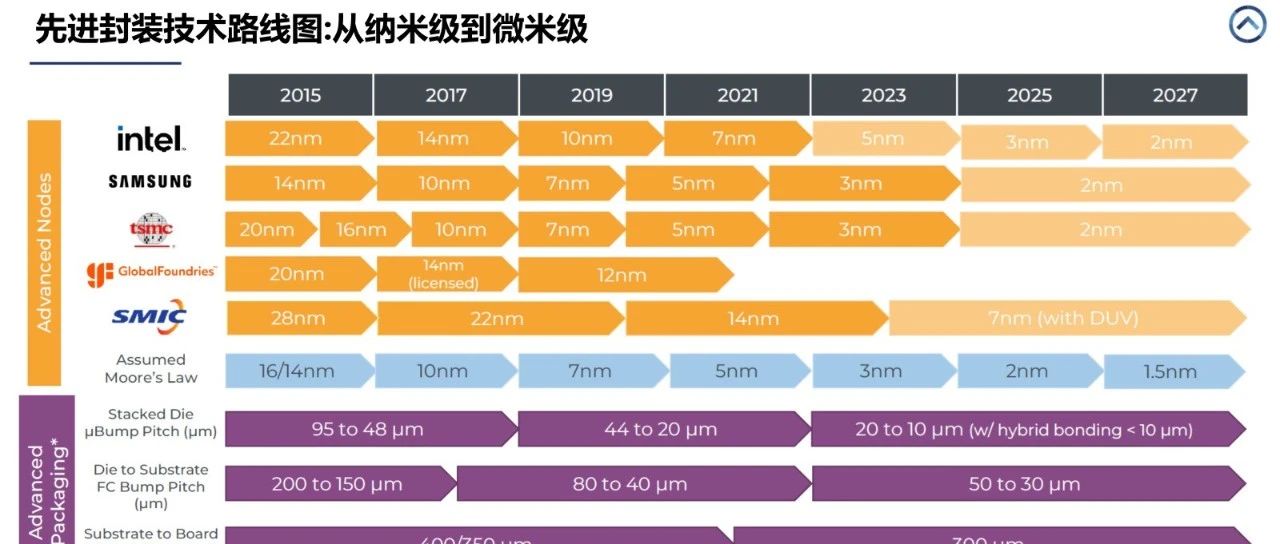
Core Insights - The article discusses the advancements and trends in the semiconductor packaging industry, particularly focusing on 2.5D and 3D packaging technologies, which are being led by major players like Intel, Samsung, and TSMC [10][11]. Advanced Packaging Trends - Advanced packaging is projected to grow significantly, with revenue expected to increase from $37.5 billion in 2021 to $65.1 billion by 2027, capturing approximately 53% of the total packaging market [16]. - The shipment volume for advanced packaging is anticipated to reach 90 billion units by 2027, with a compound annual growth rate (CAGR) of 13% for 2.5D/3D packaging [18][20]. Capital Expenditure - In 2022, the estimated capital expenditure (CapEx) for top packaging companies was $14.5 billion, up from $11.9 billion in 2021, indicating a growing investment in advanced packaging technologies [9]. Market Share and Competition - OSATs (Outsourced Semiconductor Assembly and Test) accounted for 65% of the advanced packaging wafer market in 2021, while foundries are increasingly taking market share from OSATs [23]. - Major players in the high-end packaging market include Intel, Samsung, and TSMC, which are competing vigorously in the development of advanced packaging technologies [10][12]. Technology Adoption - The adoption of chip-level packaging and heterogeneous integration is driving higher yields and optimized costs, with finer bump or pad spacing leading to increased density and faster time-to-market for products [6][10]. Global Market Overview - The global advanced packaging market is characterized by a diverse range of players, including major technology companies and specialized packaging suppliers, indicating a competitive landscape [13][14].


“十五五”新材料产业发展规划
材料汇· 2025-08-08 13:50
Core Viewpoint - The new materials industry is crucial for supporting modern industrial systems and fostering new productive forces, with significant strategic importance for China's high-level technological self-reliance and manufacturing strength [2]. Group 1: Industry Background and Development Situation - During the 14th Five-Year Plan, China's new materials industry saw continuous growth, with total output value exceeding 8.2 trillion yuan and an average annual growth rate of over 12% [4]. - Achievements include breakthroughs in ultra-high-strength steel, high-performance carbon fiber, semiconductor silicon wafers, and key materials for lithium-ion batteries [4]. - Challenges remain in high-end materials, core process equipment autonomy, and the need for improved standards and evaluation systems [4]. Group 2: Overall Requirements - The guiding ideology emphasizes innovation-driven development, demand orientation, green low-carbon practices, and open collaboration [7]. - Key principles include self-reliance through innovation, application-driven demand, enterprise-led collaboration, and a focus on green and efficient practices [9]. Group 3: Development Goals (by 2030) - Strategic material security capabilities should exceed 80%, with a focus on achieving global leadership in original achievements in frontier new materials [11]. - The goal is to cultivate internationally competitive new materials enterprises and establish over 20 distinctive, complete, and internationally leading new materials industry clusters [11]. - Significant reductions in energy consumption and emissions during material production processes are targeted, alongside a substantial increase in the proportion of green low-carbon materials [11]. Group 4: Key Development Directions - Advanced basic materials include ultra-high-strength automotive steel, high-performance aluminum alloys, and advanced chemical materials [13]. - Key strategic materials focus on high-temperature alloys, integrated circuit materials, and new energy materials [14][15][16]. - Frontier new materials include low-dimensional and smart materials, quantum information materials, and bio-based sustainable materials [17][18]. Group 5: Key Tasks and Major Projects - Focus on urgent new materials needed in key application areas, such as aerospace, new energy vehicles, and electronic information [21]. - Specific targets include high-performance carbon fiber for aircraft and high-energy density battery materials for electric vehicles [22][26][28]. Group 6: Collaborative Innovation System - Establish a collaborative innovation system centered on enterprises, integrating industry, academia, and research [45]. - Encourage leading enterprises to form innovation alliances with universities and research institutions to tackle key technologies [46]. Group 7: Market Cultivation for Key New Materials - Implement insurance compensation mechanisms for the first application of key new materials to reduce user risks [50]. - Establish a project library for demonstration projects, providing financial support and policy incentives to promote new materials [50]. Group 8: Breakthroughs in Key Processes and Equipment - Focus on overcoming bottlenecks in key processes and specialized equipment for new materials production [55]. - Develop advanced manufacturing technologies, such as 3D printing and automated composite material forming processes [56]. Group 9: Standard System Improvement - Accelerate the establishment of a comprehensive standard system covering the entire new materials industry chain [60]. - Develop and revise over 500 key new materials standards to ensure product quality and market order [61].

不起火、不爆炸,详解隔热材料数千亿级大赛道(附22页PPT)
材料汇· 2025-08-07 15:58
Core Viewpoint - Insulation materials play a crucial role in achieving energy efficiency and reducing carbon emissions, aligning with the "dual carbon" goals of the country [2][11]. Group 1: Types of Insulation Materials - Insulation materials can be categorized into four main types: organic insulation materials, inorganic insulation materials, new materials, and composite materials [18][25]. - Organic insulation materials are characterized by their porous structure and low density, making them widely applicable in construction and industrial fields [18][22]. - Inorganic insulation materials feature high porosity and nano-scale pore structures, effectively reducing heat conduction [22]. - New materials focus on optimizing performance through thermal conduction path regulation, radiation suppression, and structural stability [25]. - Composite materials combine two or more materials to enhance overall performance [26]. Group 2: Market Opportunities - The market for insulation materials is projected to exceed hundreds of billions, with new insulation materials rapidly penetrating various sectors [4][32]. - In the power battery sector, the demand for thermal management and flame-retardant insulation materials is expected to surpass 90 million square meters by 2025, corresponding to a market size of approximately 6.3 billion yuan [4][49]. - The building energy-saving market is anticipated to reach 248.5 billion yuan by 2025, with a year-on-year growth of 13.8% [63]. - The oil and gas pipeline insulation materials market is projected to reach 10.96 billion yuan by 2025 [4]. Group 3: Innovations in Insulation Materials - The emergence of super insulation materials, such as aerogels, presents significant industrialization prospects [5]. - Super insulation materials have a thermal conductivity coefficient lower than that of "still air," with room temperature thermal conductivity typically below 0.04 W·m⁻¹·K⁻¹ [5]. - Companies like Zhite New Materials are leveraging AI for material research and development, significantly enhancing performance while reducing costs [5]. Group 4: Specific Applications - In the power battery sector, the use of aerogel insulation materials is expected to grow due to the increasing sales of new energy vehicles and the rising proportion of high-nickel batteries [4][50]. - In the construction sector, insulation materials are crucial for reducing heat loss, with external wall insulation being a primary focus [55][58]. - The oil and gas industry utilizes insulation materials to effectively protect against heat loss during transportation [4][32].

百亿赛道爆发!气凝胶:双碳下的“隔热王者”,谁将主导未来?(附核心企业全梳理)
材料汇· 2025-08-07 15:58
Group 1 - The core viewpoint of the article is that the aerogel market is on the verge of explosive growth, driven by its superior thermal insulation properties and the dual forces of increasing penetration in key applications and decreasing costs [2][3]. - Aerogel is defined as a next-generation high-efficiency thermal insulation material with unique properties such as low thermal conductivity, lightweight, and long lifespan, making it suitable for various applications including energy storage, building insulation, and industrial insulation [6][40]. - The market size for aerogel is projected to reach billions, with a consensus among multiple institutions that the market will aim for a scale of 100 billion by 2025, driven by the demand in new energy vehicles and building energy efficiency [2][3]. Group 2 - The article outlines the competitive landscape of the aerogel industry, highlighting key players and their capabilities in terms of production capacity, technology routes, and customer resources [5][9]. - It emphasizes the importance of technological barriers, particularly in drying processes and patent strategies, as well as the innovation directions in developing new materials and optimizing performance [5][56]. - The article discusses the significant policy support from the government for the aerogel industry, which is crucial for achieving carbon neutrality goals and promoting the development of new materials [54][58]. Group 3 - The aerogel supply chain is detailed, including upstream sources of silica, midstream production processes, and downstream applications across various sectors such as petrochemicals, construction, and transportation [56][68]. - The article notes that the petrochemical sector is the largest application area for aerogel, accounting for 56% of consumption, followed by industrial insulation at 18% [40][57]. - It highlights the increasing adoption of aerogel in the new energy vehicle sector, with major manufacturers like BYD and CATL incorporating aerogel products into their battery designs to enhance safety and efficiency [71][73].





原子级精度之战:掩膜版上的5纳米生死线与国产替代突围战
材料汇· 2025-08-06 15:53
Core Viewpoint - The article discusses the critical role of photomasks in semiconductor manufacturing, highlighting the technological challenges and market dynamics that affect China's chip industry, particularly in the context of US export restrictions and the need for domestic alternatives [2][3]. Group 1: Photolithography and Photomasks - Photolithography is a key process in chip manufacturing, where patterns from photomasks are transferred onto silicon wafers, directly impacting chip performance and power consumption [5][8]. - The precision required for photomasks has reached atomic levels, with line width errors needing to be controlled within 5 nanometers, equivalent to one ten-thousandth of a human hair [3][4]. - The photomask manufacturing process involves complex steps including CAM data processing, coating, exposure, development, etching, and inspection, with each step having stringent requirements [15][17]. Group 2: Technical Challenges in Photomask Production - The photomask manufacturing process faces significant challenges, including the need for precise environmental control during exposure, where temperature fluctuations can lead to position drift of up to 0.5 nanometers [18][19]. - Position accuracy between different layers of photomasks is critical, with requirements for 7nm processes needing alignment within 1.5 nanometers [19][20]. - Exposure control is vital, as deviations in exposure energy can lead to significant variations in line width, affecting the final product quality [20][28]. Group 3: Market Dynamics and Trends - The global semiconductor materials market is projected to grow, with the photomask segment expected to reach a market size of approximately $5.4 billion by 2023, driven by increasing demand for advanced processes [49][50]. - The photomask market exhibits higher profit margins compared to flat panel displays, with advanced process photomasks showing significant improvements in profitability due to technological advancements [54][57]. - The shift of semiconductor manufacturing capacity to China is anticipated to increase domestic demand for photomasks, with projections indicating a rise in the number of 12-inch wafer fabs in the region [61][63]. Group 4: Photomask Industry Structure - The photomask supply chain is characterized by a heavy reliance on imports for key materials, with major suppliers located in Japan and Korea, leading to a significant domestic technology gap [42][44]. - The cost structure of photomasks is primarily composed of direct materials and manufacturing costs, with photomask substrates accounting for over 90% of direct material costs [46]. - The photomask industry is segmented into in-house production by wafer manufacturers and independent third-party suppliers, with the latter being more prevalent in mature process nodes [52].