
Tsingtao Brewery(00168)

Search documents
港股食品饮料板块投资启示
INDUSTRIAL SECURITIES· 2025-10-31 14:20
Investment Rating - The report provides a positive outlook for the Hong Kong food and beverage sector, indicating potential investment opportunities in resilient companies within the industry [2][9]. Core Insights - The report outlines six phases of the Hang Seng Consumer Staples Index, highlighting the cyclical nature of the industry and the impact of external factors such as economic conditions and policy changes on consumer demand [3][4][28]. - The analysis emphasizes the importance of identifying resilient stocks in the food and beverage sector, particularly in the upstream farming and downstream dairy product industries, as they are expected to benefit from market dynamics and policy support [6][7][53]. Summary by Sections Phase Review of the Hang Seng Consumer Staples Index - Phase 1: Downward trend due to slowing GDP and reduced consumer demand, leading to a decline in the index [3]. - Phase 2: Strong recovery driven by global economic recovery and improved earnings of leading consumer staples companies [3]. - Phase 3: Period of volatility influenced by trade tensions and tightening global liquidity [3]. - Phase 4: Rapid increase in the index due to the rigid demand for essential consumption during the pandemic [3]. - Phase 5: Continuous decline influenced by repeated pandemic disruptions and rising raw material costs [4]. - Phase 6: Valuation recovery initiated by domestic consumption policies and inflow of long-term capital [4][28]. Investment Opportunities in the Food and Beverage Sector - Upstream farming opportunities are highlighted, with a focus on the dairy and beef sectors, where prices are expected to stabilize and rise due to supply constraints and recovering demand [6][44]. - Downstream dairy product opportunities are supported by recent policies aimed at boosting demand and improving market competition, which will benefit leading companies in the sector [7][53]. Investment Recommendations - Companies such as Yurun Agriculture (09858.HK) and Modern Farming (01117.HK) are recommended for their strong cash flow and potential to benefit from the anticipated recovery in raw milk prices [9][57]. - The report suggests that policy support will create upward momentum for companies like Mengniu Dairy (02319.HK) and H&H International Holdings (01112.HK), which are positioned to capitalize on market opportunities [10][57]. - The potential for industry restructuring and the emergence of leading companies is noted, particularly in the coconut water segment, with recommendations for IFBH (06603.HK) [11][58].

行业点评报告:食品饮料持仓新低,优先布局白酒和成长型标的
KAIYUAN SECURITIES· 2025-10-31 08:22
Investment Rating - The industry investment rating is "Positive" (maintained) [1] Core Viewpoints - The food and beverage sector has seen a decline in fund allocation, with the configuration ratio dropping to a new low of 6.4% in Q3 2025 from 8.0% in Q2 2025, indicating a significant reduction in investment interest [5][14] - The white wine sector is expected to reach a performance and valuation bottom, with recommendations to strategically invest in this area due to its relatively low valuation and stable chip structure [8][40] - The beverage and snack sectors are performing well, driven by their essential consumption characteristics and resilience against external market fluctuations [41][43] Summary by Sections Fund Allocation Trends - In Q3 2025, the allocation ratio for food and beverage in all market funds decreased to 6.4%, down 1.6 percentage points from Q2 2025, marking the lowest level since 2020 [5][14] - The allocation ratio for active equity funds in food and beverage fell to 4.1% in Q3 2025, down from 5.6% in Q2 2025, reflecting a continued significant reduction in investment [5][14] White Wine Sector Insights - The proportion of active equity funds heavily invested in white wine decreased from 4.0% in Q2 2025 to 3.2% in Q3 2025, indicating a trend of reduced allocation across both active and passive funds [6][25] - Companies with cleared financial reports, such as Luzhou Laojiao and Shede Liquor, are gaining market favor, while others like Wuliangye and Moutai are seeing reduced holdings [6][25] Performance and Market Dynamics - The food and beverage sector's market value increased by 3.7% in Q3 2025, but it underperformed the CSI 300 index by approximately 18.6 percentage points, ranking fifth from the bottom in the overall market [15][21] - The overall market transaction amount for the food and beverage sector fell to 1.65%, down 1.05 percentage points from the previous quarter, indicating a decline in trading activity [15][21] Investment Recommendations - It is suggested to strategically invest in the white wine sector, focusing on stable companies like Kweichow Moutai and Shanxi Fenjiu, as well as those undergoing market reforms like Shede Liquor [8][40] - For the broader consumer goods sector, attention should be given to companies that benefit from new channels and product categories, such as Wei Long and Ximai Foods [43]




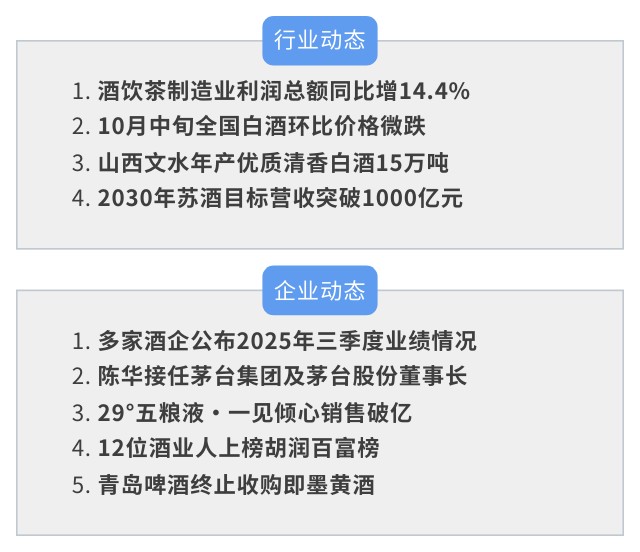
中经酒业周报∣酒饮茶制造业利润总额同比增14.4%,10月中旬全国白酒环比价格微跌,多家酒企公布2025年三季度业绩情况,12位酒业人上榜胡润百富榜
Xin Hua Cai Jing· 2025-10-31 07:31
Industry Dynamics - The total profit of the liquor, beverage, and refined tea manufacturing industry increased by 14.4% year-on-year, with total profits reaching 246.53 billion yuan despite a slight revenue decline of 0.3% to 1,184.74 billion yuan from January to September [3] - The national wholesale price index for liquor showed a slight decrease of 0.07% in mid-October, with famous liquor prices dropping by 0.19% while local liquor prices increased by 0.12% [3] - Wenshui County has become a significant player in the clear aroma liquor sector, producing 150,000 tons annually and generating an industry output value of 2 billion yuan [3] Company Dynamics - Jiangsu Province aims for the liquor industry to achieve total revenue exceeding 100 billion yuan by 2030, requiring a compound annual growth rate (CAGR) of approximately 4.5% from a base of 75.596 billion yuan in 2024 [4] - Multiple liquor companies have reported their Q3 2025 performance, with notable figures including Kweichow Moutai's revenue of 130.904 billion yuan and net profit of 64.627 billion yuan, reflecting a year-on-year growth of 6.36% and 6.25% respectively [5] - The overall liquor industry is undergoing a significant adjustment phase, with most companies experiencing a notable decline in performance, attributed to high channel inventory and weak terminal sales [6] - Chen Hua has been appointed as the new chairman of Kweichow Moutai Group and Kweichow Moutai Co., Ltd. [7] - Wuliangye's new product, 29° Wuliangye "One Glance in Love," achieved sales exceeding 100 million yuan within 60 days of its launch, indicating strong market acceptance [7] - Qingdao Beer announced the termination of its acquisition of Shandong Jimo Yellow Wine Factory due to unmet conditions in the share transfer agreement [8]

研判2025!中国精酿啤酒行业发展历程、消费量、市场规模、重点品牌及未来前景展望:消费升级驱动产品创新,精酿啤酒市场规模突破千亿元[图]
Chan Ye Xin Xi Wang· 2025-10-31 01:20
Core Insights - The craft beer segment is rapidly growing in China, driven by consumer demand for quality, unique flavors, and cultural significance, contrasting with traditional industrial beer's limited taste [1][11] - The market size of China's craft beer industry is projected to grow from 200 billion yuan in 2020 to 800 billion yuan by 2024, with a compound annual growth rate (CAGR) of 41.42%, and is expected to reach 1,342 billion yuan by 2025 [1][11] - The consumption volume of craft beer in China is forecasted to increase from 360 million liters in 2016 to 2.29 billion liters by 2025, reflecting a CAGR of 23.67% [10][11] Industry Overview - Craft beer, also known as microbrewery beer, is defined as beer made from only four ingredients: malt, hops, yeast, and water, without any artificial additives [3] - The craft beer market in China is a new product category, while it has already established a mature market in developed countries [3] Industry Development History - The Chinese craft beer industry has evolved through three stages since the establishment of the first craft brewery in 2008 [4][5] - The industry saw significant growth post-2018, with the introduction of standards for "workshop beer" by the China Alcoholic Drinks Association in 2019, marking a move towards a more regulated development phase [5] Industry Policies - Recent government policies have aimed to boost the craft beer sector, including measures to encourage research and development in unique flavors and the establishment of industry parks [5][6] Industry Value Chain - The craft beer industry value chain includes raw materials (malt, hops, yeast, water), equipment manufacturers, breweries, and sales channels such as supermarkets, bars, and restaurants [7] - The malt industry, crucial for craft beer production, is projected to produce 3.47 million tons in 2024, reflecting a 1.79% year-on-year growth [7] Current Industry Status - The overall beer production in China has been stable, with a slight decline expected in 2024 due to various market factors, while craft beer is positioned as a growth driver [9][10] - The craft beer market is characterized by a diverse brand landscape, including both local independent breweries and large beer companies [12] Future Trends - Product innovation in craft beer will increasingly draw from local cultural elements, creating unique flavors that resonate with consumers [14][15] - The consumption experience is expected to evolve, with craft beer being integrated into various lifestyle venues beyond traditional bars, enhancing consumer engagement [16] - Craft beer brands will focus on community building and shared values, fostering brand loyalty through environmental sustainability and local agriculture support [17]

青岛啤酒(600600):产品结构持续优化升级,盈利能力提升
Jianghai Securities· 2025-10-30 11:34
Investment Rating - The investment rating for the company is upgraded to "Accumulate" [4] Core Views - The company reported a revenue of 29.367 billion yuan for the first three quarters of 2025, reflecting a year-on-year increase of 1.41%. The net profit attributable to shareholders was 5.274 billion yuan, up 5.70% year-on-year [4] - The company continues to optimize its product structure, leading to improved profitability. The gross margin for the first three quarters of 2025 was 43.66%, an increase of 1.90 percentage points year-on-year [7] - The company is focusing on brand and product structure optimization, with a strong emphasis on developing high-end products and new categories [7] Financial Performance - For Q3 2025, the company achieved a revenue of 8.876 billion yuan, a slight decrease of 0.17% year-on-year, while the net profit was 1.370 billion yuan, an increase of 1.62% year-on-year [4] - The company’s sales volume for the first three quarters of 2025 was 6.894 million kiloliters, a year-on-year increase of 1.6%, with the main brand Qingdao Beer showing a sales volume of 3.99 million kiloliters, up 4.1% year-on-year [7] - The company’s operating expenses remained stable, with sales expense ratio at 11.58%, management expense ratio at 3.27%, and R&D expense ratio at 0.27% [7] Future Outlook - Revenue projections for 2025-2027 are estimated at 32.955 billion yuan, 33.891 billion yuan, and 34.920 billion yuan respectively, with growth rates of 2.54%, 2.84%, and 3.04% [7] - The net profit attributable to shareholders is projected to be 4.795 billion yuan, 5.165 billion yuan, and 5.482 billion yuan for 2025-2027, with growth rates of 10.35%, 7.73%, and 6.13% respectively [7] - The company plans to continue developing distinctive products to meet consumer demand, including new flavors and product lines [7]
瑞银:降青岛啤酒股份目标价至59.4港元 维持“买入”评级
Zhi Tong Cai Jing· 2025-10-30 09:24
Core Viewpoint - UBS reports that Qingdao Beer (600600) saw a 1.4% year-on-year increase in revenue and a 5.7% increase in net profit for the first nine months, indicating a slight decline in Q3 revenue and a modest increase in net profit, which fell short of expectations [1] Financial Performance - Revenue for Q3 was 8.876 billion RMB, a year-on-year decrease of 0.2% [1] - Net profit for Q3 was 1.37 billion RMB, a year-on-year increase of 1.6%, both figures missing expectations by 3% and 5% respectively [1] Margin and Cost Analysis - Improvement in gross margin and a decrease in SG&A ratio led to an increase in operating profit margin by 1.8 percentage points year-on-year [1] Earnings Forecast and Target Price - UBS has lowered its earnings forecast for Qingdao Beer for 2025 to 2027 by 2% to 12%, considering a slight increase in operating expenses which affected the operating profit margin [1] - The target price has been adjusted from 63.27 HKD to 59.4 HKD, while maintaining a "Buy" rating [1]
瑞银:降青岛啤酒股份(00168)目标价至59.4港元 维持“买入”评级
Zhi Tong Cai Jing· 2025-10-30 09:24
Core Viewpoint - UBS has lowered the target price for Qingdao Beer Co., Ltd. (00168) to HKD 59.4 while maintaining a "Buy" rating due to mixed financial results and adjustments in earnings forecasts [1] Financial Performance - For the first nine months, Qingdao Beer reported a revenue increase of 1.4% year-on-year and a net profit increase of 5.7% year-on-year [1] - In the third quarter, revenue was RMB 8.876 billion, reflecting a slight decline of 0.2% year-on-year, while net profit was RMB 1.37 billion, showing a year-on-year increase of 1.6% [1] - Both revenue and net profit fell short of expectations by 3% and 5%, respectively [1] Operational Metrics - The improvement in gross margin and a decrease in SG&A ratio led to an increase in operating profit margin by 1.8 percentage points year-on-year [1] - UBS has adjusted its earnings forecast for Qingdao Beer for the years 2025 to 2027 down by 2% to 12%, considering a slight increase in operating expenses [1]
中银国际:维持青岛啤酒股份(00168)目标价58.8港元 第三季业绩略逊预期
智通财经网· 2025-10-30 07:17
Core Viewpoint - Bank of China International reports that Qingdao Beer Co., Ltd. (00168) experienced a revenue increase of 1.4% and a net profit increase of 5.7% year-on-year for the first three quarters, slightly below expectations [1] Financial Performance - For the third quarter, Qingdao Beer’s total revenue decreased by 0.2% year-on-year, with volume and price changes of 0.3% increase and 0.5% decrease respectively, attributed to ongoing price deflation pressures from factory to retail for essential consumer goods [1] - Sales of mid-to-high-end products increased by 6.8% year-on-year, showing an acceleration from the previous quarter's 4.8%, indicating an encouraging structural improvement [1] Investment Outlook - The target price for Qingdao Beer is maintained at HKD 58.8, corresponding to forecasted price-to-earnings ratios of 15.9 times and 15.3 times for 2025 and 2026 respectively [1] - The rating for Qingdao Beer is "Buy" [1]
中银国际:维持青岛啤酒股份目标价58.8港元 第三季业绩略逊预期
Zhi Tong Cai Jing· 2025-10-30 07:16
Core Insights - Bank of China International reports that Qingdao Beer (600600) has seen a revenue and net profit increase of 1.4% and 5.7% year-on-year for the first three quarters, slightly below expectations [1] - In the third quarter alone, total revenue decreased by 0.2% year-on-year, with volume and price changes of 0.3% increase and 0.5% decrease respectively, due to ongoing price deflation pressures from factory to retail for essential consumer goods [1] - Sales of mid-to-high-end products increased by 6.8% year-on-year, showing an acceleration from the previous quarter's 4.8%, indicating a positive structural improvement [1] - The target price for Qingdao Beer is maintained at HKD 58.8, corresponding to a price-to-earnings ratio of 15.9 times and 15.3 times for the forecasts of 2025 and 2026 respectively [1] - The rating for Qingdao Beer remains "Buy" [1]
收购即墨黄酒告吹,青岛啤酒“啤+白”战略遇阻
Xin Lang Cai Jing· 2025-10-30 06:03
Core Viewpoint - The acquisition of 100% equity of Jimo Yellow Wine Factory by Qingdao Beer has been terminated after five months due to unmet conditions for delivery, impacting the company's diversification strategy and growth potential in the beverage market [2][3]. Summary by Sections Acquisition Details - Qingdao Beer announced the termination of the acquisition of Jimo Yellow Wine, which began on May 8, 2025, and lasted for five months [2]. - The acquisition involved a share transfer agreement with Xinhua Jin Group and Shandong Lujin Import and Export Group [2]. Company Performance - In the first three quarters of 2025, Qingdao Beer reported revenue of 29.367 billion yuan, a year-on-year increase of 1.41%, and a net profit of 5.274 billion yuan, up 5.70% [2]. - The third quarter showed a decline in revenue to 8.876 billion yuan, a decrease of 0.17%, while net profit increased by 1.62% to 1.370 billion yuan [2]. Growth Potential of Jimo Yellow Wine - Jimo Yellow Wine achieved a revenue of 166 million yuan and a net profit of 30.47 million yuan in 2024, representing year-on-year growth of 13.5% and 38.0%, respectively [3]. - The acquisition was seen as a strategic move to support Qingdao Beer's "beer + white" strategy, which aims to diversify its product offerings [3]. Financial Issues and Legal Complications - Jimo Yellow Wine is facing financial difficulties, with over 100 million yuan in equity frozen due to disputes involving its major shareholders, Xinhua Jin Group and Shandong Lujin Group [4]. - The freezing of shares is linked to financial borrowing disputes and has raised concerns about the viability of the acquisition [4].