TENCENT(00700)

Search documents
见证历史!第一重仓股,变了
Zhong Guo Ji Jin Bao· 2026-01-22 14:16
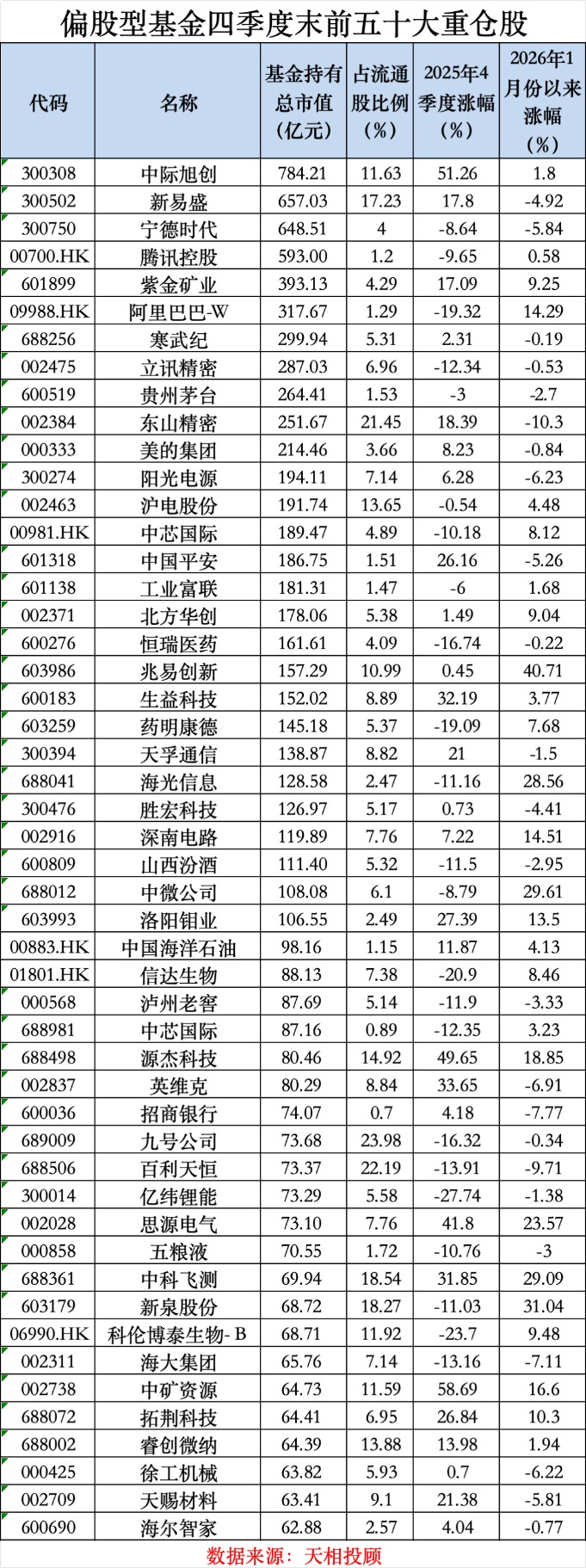
【导读】偏股型基金四季度末重仓股榜单出炉 在持续一年多的科技股牛市推动下,公募基金头号重仓股的宝座也让位于光模块巨头。 1月22日,公募基金2025年四季报披露完毕,偏股型基金四季度重仓股也随之出炉。天相投顾数据显 示,去年四季度,"易中天"三大巨头中的中际旭创、新易盛分别取代宁德时代、腾讯控股,位列公募基 金第一、第二重仓股,宁德时代、腾讯控股分别退居第三、第四大重仓股。 新易盛的情况类似,尽管偏股型基金小幅减持,持股市值仍然在股价上涨的带动下大幅增长,从而推动 座次上升。 中国平安是唯一挤入前二十大重仓股的"新面孔",从三季度末的第41名升至四季度末的第15名。 最新数据显示,信息技术板块在去年四季度获得基金较多增持。在偏股型基金增持榜前五名中,有4只 个股属于信息技术板块,保险板块中的中国平安也获得较大力度的加仓。 中际旭创登顶偏股型基金第一大重仓股 数据显示,截至去年四季度末,纳入统计的5458只积极投资偏股型基金的前十大重仓股分别为中际旭 创、新易盛、宁德时代、腾讯控股、紫金矿业、阿里巴巴-W、寒武纪、立讯精密、贵州茅台、东山精 密。 | | | 偏股型基金四季度末前五十大重仓股 | | | | | ...






见证历史!第一重仓股,变了
中国基金报· 2026-01-22 14:11
Core Viewpoint - The article highlights the significant changes in the top holdings of equity funds at the end of the fourth quarter, with Zhongji Xuchuang and Xinyi Sheng replacing CATL and Tencent as the top two holdings, reflecting a shift towards technology stocks driven by a prolonged bull market in the sector [2][3][8]. Group 1: Top Holdings - As of the end of the fourth quarter, the top ten holdings of 5,458 actively managed equity funds included Zhongji Xuchuang, Xinyi Sheng, CATL, Tencent, Zijin Mining, Alibaba-W, Cambricon, Luxshare Precision, Kweichow Moutai, and Dongshan Precision [4][8]. - Zhongji Xuchuang emerged as the largest holding with a market value of 78.42 billion yuan, despite a reduction in shares held by 970,140 shares, a decrease of 7.02% from the previous quarter [5][8]. - Xinyi Sheng also saw a similar trend, with a slight reduction in holdings but a significant increase in market value due to stock price appreciation [8]. Group 2: Sector Trends - The information technology sector received substantial increases in fund allocations, with four out of the top five increased holdings belonging to this sector, alongside significant investments in the insurance sector, particularly in China Ping An [2][10]. - The article notes that the top five increased holdings in equity funds were Zhongji Xuchuang, China Ping An, Dongshan Precision, Xinyi Sheng, and others, indicating a strong preference for technology and financial sectors [11][12]. Group 3: Fund Activity - The article reports that the fourth quarter saw a general trend of reduced holdings in major tech stocks, with Alibaba-W, Tencent, and others being among the most significantly reduced [16][18]. - The reduction in holdings for these stocks was attributed to their poor performance in the Hang Seng Tech Index, with Alibaba-W and Tencent seeing reductions of 183.46 million yuan and 106.18 million yuan, respectively [17][18]. - Conversely, several stocks that doubled in price during the fourth quarter, such as Tianhua New Energy and Maiwei, experienced significant increases in fund holdings, reflecting a shift in investment strategy towards high-growth potential stocks [14].

腾讯汤道生:中国市场普遍关注AI应用的收益与成本
Sou Hu Cai Jing· 2026-01-22 13:53
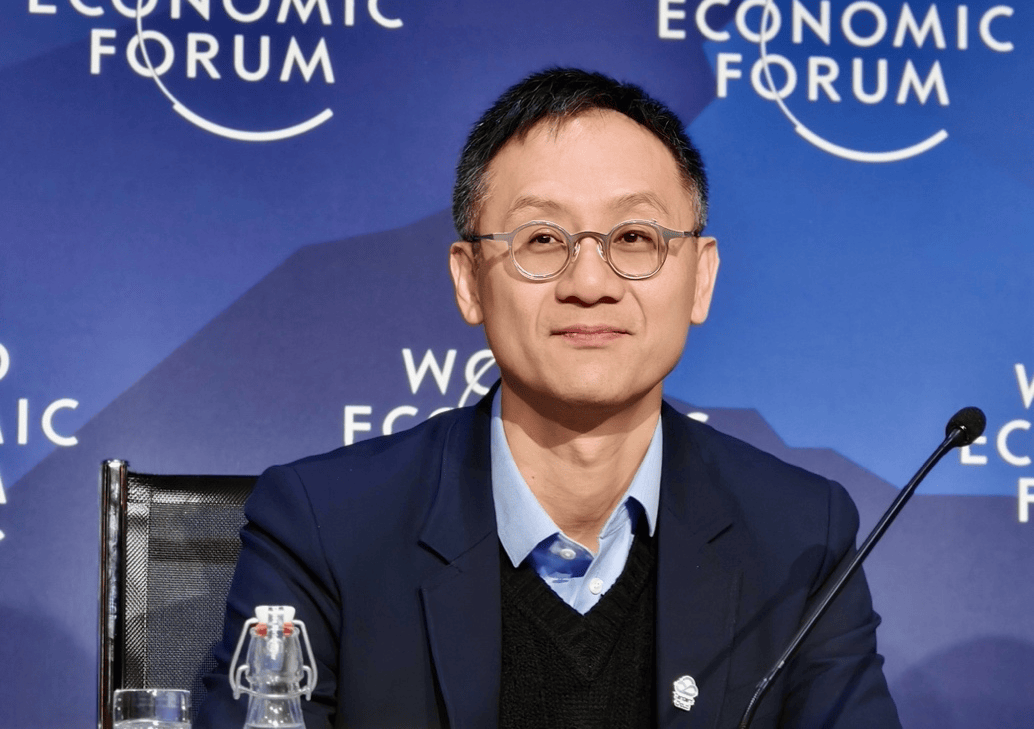
Group 1 - The core strategy of Tencent's cloud services is to support various AI models, allowing customers to choose the appropriate model for their needs [2] - A survey by the World Economic Forum indicates that 87% of Chinese enterprises plan to increase AI investments, highlighting AI as a key driver of productivity and long-term competitiveness [2] - Tencent has over 12,000 engineers using the AI programming assistant CodeBuddy, with more than 50% of new code being AI-assisted, resulting in an average coding time reduction of over 40% [3] Group 2 - Tencent's AI has been implemented across more than 30 industries, including retail, healthcare, and education, demonstrating its capability to enhance efficiency and drive industry growth [4] - AI is transforming Tencent's operations, leading to quantifiable benefits such as a 21% year-on-year increase in marketing service revenue and a 22.8% increase in gaming revenue [3] - The Chinese AI ecosystem is characterized by a diverse range of model companies and a strong open-source culture, providing flexibility for customers to select suitable models for different scenarios [3][4] Group 3 - The acceleration of AI development in China is attributed to sustained R&D investment, talent density, and innovative breakthroughs in model technology [6] - AI is deeply integrating with strategic sectors such as manufacturing, healthcare, finance, energy, retail, and education, creating a fertile ground for rapid validation and deployment of AI technologies [6] - Tencent emphasizes the importance of encouraging the new generation to utilize free AI tools for learning, fostering curiosity and adaptability in an AI-driven educational environment [5]
不允许导出微信聊天记录?腾讯回应
新华网财经· 2026-01-22 13:17
DMCA全称为Digital Millennium Copyright Act(《数字千年版权法》),是美国在1998年颁布的一部核心版权法律,专门针对数字环 境下的版权保护,也是全球互联网平台处理侵权投诉的"通用规则"之一。 机器人将再度登上央视春晚! 上述事件发生后,引发了外界对"用户无法获取自身聊天记录"的讨论,认为"用户数据主权被架空","自己的数据自己不能做主"。 据悉,此次被下架的项目核心功能为解析微信本地加密数据库,实现聊天记录导出、缓存清理等操作。此前据报道,腾讯在投诉函中援引 DMCA(《数字千年版权法》)第1201条,指控此类工具构成"未经授权规避技术保护措施",同时违反微信服务条款中禁止逆向工程的约 定,且可能因代码漏洞导致用户数据被第三方窃取,侵犯微信存储格式、加密协议等知识产权。截至目前,多数涉事开发者已删库停更, GitHub也对衍生仓库进行清理。 其中被下架的一款项目WeChat Clean,系用于帮助用户导出或清理微信聊天记录及缓存数据,以解决微信占用设备存储空间过大及管理用 户数据权利被剥夺的问题。 去年4月,微信安全中心曾发布公告称,发现有部分第三方工具以"AI管理用户微信 ...

【太平洋科技-每日观点&资讯】(2026-01-23)
远峰电子· 2026-01-22 13:00
Market Overview - Major indices showed positive performance with ChiNext Index up by 1.01%, North Star 50 by 0.69%, Shenzhen Component Index by 0.50%, Sci-Tech 50 by 0.41%, and Shanghai Composite Index by 0.14% [1] - TMT sector led the gains with SW Communication Network Equipment and Devices increasing by 4.15%, SW Printed Circuit Board by 3.84%, and SW Horizontal General Software by 3.19% [1] - Conversely, TMT sector also saw declines with SW Integrated Circuit Packaging and Testing down by 3.65%, SW Semiconductor Equipment by 2.28%, and SW Semiconductor Materials by 2.09% [1] Domestic News - BlueTech Optical raised 1.055 billion for AR optical product industrialization, with 500 million allocated for advanced production and testing equipment [2] - Fudan University team successfully created large-scale integrated circuits within flexible polymer fibers, achieving high precision interconnections [2] - Passive component manufacturer Huaxin announced a price increase for resistors effective February 1, aligning with industry leader Yageo's plans [2] - Yuexin Semiconductor's fourth-phase project commenced, with a total investment of approximately 25.2 billion for a production line capable of 40,000 12-inch wafers per month [2] Overseas News - Kioxia's storage division reported that its 2026 production capacity is sold out, and it plans to enhance factory efficiency to meet demand [3] - Cadence partnered with Microsoft to develop a high-performance, low-power memory system for data centers, set for deployment in Microsoft's facilities [3] - The EU Commission proposed a draft revision of the Cybersecurity Law, aiming to phase out high-risk suppliers in 18 critical infrastructure sectors [3] - Display industry trends indicate that panel manufacturers are adjusting utilization rates to balance supply and demand, with expectations for price increases in 2026 [3] AI News - Adobe introduced new AI features in Acrobat for document review and content creation, enhancing workflow efficiency [4] - Baidu launched the Wenxin large model 5.0, featuring 2.4 trillion parameters and advanced multimodal capabilities [4] - Tencent Cloud released CodeBuddy 2.0, enhancing AI application development capabilities for enterprises [4] - Microsoft Research introduced the Rho-alpha AI model, capable of interpreting natural language commands for complex robotic tasks [4] Industry Tracking - China's commercial space sector is projected to complete 50 launches in 2025, accounting for 54% of total launches, with 311 commercial satellites entering orbit [5] - A high-throughput flexible brain-computer interface system was developed, achieving real-time Chinese language decoding [5] - A pilot production line for 6N-grade synthetic quartz sand was established in Liaoning with an investment of 3.36 million [5] - UBTECH Robotics signed a cooperation agreement with Airbus to supply robotic products for aerospace manufacturing [5] Earnings Forecasts - Yidao Information expects a net profit of 60 million to 78 million for 2025, a year-on-year increase of 76.04% to 128.85% [6] - Zhaoyi Innovation anticipates a net profit of 1.61 billion for 2025, up 46% year-on-year [6] - Ruichuang Micro expects a net profit of 1.1 billion for 2025, reflecting a 93% increase [6] - Founder Technology forecasts a net profit of 430 million to 510 million for 2025, a growth of 67.06% to 98.14% [6] High-Frequency Data Updates - As of January 22, 2023, international DRAM spot prices showed varied trends, with DDR5 16G averaging $36.667, unchanged from the previous day [7] - Semiconductor material prices were updated, with 4N zinc oxide powder priced at 1,495 yuan per kilogram, reflecting a daily increase of 10 yuan [7]


西部利得港股通新机遇混合A:2025年第四季度利润76.21万元 净值增长率4.58%
Sou Hu Cai Jing· 2026-01-22 12:21
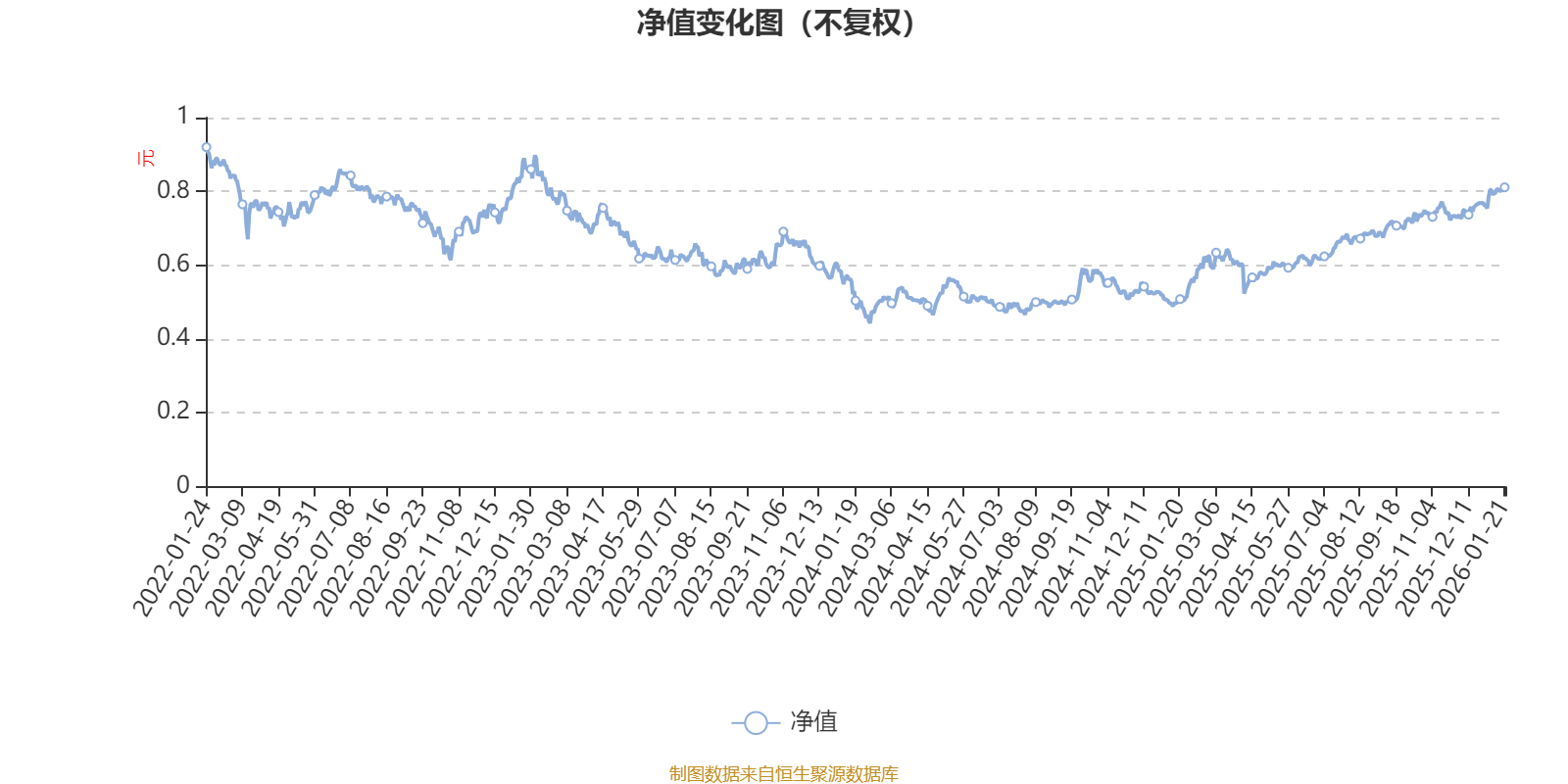
Core Insights - The AI Fund West China Gain Hong Kong Stock Connect New Opportunities Mixed A (008861) reported a profit of 762,100 yuan for Q4 2025, with a weighted average profit per fund share of 0.0342 yuan [3] - The fund's net asset value growth rate for the reporting period was 4.58%, and the fund size reached 15.5946 million yuan by the end of Q4 [3] - The fund manager highlighted that the Hong Kong stock market experienced adjustments in Q4 due to fluctuating expectations of interest rate cuts and tariffs, with notable performance in the Hang Seng materials, finance, and energy sectors [3] Fund Performance - As of January 21, the fund's three-month cumulative net asset value growth rate was 9.77%, ranking 542 out of 1,286 comparable funds [4] - The fund's six-month cumulative net asset value growth rate was 22.31%, ranking 624 out of 1,286 comparable funds [4] - The fund's one-year cumulative net asset value growth rate was 58.35%, ranking 213 out of 1,286 comparable funds [4] - The fund's three-year cumulative net asset value growth rate was -5.88%, ranking 1,088 out of 1,286 comparable funds [4] Risk Metrics - The fund's three-year Sharpe ratio was 0.2164, ranking 1,022 out of 1,275 comparable funds [9] - The maximum drawdown over the past three years was 50.65%, ranking 1,201 out of 1,264 comparable funds [12] - The largest single-quarter drawdown occurred in Q1 2022, at 28.84% [12] Investment Strategy - The fund maintained an average stock position of 81.95% over the past three years, compared to a peer average of 72.57% [15] - The fund reached its highest stock position of 90.04% by the end of Q3 2025, with a lowest position of 72.27% in the first half of 2023 [15] - The fund's top ten holdings include major companies such as Ping An Insurance, China Life, Alibaba, and Tencent [19]


走出舱门就是“战场”:不拼价格拼AI 云巨头“军备竞赛”升级了
Di Yi Cai Jing· 2026-01-22 12:06
从具体应用看,杨晨告诉记者,Agent需求去年下半年开始井喷,一些有一定体量的客户希望搭建自己 的智能体应用平台,选择私有或混合域部署,另一些客户选择公有云,公有云上的AI服务以SaaS方式 呈现。 飞机降落到深圳宝安机场,从踏出飞机舱门那一刻起,迎面扑来的是各种云广告。这是过去一年第一财 经记者常遇到的场景。在北京首都机场,情况也是如此。这些广告来自阿里云、百度智能云、火山引擎 等,关键词不外乎"AI"。为了突出优势,各家厂商都选择了最有利于自己的市场份额统计口径,将其转 化为广告语上的关键优势。 近期一场采访上,有媒体提到机场的云计算广告,并提问业内竞争与前几年的区别,一家头部云厂商高 管回答称,业内竞争的战场与以前不太一样,"原来(比拼)计算、存储、网络,后来拼大数据、数据 库能力,再后来拼AI能力。整个云基础设施、AI模型(的表现)都是竞争中很重要的衡量标准。今天 的竞争更加激烈。" 另一家已上市云计算厂商高管对第一财经记者直言,机场广告是大厂这些有钱的公司签的,对他的公司 来说,花1000万投一个广告不如用来做市场客户活动。 不论如何,机场广告战的出现折射出业内竞争的激烈程度,近期一些云厂商也披露了 ...
兴业证券基金四季报拆解:加仓有色与金融 减持电子与医药
Zhi Tong Cai Jing· 2026-01-22 11:57
Core Viewpoint - As of January 22, 2026, the disclosure rate of active equity funds' quarterly reports reached 100%, with a slight decrease in overall positions but remaining at historically high levels [2][3] Fund Positioning - Active equity funds' positions decreased by 0.83 percentage points to 86.6%, still the second highest level after Q3 2025, with ordinary stock, mixed equity, and flexible allocation funds decreasing by 0.5, 0.8, and 0.9 percentage points respectively [3] - The ChiNext board saw an increase in positions by 1.2 percentage points to 25.0%, while the Sci-Tech Innovation board decreased by 0.9 percentage points to 16.6%, and the main board decreased by 0.3 percentage points to 58.2% [3] Sector Allocation - The sectors with the highest increases in positions were non-ferrous metals (+2.3 percentage points), communication (+1.9 percentage points), and non-bank financials (+0.9 percentage points), with non-ferrous metals increasing for four consecutive quarters and communication for three [3] - The sectors with the largest decreases were electronics (-1.7 percentage points), pharmaceuticals and biology (-1.5 percentage points), and media (-1.2 percentage points) [3] Sub-sector Insights - In the secondary industry, the sectors with the highest increases were communication equipment (+1.9 percentage points), industrial metals (+1.2 percentage points), and insurance (+0.9 percentage points), while the largest decreases were in consumer electronics (-1.9 percentage points), batteries (-1.3 percentage points), and chemical pharmaceuticals (-1.0 percentage points) [3] Stock Performance - The stocks with the highest increases in positions included Zhongji Xuchuang, Xinyi Technology, Dongshan Precision, China Ping An, and Zijin Mining, while the stocks with the largest decreases included Industrial Fulian, Yiwei Lithium Energy, CATL, Luxshare Precision, and Focus Media [3] Hong Kong Market Overview - In the Hong Kong market, the active equity positions decreased by 3.1 percentage points to 16.0%, with increases in financials, materials, and energy sectors, while decreases were seen in non-essential consumer, information technology, and healthcare sectors [3] - The most increased stocks were China Ping An H, CNOOC H, and China Life H, while the most decreased stocks were Alibaba, Tencent Holdings, and SMIC [3]




走出舱门就是“战场”:不拼价格拼AI,云巨头“军备竞赛”升级了
Di Yi Cai Jing· 2026-01-22 11:44
Core Insights - The competition in the cloud computing market has intensified, particularly in the AI sector, with companies focusing on different metrics to highlight their advantages [1][4] - Major cloud providers like Tencent Cloud and Alibaba Cloud have reported significant growth in AI-related products and services, indicating a robust market expansion [2][4] Group 1: Market Dynamics - The cloud computing market is expected to expand significantly due to the demand driven by AI, with predictions that the incremental growth in the AI cloud market will exceed the total growth of the previous year [4] - Companies are experiencing a shift in competition from resource-based metrics to application-based solutions, emphasizing the need for innovative use cases rather than just price competition [5][6] Group 2: Company Performance - Tencent Cloud reported a doubling of orders related to AI and SaaS products, with AI model product revenue increasing over 50 times in two years [2] - Alibaba Cloud aims to capture 80% of the incremental growth in China's AI cloud market by 2026, indicating aggressive growth targets [2] Group 3: Pricing Strategies - A price war has emerged among major cloud providers, with companies like Alibaba Cloud and Tencent Cloud announcing reductions in the cost of AI models and services [5] - The focus on token consumption as a primary business model is deemed unsustainable, with a call for companies to develop applications that enhance user engagement rather than merely competing on price [5][6] Group 4: Future Outlook - The cloud market is anticipated to shift towards solving specific business problems using AI, moving away from a focus solely on resource sales [6][7] - The competitive landscape is evolving, with leading model providers narrowing the performance gap, suggesting that future competition will hinge on the ability to address real-world challenges [7]

大模型Infra新突破!腾讯混元开源LLM推理算子库,推理吞吐提升30%
量子位· 2026-01-22 11:13
Core Viewpoint - In the competition of large models, computational efficiency has become a critical bottleneck for AI applications and development, necessitating a shift from merely stacking GPUs to enhancing efficiency [1][7]. Group 1: HPC-Ops Development - Tencent's Mix Yuan AI Infra team has open-sourced a high-performance LLM inference core operator library called HPC-Ops to address performance issues with mainstream operator libraries like H20 [2][15]. - HPC-Ops is built from scratch using CUDA and CuTe, featuring deep architectural adaptations and optimizations to lower the development threshold for core operators, achieving significant performance breakthroughs [4][15]. Group 2: Performance Improvements - The inference performance of the Mix Yuan model has improved by 30% and the DeepSeek model by 17% when utilizing HPC-Ops [5][27]. - HPC-Ops has achieved up to 2.22 times performance improvement in Attention compared to FlashInfer/FlashAttention, 1.88 times in GroupGEMM compared to DeepGEMM, and 1.49 times in FusedMoE compared to TensorRT-LLM [6][47]. Group 3: Pain Points of Existing Operator Libraries - Current mainstream operator libraries are costly to use, complex in design, and require deep familiarity with the code, making adaptation difficult for ordinary AI researchers [11]. - Existing state-of-the-art (SOTA) operator libraries often fail to leverage the full performance potential of hardware, particularly on inference cards like H20, which differ from high-end training cards [8][13]. Group 4: Technical Innovations - HPC-Ops includes modules for FusedMoE, Attention, and GroupGEMM, with optimizations that align task characteristics with hardware capabilities, achieving over 80% of the hardware peak bandwidth [20][47]. - The library employs persistent kernels to hide overhead and uses innovative data rearrangement techniques to enhance performance, achieving superior results compared to current SOTA implementations [24][28]. Group 5: Future Development Directions - HPC-Ops aims to focus on developing sparse Attention operators to address memory and computational bottlenecks in long-context large models and to expand quantization strategies to include mixed precision [50]. - The library will also explore optimization of computation-communication coordination to reduce communication overhead in distributed inference scenarios, supporting the efficient deployment of ultra-large models [51].