TENCENT(00700)

Search documents
用AI清退全部外包?网易回应;百度挖DeepSeek核心人才入职;曝宇树对外称弹性双休,内部是另一套规则,非常卷|AI周报
AI前线· 2026-03-22 05:33
Group 1 - DeepSeek core talent has joined Baidu, but it is not the rumored Guo Daye, raising industry speculation [3][4] - Baidu's internal personnel changes include the departure of Zhao Shiqi and the appointment of He Jingzhou as the head of the new Baidu APP R&D Center [4][5] - Tencent has dissolved its AI Lab, reallocating personnel to the large language model department and the industry-academia-research cooperation center [6] Group 2 - A programmer from Yushun Technology claims that the company promotes flexible working hours externally, but internally maintains a demanding work culture [7][8] - Yushun Technology has filed for an IPO on the STAR Market, aiming to raise 4.202 billion yuan [9] - NetEase responded to rumors of "AI layoffs of all outsourced employees," stating that recent personnel changes are part of normal business adjustments [10][11] Group 3 - A man was detained for spreading false rumors about iFlytek planning to lay off 30% of its workforce [12][13] - Cheetah Mobile's chairman, Fu Sheng, publicly criticized Qihoo 360's founder Zhou Hongyi over a debt dispute [14] - Cursor's new model faced accusations of being a rebranded version of Kimi K2.5, which the company later acknowledged [15][17] Group 4 - Major layoffs in the tech industry include Dell announcing a 10% workforce reduction, affecting approximately 11,000 employees, with severance costs around 5.69 billion USD [21][22] - Japan's Rakuten AI 3.0 was criticized for allegedly copying the architecture of China's DeepSeek V3, leading to public backlash [23][24][25] - OpenAI plans to acquire the startup Astral to enhance its Codex project, expanding its developer service tools [26][27] Group 5 - Alibaba has established a new business unit, Alibaba Token Hub, to consolidate its AI services and development efforts [28][29] - AI computing and storage product prices have increased by 5%-34% due to rising demand and supply chain costs [30] - ByteDance's "Doubao AI glasses" production plans have been delayed, with a focus on ensuring product differentiation [31]





微信可以用“龙虾”了
财联社· 2026-03-22 05:02
Core Viewpoint - Tencent has launched the WeChat "ClawBot" plugin, enabling users to connect OpenClaw for efficient interaction through WeChat chat [1] Group 1 - The WeChat "ClawBot" plugin allows users to scan a code or copy a command to integrate OpenClaw into WeChat [1] - Once connected, users can quickly interact with their "lobster" through WeChat [1] - Tencent's "Shrimp Workshop" cloud shrimp Lighthouse, self-developed shrimp workbuddy, and local shrimp QClaw are all in place [1]

微信可以用“龙虾”了!
证券时报· 2026-03-22 04:25
Core Viewpoint - Tencent has launched the "ClawBot" plugin for WeChat, enabling users to connect with OpenClaw for efficient interactions through chat [2]. Group 1: Product Launch and Features - On March 22, Tencent officially introduced the "ClawBot" plugin, allowing users to integrate OpenClaw into WeChat by scanning a QR code or copying a command [2]. - Users can send commands to "龙虾" (OpenClaw) and receive replies within WeChat, facilitating applications in learning, work, and creative scenarios [10]. Group 2: Installation and User Engagement - The installation path for the plugin is found under "Me—Settings—Plugins," where users can view terminal installation instructions [3]. - A nationwide free installation plan for Tencent's "龙虾" (OpenClaw) was announced, with experts providing on-site support in 17 cities over 40 days [13]. - Specific installation events are scheduled in Shenzhen, Shanghai, and Beijing, where users can attend without prior registration [16]. Group 3: Financial and Strategic Insights - Tencent's latest financial report indicates that 2025 will be a pivotal year for accelerating AI initiatives, with products like OpenClaw gaining popularity since the 2026 Spring Festival [12]. - The company is rapidly integrating various products to create an ecosystem that supports personal, developer, and enterprise needs, significantly lowering the usage threshold [12].

微信可以用龙虾了!
21世纪经济报道· 2026-03-22 04:10
3月22日,据腾讯公众号, 微信正式推出微信"ClawBot"插件,支持接入OpenClaw 。用户扫码或复制命令,即可将OpenClaw接入微信。连 接后,用户就能通过微信聊天的方式,快速调用自己的"龙虾"高效互动。除此之外,腾讯"养虾车间"云端虾Lighthouse、自研虾workbuddy、 本地虾QClaw等均已就位。 3月18日,腾讯董事会主席兼首席执行官马化腾在财报沟通会中首次谈及"龙虾类应用"。他表示,龙虾类应用在办公等场景下打造了新的去中 心化入口,不仅具备模拟助理的"活人感",也为正在规划中的微信AI开发带来了启发。 马化腾指出,"龙虾"应用与IM(即时通讯软件)结合化解了等待焦虑,且拥有个性与记忆。他透露,微信小程序未来也可被智能化和"龙虾 化",供智能体调用互动。此外,腾讯在设计生态时将兼顾中心化与去中心化,避免服务商被管道化,保障自身流量与长期发展。因此,微信 相关AI产品的推出需要"慢工出细活",考虑生态可持续发展,希望外界多点耐心。 腾讯字节阿里集体"养龙虾" 据中新经纬不完全统计,字节、腾讯、阿里等11家互联网大厂、科技企业已陆续推出OpenClaw产品。而早在1月,京东便已官宣 ...

刚刚,微信可以连接龙虾了
新华网财经· 2026-03-22 03:45
Core Viewpoint - Tencent has officially launched the WeChat "ClawBot" plugin, allowing users to connect OpenClaw to WeChat for quick access to their "lobster" via chat [1]. Group 1: Plugin Features - Users can scan a QR code or copy commands to integrate OpenClaw with WeChat [1]. - The plugin enables users to send commands to OpenClaw and receive replies directly within WeChat, facilitating usage in various scenarios such as learning, work, and creation [9][10]. Group 2: Installation Steps - The first step involves accessing the WeChat settings to find the plugin section [3]. - The second step requires users to install the WeChat plugin on the device running OpenClaw using a specific command [5]. - The final step is to scan a QR code to activate the WeChat ClawBot plugin for use [7].
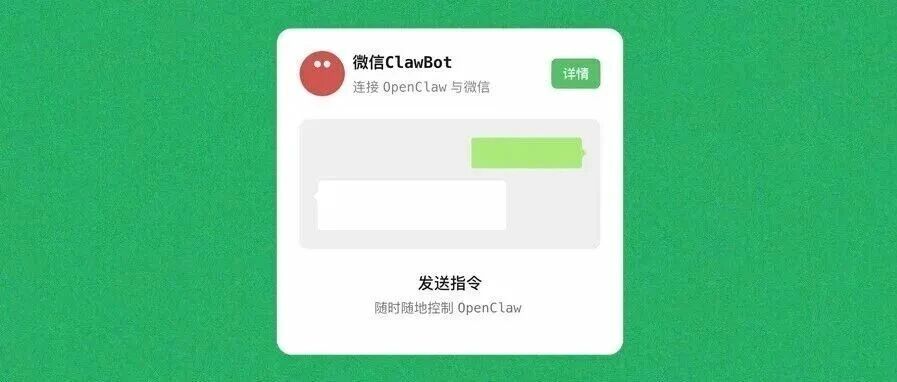
微信推出官方龙虾插件
第一财经· 2026-03-22 02:43
Core Viewpoint - Tencent has officially launched the WeChat "ClawBot" plugin, enabling integration with OpenClaw for enhanced user interaction through WeChat [1] Group 1 - The WeChat "ClawBot" plugin allows users to connect OpenClaw by scanning a code or copying a command, facilitating quick access to their "lobster" for efficient interaction [1] - Tencent's "Shrimp Workshop" cloud shrimp Lighthouse, self-developed shrimp workbuddy, and local shrimp QClaw are all in place to support this integration [1]
AI周报|黄仁勋抛出英伟达万亿美元收入预期;三星面临史上最大罢工威胁
Di Yi Cai Jing· 2026-03-22 01:52
Group 1: Nvidia's Revenue Forecast - Nvidia CEO Jensen Huang predicts revenue from Blackwell and Rubin will reach $1 trillion from 2025 to 2027, up from a previous estimate of $500 billion [1] - The revenue forecast does not include income from CPUs, Groq, storage systems, and other diversified business lines [1] - Nvidia's product lineup is expanding, showcasing collaborative design and vertical integration, with implications for space computing and autonomous driving [1] Group 2: AI Impact on Workforce - Huang asserts that AI will not eliminate jobs but will make people busier, similar to past technological advancements [2] - The efficiency brought by AI allows tasks to be completed faster, leading to increased workloads rather than leisure time [2] - Historical examples suggest that technological progress creates new job opportunities despite initial fears of job loss [2] Group 3: Alibaba's New Business Unit - Alibaba is forming a new business unit called Alibaba Token Hub to consolidate its AI services and R&D efforts [3] - The unit will oversee the development of the Qwen large model and integrate various AI-related products [3] - This restructuring aims to enhance collaboration among teams and signals Alibaba's intent to commercialize AI [3] Group 4: Baidu's Organizational Changes - Baidu has appointed He Jingzhou to lead the APP development center, promoting the integration of large models with search and recommendation services [4] - This personnel change is part of a broader strategy to enhance the application of cutting-edge technologies in core business areas [4] - The move reflects Baidu's commitment to leveraging AI to reconstruct its core products and improve competitiveness [4] Group 5: Samsung's Labor Issues - Samsung Electronics faces a significant strike threat, with a 93.1% approval rate for a planned 18-day strike starting in late May [6] - The strike could disrupt production and exacerbate global semiconductor supply shortages, with potential losses estimated between 5 trillion to 9 trillion KRW (approximately 230 million to 414 million RMB) [6] Group 6: Kioxia's Production Changes - Kioxia has announced the discontinuation of TSOP packaging products due to lifecycle, market demand, and production constraints [7] - The shift in focus towards high-performance storage products for AI data centers indicates a strategic realignment in the semiconductor industry [7] - The industry is increasingly prioritizing advanced technologies like PCIe 5.0 and QLC SSDs over older storage solutions [7] Group 7: Tencent's AI Investment - Tencent's Q4 revenue reached 194.37 billion RMB, with AI being a key focus area, driving growth in content production and marketing efficiency [8] - The company plans to double its investment in AI products this year, following a 180 billion RMB investment last year [8] - Despite the commitment to AI, Tencent's stock price fell by 6.81% after the earnings report, indicating market skepticism [8] Group 8: OpenAI's New Model Launch - OpenAI has introduced two new small models, GPT-5.4 mini and nano, optimized for high-frequency workloads with lower latency and cost [10][11] - These models aim to provide developers with options for building systems that combine large and small models for efficient task execution [11] - The competitive landscape for AI models is intensifying, particularly with lower-priced alternatives from Chinese developers [11] Group 9: Google and Apple Collaboration - Google is testing a native Gemini application for macOS, moving beyond web-based access to enhance user experience [12] - This development reflects a deeper integration of Google's AI capabilities within Apple's ecosystem, balancing competition and collaboration [12] Group 10: Rakuten's AI Model Controversy - Rakuten's new AI model has been criticized for closely resembling a Chinese open-source model without proper attribution [13] - The controversy highlights issues of transparency and ethical considerations in AI development and commercialization [13] Group 11: AI Model Poisoning Incident - A recent report revealed that an AI model was manipulated to promote false information, raising concerns about the integrity of AI systems [14] - The incident underscores the importance of maintaining authenticity and trust in AI-driven information dissemination [14] Group 12: BioMap's IPO Plans - BioMap, an AI life sciences company led by Baidu's Li Yanhong, has reportedly filed for an IPO in Hong Kong to raise several hundred million dollars [15] - The company aims to address challenges in the AI and biopharmaceutical sectors, facing competition from established players [15][16] Group 13: KH Robotics Formation - KH Robotics, a joint venture between Kandi Technology and HawkRobo, will focus on deploying quadruped robots for security inspections in North America [17] - The venture aims to address labor challenges in the logistics sector, with plans for commercial delivery by 2026 [17]


独家丨腾讯 AI Lab 撤销背后:俞栋离职是最大导火索
雷峰网· 2026-03-22 00:34
Group 1 - Tencent AI Lab is undergoing significant changes, including the departure of key personnel and a restructuring aimed at breaking down departmental barriers to enhance collaboration and innovation [5][12][14] - The recent all-hands meeting led by Yao Shunyu indicated a shift towards a more youthful and direct approach in AI model development, reflecting a proactive stance in addressing internal challenges [5][16] - The departure of notable figures such as Yu Dong and Jiang Jie has raised concerns about the stability and future direction of the AI Lab, highlighting a trend of talent loss that has been ongoing since the latter part of Zhang Zhengyou's leadership [11][12][14] Group 2 - The current structure of Tencent's AI research has evolved significantly from the original AI Lab framework, with a focus on the mixed Yuan model team led by Yao Shunyu, which encompasses various specialized groups [16][17] - Yao Shunyu has set ambitious goals for the mixed Yuan model, aiming to position the company among the top tier in the domestic market for medium-sized models by June 2026 [17] - The integration of teams and talent from other companies, including ByteDance and Alibaba, indicates a strategic move to bolster the capabilities of Tencent's AI initiatives [16]

独家丨腾讯云AI业务突发调整,CTO王慧星接手云产品三部
雷峰网· 2026-03-22 00:34
Core Viewpoint - Tencent is undergoing a significant organizational restructuring within its cloud division, particularly affecting the management and distribution of personnel across its product departments [2][3]. Group 1: Organizational Changes - Tencent has decided to reassign the management of its Cloud Product Division Three from Wu Yunsheng to Wang Huixing, who is the CTO of Tencent Cloud [2]. - The restructuring includes plans to transfer several personnel and business operations related to computing training platforms to the IaaS team, with additional adjustments ongoing [2]. - Tencent Cloud consists of five main product departments, each responsible for different areas such as computing, PaaS platforms, AI development, and CDN-related services [2]. Group 2: Key Personnel - Wu Yunsheng, a veteran at Tencent since 2007, has a background in various product roles and was previously responsible for the AI-related Cloud Product Division Three [3]. - Wang Huixing was promoted to Tencent Group Vice President and oversees multiple product departments, including the second and fourth product departments, as well as cloud technology operations [3].
任泽平带你看前沿科技:2026研学计划
泽平宏观· 2026-03-21 17:01
Core Insights - The article emphasizes the importance of practical learning experiences in cutting-edge technology sectors, aiming to connect entrepreneurs with leading companies and experts in the field [4][13][25]. Schedule Overview - The schedule for 2025 includes visits to major tech companies and events such as CES, featuring industry leaders like NVIDIA, Tesla, and Google, as well as academic institutions like Stanford and UC Berkeley [7][8]. - Specific events include closed-door research meetings focusing on AI and robotics, with participation from companies like Huawei and various leading robotics firms [9][10]. Learning Objectives - The program aims to provide deep insights into the strategic decisions and technological advancements of top companies, facilitating direct dialogue with founders and executives [13][25]. - It focuses on three main dimensions: emerging technology trends, new industry ecosystems, and innovative business strategies, helping entrepreneurs identify investment opportunities and drive practical innovation [13][25]. Past Activities - In 2023, participants visited notable companies such as Huawei, ByteDance, and NIO, engaging with prominent entrepreneurs for firsthand insights [24]. - The 2024 agenda includes visits to companies like BYD, Tencent, and JD.com, focusing on themes like artificial intelligence and renewable energy [25]. Future Aspirations - The program aims to continue exploring new investment opportunities in frontier technologies, with plans to visit leading firms in robotics, autonomous driving, and advanced sensing technologies [25]. - The initiative seeks to foster a community of entrepreneurs and investors, enhancing their understanding of macroeconomic trends and industry dynamics [48].