CHINA UNICOM(00762)

Search documents
【用AI联通】探访“数字桃花源”:联通AI让小山村C位出道
Qi Lu Wan Bao· 2025-06-27 04:04
Core Insights - The article highlights the transformative impact of AI and digital technology on the rural economy of Dasha Yu Village in Shandong, showcasing significant improvements in agriculture, tourism, and environmental protection through digitalization and AI integration [1][16]. Group 1: Agricultural Transformation - The introduction of AI-driven solutions has led to a substantial increase in agricultural productivity, with the yellow peach yield quality improving from 65% to 91% and a reduction in agricultural resource waste by 18% [5][9]. - The deployment of 1,260 IoT sensors across 3,700 acres of peach orchards allows for real-time data analysis, enhancing decision-making for farmers [5][9]. - The AI-powered sorting system has increased the commercialization rate of peaches from 35% to 89%, while reducing the loss rate from 23% to 7% [9]. Group 2: Economic Growth and E-commerce - The village's e-commerce sales exceeded 20 million yuan in 2024, with daily express delivery orders rising from 17 to 460 [9]. - The integration of AI in agriculture has enabled 62 impoverished households to increase their annual income by an average of 18,000 yuan [9]. - The village has received multiple honors, including being recognized as a national pilot for comprehensive rural reform [1]. Group 3: Tourism Development - AI technology has enhanced the tourism experience by generating personalized travel itineraries and managing visitor flow, resulting in an increase in average stay duration from 1.5 days to 3 days [16][18]. - The village's tourism revenue surged to over 5 million yuan, an 18-fold increase compared to before the digital transformation [18]. - The 2024 Peach Blossom Festival attracted 1.32 million online viewers, showcasing the effectiveness of AI in promoting local tourism [18]. Group 4: Environmental Protection - AI has been utilized for forest fire prevention, reducing response time from 40 minutes to 8 minutes and successfully intercepting three major fire hazards in 2024 [15]. - The AI system has significantly lowered forest protection costs by 65% and eliminated monitoring blind spots [15]. Group 5: Digital Empowerment and Community Engagement - The village has established a digital incubation center where new farmers receive training in agricultural live streaming, leading to increased visibility and sales for local products [11][13]. - The community has embraced a new model of "daytime harvesting, nighttime selling," creating 26 new jobs in the process [13].



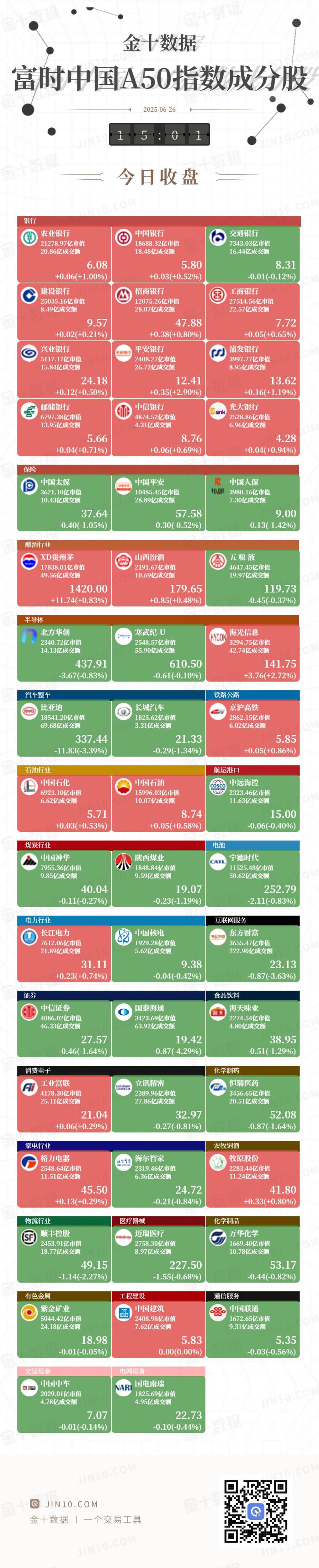
金十图示:2025年06月26日(周四)富时中国A50指数成分股今日收盘行情一览:银行股午后上涨,普遍飘红,保险股维持跌势
news flash· 2025-06-26 07:08
Market Overview - The FTSE China A50 Index component stocks showed a mixed performance with bank stocks rising in the afternoon while insurance stocks continued to decline [1][5]. Banking Sector - Bank stocks generally performed well, contributing to the positive movement in the FTSE China A50 Index [1]. Insurance Sector - Major insurance companies such as China Pacific Insurance, China Life Insurance, and Ping An Insurance experienced declines in their stock prices, with China Pacific Insurance down by 1.05%, China Life down by 0.52%, and Ping An down by 1.42% [3]. Alcohol Industry - In the alcohol sector, Kweichow Moutai saw a slight increase of 0.48%, while Shanxi Fenjiu and Wuliangye experienced declines of 0.37% and 0.83% respectively [3]. Semiconductor Industry - The semiconductor companies showed varied results, with North Huachuang increasing by 2.72%, while Cambrian and Haiguang Information saw minor declines [3]. Automotive Sector - In the automotive sector, BYD's stock fell by 3.39%, while Great Wall Motors and China Railway High-speed experienced minor declines and increases respectively [3]. Shipping and Oil Industry - China COSCO Shipping saw a slight increase of 0.53%, while Sinopec and PetroChina experienced minor declines [3]. Coal and Battery Industry - China Shenhua's stock decreased by 0.27%, while Ningde Times (CATL) saw a decline of 0.83% [3]. Power and Financial Sector - Longyuan Power and China Nuclear Power had mixed results, with Longyuan Power increasing by 0.74% and China Nuclear Power declining by 3.63% [4]. Food and Beverage Sector - The food and beverage sector showed declines, with companies like Haitian Flavor Industry and Zhongtai Securities experiencing notable decreases [4]. Consumer Electronics and Pharmaceutical Sector - The consumer electronics sector saw a slight increase in stocks like Luxshare Precision, while pharmaceutical companies like Hengrui Medicine experienced a decline [4]. Logistics and Medical Equipment - The logistics sector, represented by SF Holding, saw a minor decline, while medical equipment company Mindray Medical also experienced a decrease [4]. Non-ferrous Metals and Communication Services - Zijin Mining and China Communications Construction had mixed performances, with Zijin Mining showing a slight decline [4].





港股央企红利ETF(159333)涨1.35%,成交额3677.61万元
Xin Lang Cai Jing· 2025-06-24 07:10
Core Insights - The Wanjiac ZHONGZHENG Hong Kong Stock Connect Central Enterprise Dividend ETF (159333) closed up 1.35% on June 24, with a trading volume of 36.7761 million yuan [1] - The ETF was established on August 21, 2024, with an annual management fee of 0.50% and a custody fee of 0.10% [1] - As of June 23, 2024, the ETF had 441 million shares outstanding and a total size of 589 million yuan, reflecting a 2.32% increase in shares and a 14.75% increase in size year-to-date [1] Fund Performance - The ETF's manager, Yang Kun, has achieved a return of 33.64% since taking over management on August 21, 2024 [1] - Over the last 20 trading days, the ETF recorded a cumulative trading amount of 684 million yuan, with an average daily trading amount of 34.1891 million yuan [1] Top Holdings - The ETF's top holdings include: - COSCO Shipping Holdings (7.71% holding, 3.6175 million shares, market value of 40.8613 million yuan) [2] - Orient Overseas International (3.06% holding, 152,500 shares, market value of 16.2264 million yuan) [2] - CNOOC (2.77% holding, 860,000 shares, market value of 14.6981 million yuan) [2] - CITIC Bank (2.76% holding, 2.606 million shares, market value of 14.6458 million yuan) [2] - China National Petroleum Corporation (2.65% holding, 2.422 million shares, market value of 14.0587 million yuan) [2] - China National Foreign Trade Transportation Group (2.62% holding, 4.019 million shares, market value of 13.9082 million yuan) [2] - Bank of China (2.54% holding, 3.109 million shares, market value of 13.4560 million yuan) [2] - China Shenhua Energy (2.47% holding, 450,500 shares, market value of 13.1164 million yuan) [2] - Bank of Communications (2.36% holding, 1.947 million shares, market value of 12.5054 million yuan) [2] - China Unicom (2.34% holding, 1.546 million shares, market value of 12.3980 million yuan) [2]




以后手机不插卡了!eSIM重启,三大运营商将全面开放
猿大侠· 2025-06-24 03:45
Core Viewpoint - The three major Chinese telecom operators plan to fully restart eSIM services in the second half of 2025 after a two-year suspension due to security concerns related to fraud [1][16]. Group 1: Current Status of eSIM Services - China Unicom has resumed eSIM functionality in 25 provinces including Tianjin, Beijing, and Hebei, with no confirmed dates for other cities [2]. - China Mobile is optimizing its system and will gradually open eSIM services nationwide, with specific timelines to be announced [3]. - China Telecom has not completed the upgrade for eSIM services and does not currently support activation, with the upgrade timeline still pending [4]. Group 2: Reasons for Suspension - The suspension of eSIM services was primarily due to concerns over fraud risks associated with the technology [7]. - eSIMs pose greater information security risks compared to traditional SIM cards, as the authentication process can be bypassed, making it easier for fraudsters to exploit the system [8][9]. - There have been instances of eSIMs being converted to physical SIM cards, leading to misuse and significant losses for telecom operators [11][14]. Group 3: Future Developments and Upgrades - Operators are preparing to restart eSIM services, focusing on system optimization to address compatibility issues [17]. - The reintroduction of eSIM services will implement stricter authentication measures, including dual verification through ID and facial recognition, to prevent fraudulent registrations [18]. - The return of eSIM technology is expected to revolutionize communication methods and reshape smartphone designs [19]. Group 4: User Experience and Benefits - eSIMs allow users to switch between different operators and plans without needing to change physical SIM cards, enabling seamless transitions [22]. - The removal of SIM card slots can enhance device design by saving space, improving waterproofing, reducing thickness, or increasing battery capacity [23]. - eSIMs facilitate easier international roaming by allowing users to purchase local data plans online upon arrival, reducing costs associated with traditional roaming [24]. - In IoT applications, eSIMs enable remote management and enhance security, reducing the risk of information theft [25].



通信行业周报(20250616-20250622):MWC大会顺利落幕,聚焦6G、AI、卫星通信等核心方向-20250622
Huachuang Securities· 2025-06-22 10:11
Investment Rating - The report maintains a "Recommended" investment rating for the communication industry [1] Core Insights - The 2025 World Mobile Communication Conference (MWC) focused on key themes such as 5G integration, AI, and satellite communication, highlighting significant advancements in the industry [15][49] - The communication sector has shown resilience, outperforming major indices like the CSI 300 and the ChiNext Index in both weekly and year-to-date performance [8][9] - Key companies to watch include China Mobile, China Telecom, and China Unicom, with specific recommendations for various segments such as AI applications, satellite communication, and optical components [49][51] Summary by Sections Industry Overview - The communication industry consists of 124 listed companies with a total market capitalization of approximately 484.33 billion [3] - The sector's performance has been robust, with a 1.58% increase in the past week, outperforming the CSI 300 by 2.04 percentage points [8][9] MWC Highlights - Major announcements included the release of the "Agentic AI for Telco" white paper by China Mobile and several partners, outlining a framework for AI collaboration in telecommunications [15][16] - China Mobile introduced a series of AIoT products, emphasizing the integration of AI with IoT and satellite communications [21][22] - China Telecom showcased its cloud-network integration strategy, focusing on AI-driven applications across various sectors [25][27] Investment Recommendations - Recommended companies include: - Telecom Operators: China Mobile, China Telecom, China Unicom [51] - Optical Components: New Yisheng, Tianfu Communication, Zhongji Xuchuang [51] - Satellite Communication: Haige Communication, Shanghai Hanhua, Qiyi Er [51] - Equipment Manufacturers: Gongjin Co., Unisoc, ZTE, Ruijie Networks [51] - IoT Modules: Guanghetong, with a focus on AI applications [51]
专访GSMA首席执行官: MWC上海向全球展示创新突破
Di Yi Cai Jing· 2025-06-19 13:16
Core Insights - Shanghai is progressively achieving its goal of becoming an international technology and innovation center, with MWC Shanghai playing a crucial role in this transformation [1][9] - China has emerged as the largest mobile connectivity nation globally, leading in 5G user scale and technology development [1][10] - The mobile industry is projected to contribute over $2 trillion to China's economy by 2030, with growth rates expected to surpass the global average due to accelerated 5G application [3] Group 1: MWC Shanghai's Role and Significance - MWC Shanghai has been established for twelve years and is now a platform for showcasing China's mobile industry creativity, innovation, and leadership [4] - The event is expected to attract participation from approximately 150 countries and regions, focusing on regional market characteristics while accommodating international business needs [4] - The GSMA Innovation Hub at MWC Shanghai will feature cutting-edge technologies from leading Chinese companies, emphasizing the region's advancements in mobile technology [6] Group 2: Technological Advancements and Industry Development - Shanghai has built over 843,000 outdoor 5G base stations and 442,600 indoor small stations, establishing a leading advantage in 5G-A, optical networks, and industry-specific networks [4] - The city is promoting the development of a new generation of communication industry chains, focusing on satellite internet and 5G-A network applications [5] - MWC Shanghai will showcase key scenarios and pathways for "communication technology+" innovations, including AI, autonomous driving, and satellite communication [6] Group 3: Policy and Standardization - The Policy Leaders Forum (PLF) at MWC Shanghai will gather global policymakers and industry leaders to discuss the impact of AI, bridging the digital divide, and the future potential of mobile connectivity in the 6G era [9] - The forum will address the need for unified global communication technology standards to avoid fragmentation, which was a challenge before the advent of 4G technology [9][10] - MWC Shanghai is positioned not only as a technology showcase but also as a vital engine for promoting international cooperation and economic development [9]

运营商增长“熄火”? 华为MWC现场献计:盯紧骑手和主播!
Xin Lang Ke Ji· 2025-06-19 00:18
Core Insights - The annual MWC Shanghai highlighted the telecom industry's shift towards AI and large models, with 5G taking a backseat as operators face growth challenges [2] - The three major telecom operators reported low growth in Q1, indicating a saturation in demand and a need for new growth narratives [2][3][4] Group 1: Financial Performance - China Mobile reported Q1 revenue of 263.8 billion yuan, a slight increase of 0.02% year-on-year, with a net profit of 30.6 billion yuan, up 3.5% [2] - China Telecom's Q1 revenue was 134.5 billion yuan, showing a year-on-year increase of 0.01%, with a net profit of 8.9 billion yuan, up 3.1% [3] - China Unicom achieved Q1 revenue of 103.35 billion yuan, a year-on-year growth of 3.88%, with a net profit of 2.61 billion yuan, up 6.5% [4] Group 2: Growth Strategies - Huawei's rotating chairman Xu Zhijun emphasized the importance of identifying new growth demands, particularly from high-value user groups like delivery riders and live streamers, whose ARPU is significantly higher than average users [2][6] - The global number of delivery riders is expected to reach 160 million by 2030, with their ARPU being 1.6 times that of ordinary users; professional live streamers are projected to reach 130 million, with an ARPU four times higher [6] - Other strategies include enhancing high-definition video traffic, capitalizing on smart connected vehicles, and connecting individual businesses through FTTR technology [6] Group 3: AI and Robotics - The telecom operators are focusing on AI as a new narrative, with China Mobile's chairman stating that the industry is entering the AI+ era, where AI capabilities are reaching or exceeding human levels [2][10] - China Unicom launched the U PLUS SMART product system, integrating AI into various applications, while China Telecom showcased AI applications like the Tianyi AI phone and AI cloud computer [10][11] - Several robotics companies, including Yushu Technology and Leju Robotics, showcased their innovations at the event, highlighting the potential of AI in robotics for various applications [13][15]

中国移动杨杰:硅基生命即将迎来群体性涌现
Nan Fang Du Shi Bao· 2025-06-18 10:29
Core Insights - The emergence of "silicon-based life" is anticipated to significantly impact societal development, integrating physical hardware with advanced AI technologies [2][3] - AI is driving a new technological revolution, transitioning society into the "AI+" era, with capabilities in language understanding and image recognition surpassing human levels [2][3] Group 1: Predictions on Silicon-Based Life - Silicon-based individuals are expected to multiply, creating new social development dividends through their integration into various sectors such as AI terminals and smart vehicles [3] - The digital space is projected to expand, enhancing the fusion of digital and physical realms, thereby increasing human capabilities in various activities [3] - The efficiency of the intelligent economy is set to rise, fostering new economic growth engines through collaborative innovation networks and personalized intelligent services [4] Group 2: Technological Integration and Development Trends - The integration of 5G-A/6G with AI is reshaping communication capabilities, leading to a new era of interconnected devices [4] - The three major telecom operators are shifting resources towards computing networks and AI to create a "second growth curve," with significant investments in computing power [5][6] - The operators have reported substantial growth in their computing and AI-related revenues, indicating a competitive landscape in the AI investment arena [6][7] Group 3: Strategic Initiatives and Future Plans - China Mobile is launching an "AI+" initiative, collaborating with companies to develop comprehensive domestic inference services [7] - China Telecom and China Unicom are also focusing on enhancing their AI capabilities and infrastructure, with plans to establish new intelligent computing centers and upgrade their services [7]
独家|知情人士:暂停两年后,三大运营商将于今年下半年全面重启eSIM
Xin Lang Ke Ji· 2025-06-18 09:05
Core Viewpoint - The three major telecom operators in China are expected to fully reopen eSIM services in the second half of 2023 after a two-year suspension due to business maintenance and upgrades [1] Group 1: eSIM Service Overview - In 2023, the three major operators announced the suspension of eSIM services for smartwatches and independent eSIM cards, citing business maintenance upgrades as the reason [1] - The one-number dual-terminal service allows users to add devices like smartwatches and tablets to their main phone number, enabling shared voice and data plans while allowing independent calls and internet access [1] - The independent SIM service provides devices with their own numbers and dedicated tariff plans, supporting SMS, calls, and internet connectivity [1] Group 2: Impact and Reasons for Suspension - The suspension of eSIM services has significantly impacted smartwatch users, as many who purchased devices with independent eSIM capabilities found they could not activate the features [1] - The reasons behind the suspension include security concerns and unresolved issues among the three major operators, particularly regarding the ease of switching between operators [1] - Industry insiders expect that the operators will establish new industry standards to address these issues before reopening the services [1] Group 3: Current Status of eSIM Services - Some operators have already restarted eSIM services in select cities, with China Unicom resuming eSIM functionality in 25 provinces including Tianjin, Beijing, and Hebei [2] - China Mobile is gradually opening eSIM services nationwide, currently optimizing systems and preparing resources for the rollout [2] - China Telecom has not yet resumed eSIM services, stating that upgrades are still in progress without a specific completion timeline [2]
港股央企红利50ETF(520990)跌0.60%,成交额5256.66万元
Xin Lang Cai Jing· 2025-06-18 07:10
Core Viewpoint - The Invesco Great Wall CSI National New Hong Kong Stock Connect Central Enterprise Dividend ETF (520990) has shown significant growth in both share count and asset size in 2024, indicating strong investor interest and market performance [1][2]. Fund Overview - The fund was established on June 26, 2024, with a management fee of 0.50% and a custody fee of 0.10% [1]. - As of June 17, 2024, the fund's total shares stood at 4.891 billion, with a total asset size of 4.895 billion yuan [1]. - Year-to-date, the fund's shares have increased by 30.56%, and its asset size has grown by 39.80% compared to December 31, 2023 [1]. Liquidity Metrics - Over the last 20 trading days, the fund has recorded a cumulative trading volume of 1.455 billion yuan, with an average daily trading volume of 72.73 million yuan [1]. Fund Management - The current fund managers are Zhang Xiaonan and Gong Lili, with respective returns of 0.05% and 12.22% during their management periods [2]. Top Holdings - The fund's major holdings include: - China Mobile: 11.04% of the portfolio, valued at 529 million yuan - China Petroleum: 10.43%, valued at 499 million yuan - COSCO Shipping: 10.25%, valued at 491 million yuan - CNOOC: 10.01%, valued at 479 million yuan - China Shenhua: 8.89%, valued at 426 million yuan - Sinopec: 8.21%, valued at 393 million yuan - China Telecom: 5.39%, valued at 258 million yuan - China Unicom: 3.65%, valued at 175 million yuan - China Coal Energy: 2.38%, valued at 114 million yuan - China Merchants Bank: 2.33%, valued at 112 million yuan [3].