
ACC(00914)

Search documents
海螺水泥(00914.HK)年度股东应占净利润同比增5.12%至84.64亿元 末期息0.61元
Xin Lang Cai Jing· 2026-03-25 03:30
Core Viewpoint - Conch Cement (00914.HK) reported a revenue of 82.532 billion RMB for the year ending December 31, 2025, representing a year-on-year decline of 9.33%, while net profit attributable to shareholders increased by 5.12% to 8.464 billion RMB, with earnings per share at 1.6 RMB and a proposed final dividend of 0.61 RMB per share (tax included) [1][1]. Group 1 - The company has a clinker capacity of 234 million tons, cement capacity of 415 million tons, aggregate capacity of 180 million tons, and operational ready-mixed concrete capacity of 7.025 million cubic meters as of the end of the reporting period [1][1]. - For 2026, the company plans to achieve a total sales volume of 26 million tons for cement and clinker products, with expectations that the cost per ton of products and expenses per ton will remain relatively stable [2].
海螺水泥(600585) - 2025 Q4 - 年度财报
2026-03-24 23:20
Financial Performance - The company's net revenue for 2025 was CNY 82,532,051, a decrease of 9.33% compared to CNY 91,029,615 in 2024 [19]. - The net profit attributable to shareholders for 2025 was CNY 8,464,457, representing an increase of 5.14% from CNY 8,051,954 in 2024 [19]. - The basic earnings per share for 2025 was CNY 1.54, up 5.42% from CNY 1.46 in 2024 [19]. - The operating cash flow for 2025 was CNY 16,643,908, down 9.92% from CNY 18,476,253 in 2024 [19]. - The company reported a total liability of CNY 52,312,787 for 2025, a decrease from CNY 54,298,442 in 2024 [18]. - The weighted average return on equity for 2025 was 4.27%, an increase from 4.14% in 2024 [19]. - The company's revenue for the reporting period was 82.532 billion yuan, a decrease of 9.33% compared to the previous year [34]. - The net profit attributable to shareholders was 8.113 billion yuan, an increase of 5.42% year-on-year [34]. - The company's main business revenue for the reporting period was 69,419.33 million yuan, a decrease of 6.39% compared to the previous year [43]. - The sales volume of self-produced cement and clinker was 265 million tons, a year-on-year decrease of 1.13%, while sales revenue from self-produced products was 68.378 billion yuan, down 6.61% [39]. Dividend Policy - The company plans to distribute a cash dividend of RMB 0.61 per share (tax included) for the 2025 fiscal year, totaling RMB 0.85 per share for the entire year including the interim dividend [5]. - The board recommends a final dividend of 0.61 CNY per share for the 2025 fiscal year, totaling 321,901,000 CNY, which, combined with the interim dividend, results in a total dividend payout of 448,550,000 CNY, representing 55.29% of the net profit attributable to shareholders [96]. - The cumulative cash dividend over the last three accounting years amounts to 13,298,191,310 CNY, with a cash dividend ratio of 152.06% relative to the average net profit attributable to shareholders during that period [102]. - The cash dividend policy stipulates that at least 10% of the distributable profit for the year must be distributed in cash, with a proposed total cash dividend of 3,746,712,631.24 CNY for the 2024 fiscal year [93]. - The company will withhold a 10% corporate income tax on dividends distributed to non-resident enterprise shareholders [98]. Audit and Compliance - The company has received a standard unqualified audit report from Ernst & Young, ensuring the accuracy and completeness of the financial report [5]. - The company’s board of directors has confirmed the authenticity and completeness of the report, with no more than half of the directors unable to guarantee its accuracy [8]. - The company has complied with all relevant laws and regulations that significantly impact its operations as of December 31, 2025 [112]. - The audit committee conducted 6 meetings, reviewing the 2024 financial statements and approving the annual financial reports as of December 31, 2024 [169]. - The audit committee recommended the reappointment of Ernst & Young as the company's auditors for the 2025 fiscal year, with an audit fee of 4.96 million yuan [170]. Strategic Initiatives - The company aims to achieve its capital expenditure and sales targets for 2026, although these do not constitute a substantive commitment to investors [5]. - The company plans to continue expanding its market presence and invest in new technologies to enhance operational efficiency [18]. - The company aims to improve its financial performance through strategic mergers and acquisitions in the upcoming fiscal year [18]. - The company plans to enhance market expansion and product innovation strategies in response to the competitive landscape [45]. - The company is committed to reducing carbon emissions and enhancing energy efficiency, with a focus on increasing the use of alternative fuels and optimizing energy structure adjustments [66]. Risk Management - The company has disclosed potential policy and environmental risks it may face in 2026, advising investors to be cautious [8]. - The company has faced risks related to demand fluctuations, intensified competition, and environmental policy pressures, which it plans to address through strategic market positioning and adherence to industry regulations [69]. - The company has established an internal control system that includes a controlled management system with various permissions to continuously identify, assess, and manage significant risks [177]. Management and Governance - The company has a strong management team with extensive experience in various sectors, including finance and operations [120][121]. - The company has maintained a strong governance structure since its listing, ensuring independent and effective decision-making processes [113]. - The board of directors consists of 9 members, including 3 independent non-executive directors, with a gender diversity of 7 males and 2 females [165]. - The company has established a performance evaluation mechanism for senior management, linking their remuneration to key performance indicators such as profit, cost, and production [149]. - The company has implemented a shareholder communication policy and actively engages with investors through various channels, including shareholder meetings and performance briefings [184]. Employee and Training Initiatives - As of the end of the reporting period, the company had a total of 48,286 employees, with 27,895 in production, 2,483 in sales, and 11,988 in technical roles [144]. - The total annual remuneration for senior management amounted to CNY 11,825,657, with the highest individual remuneration being CNY 1,856,254 for the General Manager [140]. - The company has conducted 56 training sessions, with a total of 1,545 participants, helping 353 individuals obtain intermediate or higher skill qualifications [146]. - The company has committed to a deferred payment arrangement for a portion of performance-based salaries, with a deferral period of no less than three years [142]. Environmental and Social Responsibility - The company has maintained a commitment to ecological protection and sustainable development, focusing on building green factories and digital smart mines [195]. - The company reported a total of 191 million yuan in external industry support funds to promote local agricultural projects, enhancing income stability for residents [194]. - Approximately 309 million yuan was spent on purchasing agricultural products to support local farmers [194]. - The company has invested in three public service projects and four infrastructure improvement projects in the supported areas, significantly improving local living conditions [194].
\t海螺水泥(600585.SH):2025年净利润同比增长5.42% 拟10派6.1元
Ge Long Hui· 2026-03-24 21:24
Core Viewpoint - The company reported a decline in revenue for 2025, while net profit showed growth, indicating a mixed performance in the financial results [1] Financial Performance - The company achieved an operating revenue of 82.532 billion yuan, a year-on-year decrease of 9.33% [1] - The net profit attributable to shareholders was 8.113 billion yuan, reflecting a year-on-year increase of 5.42% [1] - Basic earnings per share were reported at 1.54 yuan [1] Dividend Distribution - The company proposed a cash dividend of 6.1 yuan per 10 shares (including tax) [1] Sales and Profitability - The sales volume of self-produced cement clinker was 26.5 million tons, showing a year-on-year decline of 1.13%, which is better than the average decline in the cement industry [1] - The comprehensive gross profit margin for self-produced products was 27.76%, an increase of 2.95 percentage points compared to the same period last year [1]
海螺水泥发布2025年度业绩,归母净利润81.13亿元,同比增长5.42%
Zhi Tong Cai Jing· 2026-03-24 21:01
Group 1 - The company has a clinker capacity of 234 million tons, cement capacity of 415 million tons, aggregate capacity of 180 million tons, and operational ready-mixed concrete capacity of 70.25 million cubic meters [1] - In the 2025 annual report, the company achieved an operating revenue of 82.532 billion yuan, a year-on-year decrease of 9.33% [2] - The net profit attributable to shareholders of the listed company was 8.113 billion yuan, an increase of 5.42% year-on-year [2] - The net profit attributable to shareholders after deducting non-recurring gains and losses was 7.588 billion yuan, a year-on-year increase of 3.03% [2] - The basic earnings per share were 1.54 yuan, and the company proposed a cash dividend of 0.61 yuan per share (including tax) [2]
海螺水泥发布年度业绩,归母净利润为84.64亿元 同比增长5.12%
Zhi Tong Cai Jing· 2026-03-24 21:01
Core Viewpoint - Conch Cement reported a revenue of 82.532 billion yuan for the year ending December 31, 2025, a decrease of 9.33% year-on-year, while net profit attributable to shareholders increased by 5.12% to 8.464 billion yuan, indicating a focus on consolidating core business and expanding its industrial chain [2] Group 1: Financial Performance - The company achieved a revenue of 82.532 billion yuan, down 9.33% from the previous year [2] - Net profit attributable to shareholders was 8.464 billion yuan, reflecting a growth of 5.12% year-on-year [2] - Earnings per share increased to 1.60 yuan, up by 0.07 yuan compared to the previous year [2] Group 2: Business Development - The company made significant progress in its core cement business, with successful project completions including the acquisition of the Xinjiang Yaobai project and the commissioning of the Fuzhou Conch Cement project [2] - Internationally, the Cambodia Conch Cement project was successfully completed and is now operational, contributing to the company's global expansion [2] - The company expanded its industrial chain by launching 9 aggregate projects and adding 22 new ready-mixed concrete stations [2] Group 3: Technological and Green Development - The company focused on technological innovation, obtaining nearly 400 authorized patents and establishing a smart cement factory recognized by the Ministry of Industry and Information Technology [3] - It launched the first AI model in the building materials industry, achieving breakthroughs in various applications to enhance production efficiency and reduce carbon emissions [3] - The company invested in green development, creating a fully green electric factory and the first integrated hydrogen storage and transportation project in the cement industry [3]
海螺水泥2025年度合计计提减值损失9.07亿元
Zhi Tong Cai Jing· 2026-03-24 21:01
Core Viewpoint - Conch Cement announced a significant impairment loss for the fiscal year 2025, reflecting a proactive approach to accurately represent its financial and operational status [1] Financial Performance - The company reported a total impairment loss of RMB 907 million for the year 2025, which includes a credit impairment loss of RMB 87.14 million and an asset impairment loss of RMB 820 million [1] - This impairment loss accounts for 11.18% of the audited net profit attributable to shareholders of the listed company for the year 2025 [1]
安徽海螺水泥股份有限公司
Shang Hai Zheng Quan Bao· 2026-03-24 19:19
公司是否通过访谈、座谈、问卷调查等方式开展利益相关方沟通并披露:√是 □否 ■ 4、双重重要性评估结果 ■ 注:公司依据《上海证券交易所上市公司自律监管指引第14号一一可持续发展报告(试行)》规定的议 题与要求开展双重重要性分析,其中,水资源利用、乡村振兴、社会贡献、科技伦理、供应链安全、平 等对待中小企业、利益相关方沟通、反不正当竞争、尽职调查议题对公司不具有重要性,已在报告中对 评估流程及结果进行展示说明。 证券代码:600585 证券简称:海螺水泥 公告编号:临2026-05 安徽海螺水泥股份有限公司 安徽海螺水泥股份有限公司("本公司"或"公司")第十届董事会第三次会议于二〇二六年三月二十四日 在本公司会议室召开,应到董事9人,实到董事9人。本次会议由公司董事长杨军先生主持,公司部分高 级管理人员列席了会议。本次会议的召开符合《公司法》和本公司《公司章程》的规定,会议程序及所 作决议合法有效。本次会议通过如下决议: 一、审议通过本公司2025年度总经理报告以及2026年度经营计划和目标。 表决情况:同意9票,反对0票,弃权0票。 二、审议通过本公司2025年度报告(包括董事会报告)及其摘要、业绩公告, ...
安徽海螺水泥股份有限公司2025年年度报告摘要
Shang Hai Zheng Quan Bao· 2026-03-24 18:55
Core Viewpoint - The company, Anhui Conch Cement Co., Ltd., has announced its annual report, highlighting its business operations, financial status, and future development plans, including a cash dividend distribution proposal and changes in share repurchase policies [1][9][46]. Company Overview - The main business of the company includes the production and sales of cement, clinker, aggregates, and concrete, with products used in large infrastructure projects and urban development [1][2]. - The company has established a comprehensive marketing network with over 500 market departments in China and overseas, focusing on direct sales and enhancing market control [2]. Financial Data and Indicators - The company reported a total of 5,299,302,579 shares as of the latest disclosure, with a proposed cash dividend of RMB 0.61 per share, amounting to a total distribution of approximately RMB 3.22 billion [46][49]. - The company has also reported a total of RMB 90.70 million in impairment losses for the year 2025, which includes credit impairment losses and asset impairment losses [55][60]. Shareholder Information - As of December 31, 2025, the company had 247,947 registered shareholders, with the top ten shareholders holding significant stakes, including Hong Kong Central Clearing Limited [4][5]. - The company plans to change the purpose of repurchased shares to cancellation and reduction of registered capital, following the completion of a share buyback of 22,242,535 shares [41][43]. Important Matters - The company has proposed to revise its articles of association to reflect changes in share repurchase policies and to ensure compliance with regulatory requirements [9][10]. - The company has also announced plans to provide guarantees for 22 subsidiaries and joint ventures, with a total expected guarantee amount of RMB 271.69 million [13][16].
去年归母净利润同比增长5.42% 海螺水泥:今年面临三方面风险
Mei Ri Jing Ji Xin Wen· 2026-03-24 14:57
Core Viewpoint - In 2025, Conch Cement reported a revenue of approximately 82.53 billion yuan, a year-on-year decrease of 9.33%, while achieving a net profit attributable to shareholders of approximately 8.11 billion yuan, a year-on-year increase of 5.42%, indicating a mixed performance against market expectations [2][5]. Financial Performance - Revenue for 2025 was 82.53 billion yuan, down from 91.03 billion yuan in 2024, reflecting a decline of 9.33% [3]. - Total profit for 2025 was approximately 10.42 billion yuan, showing a year-on-year increase of 3.90% [3]. - Net profit attributable to shareholders was approximately 8.11 billion yuan, up 5.42% from 7.70 billion yuan in 2024 [3]. - The net profit after deducting non-recurring gains and losses was approximately 7.59 billion yuan, a 3.03% increase from 7.36 billion yuan in 2024 [3]. - Basic earnings per share were 1.54 yuan, an increase of 5.42% compared to 1.46 yuan in 2024 [3]. Cost Management and Innovation - In 2025, Conch Cement improved cost control significantly, with the comprehensive cost of self-produced cement clinker decreasing by 11.12% year-on-year [4]. - The company expanded its business into aggregates and commercial concrete, adding 22 new concrete stations and launching 13 dry-mixed mortar and tile adhesive projects [4]. - Conch Cement achieved nearly 400 authorized patents and was recognized for its intelligent factory project, which optimizes the entire data process [4]. Environmental and Operational Metrics - As of the end of 2025, Conch Cement had an installed capacity of 1,377 megawatts for wind and solar energy storage [4]. - The company had 56 subsidiaries recognized as provincial and municipal "green factories," with 29 achieving national-level recognition [4]. Risk Factors - Conch Cement identified three main risk factors for 2026: demand fluctuation risk, intensified competition risk, and pressure from environmental policies [5]. - The company noted that the net cash flow from operating activities decreased by 9.92% to 16.64 billion yuan in 2025, despite a year-on-year increase in net profit [5].

海螺水泥将于6月30日派发末期股息每股0.61元
Zhi Tong Cai Jing· 2026-03-24 13:36
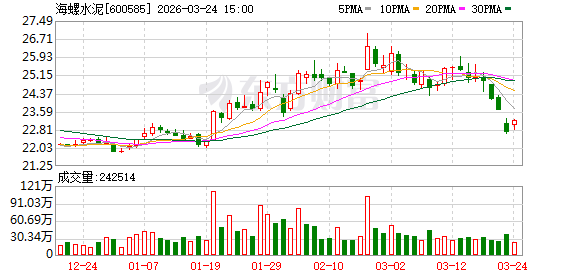
Group 1 - The company, Conch Cement (00914), announced a final dividend of HKD 0.61 per share for the year ending December 31, 2025, to be distributed on June 30, 2026 [1]