
CCB(00939)

Search documents
建设银行广东省分行赋能金融强省建设系列调研
2 1 Shi Ji Jing Ji Bao Dao· 2025-12-02 02:59
Core Insights - The article highlights the progress made by Guangdong in financial reform and innovation over the past five years, emphasizing the role of the China Construction Bank Guangdong Branch in supporting the province's economic development [1] Group 1: Financial Empowerment - The China Construction Bank Guangdong Branch is actively fulfilling its responsibilities as a state-owned bank by contributing to the construction of a financially strong province [1] - The bank's efforts are guided by the "Five Major Articles" of finance, which aim to inject financial momentum into the high-quality development of the regional economy [1] Group 2: Innovation Practices - A series of research initiatives titled "New Intelligence Guangdong Financial Empowerment" has been launched in collaboration with the Southern Finance and Economics Media Group and the 21st Century Economic Report to showcase the bank's innovative practices in various fields [1] - The focus areas of innovation include technological advancement, industrial upgrading, and rural revitalization [1]

肖宏伟:协同联动彰显财政贴息成效
Zhong Guo Jing Ji Wang· 2025-12-01 23:38
Core Viewpoint - The personal consumption loan interest subsidy policy aims to stimulate domestic demand and support economic recovery in China, marking a shift from broad financial support to targeted measures [1][2]. Group 1: Policy Implementation and Impact - The interest subsidy policy has shown positive results, with over 1.1 million clients served by Agricultural Bank and an additional 117.7 billion yuan in loans from China Construction Bank by the end of September [1]. - The policy is designed to support two types of consumption: daily expenses under 50,000 yuan and key areas such as household vehicles, education, and elderly care, with a subsidy cap of 3,000 yuan [1][2]. - The collaboration between the Ministry of Finance, the People's Bank of China, and financial regulators emphasizes a "precise drip irrigation" approach, enhancing the efficiency of fiscal funds and targeting consumer needs [1][2]. Group 2: Consumer and Supply Side Effects - The policy effectively reduces consumer credit costs, with a 500 yuan subsidy covering nearly 30% of interest for a 50,000 yuan loan at a 3.5% annual rate, significantly easing the burden on families [2]. - Major state-owned banks and financial institutions have established a comprehensive service network, with Agricultural Bank's consumer loan balance increasing by 126.1 billion yuan and China Construction Bank surpassing 645.8 billion yuan [2]. - The policy creates a virtuous cycle of "fiscal guidance, financial support, and consumption stimulation," leveraging fiscal funds to encourage financial institutions to serve real consumption [2]. Group 3: Long-term Market Confidence and Structural Changes - The subsidy policy aligns with the trend of rising service consumption, with per capita service expenditure reaching 46.8% in the first three quarters of this year, driving consumption growth [3]. - The policy not only aims for short-term consumption boosts but also focuses on cultivating long-term market confidence and optimizing the consumption environment [3]. - Future efforts should enhance policy implementation mechanisms, strengthen inter-departmental collaboration, and improve data sharing to ensure the sustainability and precision of the policy [3].

银行网点收缩,服务会缩水吗?
Chang Sha Wan Bao· 2025-12-01 23:26
Core Insights - The number of bank branches in Hunan province has decreased by over 60 this year, indicating a significant structural adjustment in the banking sector's physical presence [1] - Banks are focusing on optimizing their overall layout and upgrading functionalities to adapt to changing consumer behaviors and preferences [5] Group 1: Structural Adjustments in Bank Branches - The reduction in bank branches reflects a nationwide trend of shrinking physical banking networks, with state-owned banks slightly reducing their presence mainly in older urban areas, while some joint-stock banks and local institutions are expanding in emerging regions [1][2] - Notably, several banks are concentrating their branches in the Xiangjiang New Area, aligning with urban development trends, and planning to establish new branches in strategic locations [2] Group 2: Enhanced Service Experience - Despite the reduction in the number of branches, the service experience within remaining branches is improving, with a shift towards integrating smart devices and mobile services to enhance customer convenience [3] - Banks are implementing personalized service approaches, such as one-on-one assistance from staff using handheld devices to facilitate various transactions, thereby transforming the customer experience [3] Group 3: Evolution of Bank Functions - The role of bank branches is evolving from mere transaction points to becoming integral parts of a broader service ecosystem, with a focus on creating more engaging customer interactions and community spaces [4][5] - The integration of financial technology is reshaping the function of bank branches, making them not only places for transactions but also community hubs for social interaction [5]

智通ADR统计 | 12月2日
智通财经网· 2025-12-01 22:34
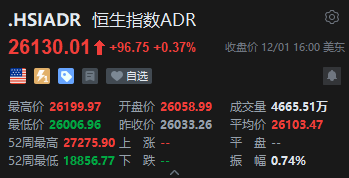
智通财经APP获悉,周一,美股三大指数集体下跌。恒生指数ADR上涨,按比例计算,收报26130.01点,较香港收市涨96.75或 0.37%。 大型蓝筹股多数上涨,汇丰控股收报111.153港元,较香港收市涨0.59%;腾讯控股收报621.575港元,较香港收市涨0.33%。 | 序号 | 名称 | 港股代码 | 最新价 | 涨跌额 | 涨跌幅 | ADR代码 | ADR换算价(HKD) | 较港股升跌 | 较港股升跌% | | --- | --- | --- | --- | --- | --- | --- | --- | --- | --- | | 1 | 腾讯控股 | 00700 | 619.500 | +8.000 | 1.31% | TCEHY | 621.575 | +2.075 | 0.33% | | 2 | 阿里巴巴-W | 09988 | 154.900 | +3.400 | 2.24% | BABA | 159.911 | +5.011 | 3.23% | | 3 | 建设银行 | 00939 | 8.150 | -0.020 | -0.24% | CICHY | 8.181 | +0.03 ...





建设银行广东省分行助力打通产业链堵点 破解融资难 为科技型企业精准画像
Ren Min Ri Bao· 2025-12-01 21:57
Core Insights - The article highlights the innovative supply chain financing model introduced by China Construction Bank (CCB) in Guangdong Province, which addresses the cash flow challenges faced by technology companies by providing timely loans through a digital platform [1][2][3] Group 1: Supply Chain Financing Model - CCB's supply chain financing allows suppliers to apply for accounts receivable financing online, enabling them to receive payments quickly when they deliver goods to companies like Southern Surveying and Mapping [1][2] - The initial credit limit for this financing model was set at 80 million yuan, aimed at alleviating the financial pressure on suppliers who previously faced long payment terms of 60 to 180 days [1][2] Group 2: Digital Solutions and Risk Management - CCB has developed a multi-dimensional evaluation system for technology companies, utilizing over 30 quantitative indicators to create precise risk profiles [2] - The bank's digital system, known as the Financial Cloud System, integrates cross-bank cash management functions, addressing issues such as system fragmentation and data security for corporate clients [2] Group 3: Growth in Technology Lending - The loan balance for technology companies at CCB in Guangdong has exceeded 250 billion yuan, with over 130 billion yuan disbursed to more than 8,000 technology firms this year, of which over 97% are small and micro enterprises [3]
【华创金融 徐康团队】红利资产月报:多因素催化银行股涨幅居前,地产风险可控
Xin Lang Cai Jing· 2025-12-01 15:07
Monthly Performance - The banking sector increased by 2.99% from November 1 to November 28, 2025, outperforming the CSI 300 index by 5.4 percentage points, ranking second among 31 Shenwan first-level industries [1][6] - Institutional investors increased their holdings in bank stocks due to a stable improvement in fundamentals, shareholder buybacks, and expectations of valuation recovery [1][6] Valuation Trends - State-owned banks saw a significant increase in valuation, with their PB ratio rising from approximately 0.76X at the beginning of the month to 0.78X by the end, while the PB ratios for joint-stock banks and city commercial banks remained stable at 0.67X and 0.60X, respectively [1][9] - As of November 28, the overall PE ratio for the banking sector was 6.53 times, with a historical percentile of 56.18%, and the PB ratio was 0.56 times, with a historical percentile of 32.25% [21] Individual Bank Performance - Notable gainers included Bank of China (8.20%), China Everbright Bank (8.08%), China Construction Bank (5.81%), and Nanjing Bank (5.13%), while Qingdao Bank and rural commercial banks experienced significant declines [1][12] - The performance of banks with improved earnings and mid-term dividend payouts led to notable increases in their stock prices [1][12] Market Environment - The 10-year government bond yield rose from around 1.80% in early November to 1.84% by the end of the month, while the 1-year bond yield remained stable at approximately 1.40% [16] - The trading volume in the banking sector increased by 13.07% year-on-year, accounting for 1.65% of the total trading volume in the AB share market, although it decreased by 0.18 percentage points compared to the previous month [19] Social Financing and Credit Trends - In October, the social financing growth rate fell to 8.5%, with new social financing of 816.1 billion yuan, a year-on-year decrease of 5.959 billion yuan [25] - The decline in credit supply was attributed to a shift in government bond issuance timing and a decrease in demand for consumer loans [25]



多家银行上调代销基金产品风险等级 业内专家:或成常态化趋势
Sou Hu Cai Jing· 2025-12-01 11:39
Core Viewpoint - Several banks, including China Construction Bank, Minsheng Bank, Postal Savings Bank, and Citic Bank, have raised the risk levels of certain mutual fund products they distribute, reflecting a proactive approach to investor suitability management and compliance with regulatory requirements [1][2][3] Group 1: Risk Level Adjustments - China Construction Bank announced adjustments to 87 mutual fund products, with 32 products upgraded from R2 (low to medium risk) to R3 (medium risk) and 55 products from R3 to R4 (medium to high risk) [1] - Minsheng Bank also adjusted the risk ratings of 8 funds, moving them from lower risk to medium risk, emphasizing the priority of investor interests [1][2] - Citic Bank has made its fourth adjustment to risk ratings this year, indicating a trend of ongoing evaluations and adjustments in response to market conditions [2][3] Group 2: Regulatory Compliance and Market Conditions - The adjustments are primarily driven by regulatory compliance requirements, necessitating banks to dynamically assess and accurately disclose product risks [3] - The current market volatility, particularly in equity funds due to increased asset fluctuations and high concentration, has led to a more realistic reflection of risk characteristics through these adjustments [3] - The trend of banks adjusting risk ratings is expected to become a standard practice in the industry, aligning with the ongoing regulatory emphasis on investor suitability management [3] Group 3: Investor Guidance - Banks are encouraging investors to reassess their risk tolerance in light of the new risk ratings, providing options for redemption or conversion to more suitable products [2][3] - Investors are advised to verify their mutual fund holdings through various channels and make informed decisions based on their risk capacity [2]


立减金、组合礼扎堆!银行个人养老金开启年末冲刺
Hua Xia Shi Bao· 2025-12-01 09:36
Core Insights - Banks are intensifying promotional activities for personal pension accounts, focusing on customer retention and active participation rather than just attracting new accounts [3][6][7] Group 1: Promotional Strategies - Major banks, including China Bank and Industrial and Commercial Bank, are offering various incentives such as WeChat discounts and cash rewards to encourage account opening and contributions [4][5] - The promotional focus has shifted from merely attracting new customers to enhancing customer experience and retention, as many accounts remain inactive after initial opening [3][6] Group 2: Customer Behavior and Market Trends - There is a prevalent issue of "high account openings but low contributions," with many customers opening accounts for short-term rewards but not actively contributing [7][8] - A report indicates that as of November 2024, only 21% of personal pension account holders are making contributions, despite a significant number of accounts being opened [7][8] Group 3: Regulatory and Competitive Landscape - The regulatory framework allows individuals to open only one personal pension account with a commercial bank, intensifying competition among banks to attract customers [5][8] - Banks are innovating their services, such as introducing appointment-based contribution options, to lower barriers for customers and encourage ongoing contributions [9][10]

建设银行(00939) - 截至2025年11月30日止股份发行人的证券变动月报表
2025-12-01 09:27
FF301 股份發行人及根據《上市規則》第十九B章上市的香港預託證券發行人的證券變動月報表 截至月份: 2025年11月30日 狀態: 新提交 致:香港交易及結算所有限公司 公司名稱: 中國建設銀行股份有限公司 呈交日期: 2025年12月1日 I. 法定/註冊股本變動 | 1. 股份分類 | 普通股 | 股份類別 | H | | 於香港聯交所上市 (註1) | | 是 | | | --- | --- | --- | --- | --- | --- | --- | --- | --- | | 證券代號 (如上市) | 00939 | 說明 | | | | | | | | | | 法定/註冊股份數目 | | | 面值 | | 法定/註冊股本 | | | 上月底結存 | | | 240,417,319,880 | RMB | | 1 RMB | | 240,417,319,880 | | 增加 / 減少 (-) | | | 0 | | | RMB | | 0 | | 本月底結存 | | | 240,417,319,880 | RMB | | 1 RMB | | 240,417,319,880 | | 2. 股份分 ...
我国5家银行入选2025年G-SIB名单 分析称未来继续看好银行板块
Zhong Guo Jing Ying Bao· 2025-12-01 09:21
Group 1 - The Financial Stability Board (FSB) announced the 2025 list of Global Systemically Important Banks (G-SIBs), with five Chinese banks included, maintaining the same number as the previous year [1] - Industrial and Commercial Bank of China (ICBC) has been upgraded to the third group with an additional capital requirement of 2.0%, while Bank of China, Agricultural Bank of China, and China Construction Bank remain in the second group with a requirement of 1.5%, and Bank of Communications stays in the first group with a requirement of 1% [1] - Following the upgrade, ICBC's core Tier 1 capital adequacy ratio regulatory requirement increases from 9% to 9.5%, with a current ratio of 13.6%, providing a buffer of 4.6 percentage points [1] Group 2 - Fitch Ratings noted that the scoring changes for Chinese G-SIBs in 2025 show that scale is no longer the primary driver for score increases, and exchange rate effects have positively influenced scores [2] - The Basel Committee plans to adjust the framework for identifying G-SIBs from year-end static data to annual average calculations, which may reduce data volatility and limit the impact on most banks, although institutions near threshold levels may experience changes [2] - The increase in global systemic importance reflects the fundamental strength of large banks, with scores for the five major banks rising between 9 to 33 points, and Bank of China is likely to be upgraded soon [2] Group 3 - The banking sector is viewed positively for long-term investment, with a high dividend strategy still having room for growth amid an "asset shortage" environment, suggesting a continuation of structural market trends [3]