CHINA MOBILE(00941)

Search documents
咪咕音乐等取得实时调整伴奏以提升用户演唱效果专利
Sou Hu Cai Jing· 2025-08-26 05:35
Group 1 - The State Intellectual Property Office of China granted a patent titled "Accompaniment Adjustment Method, Device, Equipment, and Storage Medium" to Migu Music Co., Ltd., Migu Culture Technology Co., Ltd., and China Mobile Communications Group Co., Ltd. The patent was applied for on December 2021 [1] - Migu Music Co., Ltd. was established in 2014, located in Chengdu, with a registered capital of 1.1 billion RMB. The company has participated in 1,578 bidding projects, holds 169 trademark records, 368 patent records, and possesses 14 administrative licenses [1] - Migu Culture Technology Co., Ltd. was also established in 2014, located in Beijing, with a registered capital of 1.04 billion RMB. The company has invested in 9 enterprises, participated in 2,554 bidding projects, holds 982 trademark records, 2,712 patent records, and possesses 10 administrative licenses [1] Group 2 - China Mobile Communications Group Co., Ltd. was founded in 1999, located in Beijing, with a registered capital of 30 billion RMB. The company has invested in 55 enterprises, participated in 5,000 bidding projects, holds 2,219 trademark records, 5,000 patent records, and possesses 50 administrative licenses [2]

为什么总有私人号码给你打电话,让你免费升级话费套餐?
3 6 Ke· 2025-08-26 03:04
Core Viewpoint - The article highlights the ongoing issue of deceptive marketing practices by telecom operators in China, where consumers are misled into upgrading their service plans under the guise of "free upgrades," resulting in increased monthly charges [1][3][7]. Group 1: Telecom Operators' Response - The three major telecom operators in China have announced a unified approach to combat misleading marketing calls by using official numbers for promotions, aiming to help consumers identify legitimate marketing channels [1][2]. - Despite the operators' statements, complaints related to telecom service plans continue to rise, with over 65,000 complaints recorded on consumer platforms regarding issues with service charges and plan changes [2]. Group 2: Nature of Deceptive Practices - Consumers often receive calls claiming to offer lower-cost plans, but these calls frequently result in higher charges due to hidden fees or changes in service plans that are not clearly communicated [3][4]. - A common tactic involves presenting a plan that appears cheaper but actually increases the total monthly cost when additional services are included, effectively manipulating consumer perceptions [3][4]. Group 3: Structure of Marketing Practices - The telecom industry is structured into three main components: the company headquarters, retail stores, and third-party channel partners, with the latter often responsible for aggressive marketing tactics [4][5]. - External call agents, who are under pressure to meet sales targets, typically lack comprehensive knowledge of the plans they are selling, focusing solely on pushing sales rather than providing accurate information [5][6]. Group 4: Consumer Experience and Challenges - Consumers face significant challenges in canceling or downgrading plans, as the process is often complicated and time-consuming, leading to frustration and increased costs [3][6]. - The system is designed in such a way that external agents can only increase service plans, while retail staff have limited authority to reduce plans, creating a barrier for consumers seeking to lower their expenses [6][7]. Group 5: Implications for the Industry - The article suggests that the telecom operators are aware of these deceptive practices but continue to allow them to persist, effectively placing the burden of accountability on consumers [7][8]. - The ongoing issue of unsolicited marketing calls indicates that these practices are likely to continue, as the operators gamble on consumers' ability to recognize and report such tactics [8].


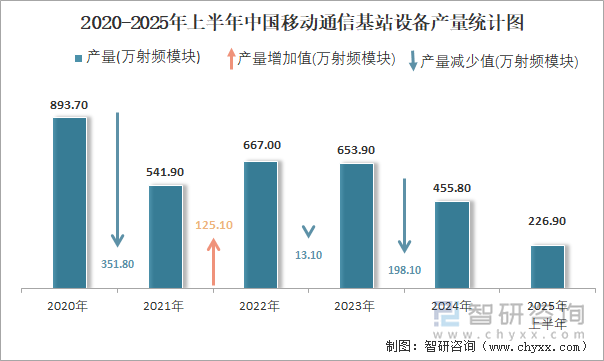
2025年1-6月中国移动通信基站设备产量为226.9万射频模块 累计下降7.8%
Chan Ye Xin Xi Wang· 2025-08-26 02:52
Group 1 - The core viewpoint of the article highlights a significant decline in the production of mobile communication base station equipment in China, with a notable drop in the output of RF modules [1] - In June 2025, the production of mobile communication base station equipment reached 470,000 RF modules, representing a year-on-year decrease of 34.4% [1] - Cumulatively, from January to June 2025, the total production of mobile communication base station equipment was 2.269 million RF modules, reflecting a cumulative decline of 7.8% [1] Group 2 - The article references several listed companies in the telecommunications sector, including ZTE Corporation, Datang Telecom, XinKe Mobile, Fenghuo Communication, and others [1] - The report mentioned is from Zhiyan Consulting, which provides insights into the market trends and forecasts for the Chinese telecommunications equipment industry from 2025 to 2031 [1][3]

英伟达产品安全存疑,利好国产算力链全方位闭环
Tebon Securities· 2025-08-26 02:49
Investment Strategy - Concerns over Nvidia's security may accelerate the replacement of domestic chips, creating a vacuum in the supply of computing chips in China. Recent advancements in domestic computing cards are expected to drive rapid development in the related industry chain. Nvidia's H20 computing chip has been reported to have serious security issues, which could negatively impact its future orders in the Chinese market. In 2024, over 50% of the data center accelerator cards in China are expected to be inference cards, with domestic computing cards projected to account for over 40% by the first half of 2025. The domestic accelerated computing server market is expected to grow by 97.3% year-on-year in 2024 and by 52.9% in 2025 [10][12][13] - The release of DeepSeek-V3.1 is expected to enhance the usability of domestic computing cards in large model applications. The V3.1 version supports UE8M0 FP8 precision, which significantly reduces storage and improves computational throughput compared to traditional FP16 and FP32 formats. This advancement is anticipated to lead to a qualitative leap in the application of domestic computing cards [11][14] - The demand for computing infrastructure from operators and cloud vendors is clear, with capital expenditures expected to increase in the second half of the year. The three major operators reported good growth in computing-related business revenues, with China Telecom's cloud service revenue at 57.3 billion yuan, China Unicom's at 37.6 billion yuan, and China Mobile's at 56.1 billion yuan. Capital expenditures for the first half of 2025 are projected to be 494 billion yuan for China Telecom, 348 billion yuan for China Unicom, and 928 billion yuan for China Mobile, accounting for 59.1%, 63.3%, and 61.4% of their annual expenditures respectively [12][13][18] Industry News - The successful launch of the low-orbit satellite internet 09 group marks a significant step in China's satellite internet development, with the country entering a high-density launch phase. This mission was the 590th flight of the Long March series of rockets, and it is expected to enhance the satellite internet network [15][16] - The budget for the 2025 rocket launch service procurement project by Shanghai Yuanxin Satellite Technology Co., Ltd. is approximately 1.336 billion yuan, with a focus on launching 94 satellites across seven missions. This indicates a growing emphasis on satellite internet and commercial space development in China [16][17] - Capital expenditures by the three major operators in the first half of 2025 were the lowest in recent years, totaling 112.8 billion yuan, a decrease of 16.5% year-on-year. However, there is an expectation of increased investment in AI and computing infrastructure in the second half of the year, which could significantly boost the domestic computing chain [18][19] Weekly Review and Focus - The communication sector saw a significant increase of 10.47% this week, outperforming major indices. The IDC and optical module sectors continued to lead gains, with increases of 14.59% and 14.41% respectively. The overall performance of the communication sector suggests strong investment opportunities in domestic computing chains and satellite internet [19][20]

30岁是道坎?中移动芒果卡套餐限年龄惹争议
Hu Xiu· 2025-08-26 01:52
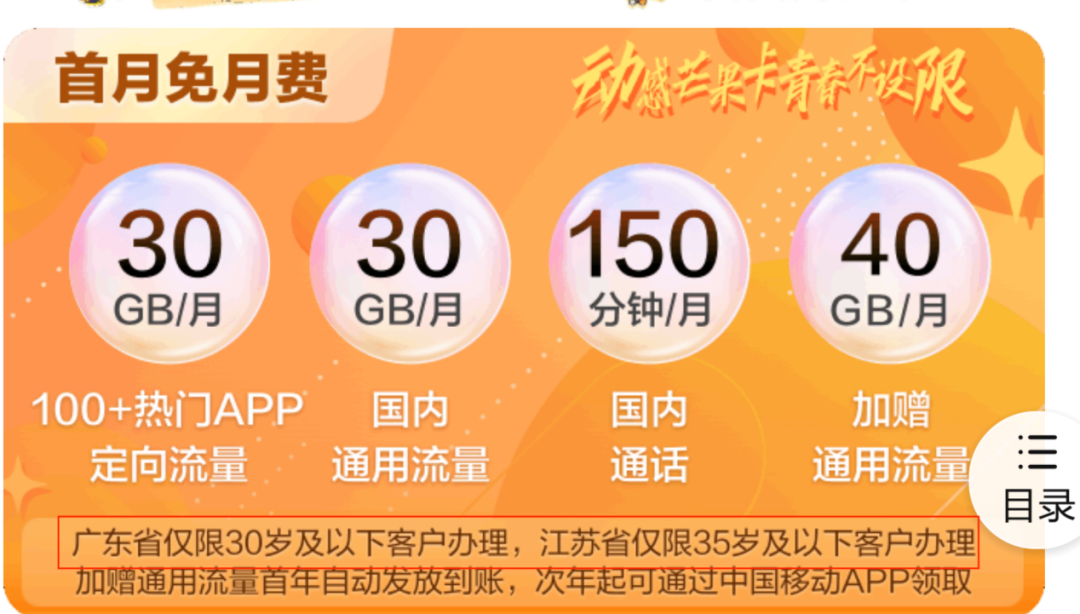
Core Viewpoint - The introduction of age restrictions for the "Mango Card" package by China Mobile has sparked controversy, with users questioning the fairness and transparency of such policies [1][3][4]. Group 1: Age Restrictions - China Mobile has implemented age restrictions for the "Mango Card" package, allowing only customers aged 30 and below in Guangdong and 35 and below in Jiangsu to apply [2][8]. - Customer service representatives confirmed the existence of these age limits but did not provide specific reasons for their implementation [9][10]. - The age restriction has led to mixed reactions among users, with some viewing it as age discrimination, while others see it as a tailored service approach [3][11]. Group 2: Financial Performance - China Mobile reported a revenue of 543.8 billion yuan for the first half of the year, marking a 0.5% decline year-on-year, the first negative growth in six years [12][13]. - The personal market revenue decreased by 4.1% to 244.7 billion yuan, with declines in voice, SMS, and wireless internet services [15]. - The chairman of China Mobile acknowledged challenges such as slowing communication service revenue growth and increasing market competition, particularly from low-cost data plans [15][16]. Group 3: Customer Retention and Competition - The introduction of number portability has led to increased competition, with China Mobile reportedly losing customers as users seek better value packages [16][17]. - Restrictions on changing to more cost-effective packages may push users towards number portability as a viable option [17].
30岁是道坎? 中移动芒果卡套餐限年龄惹争议 | BUG
Xin Lang Cai Jing· 2025-08-26 00:44
Core Points - The article discusses the age restrictions imposed by China Mobile on the "Mango Card" package, limiting it to customers under 30 in Guangdong and under 35 in Jiangsu, raising concerns about potential age discrimination [2][3][5] - Users express confusion and frustration over these restrictions, questioning the rationale behind them, while some argue that tailored services based on consumer characteristics are a form of refined service [2][5] - China Mobile's recent financial report indicates a 0.5% decline in revenue for the first half of the year, marking the first negative growth in six years, with net profit growth slowing to 5% [6][8] Financial Performance - China Mobile reported a revenue of 543.8 billion yuan for the first half of the year, the first negative growth since 2020 [6] - Personal market revenue decreased by 4.1% to 244.7 billion yuan, with declines in voice, SMS, and wireless internet services [8] - The chairman highlighted challenges such as saturated traditional communication demand and intensified market competition, particularly regarding the "number portability" service [10][11]

中国移动有限公司2025年中期利润分派A股实施公告
Shang Hai Zheng Quan Bao· 2025-08-25 20:06
Core Points - China Mobile announced a mid-year profit distribution plan for 2025, with a cash dividend of RMB 2.5025 per share (including tax) for A-shares [1][2] - The dividend represents a year-on-year increase of 5.8% compared to the previous period, reflecting the company's commitment to enhancing shareholder value [2] - The total cash dividend distribution for A-shares amounts to approximately RMB 2.259 billion (including tax), based on 902,767,867 A-shares [2] Distribution Plan - The distribution is for the mid-year of 2025, targeting all A-share shareholders registered with China Securities Depository and Clearing Corporation Limited, Shanghai Branch, as of the close of trading on the registration date [2] - The cash dividend for A-shares will be paid in RMB, calculated based on the average exchange rate of HKD to RMB published by the People's Bank of China one week prior to the dividend declaration [2] - The company will not implement differentiated dividend distribution or stock transfers [1] Implementation Details - The dividend will be distributed through the clearing system of China Securities Depository and Clearing Corporation Limited, Shanghai Branch, to shareholders who have completed designated transactions [3] - Shareholders who have not completed designated transactions will have their dividends held by the clearing company until the transactions are completed [3] Taxation Information - Individual shareholders holding shares for over one year will be exempt from personal income tax on the dividend, resulting in a net cash dividend of RMB 2.5025 per share [4] - For shares held for one year or less, the company will not withhold personal income tax at the time of distribution, but tax will be calculated based on the holding period upon transfer of shares [4] - Qualified Foreign Institutional Investors (QFIIs) will have a 10% withholding tax applied, resulting in a net cash dividend of RMB 2.25225 per share [6]
8月173款游戏过审 版号数量创新高 年内1100款获批
Nan Fang Du Shi Bao· 2025-08-25 16:07
Group 1 - The National Press and Publication Administration approved a total of 173 games in August, including 166 domestic and 7 imported games, setting a new high for the year [1][2] - By August 2025, over 1100 games have been approved in total for the year, with 1119 games receiving approval, an increase of 193 compared to the same period last year [4] - Among the 166 domestic games, there are 107 mobile games, 39 mobile-casual puzzle games, 17 mobile and client games, 2 client games, and 1 console game [1] Group 2 - Notable companies with approved products include NetEase with "Tianxia: Wanxiang," Century Huatong with "Legend of the Ancients," and Bilibili with "Escape from Duckkov" [1] - The 7 imported games include "Kaeas Dreamland" by Xiaoming Taiji and Tencent Games, "Age of Discovery: Origins" by Century Huatong, and "Dudu Face Prank" by Bilibili [2] - Some games underwent approval information changes, such as "Matrix: Zero Day Crisis" adding a console version and "Tianya Mingyue Dao" being renamed to "Tianya Mingyue Dao: World" with an added client version [4]





中国算力产业迈向高质量发展 互联互通深化
Zhong Guo Xin Wen Wang· 2025-08-25 14:03
Core Insights - The Chinese computing power industry is transitioning from scale expansion to high-quality development, as highlighted by the Ministry of Industry and Information Technology [1] - The 2025 Computing Power Development Report indicates that China's computing power infrastructure ranks among the top globally, with significant advancements in computing, storage, and transmission capabilities [1][2] Group 1: Industry Development - As of June 2023, China has 10.85 million standard racks in use for computing power centers and an intelligent computing power scale of 788 EFLOPS [1] - The total storage capacity in China has exceeded 1680 EB, reflecting continuous growth in storage capabilities [1] - The construction of over 250 "East Data West Computing" optical cable lines is planned to enhance transmission capacity [1] Group 2: Technological Innovations - The forum announced 10 major breakthrough achievements in computing power technology, including innovations from China Mobile and Huawei, showcasing global leadership in the field [2] - The report emphasizes that key core technologies in chips and software have made significant breakthroughs, contributing to the rapid development of the computing power sector [2] Group 3: Infrastructure and Connectivity - The integration of computing power networks is a key focus, with 10 provinces connecting to the national computing power platform, forming a new development pattern [3] - The number of supercomputing centers connected to the national supercomputing internet has surpassed 30, with over 200 members in the consortium [3] - The average Power Usage Effectiveness (PUE) of computing centers in China has decreased to 1.42, with 246 national green data centers established to support industrial upgrades and carbon neutrality goals [3] Group 4: Future Outlook - The future development of the computing power industry in China will focus on enhancing quality and speed, deepening the integration of computing power networks, and optimizing resource coordination [4] - Policies will be implemented to improve the layout of computing power infrastructure and accelerate breakthroughs in key core technologies, particularly in sectors like education, healthcare, and energy [4]
投资者指南:科技自主浪潮下,如何布局通信与硬科技核心赛道?(附111页PPT)
材料汇· 2025-08-25 13:17
Core Viewpoints - The article emphasizes the advancement of China's technology across the entire supply chain, driven by external pressures and domestic policies supporting innovation and self-reliance [1][3]. Group 1: Technology Competition - The U.S. has imposed export controls on Chinese companies, leading to unexpected growth in certain sectors as companies adapt to these challenges [3][8]. - The "Entity List" has expanded, with 586 Chinese companies affected, indicating a long-term strategy by the U.S. to restrict access to advanced technologies [8][9]. - China's semiconductor industry has made significant strides, with domestic production capabilities for lithography machines being announced, suggesting a failure of U.S. containment strategies [8][9]. Group 2: Investment Strategies - The article suggests that investment strategies should focus on domestic technology development, particularly in high-elasticity sectors that can provide significant returns [1][9]. - The communication sector has seen a notable increase in fund holdings, with a 1.09 percentage point year-on-year increase in heavy holdings in the communication industry [5][7]. - The performance of AI-related companies is improving, with the communication sector's revenue and net profit showing positive growth, indicating a favorable investment environment [5][6]. Group 3: Mergers and Acquisitions - The regulatory environment is becoming more favorable for mergers and acquisitions, particularly in the technology sector, with new policies aimed at facilitating these processes [9][13]. - The number of merger events in the communication sector has decreased in recent years, but the expectation is for an increase in 2025 as policies take effect [9][13]. - State-owned enterprises are expected to drive value through mergers and acquisitions, particularly in the context of market management and optimization [9][13]. Group 4: Funding Support - The Chinese government is set to issue long-term bonds to support strategic industries, with an initial issuance of 1 trillion yuan planned for 2024 [19][23]. - A 100 billion yuan fund has been established to support the satellite internet industry, indicating strong governmental backing for technological advancements [23][24]. - The government's focus on "new quality productivity" highlights a commitment to fostering innovation and technological self-sufficiency [19][22]. Group 5: Industry Opportunities - The article identifies significant opportunities in hard technology sectors, particularly in satellite internet and computing power, as domestic capabilities improve [1][30]. - The demand for domestic chips is increasing, with initial orders for Huawei's new AI chips valued at approximately 2 billion USD, reflecting a growing market for local technology [53][54]. - The overall computing power in China is expected to continue its upward trajectory, with projections indicating a substantial increase in capacity by 2024 [54][75].