CHINA TAIPING(00966)

Search documents
曾长期任职最高检,那艳芳履新
Xin Hua Ri Bao· 2025-10-04 04:19
Group 1 - China Pacific Insurance Holdings Co., Ltd. has appointed Na Yanfang as an executive director and a member of the nomination and remuneration committee, risk management committee, and strategic and investment committee [1] - Na Yanfang currently serves as an executive director at China Pacific Insurance Group Co., Ltd. and China Pacific Insurance Group (Hong Kong) Co., Ltd. [1] Group 2 - Na Yanfang, born in June 1973, is a member of the Communist Party of China with a doctoral degree and has a long career at the Supreme People's Procuratorate [3] - She has held various positions including Deputy Secretary of the Party Committee, Director of the Ninth Procuratorial Division, Director of the Tenth Procuratorial Division, and Senior Procurator [3] - China Pacific Insurance Group, established in 1929 in Shanghai, is the oldest continuously operating national insurance brand in China and the only centrally managed financial enterprise headquartered overseas [3]


那艳芳任中国太平执行董事,此前曾长期任职最高检
Guan Cha Zhe Wang· 2025-10-04 04:19
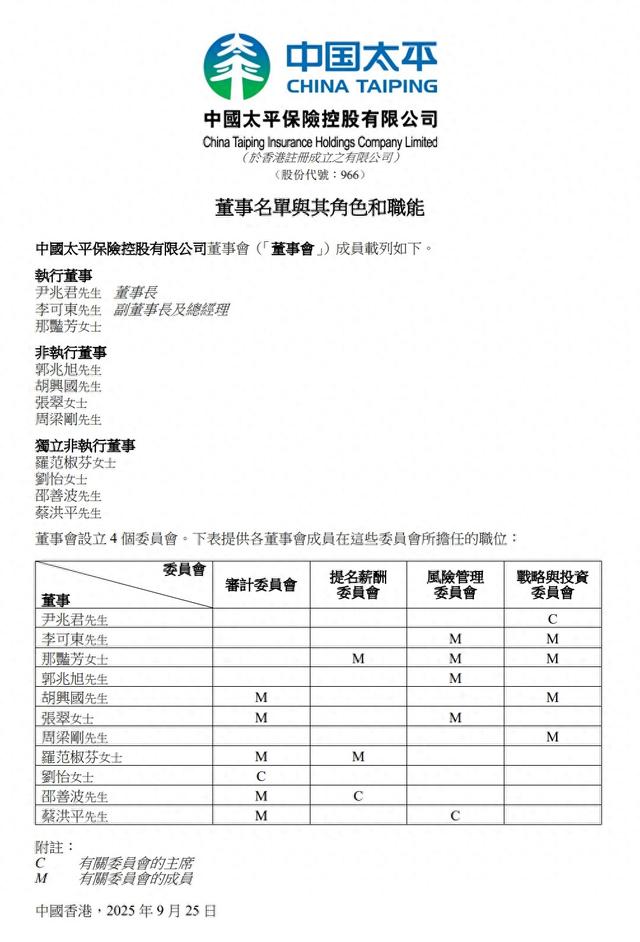
Group 1 - China Taiping Insurance Holdings Company Limited has announced that Na Yanfang has become an executive director and a member of the nomination and remuneration committee, risk management committee, and strategy and investment committee [1][6] - Na Yanfang also serves as an executive director of China Taiping Insurance Group Co., Ltd. and China Taiping Insurance Group (Hong Kong) Co., Ltd. [1] - The board of directors of China Taiping includes various members with specific roles in different committees, highlighting the governance structure of the company [4][6] Group 2 - Na Yanfang has a long career in the Supreme People's Procuratorate, holding positions such as deputy secretary of the party committee and head of the Ninth and Tenth Procuratorial Divisions [6] - China Taiping was founded in 1929 in Shanghai and is recognized as the longest-operating national insurance brand in China, with its headquarters currently in Hong Kong [6] - The company was registered in February 2000 under Hong Kong company regulations and was listed on the Hong Kong Stock Exchange in June 2000, making it the first overseas-listed financial holding platform under China Taiping Insurance Group [6]
人保、太平,两家险资巨头出手了!
Zhong Guo Ji Jin Bao· 2025-10-03 06:16
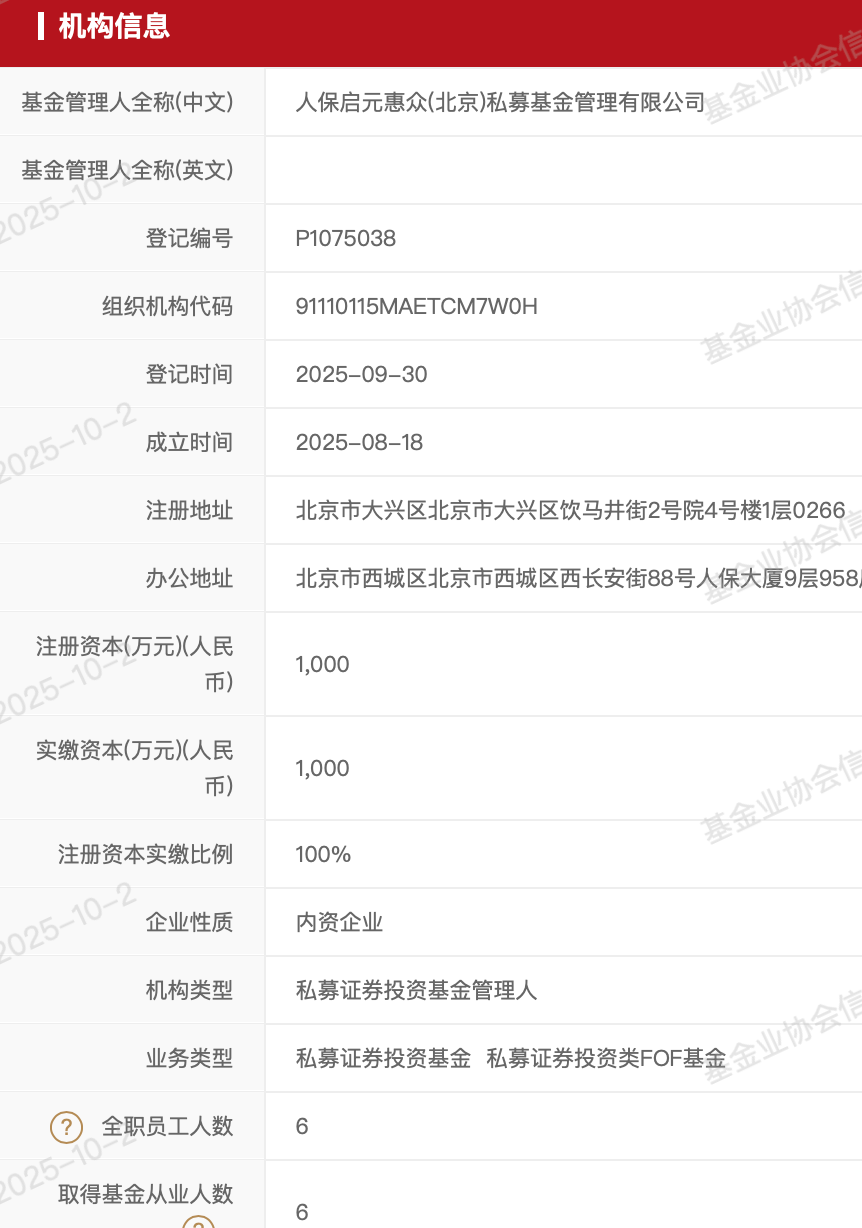
Core Insights - Two insurance-related private equity funds, Renbao Qiyuan Huizhong and Taiping Private Equity, have completed their registration as private fund managers, indicating a significant development in the long-term stock investment pilot program for insurance capital in China [1][9]. Group 1: Renbao Qiyuan Huizhong - Renbao Qiyuan Huizhong (Beijing) Private Fund Management Co., Ltd. was established on August 18, 2025, and completed its registration on September 30, 2025, with a registered capital of 10 million yuan [3][4]. - The company is fully owned by China Renbao Asset Management Co., Ltd., which has been approved to participate in the second batch of long-term stock investment pilots with a scale of 10 billion yuan [5]. - The management team includes Mai Jing, the legal representative and general manager, who has extensive experience in investment management [6][7]. Group 2: Taiping Private Equity - Taiping (Shenzhen) Private Securities Investment Fund Management Co., Ltd. was established on August 29, 2025, and completed its registration on September 29, 2025, also with a registered capital of 10 million yuan [10][11]. - The company is fully owned by Taiping Asset Management Co., Ltd., which aims to respond to the long-term investment reform pilot for insurance capital [12]. - The management team is led by Liu Yang, who has held various senior positions within Taiping Asset Management [12][13]. Group 3: Industry Context - The long-term investment pilot program for insurance capital has seen three batches, with a total approved investment amount of 222 billion yuan, involving several major insurance companies [17]. - The initiative aims to gradually expand the range of participating institutions and the scale of funds, promoting the entry of long-term capital into the stock market [16][17].
中国太平(00966) - 截至2025年9月30日止月份之月报表
2025-10-02 08:31
股份發行人及根據《上市規則》第十九B章上市的香港預託證券發行人的證券變動月報表 | 截至月份: | 2025年9月30日 | 狀態: | 新提交 | | --- | --- | --- | --- | | 致:香港交易及結算所有限公司 | | | | | 公司名稱: | 中國太平保險控股有限公司 | | | | 呈交日期: | 2025年10月2日 | | | | I. 法定/註冊股本變動 不適用 | | | | | 備註: | | | | | 由於本公司是於香港註冊成立的公司,因此「法定/註冊股本」之概念並不適用於本公司。 | | | | FF301 第 1 頁 共 10 頁 v 1.1.1 FF301 II. 已發行股份及/或庫存股份變動 | 1. 股份分類 | 普通股 | 股份類別 | 不適用 | | 於香港聯交所上市 (註1) | 是 | | | --- | --- | --- | --- | --- | --- | --- | --- | | 證券代號 (如上市) | 00966 | 說明 | | | | | | | | | 已發行股份(不包括庫存股份)數目 | | 庫存股份數目 | | 已發行股份 ...
晋中监管分局同意中国太平晋中中心支公司变更营业场所
Jin Tou Wang· 2025-09-30 03:27
Core Viewpoint - The National Financial Supervision Administration of Jinzhong has approved the relocation of the Tai Ping Life Insurance Company Jinzhong Branch to a new address in Jinzhong City, Shanxi Province [1] Group 1 - The new business location for Tai Ping Life Insurance Company Jinzhong Branch is set at Longhu Avenue 229, Longdu Tianyuan Building, 12th Floor, Room 1201, Yuci District, Jinzhong City, Shanxi Province [1] - The company is required to handle the change and obtain the necessary permits in accordance with relevant regulations [1]
驻马店金融监管分局同意中国太平驻马店中心支公司西平营销服务部变更营业场所
Jin Tou Wang· 2025-09-29 08:40
Core Points - The financial regulatory bureau of Zhumadian approved the request from Taiping Life Insurance Co., Ltd. Zhumadian Central Branch to change the business location of its Xiping Marketing Service Department [1] Group 1 - The new business location will be at Building 1-09, 1-10, Baiting Landscape Apartment, 220 meters south of the intersection of Fengming Road and Xianghe Road, Xiping County, Zhumadian City, Henan Province [1] - Taiping Life Insurance Co., Ltd. is required to handle the change and obtain the new permits in accordance with relevant regulations [1]
非银行金融行业周报:三季报业绩预计表现较好,关注三季报行情-20250928
SINOLINK SECURITIES· 2025-09-28 09:14
Investment Rating - The report suggests a focus on three main lines of investment opportunities in the securities sector, highlighting the potential for significant returns in the coming months [3][4]. Core Insights - The report emphasizes the transition of the capital market from "quantitative expansion" to "qualitative improvement" during the "14th Five-Year Plan" period, with expectations for increased support for technology innovation and a focus on investor returns [2][37]. - The insurance sector is experiencing high growth in life insurance premiums, with a notable increase in health insurance, while non-auto insurance faces challenges [4][36]. - The report identifies a significant improvement in the performance of brokerage firms, with a mismatch between high profitability and low valuations, suggesting a favorable investment opportunity [3][4]. Summary by Sections Securities Sector - The report indicates that the average daily trading volume of A-shares is 23,132 billion, reflecting a decrease of 8.1% week-on-week, while the year-to-date average daily trading volume for equity funds has increased by 98.1% year-on-year [15]. - It highlights the strong performance of brokerage firms in the first half of the year, with a recommendation to focus on those with high investment ratios and significant merger and acquisition potential [3][4]. Insurance Sector - The report notes that life insurance premiums increased by 11.4% year-on-year to 35,797 billion in the first eight months of 2025, with life insurance and health insurance growing by 14.0% and 0.5%, respectively [4][36]. - It also mentions that property insurance premiums grew by 4.7% year-on-year, with auto insurance maintaining steady growth while non-auto insurance faced pressure [4][36]. Market Dynamics - The report discusses the increasing interest of insurance companies in real estate investments, with a notable rise in investment scale compared to the previous year [36]. - It also highlights the significant increase in direct financing in the capital market, with a total of 57.5 trillion raised in the past five years, indicating a shift towards a more robust financing structure [37].


金融行业周报(2025、09、28):险资配置动作活跃,看好银行股中长期修复空间-20250928
Western Securities· 2025-09-28 08:20
Investment Rating - The report maintains a positive outlook on the insurance sector, suggesting it is a growth area within the financial industry due to supply-side reforms and benefits from rising equity assets [2][17] - The securities sector is viewed as relatively undervalued with high growth potential, particularly in light of ongoing industry improvements and potential mergers and acquisitions [3][19] - The banking sector is expected to see a medium to long-term valuation recovery, with limited downside risk due to strong fundamentals [4][20] Core Insights - The non-bank financial index experienced a slight decline of -0.09%, underperforming the CSI 300 index by 1.16 percentage points [1][11] - The insurance sector has made significant progress in cost reduction, achieving a cumulative cost reduction of 350 billion yuan since 2024, with the lowest comprehensive cost and expense ratios in nearly a decade for property insurance [2][14] - The securities sector is projected to achieve a net profit of 67 billion yuan in Q3 2025, reflecting an 86% year-on-year increase, supported by a favorable market environment [3][19] - The banking sector's price-to-book (PB) ratio stands at 0.53, indicating substantial room for valuation recovery, with a focus on banks with high growth and low non-performing loans [4][20] Summary by Sections Insurance Sector - The insurance sector's index rose by 0.46%, but still underperformed the CSI 300 index by 0.61 percentage points [2][14] - The sector is benefiting from regulatory support and a focus on cost efficiency, with significant reductions in operational costs [2][15] - Investment recommendations include China Pacific Insurance (A+H), New China Life Insurance (A+H), and Ping An Insurance (A) [2][17] Securities Sector - The securities index fell by 0.18%, underperforming the CSI 300 index by 1.25 percentage points [3][18] - The sector is characterized by ongoing digital transformation and potential for mergers, with a projected net profit of 67 billion yuan for Q3 2025 [3][19] - Recommended stocks include Huatai Securities (A+H), GF Securities (A+H), and Dongfang Securities (A+H) [3][19] Banking Sector - The banking index declined by 0.48%, underperforming the CSI 300 index by 1.55 percentage points [4][20] - The banking sector's PB ratio is at 0.53, indicating a favorable valuation environment for long-term investments [4][20] - Investment focus should be on banks with diversified operations and stable performance, such as Hangzhou Bank and China CITIC Bank (H) [4][21]


中国太平为低空经济护航
Xin Hua Wang· 2025-09-28 02:43
6月6日,香港低空经济监管沙盒框架下的首条常态化无人机配送航线正式投入运营。该航线选择 了"跨海+公园"场景,对比传统骑行配送方式,效率提升近7倍。中国太平保险集团旗下太平香港为该航 线提供无人机起降点停机坪公众责任险,用专业守护每一次起降。 近年来,在政策扶持与科技赋能的双轮驱动下,中国低空经济正蓬勃兴起。中国太平秉持"国家所 需、太平所向",深度参与低空经济产业链,以创新保险服务护航低空经济"高飞远翔"。一是深度参与 香港低空经济试点。太平香港按照集团部署,立足国家重大战略需求,积极主动作为,开发"智航无人 机保险"产品。在香港低空经济监管沙盒计划推出后,为多个沙盒项目提供保险保障,包括首单无人机 起降点停机坪公众责任险、首单应用于科研场景的无人机保险、首单应用于紧急医疗配送的无人机保险 等,彰显了太平香港在低空经济领域的过硬实力和责任担当。二是为低空经济提供综合保险方案。太平 财险为应用于遥感测绘、电力巡检、应急救援、安防监控等领域的无人机提供综合保险方案,保障覆盖 无人机机身损失、第三者责任、操作人员责任等多维度风险。2024年至今,太平财险已为全国469个客 户提供风险保障约9亿元。三是搭建行业交流 ...
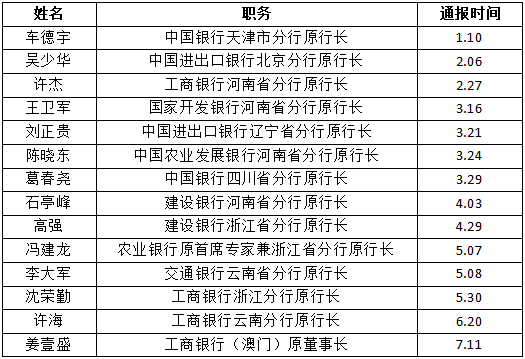
银行地方“一把手”密集落马!10家金融机构公布巡视整改情况,多方强调对“一把手”监督
Xin Lang Cai Jing· 2025-09-26 01:11
Group 1: Central Bank and Financial Regulatory Authority Actions - The Central Bank and the Financial Regulatory Authority are focusing on long-term rectification measures, including enhancing financial infrastructure, advancing information technology reforms, and promoting financial legislation [1][2] - The Financial Regulatory Authority has implemented multiple measures to prevent financial risks, such as strict market access regulations and enhancing administrative penalties to protect consumer rights [1][2] Group 2: Supervision of Leadership - Emphasis on the supervision of "one leaders" in financial institutions, with a focus on accountability and responsibility among top executives [2][9] - At least 32 financial unit officials have been investigated this year, with 23 in the first half alone, highlighting ongoing anti-corruption efforts [2][10] Group 3: Bank-Specific Initiatives - The Export-Import Bank is reinforcing its policy-oriented banking role and enhancing monitoring of policy-related business [3] - The Industrial and Commercial Bank is developing a high-quality growth strategy and improving internal governance and risk management [3] - The Agricultural Bank is focusing on supporting rural revitalization and agricultural development through increased financing [4] Group 4: Global Strategy and Regional Development - The Bank of China is continuing its global strategy by enhancing overseas operations and supporting enterprises in international expansion [5] - The Construction Bank is committed to regional development strategies, including support for the Guangdong-Hong Kong-Macao Greater Bay Area [5] Group 5: Insurance Sector Actions - China Life is addressing the negative impacts of the Wang Bin case and is implementing measures to ensure accountability among its leadership [6][7] - China Pacific Insurance is focusing on strengthening its talent pool and enhancing the political and organizational functions of its party committees [8]