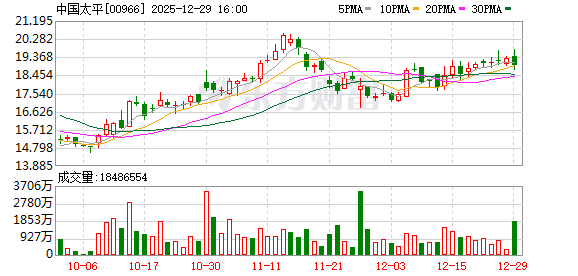
CHINA TAIPING(00966)

Search documents
港股保险股午后冲高,阳光保险、中国太平、新华保险涨超6%
Mei Ri Jing Ji Xin Wen· 2026-01-05 05:36
Group 1 - Hong Kong insurance stocks experienced a significant afternoon rally, with Sunshine Insurance, China Pacific Insurance, and New China Life Insurance rising over 6% [1] - China Ping An and China Taiping both saw increases of over 5%, while China Life Insurance rose more than 3% [1]


港股保险股午后冲高,阳光保险(06963.HK)、中国太平(00966.HK)、新华保险(01336.HK)涨超6%,中国平安(02318.HK)、中国...
Jin Rong Jie· 2026-01-05 05:35
Group 1 - Hong Kong insurance stocks experienced a significant afternoon rally, with Sunshine Insurance (06963.HK), China Pacific Insurance (00966.HK), and New China Life Insurance (01336.HK) rising over 6% [1] - China Ping An (02318.HK) and China Taiping Insurance (02601.HK) saw increases of more than 5%, while China Life Insurance (02628.HK) rose over 3% [1]

港股异动丨保险股走强,新华保险、中国太保创历史新高
Ge Long Hui· 2026-01-05 03:55
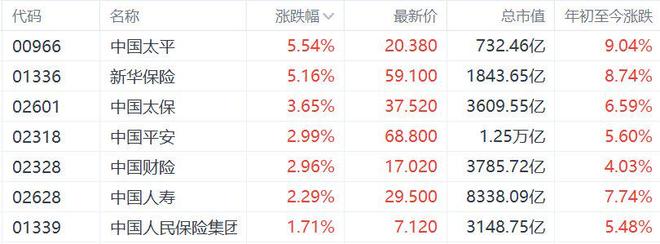
Core Viewpoint - The strong performance of insurance stocks in the A-share market has positively influenced the Hong Kong market, with several major insurance companies reaching new highs in stock prices [1]. Group 1: Stock Performance - China Taiping, New China Life, and China Pacific Insurance saw stock increases of over 5%, while China Ping An and China Property & Casualty Insurance rose nearly 3% [1]. - New China Life and China Pacific Insurance reached historical highs, while China Ping An achieved a nearly five-year high [1]. - The year-to-date performance of major insurance stocks includes: - China Taiping: 9.04% increase - New China Life: 8.74% increase - China Pacific Insurance: 6.59% increase - China Ping An: 5.60% increase - China Property & Casualty Insurance: 4.03% increase - China Life: 7.74% increase - People's Insurance Group: 5.48% increase [2]. Group 2: Industry Trends - The report by CICC highlights five key trends in the life insurance industry for 2026: 1. Continued rapid growth of new business, embracing "deposit migration" and a "new era of health insurance" 2. Further decline in the rigid costs of new business, enhancing the persuasive power of new business value 3. Diversification of new business product structures, with quality companies showing more significant optimization in business structure and differentiation in new business quality compared to peers 4. An upward migration of customer tiers in the industry, with opportunities for upgrading and optimizing operational models and talent 5. A competitive landscape concentrating on companies with strong life insurance operational capabilities [1].

港股保险股集体走强,新华保险(01336.HK)、中国人寿(02628.HK)、中国太平(00966.HK)涨超3%,中国太保(02601.HK)、阳光...
Jin Rong Jie· 2026-01-05 02:22
Group 1 - Hong Kong insurance stocks experienced a collective surge, with New China Life Insurance (01336.HK), China Life Insurance (02628.HK), and China Pacific Insurance (00966.HK) rising over 3% [1] - China Taiping Insurance (02601.HK), Sunshine Insurance (06963.HK), and ZhongAn Online (06060.HK) saw increases of more than 2% [1]

公募费改收官且险企开门红向好,关注春季躁动机遇
GF SECURITIES· 2026-01-04 10:05
Core Insights - The report highlights that the public fund fee reform has concluded, and insurance companies are expected to perform well, indicating potential investment opportunities in the spring market [1][6]. Group 1: Industry Performance - As of December 31, 2025, the Shanghai Composite Index closed at 3968.84 points, up 0.13%, while the Shenzhen Component Index fell by 0.58% [11]. - The average daily trading volume in the Shanghai and Shenzhen markets reached 2.13 trillion yuan, an increase of 8.30% week-on-week [6]. Group 2: Insurance Sector - Insurance companies are anticipated to maintain high growth in performance, with short-term results expected to exceed expectations and long-term interest rate spreads likely to improve [17]. - The Ministry of Finance released a draft revision of the accounting standards, enhancing the clarity of profit sources for insurance companies and improving comparability across industries [17]. - Key stocks to watch in the insurance sector include China Ping An, China Life, and New China Life, among others [17]. Group 3: Securities Sector - The public fund fee reform is expected to save investors approximately 51 billion yuan annually, with a fee reduction of about 20% [18]. - The reform includes differentiated redemption fee structures aimed at promoting long-term investment and reducing short-term trading behaviors [19]. - The introduction of new REITs regulations is expected to enhance the market's quality and expand opportunities for securities firms [24][28]. Group 4: Valuation and Financial Analysis - China Ping An (601318.SH) has a target price of 85.17 yuan, with an estimated EPS of 8.91 yuan for 2025, reflecting a PE ratio of 7.68 [7]. - New China Life (601336.SH) has a target price of 94.21 yuan, with an estimated EPS of 14.04 yuan for 2025, indicating a PE ratio of 4.96 [7]. - The report suggests that the valuation metrics for various companies in the sector indicate potential upside, with several stocks rated as "Buy" [7].


中国太平(00966) - 截至2025年12月31日止月份之月报表
2026-01-02 08:42
| 截至月份: | 2025年12月31日 | 狀態: 新提交 | | --- | --- | --- | | 致:香港交易及結算所有限公司 | | | | 公司名稱: | 中國太平保險控股有限公司 | | | 呈交日期: | 2026年1月2日 | | | I. 法定/註冊股本變動 不適用 | | | | 備註: | | | | 由於本公司是於香港註冊成立的公司,因此「法定/註冊股本」之概念並不適用於本公司。 | | | FF301 股份發行人及根據《上市規則》第十九B章上市的香港預託證券發行人的證券變動月報表 第 1 頁 共 10 頁 v 1.1.1 FF301 II. 已發行股份及/或庫存股份變動 | 1. 股份分類 | 普通股 | 股份類別 | 不適用 | | 於香港聯交所上市 (註1) | 是 | | | --- | --- | --- | --- | --- | --- | --- | --- | | 證券代號 (如上市) | 00966 | 說明 | | | | | | | | | 已發行股份(不包括庫存股份)數目 | | 庫存股份數目 | | 已發行股份總數 | | | 上月底結存 | | | ...
保险行业2026年策略:资负两端全面改善,估值修复正当其时
SINOLINK SECURITIES· 2025-12-31 15:27
Investment Rating - The report indicates a positive outlook for the insurance industry, with expectations of double-digit growth in new premiums and net profit value (NBV) driven by the migration of deposits and improved margins [2][22]. Core Insights - The insurance sector is expected to benefit from strong household savings demand, with insurance products becoming increasingly attractive as low-risk savings options amid declining bank deposit rates [2][22]. - The transition towards participating insurance products is anticipated to enhance market share for leading insurance companies, as they leverage their stronger investment capabilities and distribution channels [2][3]. - The report highlights a favorable market environment for insurance stocks, driven by high demand for new policies and a stable investment return outlook, which is expected to support valuation recovery [4][8]. Summary by Sections Liability Side Outlook - New business and NBV are projected to grow at double-digit rates, supported by strong household savings and a shift towards insurance products due to declining bank deposit rates [2][22]. - The insurance sector is expected to maintain stable margins despite the downward adjustment of preset interest rates and the transition to participating insurance [2][22]. Asset Side Outlook - Insurance funds are expected to actively enter the market, with a significant portion of new premiums allocated to equities, particularly in A-shares [3][16]. - The report anticipates a diversified approach to asset allocation, with a focus on high-dividend stocks and sectors such as technology and advanced manufacturing [3][19]. Market Performance Review - The insurance sector has outperformed the broader market, with significant gains in both A-shares and H-shares, indicating strong investor confidence [8][4]. - The report notes that the insurance index has increased by 27.0%, outperforming the CSI 300 index, which rose by 18.2% [8]. Premium Income and Profitability - New premium income is expected to achieve double-digit growth, with specific companies like China Life and Ping An showing substantial increases in their new business premiums [14][32]. - The report highlights the importance of maintaining a favorable cost structure and investment returns to support profitability in the insurance sector [4][11].

中国分红险发展的前世今生:低利率时代的重逢
Soochow Securities· 2025-12-30 10:06
Investment Rating - The report maintains an "Accumulate" rating for the insurance sector [1]. Core Insights - The report discusses the evolution of participating insurance in China, highlighting its significance in a low-interest-rate environment and the shift towards floating yield products, which are gaining traction among domestic investors [2][6]. Summary by Sections 1. What is Participating Insurance? - Participating insurance is a type of insurance that combines protection and investment, allowing policyholders to share in the insurer's surplus [12]. - The operational mechanism involves sharing profits derived from better-than-expected performance, with a minimum of 70% of the surplus distributed to policyholders [6][15]. 2. Historical Development of Participating Insurance in Mainland China - The development of participating insurance has seen significant fluctuations influenced by policy and market factors, with its market share peaking at 75% in 2010 before declining due to market reforms [6][45]. - Since 2024, regulatory policies have encouraged the development of floating yield products, marking a consensus in the industry towards transitioning to participating insurance [6][45]. 3. Current Transition of Participating Insurance - The report anticipates that the proportion of participating insurance will continue to rise, with over 50% of new policies in the first half of 2025 being participating insurance [6][45]. - The transition is expected to alleviate pressure from interest rate losses and enhance the reliability of the insurance sector's embedded value (EV) [6][45]. 4. International Experience - In mature markets, floating yield products dominate, with Hong Kong's participating insurance being a core component, accounting for 85% of new premiums in 2024 [2][6]. - The report suggests that the characteristics of participating insurance in Hong Kong, such as multi-currency support and a design of low guarantees with high floating returns, could serve as a model for the mainland market [2][6]. 5. Key Metrics for Evaluating Participating Insurance - The report outlines four key indicators for assessing the performance of participating insurance: 1. **Guaranteed Rate**: Currently set at 1.75%, which is lower than traditional insurance [23]. 2. **Demonstration Rate**: Reflects expected returns, with current rates around 3.5% to 4% [24]. 3. **Actual Yield**: The industry average is capped at 3.2%, with some companies exceeding this limit [27]. 4. **Dividend Realization Rate**: Increased by 11 percentage points to 62% in 2024, indicating improved management and expectation guidance [29].

中国太平产寿险子公司齐换将 “70后”高管走上关键岗位
Zhong Guo Jing Ying Bao· 2025-12-29 14:54
Core Viewpoint - The recent leadership changes at China Taiping Insurance Group's subsidiaries, Taiping Life and Taiping General Insurance, reflect a shift in governance, with new leaders being promoted from within rather than appointed from the group's senior management [2][5]. Group 1: Leadership Changes - Wang Xuze has been appointed as the Party Secretary and proposed General Manager of Taiping Life, while Peng Yunping has been appointed as the Party Secretary and proposed General Manager of Taiping General Insurance [2]. - Both Wang and Peng are internal promotions, indicating a move away from the previous practice of having senior executives from the group serve in these roles [2][5]. - The changes are pending regulatory approval before the new leaders officially assume their positions [2]. Group 2: Background of New Leaders - Peng Yunping has over 20 years of experience in the property insurance industry, with a background in sales, management, governance, and compliance [3]. - She has held various positions within China Taiping Insurance Group, including Vice General Manager of the Comprehensive Development Department and Secretary of the Discipline Inspection Commission at Taiping General Insurance [3]. - Wang Xuze has extensive frontline experience, having worked in various branches of Taiping Life and served as the Market Director before becoming the temporary head of the company [4]. Group 3: Recent Performance Metrics - From January to November 2025, Taiping General Insurance achieved original insurance premium income of 30.2 billion yuan, a year-on-year increase of 3.7% [6]. - Taiping Life reported insurance business income of 158.04 billion yuan for the first three quarters of 2025, a 6.6% increase year-on-year, with net profit rising by 61.2% to 18.13 billion yuan [6]. - As of the end of the third quarter, Taiping Life's net asset scale reached 87.068 billion yuan, a 31.18% increase from the beginning of the year, and total assets amounted to 1.4 trillion yuan, up 10.19% [6].
40家寿险公司投资收益率比拼,前三强都是合资公司,泰康平安人保跻身前7
Xin Lang Cai Jing· 2025-12-29 13:46
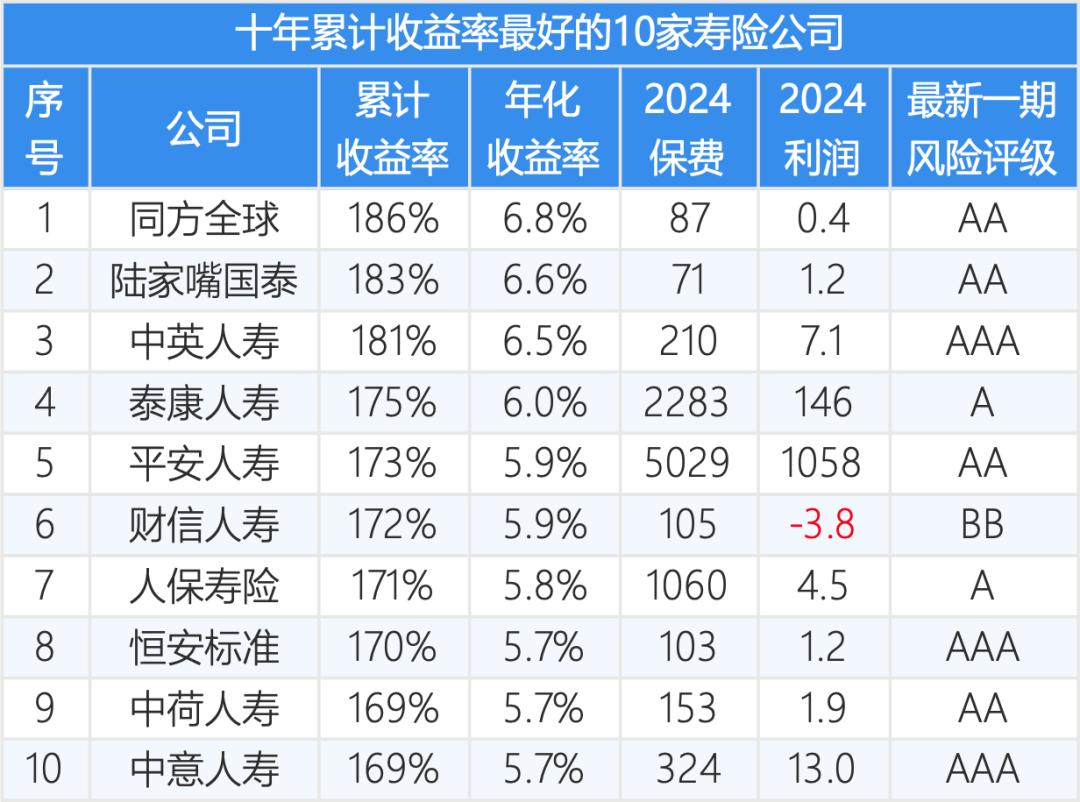
Core Insights - The article compares the investment returns of various life insurance companies over the past decade, highlighting the top performers and the bottom performers in terms of annualized returns. Group 1: Top Performers - The top three companies in terms of annualized returns are joint ventures: Tongfang Global (6.8%), Lujiazui Guotai (6.6%), and Zhongying Life (6.5%) [1][14] - The fourth and fifth positions are held by Taikang Life (6.0%) and Ping An Life (5.9%), respectively [14] - Other notable companies in the top ten include PICC Life, Caixin Life, Heng'an Standard, Zhonghe Life, and Zhongyi Life, with Caixin Life also having the smallest volatility among the top ten [1][14] Group 2: Bottom Performers - The company with the lowest ten-year cumulative return is Great Wall Life, which has a 40 percentage point difference compared to the top performer, Tongfang Global [2][15] - Junlong Life not only has a low return but also exhibits high volatility, while China Life's poor investment returns may be attributed to its large scale [2][15] Group 3: Historical Performance - Eight companies have previously held the top position, with Tongfang Global and Hongkang Life achieving first place twice [3][15] - The article notes that Tongfang Global has also secured second place three times and ninth place once, indicating consistent strong performance [3][15] Group 4: Risk Ratings - The bottom five companies generally have lower risk ratings, with most rated as B, except for China Life, which holds an AAA rating [3][15]