
CHINA TAIPING(00966)

Search documents
大行评级|小摩:大幅上调中国太平目标价至30港元,评级一举升至“增持”
Ge Long Hui· 2026-01-19 03:24
基于对保险公司承保韧性、每股盈利增长及股息能见度有信心,摩通仍有相信内险股股价有充足上行空 间,将中国太平的评级由"减持"一举上调至"增持",目标价由9.4港元升至30港元,看好其寿险销售复 苏及短期盈利预测上调,可能触发股价上升。 摩根大通发表研究报告指,中国中小型保险股去年跑赢大市,股价平均上升约58%,反映市场对新兴人 寿保险需求及宏观经济向好的乐观情绪正在增加。然而该行认为,近期的温和盈利及股息预期调整,似 乎只部分反映了2025年下半年宏观经济向好因素。 ...

衍生品新规释放积极信号,关注板块发布业绩预增机遇
GF SECURITIES· 2026-01-18 10:26
Core Insights - The report highlights that new regulations in derivatives are expected to release positive signals for the non-bank financial sector, with a focus on companies likely to announce performance increases [1][5]. Group 1: Market Performance - As of January 16, 2026, the Shanghai Composite Index closed at 4101.91, down 0.45%, while the Shenzhen Component Index rose by 1.14% to 14281.08 [10]. - The average daily trading volume in the Shanghai and Shenzhen markets reached 3.47 trillion yuan, an increase of 21.50% month-on-month [5]. Group 2: Industry Dynamics and Weekly Commentary Insurance Sector - Listed insurance companies are expected to continue high growth, with improvements in long-term interest rate spreads anticipated [12][16]. - As of January 12, 2026, the total scale of private equity securities investment funds by insurance capital reached 184.5 billion yuan, with 11 funds established [16]. - The report suggests focusing on companies such as China Ping An, China Life, and New China Life for potential investment opportunities [16]. Securities Sector - The China Securities Regulatory Commission (CSRC) emphasized stability and quality improvement in its 2026 work meeting, aiming to prevent market volatility and enhance internal stability [17][18]. - The CSRC's new derivatives regulations aim to standardize the market, encourage risk management, and improve the income structure of brokerage firms [25][26]. - The report indicates that the derivatives market is expected to grow significantly, with the scale of over-the-counter derivatives increasing from 0.32 trillion yuan in 2015 to 2.38 trillion yuan in 2023, reflecting a compound annual growth rate of 29% [26]. Group 3: Key Company Valuations and Financial Analysis - China Ping An (601318.SH) has a current price of 66.33 yuan, with a target value of 85.17 yuan, indicating a buy rating [6]. - New China Life (601336.SH) is rated as a buy with a current price of 82.09 yuan and a target value of 94.21 yuan [6]. - China Life (601628.SH) is also rated as a buy, with a current price of 47.52 yuan and a target value of 55.47 yuan [6].



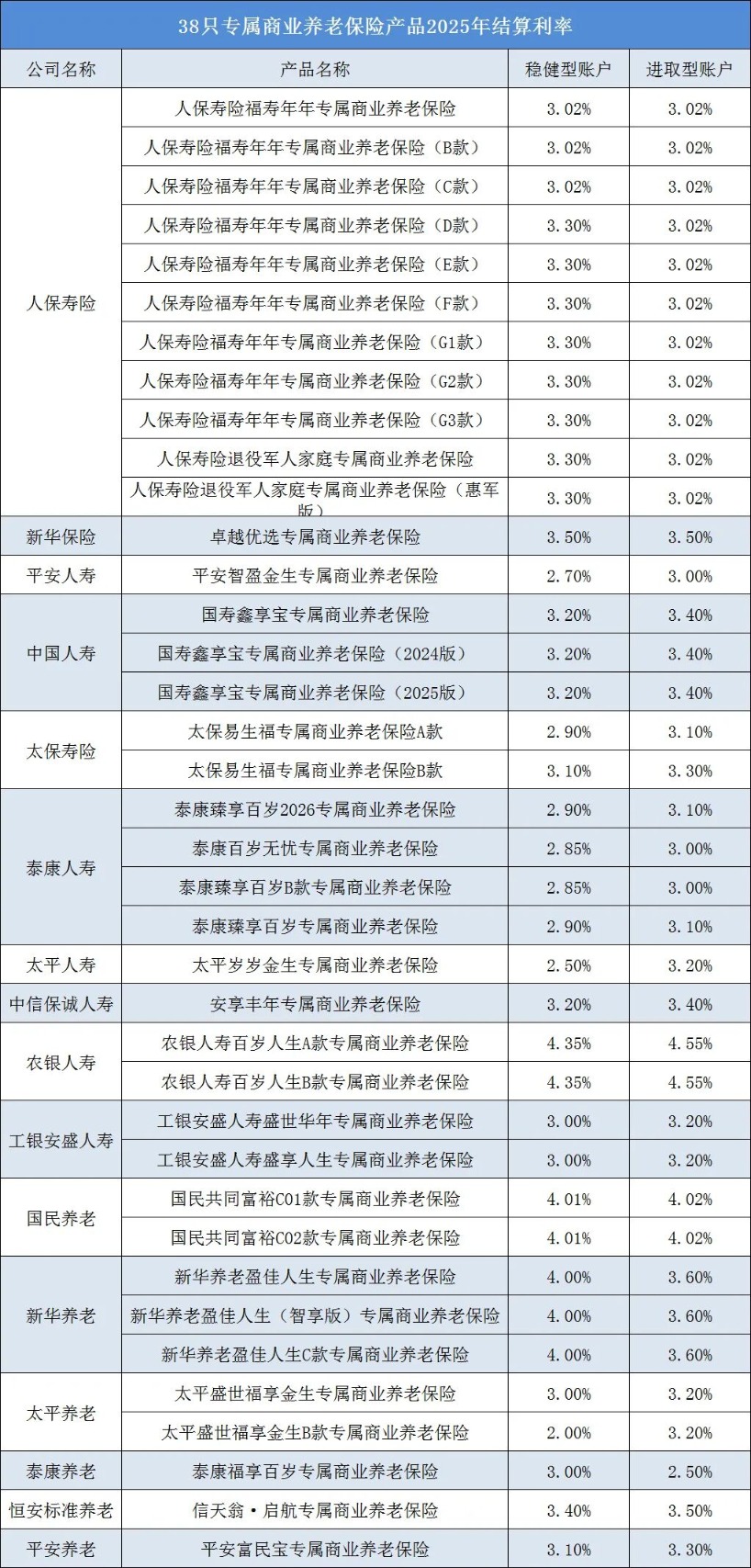
最高4.55%!专属商业养老保险2025年结算利率出炉
Guo Ji Jin Rong Bao· 2026-01-14 14:44
Core Viewpoint - The exclusive commercial pension insurance products have shown promising settlement interest rates for 2025, with a significant portion exceeding 3% and several surpassing 4% [1][3]. Group 1: Settlement Rates - A total of 67 accounts have settlement rates of 3% or higher, accounting for nearly 90% of the total [1]. - Among 38 exclusive commercial pension insurance products, the settlement rates for stable accounts range from 2% to 4.35%, while for aggressive accounts, they range from 2.5% to 4.55% [3]. - Three insurance companies have products with settlement rates of 4% or higher, with the highest rates being 4.35% for stable accounts and 4.55% for aggressive accounts from Agricultural Bank Life Insurance [4]. Group 2: Product Design and Strategy - Exclusive commercial pension insurance is designed with two phases: accumulation and payout, featuring a "guarantee + floating" yield model [3]. - The stable accounts are tailored for risk-averse clients, focusing more on fixed-income assets, while aggressive accounts have a higher allocation to equity assets [3][5]. - The dual-account structure allows for risk diversification and improved overall returns, leveraging long-term capital attributes for cross-cycle asset allocation [5]. Group 3: Market Development and Policy Support - The pilot program for exclusive commercial pension insurance began in June 2021 and expanded nationwide by March 2022, transitioning to a regular business model by October 2023 [6]. - Recent policies have emphasized the development of the third pillar of pension insurance, encouraging the creation of new products and enhancing the market for exclusive commercial pension insurance [6]. - To enhance competitiveness, insurance companies are encouraged to shift from a single financial product model to a comprehensive ecosystem solution, integrating health management and community services [7][8].


南平监管分局同意中国太平建阳支公司变更营业场所
Jin Tou Wang· 2026-01-14 04:17
Core Viewpoint - The National Financial Supervision Administration of Nanping has approved the relocation of Taiping Life Insurance Co., Ltd.'s Jianyang branch to a new address in Nanping City, Fujian Province [1] Group 1 - Taiping Life Insurance Co., Ltd.'s Jianyang branch will change its business location to: 269 Renmin West Road, Jianyang District, Nanping City, Fujian Province (Building 22412, 22413 of Jianda Yucheng Complex) [1] - The Fujian branch of Taiping Life Insurance is required to handle the relocation and license renewal procedures in accordance with relevant regulations [1]
港股保险股盘初走低
Mei Ri Jing Ji Xin Wen· 2026-01-14 02:04
Group 1 - Hong Kong insurance stocks opened lower on January 14, with China Life and China Taiping both dropping over 2% [1] - Other stocks such as New China Life and Ping An also experienced declines [1]


银保渠道锁定26年新单增长主阵地
Ge Long Hui· 2026-01-13 00:08
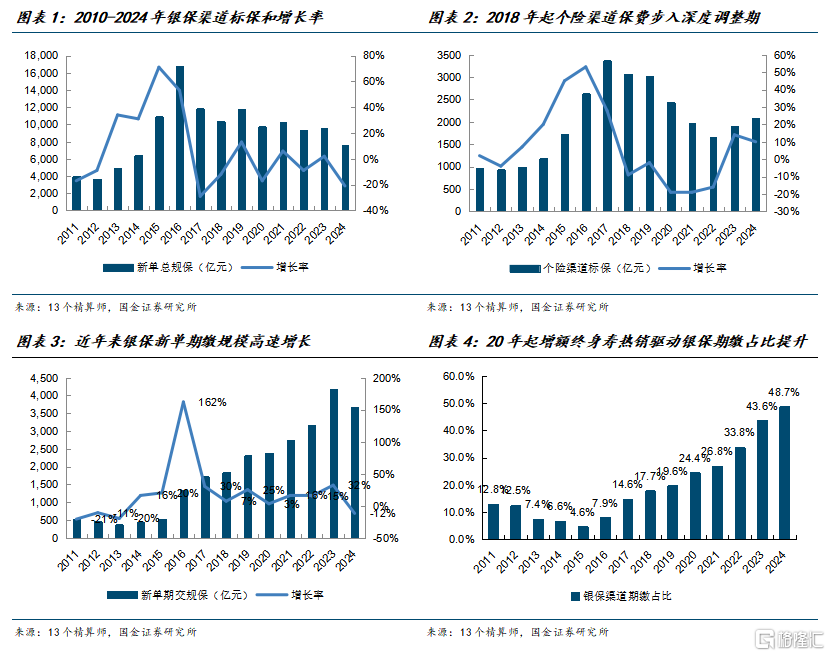
Investment Logic - The core view is that new individual insurance premiums for listed insurance companies are expected to achieve double-digit growth by 2026, primarily driven by the bancassurance channel [1][18] - The individual insurance channel is anticipated to maintain steady growth, while the bancassurance channel will benefit from the migration of deposits, leading to an increase in market share for large insurance companies [1][18] - The growth in the bancassurance channel is expected to dilute fixed costs, significantly enhancing overall profitability [1][18] Bancassurance Channel - Since 2020, leading insurance companies have refocused on the bancassurance channel, transitioning from scale compensation to value pursuit, resulting in a rise in market share [2][8] - The bancassurance channel has seen a compound annual growth rate (CAGR) of 16.2% from 2019 to 2023, while individual insurance premiums have declined [9] - The "reporting and banking integration" policy implemented in August 2023 has significantly reduced costs, enhancing the value rate of the bancassurance channel [14][9] Customer Deposit Analysis - A survey of 88 frontline bank wealth managers indicates that a significant portion of residents' deposits will mature in 2026, with expectations of low renewal rates due to the withdrawal of high-yield time deposits [3][25] - The majority of maturing depositors are aged 45 and above, indicating a lower risk appetite, with insurance products being the second choice for reallocating maturing deposits [4][30] - Wealth managers believe that bank wealth management products will be the most accepted option for maturing deposits, followed by insurance products [30][27] Sales Logic for Insurance Products - Wealth managers prioritize customer returns and the brand of insurance companies when recommending insurance products [5][33] - The core advantages of participating in dividend insurance sales include stable returns, capital safety, and alignment with long-term financial planning [36][40] - Challenges in selling dividend insurance include uncertainty in returns and the long duration of products, which may deter potential customers [40][36] Market Forecast - The insurance industry is projected to see new single premium growth exceeding 25% in 2026, driven by the bancassurance channel [42][44] - The expected influx of maturing deposits into insurance products will be significant, with estimates of new funds in the bancassurance channel reaching 11,150 billion by the end of 2026 [44][44] - The concentration trend among leading insurance companies is expected to continue, with larger firms benefiting from improved profitability in the bancassurance channel [47][48]
存款搬家与市占率提升双重加持,银保渠道锁定26年新单增长主阵地
SINOLINK SECURITIES· 2026-01-12 05:16
Investment Rating - The report maintains a positive investment rating, recommending continued active investment in the insurance sector due to expected double-digit growth in new premiums driven by the bancassurance channel [5]. Core Insights - The insurance industry is projected to achieve double-digit growth in new premiums by 2026, primarily driven by the bancassurance channel, which benefits from the migration of deposits and the competitive advantages of large insurance companies [1][26]. - The bancassurance channel has seen a significant increase in market share, with the "old seven" insurance companies' new premium market share rising from 8.2% in 2019 to 23.8% in 2023, and expected to reach 26.0% in 2024 [2][22]. - A survey of 88 frontline bank wealth managers indicates that a substantial portion of household deposits will mature in 2026, with expectations that many will not be renewed, leading to a shift towards insurance products [3][35]. - The demographic of clients with maturing deposits is predominantly older, with a lower risk appetite, making insurance products a preferred option for reallocating funds [4][40]. - The report highlights that the bancassurance channel's growth will significantly enhance the overall profitability of large insurance companies by spreading fixed costs over a larger premium base [1][26]. Summary by Sections Bancassurance Channel - The bancassurance channel is identified as the main driver of value growth in the insurance industry for 2026, with a compound annual growth rate of 16.2% from 2019 to 2023 [12]. - The report notes that the shift in focus from individual insurance channels to bancassurance began in 2020, driven by the need to compensate for declining individual premium growth [2][12]. Bank Wealth Manager Survey Analysis - The survey indicates that a significant portion of maturing deposits will not be renewed, with expectations that 50% of clients will have deposits maturing in the 10%-30% and 30%-50% ranges [3][35]. - Wealth managers believe that the most acceptable financial products for clients will be bank wealth management and insurance, with insurance ranking second [4][40]. Projections for 2026 - The report estimates that the new premium growth rate for the bancassurance channel will exceed 25% in 2026, with expected incremental funds of 3,057 billion in January, 5,094 billion in Q1, and 11,150 billion for the entire year [5][62]. - The anticipated growth is attributed to the large volume of maturing deposits and the expected shift towards insurance products due to lower renewal rates for traditional bank deposits [60].
大行评级|星展:上调中国太平目标价至25港元 维持“买入”评级
Ge Long Hui· 2026-01-07 03:06
Core Viewpoint - DBS has raised the target price for China Taiping from HKD 23 to HKD 25, maintaining a "Buy" rating, indicating a positive outlook for the company's future performance [1] Group 1: Business Strategy - Over 90% of China Taiping's new business consists of policy products, reflecting a strong focus on insurance offerings [1] - The company's investment strategy has shifted from high-yield investments to a barbell strategy, suggesting a more balanced approach to risk and return [1] Group 2: Future Outlook - 2025 is identified as a transitional year for China Taiping, with management optimistic about growth prospects for the fiscal year 2026 as adjustments are expected to be completed [1] - The company is placing significant emphasis on dividend growth to enhance its core solvency [1]
港股收评:脑机接口概念火爆!科技股分化,快手飙涨11%
Ge Long Hui· 2026-01-05 08:47
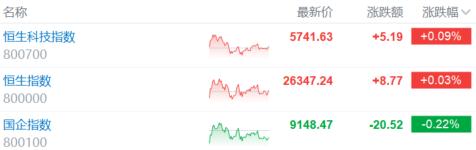
Market Overview - The Hong Kong stock market showed a narrow range of fluctuations on January 5, with the Hang Seng Index slightly up by 0.03%, the Hang Seng China Enterprises Index down by 0.22%, and the Hang Seng Tech Index up by 0.09% [1][2]. Sector Performance - Large tech stocks exhibited mixed performance, with Kuaishou surging by over 11%, while other notable stocks like Bilibili and Alibaba also saw gains of over 5% and 2%, respectively. Conversely, stocks like NetEase and Xiaomi fell by over 2% [2][4]. - The biotechnology sector was active, with companies like Rongchang Bio and Kelun-Bothai rising over 7%, and other firms like Fuhong Hanlin and Tigermed increasing by over 6% [7]. - The insurance sector saw strong gains, with China Pacific Insurance up over 6% and New China Life Insurance up over 5%. Analysts highlighted five key trends in the life insurance industry for 2026, including rapid growth in new business and a shift in customer demographics [8]. - The automotive sector faced declines, with Great Wall Motors dropping over 6% and NIO nearly 6%. Despite some brands achieving record sales in 2025, only a few met their annual sales targets [10]. Notable Stock Movements - Kuaishou's stock price reached 73.60 HKD, reflecting an increase of 11.09% with a market cap of 317.91 billion HKD [5]. - Nanjing Panda Electronics surged by nearly 40%, while Micron Brain Science and Brainhole Technology rose by nearly 20% and over 17%, respectively, following news of Neuralink's plans for large-scale production of brain-computer interface devices [6][4]. - The "three oil giants" saw significant declines, with China Petroleum and China National Offshore Oil Corporation both dropping over 3% due to geopolitical tensions and OPEC+ decisions [9]. Capital Flows - Southbound funds recorded a net inflow of 18.723 billion HKD, with the Shanghai-Hong Kong Stock Connect contributing 9.809 billion HKD and the Shenzhen-Hong Kong Stock Connect contributing 8.914 billion HKD [12]. Future Outlook - Goldman Sachs recommends overweighting Chinese stocks, predicting a 15% to 20% annual increase in the Chinese stock market for 2026 and 2027. Guosen Securities also sees potential in the market driven by a weaker US dollar and improved domestic liquidity in the spring of 2026 [15].

保险25年显著跑赢大盘,险资举牌仅十年新高:保险行业周报(20251229-20251231)-20260105
Huachuang Securities· 2026-01-05 08:44
Investment Rating - The industry investment rating is "Recommended," indicating an expected increase in the industry index by more than 5% over the next 3-6 months compared to the benchmark index [19]. Core Insights - The insurance sector has significantly outperformed the market over the past 25 years, with insurance capital's stake acquisitions reaching a ten-year high [1]. - In 2025, there were a total of 31 stake acquisitions by insurance capital, marking a resurgence in activity, second only to 2015, and surpassing the 28 acquisitions in 2020 [3]. - The preference for H-shares among insurance capital is evident, with 26 out of 31 acquisitions targeting H-shares, likely due to favorable dividend yields [3]. - The main sectors attracting insurance capital include banking (7 acquisitions) and public utilities (6 acquisitions), reflecting a preference for dividend-yielding assets [3]. - The report anticipates that the trend of stake acquisitions will continue into 2026, driven by two main motivations: seeking stable dividend cash flows and targeting mature, monopolistic enterprises with solid ROE [3]. Summary by Sections Weekly Updates - China Pacific Insurance appointed Liu Long as the Chief Investment Officer [2]. - Great Wall Life successfully issued its first perpetual bond with a scale of 1 billion yuan and a rating of AAA [2]. - Great Wall Life increased its holdings in New Tian Green Energy and Datang New Energy, raising its shareholding percentages to 11.04% and 17.39%, respectively [2]. Stake Acquisition Overview - In 2025, insurance capital's stake acquisitions totaled 31 times, with a minimum of 38 times when accounting for repeated acquisitions [3]. - The report highlights a shift in acquisition activity towards larger insurance companies, with Ping An leading with 7 acquisitions, followed by Great Wall Life (5) and others [3]. Investment Recommendations - The insurance sector saw a general increase in December, driven by expectations of rising long-term interest rates and favorable sales performance [3]. - Despite anticipated pressure from high investment baselines, the report suggests that the sector's valuation may continue to recover due to stabilizing interest rates and declining liability costs [3]. - Companies recommended for investment include China Ping An and China Pacific Insurance, which are expected to manage liability costs effectively [3]. Valuation Metrics - The report provides PEV valuations for major life insurance companies, with China Life at 0.87x, Ping An at 0.82x, and China Pacific at 0.68x for A-shares [4]. - For H-shares, Ping An is valued at 0.75x, while China Life is at 0.51x [4]. - The report recommends a ranking of investment opportunities: China Ping An, China Pacific Insurance, China Life H, and China Property Insurance [4].