
SMIC(00981)

Search documents
北水动向|北水成交净买入27.27亿 阿里(09988)再获加仓 广汽集团(02238)暴涨后遭抛售
智通财经网· 2025-11-28 10:07
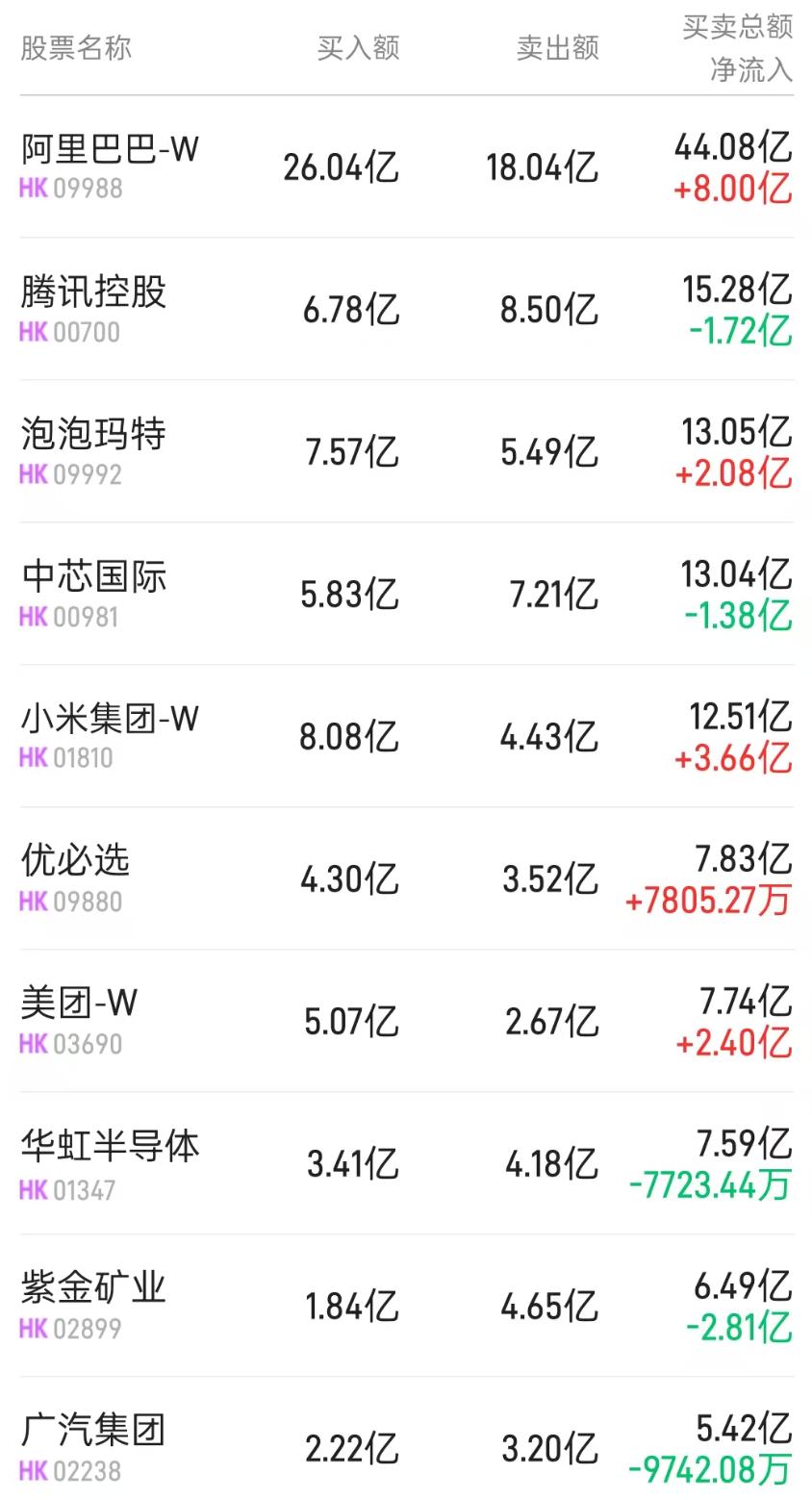
Core Viewpoint - The Hong Kong stock market saw significant net inflows from northbound trading, totaling HKD 27.27 billion on November 28, with notable net purchases in stocks like Alibaba, Pop Mart, and Xiaomi [1][2]. Group 1: Northbound Trading Activity - Northbound trading through Stock Connect recorded a net purchase of HKD 27.27 billion, with HKD 9.33 billion from the Shanghai Stock Connect and HKD 17.94 billion from the Shenzhen Stock Connect [1]. - The most purchased stocks included Alibaba-W (09988) with a net inflow of HKD 10.94 billion, Pop Mart (09992) with HKD 5.49 billion, and Xiaomi Group-W (01810) with HKD 4.7 billion [4][5]. Group 2: Individual Stock Performance - Alibaba-W (09988) had a total trading volume of HKD 44.08 billion, with a net inflow of HKD 8 billion, driven by the launch of its new AI product, Quark AI Glasses S1 [2][4]. - Pop Mart (09992) benefited from government initiatives to promote consumer goods, resulting in a net inflow of HKD 2.08 billion [5]. - Xiaomi Group-W (01810) saw a net inflow of HKD 3.66 billion, supported by its recent share buyback program totaling over HKD 12 billion this month [5]. - Other notable stocks included Meituan-W (03690) and Tencent Holdings (00700), which received net inflows of HKD 4.7 billion and HKD 2.62 billion, respectively [6]. Group 3: Net Sell-offs - The stocks with the highest net sell-offs included Semiconductor Manufacturing International Corporation (00981) and Zijin Mining (02899), with net outflows of HKD 3 billion and HKD 2.81 billion, respectively [6]. - The semiconductor sector continues to face selling pressure, as evidenced by the net sell-off of Huahong Semiconductor (01347) amounting to HKD 1.23 billion [6].





恒生科技高开0.43%,科网股表现强势,中芯国际涨近2%
Mei Ri Jing Ji Xin Wen· 2025-11-28 03:17
Group 1 - The Hang Seng Index opened up by 0.25%, and the Hang Seng Tech Index rose by 0.43%, with notable gains in tech stocks and the non-ferrous metals sector [1] - Capital market policies have significantly increased in intensity over the past two years, focusing on supporting technological development and optimizing resource allocation [1] - The current technological breakthroughs, represented by innovations such as large models, robotics, smart vehicles, and quantum computing, are driven by top-level policy design that enhances the innovation ecosystem [1] Group 2 - In 2024, China has achieved milestone breakthroughs in several key technology fields, with Huawei's Ascend chips nearing international leading performance and domestic humanoid robots breaking overseas monopolies [2] - The smart vehicle industry chain has demonstrated strong competitiveness in the global market, with companies like iFlytek surpassing international counterparts in core capabilities of large models [2] - This "pressure-response-breakthrough" innovation paradigm is reshaping the global technology competition landscape, with China transitioning from a technology follower to a partial leader in certain areas [2]

中国芯片设计产业规模有望突破万亿元,科创芯片ETF(588200)聚焦科创板芯片板块
Xin Lang Cai Jing· 2025-11-28 03:15
Group 1 - The semiconductor sector showed strength on November 28, 2025, with the Shanghai Stock Exchange Sci-Tech Innovation Board Chip Index rising by 1.22% [1] - Key stocks such as Jinghe Integrated rose by 11.32%, Tuojing Technology by 6.55%, and Tianyue Advanced by 6.13% [1] - The Chinese semiconductor industry is expected to see the chip design sector exceed 1 trillion yuan by 2030, indicating strong long-term growth potential [1] Group 2 - Dongguan Securities forecasts that artificial intelligence will remain the main innovation line in the technology sector through 2026, benefiting multiple segments including computing power, storage, equipment, and advanced packaging [1] - The top ten weighted stocks in the Sci-Tech Innovation Board Chip Index account for 60.55% of the index, with major companies including Haiguang Information, Cambricon, and SMIC [1] Group 3 - The Sci-Tech Chip ETF (588200) tracks the Shanghai Stock Exchange Sci-Tech Innovation Board Chip Index, providing a convenient tool for investing in the chip sector [2] - Investors without stock accounts can access domestic chip investment opportunities through the Sci-Tech Chip ETF Linked Fund (017470) [3]


恒生指数开盘涨0.25% 恒生科技指数涨0.43%
Zheng Quan Shi Bao· 2025-11-28 01:52
Core Viewpoint - The Hang Seng Index opened with a gain of 0.25%, while the Hang Seng Tech Index increased by 0.43%, indicating a positive market sentiment towards technology stocks and overall market performance [1] Group 1 - The Hang Seng Index experienced an opening increase of 0.25% [1] - The Hang Seng Tech Index saw a rise of 0.43% [1] - Semiconductor company SMIC (中芯国际) rose by over 1% [1]

港股开盘 | 恒指高开0.25% 科网股多数上涨 中芯国际(00981)涨近2%
智通财经网· 2025-11-28 01:36
Core Viewpoint - The Hong Kong stock market is experiencing a bullish trend driven by liquidity and sentiment, with expectations for continued growth in technology stocks over the next two to three years, transitioning to a broader bull market by 2026 [2][4]. Group 1: Market Trends - The Hang Seng Index opened up by 0.25%, and the Hang Seng Tech Index rose by 0.43%, with most tech stocks, including SMIC and Alibaba, showing gains [1]. - Analysts suggest that the recent adjustments in the Hong Kong stock market are normal due to previous significant gains and tightening U.S. dollar liquidity, with historical averages indicating small pullbacks of around 7% during bull markets [2][4]. Group 2: Investment Strategies - Key investment directions include focusing on AI-driven industry trends, capacity cycle reversals, and sectors related to export and commodities amid global uncertainties [2]. - The Hong Kong market is seen as a valuation haven, with the Hang Seng Tech Index trading below historical averages, indicating substantial room for valuation recovery [4][5]. Group 3: Future Outlook - The liquidity environment is expected to remain supportive, with potential inflows from both domestic and foreign investors as the U.S. enters a rate-cutting phase [5]. - Despite short-term volatility, the underlying fundamentals of the Hong Kong market remain strong, with many institutions maintaining a positive outlook for the continuation of the bull market [4][5].
智通港股通持股解析|11月28日
智通财经网· 2025-11-28 00:37
Core Insights - The top three companies by Hong Kong Stock Connect holding ratios are China Telecom (72.69%), Gree Power Environmental (69.23%), and Haotian International Construction Investment (68.93%) [1][2] - The companies with the largest increase in holding amounts over the last five trading days are WanGuo Gold Group (+12.079 billion), Alibaba-W (+11.504 billion), and Tencent Holdings (+2.873 billion) [1][2] - The companies with the largest decrease in holding amounts over the last five trading days are SMIC (-1.455 billion), Innovent Biologics (-0.665 billion), and New China Life Insurance (-0.523 billion) [2] Group 1: Hong Kong Stock Connect Holding Ratios - China Telecom (00728) has a holding of 10.09 billion shares, representing 72.69% [1] - Gree Power Environmental (01330) has a holding of 0.28 billion shares, representing 69.23% [1] - Haotian International Construction Investment (01341) has a holding of 7.48 billion shares, representing 68.93% [1] - Other notable companies include China Shenhua (67.29%) and Tianjin Chuangye Environmental Protection (66.32%) [1] Group 2: Recent Increases in Holdings - WanGuo Gold Group (03939) saw an increase of +12.079 billion, with a change of +37.936 million shares [1] - Alibaba-W (09988) increased by +11.504 billion, with a change of +7.638 million shares [1] - Tencent Holdings (00700) increased by +2.873 billion, with a change of +0.469 million shares [1] Group 3: Recent Decreases in Holdings - SMIC (00981) experienced a decrease of -1.455 billion, with a change of -2.128 million shares [2] - Innovent Biologics (01801) decreased by -0.665 billion, with a change of -0.691 million shares [2] - New China Life Insurance (01336) saw a decrease of -0.523 billion, with a change of -1.111 million shares [2]


智通港股通资金流向统计(T+2)|11月28日
智通财经网· 2025-11-27 23:34
Key Points - On November 25, Alibaba-W (09988), Kuaishou-W (01024), and Pop Mart (09992) ranked the top three in net inflow of southbound funds, with net inflows of 5.587 billion, 567 million, and 377 million respectively [1] - The top three in net outflow of southbound funds were Yingfu Fund (02800), SMIC (00981), and China Aluminum (02600), with net outflows of -364 million, -187 million, and -145 million respectively [1] - In terms of net inflow ratio, Southern East Select (03441), Prudential (02378), and Southern Hong Kong US Technology (03442) led the market with ratios of 88.59%, 85.03%, and 71.70% respectively [1] - The top three in net outflow ratio were GX China (03040), Greentown Service (02869), and Aidi Kang Holdings (09860) with ratios of -91.54%, -58.74%, and -54.29% respectively [1] Top 10 Net Inflow Stocks - Alibaba-W (09988) had a net inflow of 5.587 billion, representing a 24.06% increase, closing at 157.800 (+2.14%) [2] - Kuaishou-W (01024) saw a net inflow of 567 million, with a 15.90% increase, closing at 70.650 (+3.06%) [2] - Pop Mart (09992) recorded a net inflow of 377 million, with a 21.51% increase, closing at 200.200 (+0.35%) [2] - Other notable stocks included Xpeng Motors-W (09868) with a net inflow of 274 million and a 17.01% increase, and China Construction Bank (00939) with a net inflow of 271 million and a 15.20% increase [2] Top 10 Net Outflow Stocks - Yingfu Fund (02800) experienced a net outflow of -364 million, with a -2.62% change, closing at 26.040 (+0.85%) [2] - SMIC (00981) had a net outflow of -187 million, with a -3.52% change, closing at 67.950 (-0.15%) [2] - China Aluminum (02600) saw a net outflow of -145 million, with a -31.17% change, closing at 10.660 (+0.76%) [2] - Other significant outflows included Xinda Biopharmaceutical (01801) with -136 million and a -10.94% change, and ZTO Express-W (02057) with -122 million and a -29.90% change [2] Top 10 Net Inflow Ratios - Southern East Select (03441) led with a net inflow ratio of 88.59%, with a net inflow of 8.441 million, closing at 10.300 (+0.19%) [3] - Prudential (02378) followed with a ratio of 85.03%, net inflow of 11.732 million, closing at 107.800 (+0.94%) [3] - Southern Hong Kong US Technology (03442) had a ratio of 71.70%, with a net inflow of 14.887 million, closing at 9.080 (+2.66%) [3]

2026全球半导体市场趋势展望(附24页PPT)
材料汇· 2025-11-27 15:44
Group 1 - The global semiconductor market is entering an upward phase of the "silicon cycle," with an expected market size of $783.8 billion in 2025, representing a growth rate of 23.4% [4][5] - The demand for high-performance semiconductor products is increasing due to the requirements of large AI models, leading to a tight supply situation in the memory market [5][10] - The U.S. has surpassed China to become the largest single semiconductor product market, with a projected market size of $269.6 billion in 2025, growing by 37.5% [10][11] Group 2 - Logic chips are expected to be the fastest-growing category in the semiconductor market, with a growth rate of 41.5% by 2025, followed by memory products [11][12] - The computing and communication sectors are projected to be the two main growth markets for semiconductors, with market sizes reaching $2.483 trillion and $2.822 trillion, respectively, by 2025 [14][12] Group 3 - China maintains its position as the largest exporter and importer of integrated circuits, with trade volumes significantly increasing due to the semiconductor industry's growth [15][16] - The trade deficit between China and the U.S. is widening, with China's imports from the U.S. increasing while exports are declining [21][22] Group 4 - China leads in the number of semiconductor patents and key articles published, indicating a strong position in intellectual property within the semiconductor industry [19][22] - The top 100 influential semiconductor companies in China are primarily concentrated in the integrated circuit design sector, with a significant presence in the Yangtze River Delta region [28][32] Group 5 - The new wave of semiconductor companies in China is also concentrated in the integrated circuit design field, with a notable presence in the Yangtze River Delta region [38][43] - High-performance storage and edge AI products are expected to drive new market developments, with high-performance storage becoming a core product in AI applications [47][48]

港股通(深)净买入6.93亿港元
Zheng Quan Shi Bao Wang· 2025-11-27 15:09
Core Points - The Hang Seng Index rose by 0.07% to close at 25,945.93 points on November 27, with a net inflow of HKD 1.328 billion through the southbound trading channel [1] - The total trading volume for the southbound trading was HKD 86.624 billion, with a net buy of HKD 1.328 billion [1] - In the Shanghai-Hong Kong Stock Connect, the trading volume was HKD 55.325 billion with a net buy of HKD 0.635 billion, while in the Shenzhen-Hong Kong Stock Connect, the trading volume was HKD 31.299 billion with a net buy of HKD 0.693 billion [1] Trading Activity - Alibaba-W was the most actively traded stock in the Shanghai-Hong Kong Stock Connect with a trading volume of HKD 73.15 billion and a net buy of HKD 6.02 billion, despite a closing price drop of 2.71% [1][2] - Xiaomi Group-W followed with a trading volume of HKD 35.41 billion and a net sell of HKD 5.37 billion, closing up by 2.49% [1][2] - In the Shenzhen-Hong Kong Stock Connect, Alibaba-W also led with a trading volume of HKD 36.70 billion and a net buy of HKD 3.17 billion, while Xiaomi Group-W had a net sell of HKD 1.52 billion [2] Summary of Active Stocks - The top ten actively traded stocks included Alibaba-W, Xiaomi Group-W, and Tencent Holdings, with respective trading volumes of HKD 73.15 billion, HKD 35.41 billion, and HKD 28.17 billion [1][2] - The net buy and sell amounts for these stocks indicated a strong interest in Alibaba-W, while Xiaomi Group-W faced significant selling pressure [1][2]
北水成交净买入13.28亿 芯片股遭内资抛售 阿里再获9亿港元加仓
Zhi Tong Cai Jing· 2025-11-27 13:05
Group 1: Market Overview - On November 27, the Hong Kong stock market saw a net inflow of 1.328 billion HKD from northbound trading, with 635 million HKD from the Shanghai Stock Connect and 693 million HKD from the Shenzhen Stock Connect [2] - The most net bought stocks included Alibaba-W (09988), Pop Mart (09992), and Meituan-W (03690), while the most net sold stocks were Zijin Mining (601899) (02899), Tencent (00700), and SMIC (00981) [2] Group 2: Stock Performance - Alibaba-W had a net inflow of 6.02 billion HKD, with a buy amount of 39.59 billion HKD and a sell amount of 33.57 billion HKD [3] - Pop Mart received a net inflow of 4.34 billion HKD, supported by positive sales data in the U.S. and expectations for strong performance during the holiday season [6] - Meituan-W had a net inflow of 3.25 billion HKD, with insights from Alibaba's CFO indicating a potential reduction in investment in flash purchase business due to improved efficiency [6] Group 3: Sector Insights - Longi Green Energy (601869) and Long Fiber (06869) saw a net inflow of 42.81 million HKD, driven by advancements in AI-driven growth and the development of next-generation optical fiber technology [7] - Semiconductor stocks, including Huahong Semiconductor (01347) and SMIC (00981), faced net sell-offs, with net outflows of 138.5 million HKD and 2.32 billion HKD respectively [7] - The IPO of domestic GPU leader Moore Threads has attracted attention, marking a significant event in the semiconductor sector [7]


