
CNCB(00998)

Search documents
定格城市温度!2025“微笑青岛”城市公益活动正式启动
Xin Lang Cai Jing· 2025-11-09 01:39
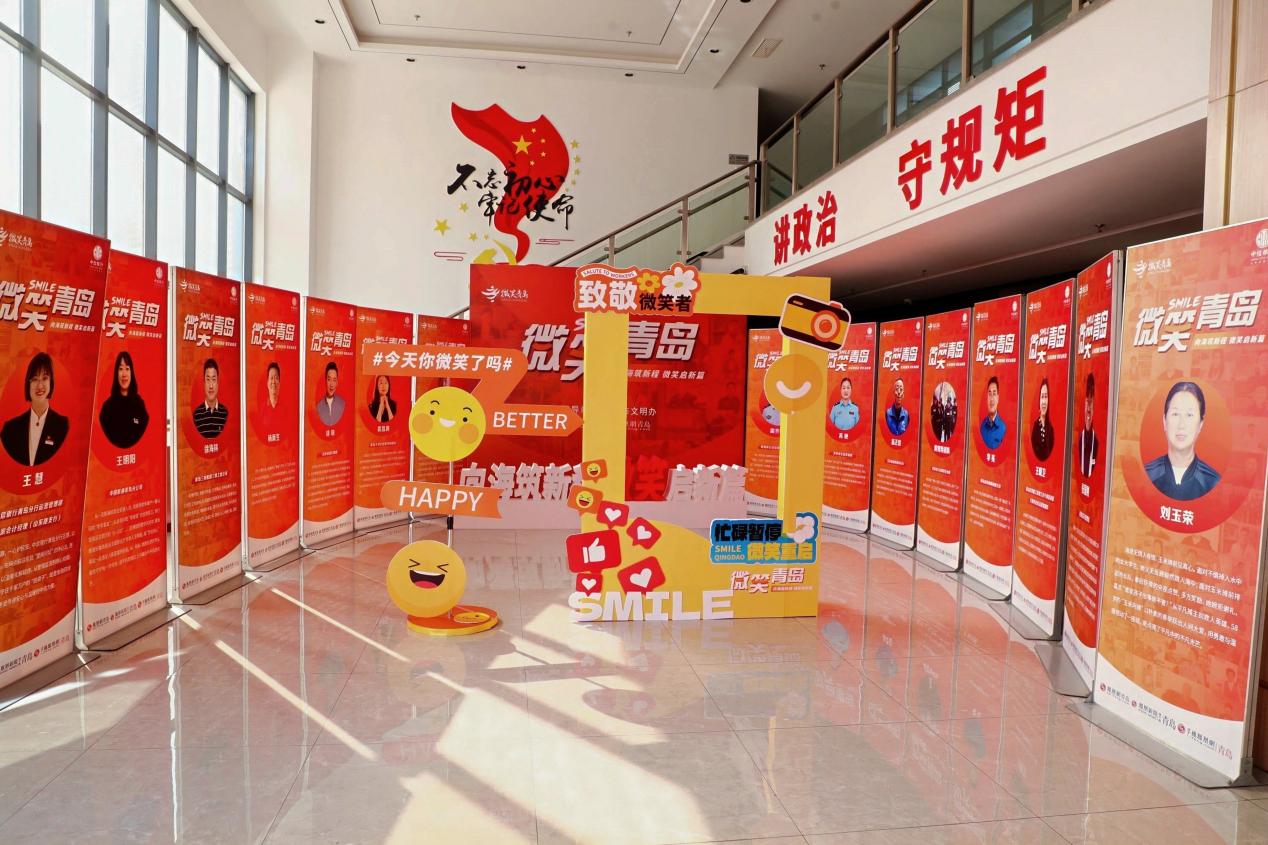
Core Viewpoint - The "Smile Qingdao" urban public welfare initiative aims to enhance the city's cultural and civilizational spirit, promoting warmth and kindness through smiles, and is supported by various local organizations and institutions [1][8][19]. Group 1: Event Overview - The "Smile Qingdao" initiative was launched on November 7, 2023, at the Wangjiamaidao Community, focusing on building a civilized city through community engagement and warmth [1][2]. - The event featured performances by local school children and speeches from various leaders, emphasizing the importance of inner warmth alongside external beauty in a city [4][8]. Group 2: Support and Collaboration - The initiative is supported by the Qingdao Civilization Office and CITIC Bank Qingdao Branch, which has been actively involved in the city's economic and social development for 34 years [6][19]. - CITIC Bank focuses on various financial services, including technology, green finance, and digital finance, contributing to the sustainable development of the local economy [6][19]. Group 3: Cultural Significance - The "Smile Qingdao" initiative serves as a cultural link, showcasing the city's spirit through the smiles of its residents, and aims to transition from merely creating a civilized city to building a deeper cultural civilization [8][19]. - The event highlighted stories of local heroes and community members who embody the spirit of kindness and service, reinforcing the city's commitment to civility and warmth [8][11][13]. Group 4: Future Aspirations - The initiative will continue into 2025-2026, with plans for further community engagement and storytelling to spread the message of kindness and civility [14][21]. - The ongoing collaboration between media, government, and enterprises is crucial for sustaining the momentum of the "Smile Qingdao" initiative and enhancing the city's cultural identity [19][21].


你的支付优惠用了吗?各大银行加入双十一“狂欢”,算的什么账?
Sou Hu Cai Jing· 2025-11-08 00:51
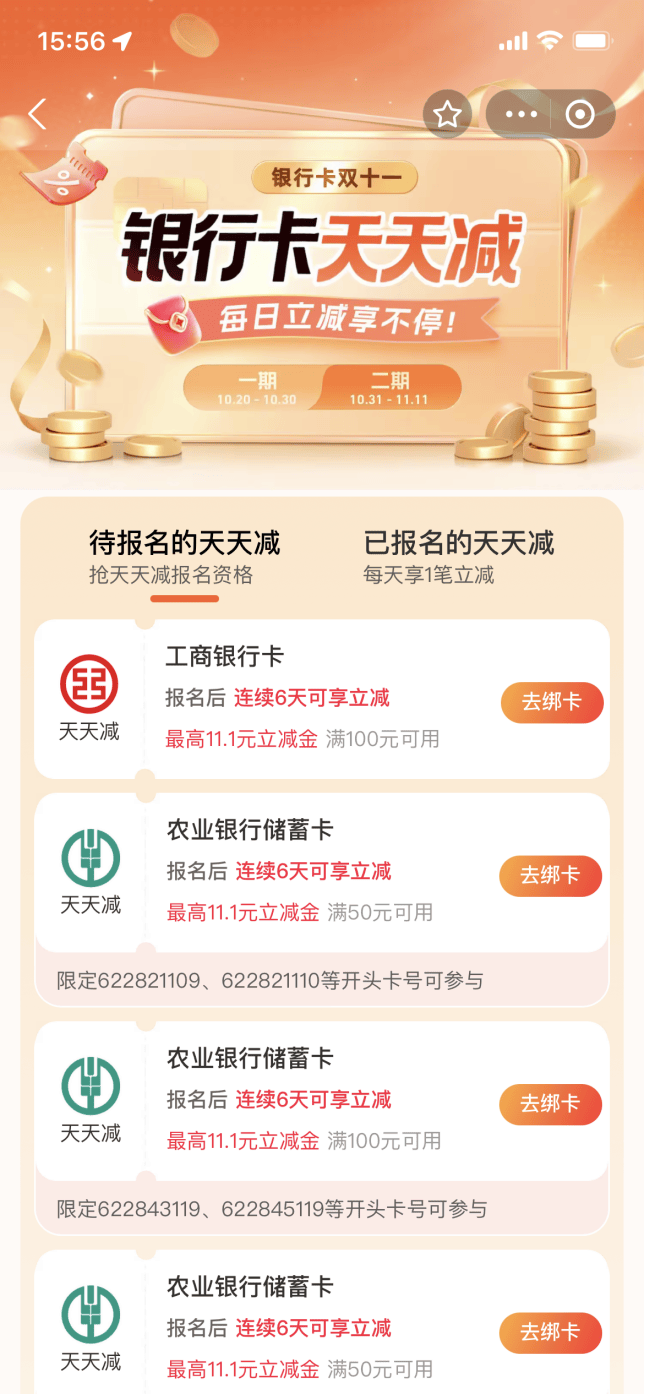
Core Viewpoint - The annual Double Eleven shopping season has officially started, with major commercial banks launching various promotional activities to stimulate consumer spending and boost business before the year-end [1][2]. Group 1: Promotional Activities by Banks - Major banks such as China Construction Bank, Bank of China, Agricultural Bank of China, and others have introduced cashback, discounts, installment benefits, and exclusive offers to attract consumers [1]. - Construction Bank offers a maximum discount of 400 yuan for credit card customers using installment payments on platforms like Alipay and Taobao, while Bank of China provides a random discount of up to 118 yuan for transactions made through Alipay [2]. - Other banks, including China Merchants Bank and Ping An Bank, have also launched various cashback and discount campaigns to engage customers during this shopping season [2]. Group 2: Strategic Insights - Experts suggest that the banks' promotional strategies represent a cost-effective method to acquire and retain customers, activating dormant accounts with low-cost random discounts [5]. - The focus on marketing during peak shopping seasons aims to enhance the usage of bank cards over third-party payment channels, thereby driving growth in credit and debit card transactions [5]. - Recommendations for banks post-Double Eleven include offering temporary credit limit increases and integrating with government consumption voucher programs to enhance customer experience and engagement [5].




轻审负债,建行、中行、兴业银行、中信银行联合放量,企业信用贷70万-920万,快至6天快速放款
Xin Lang Cai Jing· 2025-11-07 21:05
Core Insights - The new inclusive finance policy for 2025 aims to alleviate financing difficulties for enterprises by introducing a "light review of liabilities" credit loan program, with a credit pool formed by four major banks [1][4] - The program targets three types of enterprises: small and micro businesses, light asset innovative companies, and stable operating merchants, providing credit limits ranging from 700,000 to 9.2 million [1][3] Group 1: Key Features of the New Loan Program - High debt tolerance allows businesses with higher liabilities to access loans without being rejected based on historical debt details [3] - Credit limits are tailored to meet specific needs, starting from 700,000 for daily operations to 9.2 million for equipment upgrades and supply chain expansion [3] - Interest rates are significantly reduced, starting from 2.98%, which is 30% lower than the market average, potentially saving over 300,000 in interest for large loans [3] Group 2: Application Process and Requirements - Core application requirements include being established for at least one year, having a legal representative holding at least 5% of shares, and maintaining a good credit record [6][9] - Businesses must have a minimum tax payment of 5,000 in the last 12 months and must open a corresponding bank account [6] - The application process involves submitting necessary documents for preliminary review, with funding potentially available within 3 to 6 days after approval [12][8] Group 3: Real-World Examples - A Guangzhou electronics factory, previously rejected by three banks due to high debt, received 4.2 million in just four days through the "operating quick loan" channel, allowing for early production line launch [4] - A Hangzhou e-commerce company secured 2.8 million in six days to boost inventory for the peak season, resulting in a 180% increase in sales [4] Group 4: Additional Information - The program is available nationwide, excluding Hong Kong, Macau, and Taiwan, and is not applicable to certain industries such as finance and government [10][11] - The loan terms are flexible, with amounts ranging from 500,000 to 50 million, and repayment options include interest-first, principal later [8]

股份制银行板块11月7日涨0.42%,中信银行领涨,主力资金净流出1513.37万元
Zheng Xing Xing Ye Ri Bao· 2025-11-07 08:37
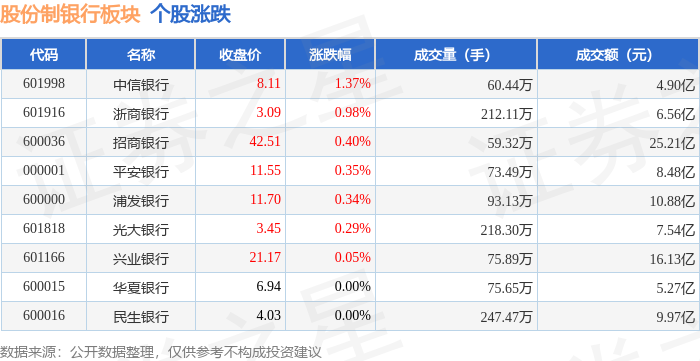
Core Insights - The banking sector saw a slight increase of 0.42% on November 7, with CITIC Bank leading the gains [1] - The Shanghai Composite Index closed at 3997.56, down 0.25%, while the Shenzhen Component Index closed at 13404.06, down 0.36% [1] Banking Sector Performance - CITIC Bank's closing price was 8.11, with a rise of 1.37% and a trading volume of 604,400 shares, amounting to a transaction value of 490 million [1] - Other notable banks included Zhejiang Commercial Bank at 3.09 (up 0.98%), China Merchants Bank at 42.51 (up 0.40%), and Ping An Bank at 11.55 (up 0.35%) [1] - The overall trading volume for the banking sector showed mixed results, with some banks experiencing slight increases while others remained flat or decreased [1] Fund Flow Analysis - The banking sector experienced a net outflow of 15.13 million from institutional investors, while retail investors saw a net inflow of 18.1 million [1] - Specific banks like China Merchants Bank had a net inflow of 17.9 million from institutional investors, while CITIC Bank faced a net outflow of 24.62 million from retail investors [2] - The overall trend indicates a divergence in fund flows, with institutional investors pulling back while retail investors are more active in the sector [2]



上市银行大类资产配置跟踪:信贷投放稳健,债券配置灵活性提升
Ping An Securities· 2025-11-07 08:10
Industry Investment Rating - The investment rating for the banking sector is "Outperform" [1] Core Insights - The proportion of corporate loans has increased, while retail demand recovery is being monitored. As of mid-2025, the proportion of corporate loans among listed banks rose by 1.65 percentage points from the end of 2024 to 60.2%. The manufacturing sector's loans accounted for 18.5% of corporate loans, reflecting a recovery in the operations of manufacturing enterprises [3][12] - The flexibility in bond allocation has increased, with bond trading helping to stabilize market fluctuations. In the first half of 2025, listed banks saw a significant decline in other comprehensive income and fair value changes due to interest rate fluctuations. Some banks, primarily state-owned, increased bond trading to enhance investment returns and stabilize net profit growth [3][6] - Asset quality pressure is manageable, with a focus on risks in the retail sector. The overall asset quality remains stable, with the non-performing loan (NPL) ratio for A-share listed banks holding steady at 1.15% as of Q3 2025. However, the average NPL ratio for retail loans increased by 15 basis points to 1.58% compared to the end of 2024 [3][6] Summary by Sections Corporate Loan Structure - The overall asset structure of listed banks shows an increase in loan allocation, with the loan proportion rising by 0.1 percentage points from the end of 2024. State-owned banks increased interbank asset allocation, while small and medium-sized banks focused more on loan issuance [12][19] - Corporate loans remain the primary focus of credit allocation, with corporate loans accounting for 91.1% of all new loans in the first nine months of 2025. Short-term corporate loans made up 33.7% of new corporate loans [17][18] Bond Investment Preferences - The preference for flexible bond allocation has increased, with banks primarily investing in government bonds and central bank bills. The proportion of OCI accounts has risen, indicating a shift towards more flexible investment strategies [6][3] Asset Quality and Risk Monitoring - The asset quality of the banking sector is stable, with a non-performing loan ratio of 1.15% as of Q3 2025. The retail loan sector has shown slight increases in NPL ratios, necessitating ongoing monitoring of risks in this area [3][6]



又一大型理财子公司高管变动
中国基金报· 2025-11-07 07:07
Core Viewpoint - The article discusses the significant leadership change at Xinyin Wealth Management, with He Jin taking over as president from Dong Wenzhen, who has moved to a new role at CITIC Bank's Fuzhou branch [2]. Group 1: Leadership Changes - He Jin, born in January 1979 and a graduate of Peking University, has extensive experience in the banking and asset management sectors, having worked at major banks including Agricultural Bank of China and Industrial and Commercial Bank of China before joining CITIC Bank [3]. - He Jin has been with Xinyin Wealth Management since its inception, serving in various roles including vice president and overseeing multiple business areas such as investment, research, risk, and finance [3]. - The leadership transition reflects a broader trend within Xinyin Wealth Management, which has seen multiple changes in its top management since its establishment in July 2020 [3]. Group 2: Company Performance - As of September 2025, Xinyin Wealth Management's asset management scale reached 2.21 trillion yuan, marking a 10.90% increase from the end of the previous year [4]. - The number of clients holding wealth management products grew to 10.92 million, a 9.44% increase year-on-year [4]. - The company generated investment returns of 33.71 billion yuan in the first three quarters of the year, reflecting a 15.15% year-on-year growth [4]. Group 3: Product Development - Xinyin Wealth Management is focusing on a dual-driven growth strategy that combines multi-asset and multi-strategy investment with advisory services, aiming to become a key supplier of rights-based products [4]. - As of September 2025, the scale of rights-based products reached 261.02 billion yuan, an increase of 53.94 billion yuan from the previous quarter, with the proportion of new products rising from 9.83% to 11.94% [5].

多家股份行城商行前三季发力个人房贷
Feng Huang Wang· 2025-11-07 02:27
Core Insights - The latest reports indicate a significant increase in personal housing loans from several listed banks, contrasting with the decline observed in state-owned banks' mortgage lending [1][2][6][7] Group 1: Personal Housing Loan Growth - Nearly ten listed banks, including Minsheng Bank, Ping An Bank, and others, reported a clear increase in personal housing loans by the end of Q3 compared to the beginning of the year [1][2] - Specific banks like Ping An Bank reported a housing loan balance of 3,523.50 billion yuan, growing by 8.1% from the beginning of the year [2] - Minsheng Bank's mortgage loan balance increased by 180.41 billion yuan, marking a growth of 3.24% [2] Group 2: State-Owned Banks' Decline - The six major state-owned banks experienced a reduction of over 1,000 billion yuan in personal housing loans in the first half of the year, continuing a downward trend for three consecutive years [1][6] - By the end of Q3, the total personal housing loan balance for these banks was approximately 25.086 trillion yuan, reflecting a decrease of 1,078 billion yuan since the beginning of the year [6] Group 3: Market Dynamics and Regional Insights - The demand for housing loans remains strong in certain regions, such as Jiangsu, Zhejiang, and Shanghai, prompting banks to increase mortgage lending [4][5] - The new personal housing loans issued in key economic regions accounted for 87.70% of the total new loans issued by Shanghai Pudong Development Bank, indicating a regional focus in lending strategies [3] Group 4: Overall Market Trends - As of the end of Q3 2025, the total personal housing loan balance in the market was 37.44 trillion yuan, showing a year-on-year decline of 0.3% despite the growth from smaller banks [7] - The overall trend suggests that while some smaller banks are increasing their mortgage lending, it is not sufficient to offset the overall decline in the personal housing loan market driven by the larger state-owned banks [7]

私行业务成银行“香饽饽”?七家客户数破10万大关
Xin Lang Cai Jing· 2025-11-07 00:20
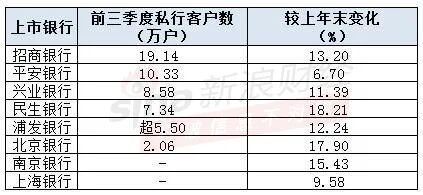
Core Insights - The private banking sector in China is experiencing significant growth, with several listed banks reporting an increase in private banking clients exceeding 10% [1][2][3] - Notably, Minsheng Bank, Beijing Bank, and Nanjing Bank have all reported client growth rates above 15% [1][2][3] - As of the end of September, the total number of private banking clients at Minsheng Bank reached 73,409, marking an 18.21% increase from the previous year [3][5] Private Banking Client Growth - Multiple banks have shown robust growth in private banking clients, with Minsheng Bank, Beijing Bank, and Nanjing Bank leading with growth rates over 15% [1][2][3] - As of September 30, 2023, the number of private banking clients at major banks is as follows: - China Merchants Bank: 191,418 clients, up 13.2% - Ping An Bank: 103,300 clients, up 6.7% - Minsheng Bank: 73,409 clients, up 18.21% - Beijing Bank: 20,586 clients, up 17.9% - Nanjing Bank: growth of 15.43% [3][5][6] Wealth Management Market Expansion - The wealth management market in China continues to expand, with listed banks reporting steady growth in wealth clients [8][9] - As of September 30, 2023, Ping An Bank reported 1.4911 million wealth clients, a 2.4% increase from the previous year [9] - Nanjing Bank's wealth clients grew by 16.31%, while Guiyang Bank's wealth clients increased by 7.77% [9] Asset Under Management (AUM) Growth - The total assets under management (AUM) for private banking clients at Minsheng Bank reached 1,014.72 billion yuan, an increase of 148.75 billion yuan, or 17.18% [3][5] - Beijing Bank's private banking AUM was 224 billion yuan, up 14.39% from the beginning of the year [4] Revenue from Wealth Management Services - Several banks reported positive growth in wealth management fee income, with many exceeding 15% growth [10][12] - For instance, China Merchants Bank's wealth management fee income reached 20.67 billion yuan, an 18.76% year-on-year increase [10] - Ping An Bank's wealth management fee income was 3.979 billion yuan, up 16.1% [10] Distribution and Sales Growth - The distribution of financial products has become a significant revenue source for banks, with many reporting substantial increases in sales [11][12] - For example, Ping An Bank's income from personal insurance sales grew by 48.7%, while its income from personal fund sales increased by 6.7% [12] - China Merchants Bank's income from fund sales rose by 38.76%, driven by increased sales and improved product structure [12]
5家银行不良率下降,零售AUM增长成亮点
Nan Fang Du Shi Bao· 2025-11-06 23:10
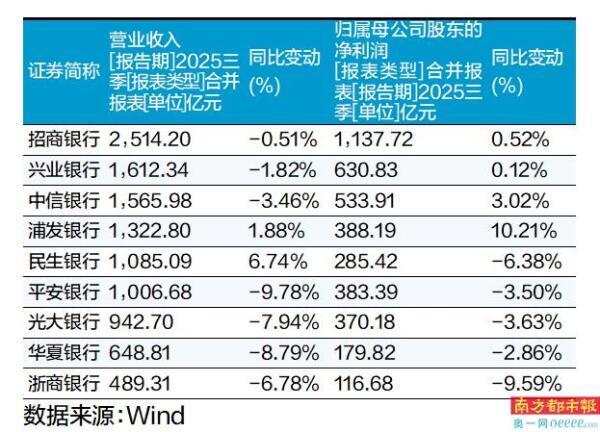
Core Viewpoint - The performance of A-share listed joint-stock banks in the third quarter of 2025 shows a mixed picture, with seven banks experiencing a year-on-year decline in operating income and five banks reporting a drop in net profit. Only Shanghai Pudong Development Bank achieved growth in both metrics [1][2][3]. Group 1: Revenue Performance - Among the nine listed joint-stock banks, only Shanghai Pudong Development Bank and Minsheng Bank reported year-on-year revenue growth, with Minsheng Bank achieving the highest growth rate of 6.74% [2]. - China Merchants Bank led in revenue scale with 2,514.20 billion yuan, followed by Industrial Bank and CITIC Bank with 1,612.34 billion yuan and 1,565.98 billion yuan, respectively [2][3]. - Ping An Bank experienced the most significant revenue decline at -9.78%, while several other banks, including Everbright Bank and Huaxia Bank, also saw declines exceeding 6% [2][3]. Group 2: Net Profit Analysis - China Merchants Bank maintained the highest net profit at 1,137.72 billion yuan, with a slight increase of 0.52% year-on-year. Shanghai Pudong Development Bank saw a notable increase of 10.21% in net profit [3]. - The banks that reported a decline in net profit include Zhejiang Commercial Bank, which had the largest drop at -9.59%, along with Minsheng Bank, Ping An Bank, and others experiencing varying degrees of decline [3]. Group 3: Interest Income and Net Interest Margin - Interest income growth varied significantly, with China Merchants Bank leading at 1,600.42 billion yuan and a 1.74% increase. Shanghai Pudong Development Bank had the highest growth rate in interest income at 3.93% [5]. - The net interest margin faced pressure across the industry, with CITIC Bank experiencing the largest decline of 16 basis points. Only Minsheng Bank reported a slight increase of 2 basis points [5][6]. Group 4: Asset Quality and Provision Coverage - The asset quality of joint-stock banks showed resilience, with a mixed performance in non-performing loan (NPL) ratios. China Merchants Bank had the best NPL ratio at 0.94%, while several banks saw slight increases in their NPL ratios [8]. - Provision coverage ratios decreased for most banks, with China Merchants Bank still leading at 405.93%, despite a decline of 6.05 percentage points [9][10]. Group 5: Loan Structure - The loan structure indicates a shift towards corporate loans, with all five banks reporting growth in corporate loans, while personal loan growth was weak for several banks [11][12]. - China Merchants Bank led in personal loan balance with nearly 3.7 trillion yuan, while corporate loan growth was particularly strong for CITIC Bank, which saw a 10.45% increase [11][12].
专业敏锐筑防线 中信银行北京八里庄支行成功拦截20万元电信诈骗
Bei Jing Qing Nian Bao· 2025-11-05 19:05
Group 1 - The core viewpoint of the articles highlights the successful interception of a telecom fraud attempt by the staff of CITIC Bank's Bali Zhuang branch, preventing a transfer of 200,000 yuan and avoiding significant financial loss for the customer [1][2] Group 2 - CITIC Bank's Beijing branch places a high emphasis on anti-fraud efforts, regularly conducting training to enhance the risk identification and handling capabilities of its grassroots outlets [2] - The successful case at the Bali Zhuang branch serves as a concrete example of the effectiveness of the branch's anti-fraud initiatives [2] - Moving forward, the Beijing branch aims to continue prioritizing customer asset safety and strengthening risk prevention measures within financial services to maintain financial order in the region [2]